Reading RPLS is free for the whole profession. Members post, reply, and get the members-only rooms.

Notifications
Clear all

Topic starter
Translate
▼
English
Spanish
French
German
Italian
Portuguese
Russian
Chinese
Japanese
Korean
Arabic
Hindi
Dutch
Polish
Turkish
Vietnamese
Thai
Swedish
Danish
Finnish
Norwegian
Czech
Hungarian
Romanian
Greek
Hebrew
Indonesian
Malay
Ukrainian
Bulgarian
Croatian
Slovak
Slovenian
Serbian
Lithuanian
Latvian
Estonian
I am curious how many licensed professionals still go out in the field. My opinion is that there are not enough LS's in the field training what to look for & where (in my area at least). Just want an idea % wise.
Posted : August 14, 2017 6:24 pm

Translate
▼
English
Spanish
French
German
Italian
Portuguese
Russian
Chinese
Japanese
Korean
Arabic
Hindi
Dutch
Polish
Turkish
Vietnamese
Thai
Swedish
Danish
Finnish
Norwegian
Czech
Hungarian
Romanian
Greek
Hebrew
Indonesian
Malay
Ukrainian
Bulgarian
Croatian
Slovak
Slovenian
Serbian
Lithuanian
Latvian
Estonian
I have always done my own field work, except one precise leveling job and one PLSS job I trusted to others in the last 45 years.
Posted : August 14, 2017 6:36 pm

Translate
▼
English
Spanish
French
German
Italian
Portuguese
Russian
Chinese
Japanese
Korean
Arabic
Hindi
Dutch
Polish
Turkish
Vietnamese
Thai
Swedish
Danish
Finnish
Norwegian
Czech
Hungarian
Romanian
Greek
Hebrew
Indonesian
Malay
Ukrainian
Bulgarian
Croatian
Slovak
Slovenian
Serbian
Lithuanian
Latvian
Estonian
Being solo, I am in the field for all my jobs. Regrettably being solo also means I am not training the next generation. This concerns me that if current trends continue, fewer and fewer new surveyors will benefit from the experience of a mentor.
Sent from my SM-G920V using Tapatalk
Posted : August 14, 2017 6:46 pm

Translate
▼
English
Spanish
French
German
Italian
Portuguese
Russian
Chinese
Japanese
Korean
Arabic
Hindi
Dutch
Polish
Turkish
Vietnamese
Thai
Swedish
Danish
Finnish
Norwegian
Czech
Hungarian
Romanian
Greek
Hebrew
Indonesian
Malay
Ukrainian
Bulgarian
Croatian
Slovak
Slovenian
Serbian
Lithuanian
Latvian
Estonian
I dig my own holes, put my eyes and hands on the stone, write the legals, and prepare the plat. My wonderful wife sees to it that we I am paid, and that we pay the nice tax man...which keeps me out of jail.
I hate to say it...but I do not see how responsible charge can sit in the office.
I must admit that the office was how it used to be for me for several years. I then gave up herding cats.
Posted : August 14, 2017 6:50 pm

Translate
▼
English
Spanish
French
German
Italian
Portuguese
Russian
Chinese
Japanese
Korean
Arabic
Hindi
Dutch
Polish
Turkish
Vietnamese
Thai
Swedish
Danish
Finnish
Norwegian
Czech
Hungarian
Romanian
Greek
Hebrew
Indonesian
Malay
Ukrainian
Bulgarian
Croatian
Slovak
Slovenian
Serbian
Lithuanian
Latvian
Estonian
Tom Healy, post: 442151, member: 1139 wrote: Being solo, I am in the field for all my jobs. Regrettably being solo also means I am not training the next generation.
Same situation here. Though this morning my son, much to my surprise, said that he wants to know more about what I do, both field and office. It only took 19 years!
Posted : August 14, 2017 7:02 pm

Translate
▼
English
Spanish
French
German
Italian
Portuguese
Russian
Chinese
Japanese
Korean
Arabic
Hindi
Dutch
Polish
Turkish
Vietnamese
Thai
Swedish
Danish
Finnish
Norwegian
Czech
Hungarian
Romanian
Greek
Hebrew
Indonesian
Malay
Ukrainian
Bulgarian
Croatian
Slovak
Slovenian
Serbian
Lithuanian
Latvian
Estonian
:gammon:
Jim Frame, post: 442155, member: 10 wrote: Same situation here. Though this morning my son, much to my surprise, said that he wants to know more about what I do, both field and office. It only took 19 years!
Great news!
Posted : August 14, 2017 7:23 pm

Translate
▼
English
Spanish
French
German
Italian
Portuguese
Russian
Chinese
Japanese
Korean
Arabic
Hindi
Dutch
Polish
Turkish
Vietnamese
Thai
Swedish
Danish
Finnish
Norwegian
Czech
Hungarian
Romanian
Greek
Hebrew
Indonesian
Malay
Ukrainian
Bulgarian
Croatian
Slovak
Slovenian
Serbian
Lithuanian
Latvian
Estonian
Best part of my job is getting in the field every day. I was a cube rat for five plus years working for the bureaucracy and it about sucked all the joy out my life. Learned a lot on the office end though, mostly that it wasn't for me full time. Have a sharp PC under my wing and I'm going to kick his butt if he doesn't get licensed eventually.
Just because I'm paranoid, doesn't mean they aren't out to get me.
Posted : August 14, 2017 7:46 pm

Translate
▼
English
Spanish
French
German
Italian
Portuguese
Russian
Chinese
Japanese
Korean
Arabic
Hindi
Dutch
Polish
Turkish
Vietnamese
Thai
Swedish
Danish
Finnish
Norwegian
Czech
Hungarian
Romanian
Greek
Hebrew
Indonesian
Malay
Ukrainian
Bulgarian
Croatian
Slovak
Slovenian
Serbian
Lithuanian
Latvian
Estonian
Absolutely
Posted : August 14, 2017 8:06 pm

Translate
▼
English
Spanish
French
German
Italian
Portuguese
Russian
Chinese
Japanese
Korean
Arabic
Hindi
Dutch
Polish
Turkish
Vietnamese
Thai
Swedish
Danish
Finnish
Norwegian
Czech
Hungarian
Romanian
Greek
Hebrew
Indonesian
Malay
Ukrainian
Bulgarian
Croatian
Slovak
Slovenian
Serbian
Lithuanian
Latvian
Estonian
Webbed feet, post: 442147, member: 10038 wrote: I am curious how many licensed professionals still go out in the field.
If you are polling the people on this board I think you will get skewed results. I'd wager that a far higher percentage of participants on this board do their own field work than do in the general population of licensed surveyors.
Posted : August 14, 2017 8:13 pm

Translate
▼
English
Spanish
French
German
Italian
Portuguese
Russian
Chinese
Japanese
Korean
Arabic
Hindi
Dutch
Polish
Turkish
Vietnamese
Thai
Swedish
Danish
Finnish
Norwegian
Czech
Hungarian
Romanian
Greek
Hebrew
Indonesian
Malay
Ukrainian
Bulgarian
Croatian
Slovak
Slovenian
Serbian
Lithuanian
Latvian
Estonian
When I obtained licensure in the very early '80s it was almost expected for licensed surveyors to remove themselves from the dirty little chores of field work. I tried and failed miserably. And for a number of years I would run into colleagues asking me "are you still out in the field?"
There is no getting around the fact that 'responsible charge' requires a great deal of desk work. But the actual work is still outdoors, not indoors. I can't think of a better example to give subordinate personnel than someone that not only works daily in the field, but also enjoys even the mundane and menial.
I have always made a habit of training new employees myself. The last rodman I hired had the easiest first day of his life. I grabbed the rod and told him "try and keep up with me and pay attention...all I want you to do today is watch me and learn."
It's a system that has worked well for years.
Posted : August 14, 2017 10:26 pm

Translate
▼
English
Spanish
French
German
Italian
Portuguese
Russian
Chinese
Japanese
Korean
Arabic
Hindi
Dutch
Polish
Turkish
Vietnamese
Thai
Swedish
Danish
Finnish
Norwegian
Czech
Hungarian
Romanian
Greek
Hebrew
Indonesian
Malay
Ukrainian
Bulgarian
Croatian
Slovak
Slovenian
Serbian
Lithuanian
Latvian
Estonian
paden cash, post: 442186, member: 20 wrote: I grabbed the rod and told him "try and keep up with me and pay attention...all I want you to do today is watch me and learn."
I've tried that, and soon found out that I was the one thing they didn't watch - never knew a cloudless sky could be so fascinating.
Posted : August 14, 2017 11:04 pm

Translate
▼
English
Spanish
French
German
Italian
Portuguese
Russian
Chinese
Japanese
Korean
Arabic
Hindi
Dutch
Polish
Turkish
Vietnamese
Thai
Swedish
Danish
Finnish
Norwegian
Czech
Hungarian
Romanian
Greek
Hebrew
Indonesian
Malay
Ukrainian
Bulgarian
Croatian
Slovak
Slovenian
Serbian
Lithuanian
Latvian
Estonian
I'll admit that I rarely work in the field. Once a week at most. Most of my crews travel over an hour or stay out of town. I'm 32, and I've been Surveying half of my life. Started at $6.50/hr when I was 16. My least experienced crew chief has been with me for 10+ years. I actually went to high school with every one and have known them longer than that. Plus, I have a supervisor advising them and lining them out with 35+ years experience. I trust them. Communication is key. Take pictures, describe stuff and take notes in detail, write me a book. Call with questions. Etc.
Posted : August 15, 2017 1:07 am

Translate
▼
English
Spanish
French
German
Italian
Portuguese
Russian
Chinese
Japanese
Korean
Arabic
Hindi
Dutch
Polish
Turkish
Vietnamese
Thai
Swedish
Danish
Finnish
Norwegian
Czech
Hungarian
Romanian
Greek
Hebrew
Indonesian
Malay
Ukrainian
Bulgarian
Croatian
Slovak
Slovenian
Serbian
Lithuanian
Latvian
Estonian
I have been doing my own field work for the past 14 years. Prior to that I rarely did field work, for 18 years. I managed field crews and supervised technicians. I don't see a problem in managing field crews and techs. It does make the project less efficient, in my opinion, but I don't believe that it has to reduce quality.
I feel very efficient because I can make decisions in the field instead of making two field trips, like it used to be 😉
Posted : August 15, 2017 6:00 am

Translate
▼
English
Spanish
French
German
Italian
Portuguese
Russian
Chinese
Japanese
Korean
Arabic
Hindi
Dutch
Polish
Turkish
Vietnamese
Thai
Swedish
Danish
Finnish
Norwegian
Czech
Hungarian
Romanian
Greek
Hebrew
Indonesian
Malay
Ukrainian
Bulgarian
Croatian
Slovak
Slovenian
Serbian
Lithuanian
Latvian
Estonian
I haven't worked with anyone who was on any possible path to licensure for at least 25 years. Maybe that's partly my fault.
Where I live most kids that have the ambition to get an education don't come back and certainly won't do this much work for so little pay.
Recently a customer said "What are we going to do when you and xxx are gone? No young people are learning this."
In 20 years, when a button pusher uses only a next generation GPS and a GIS, and there's no one to disagree, maybe there will be less controversy and confusion.
Posted : August 15, 2017 6:25 am

Translate
▼
English
Spanish
French
German
Italian
Portuguese
Russian
Chinese
Japanese
Korean
Arabic
Hindi
Dutch
Polish
Turkish
Vietnamese
Thai
Swedish
Danish
Finnish
Norwegian
Czech
Hungarian
Romanian
Greek
Hebrew
Indonesian
Malay
Ukrainian
Bulgarian
Croatian
Slovak
Slovenian
Serbian
Lithuanian
Latvian
Estonian
I do my own research, work w/ the crew to locate monumentation, help set up the control, basically get the ball rolling, and then let the crew do the measurements which I review in the office. I'm lucky that I have a very good crew w/ a PC that I have known since 1983.
I want to be there when things are being found at the minimum...sometimes by myself.
Posted : August 15, 2017 7:07 am

Translate
▼
English
Spanish
French
German
Italian
Portuguese
Russian
Chinese
Japanese
Korean
Arabic
Hindi
Dutch
Polish
Turkish
Vietnamese
Thai
Swedish
Danish
Finnish
Norwegian
Czech
Hungarian
Romanian
Greek
Hebrew
Indonesian
Malay
Ukrainian
Bulgarian
Croatian
Slovak
Slovenian
Serbian
Lithuanian
Latvian
Estonian
I currently do most of my own field work. There are some people I trust enough to do it for me. With the trends in the Survey business that list is getting extremely short.
Posted : August 15, 2017 7:19 am
Translate
▼
English
Spanish
French
German
Italian
Portuguese
Russian
Chinese
Japanese
Korean
Arabic
Hindi
Dutch
Polish
Turkish
Vietnamese
Thai
Swedish
Danish
Finnish
Norwegian
Czech
Hungarian
Romanian
Greek
Hebrew
Indonesian
Malay
Ukrainian
Bulgarian
Croatian
Slovak
Slovenian
Serbian
Lithuanian
Latvian
Estonian
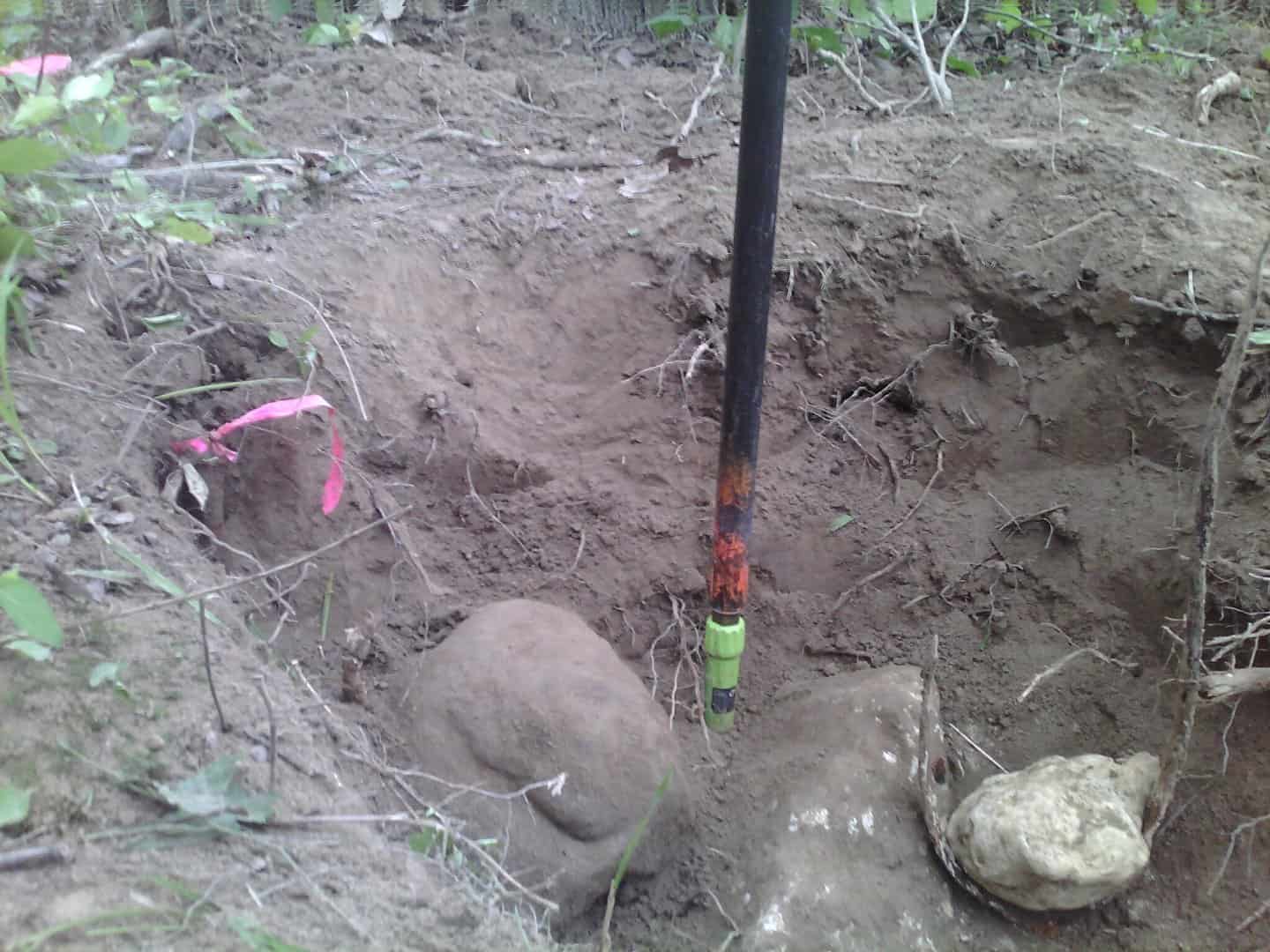
Here is a good example of the problem. I have a fence post not shown, with on old iron pin, and two nice stones. The picture does not do it justice, but the hole is nearly three feet deep, and four feet wide. The post and pin are easy to see, the round stone was the first stone found, but my curiosity as to why an old steel strap was coming out of the ground kept me digging. Many years ago, someone had placed the small rock into the loop of the steel strap to make it impossible to pull from the ground. Due to tree roots, it took me over an hour to dig and expose this. I know that they exist, but I unfortunately have never met a purely field crew with enough determination to do this. Too many crews I see would have located the wood post, or the pin and called it good.
When my name is on it...I want to dig it...plain and simple. The only question I have is, whether or not I should toss the round stone aside? I suspect someone knew a stone should be there based on the deeds, and put the round one there when they did not dig deep enough to find the original.
Posted : August 15, 2017 7:59 am

Translate
▼
English
Spanish
French
German
Italian
Portuguese
Russian
Chinese
Japanese
Korean
Arabic
Hindi
Dutch
Polish
Turkish
Vietnamese
Thai
Swedish
Danish
Finnish
Norwegian
Czech
Hungarian
Romanian
Greek
Hebrew
Indonesian
Malay
Ukrainian
Bulgarian
Croatian
Slovak
Slovenian
Serbian
Lithuanian
Latvian
Estonian
I wish I could go to the field, well maybe not right now when it is 105?ø outside, but I do wish I could spend some time doing the actual "survey" work. Unfortunately, the types of projects I work on don't allow for that. Currently I am working on a survey for a new highway ROW in the piney woods of East Texas. Being that this highway will affect close to 100 tracts (some very large), I would hate to think how long it would take, and how expensive it would be to use only RPLSs in the field.
Also, just as important as it is to have a crew with a good foundation for searching for boundary corners, I think it is very important that office staff is trained in proper ways to assist the crews to make sure they understand what evidence to search for.
Posted : August 15, 2017 10:24 am

Translate
▼
English
Spanish
French
German
Italian
Portuguese
Russian
Chinese
Japanese
Korean
Arabic
Hindi
Dutch
Polish
Turkish
Vietnamese
Thai
Swedish
Danish
Finnish
Norwegian
Czech
Hungarian
Romanian
Greek
Hebrew
Indonesian
Malay
Ukrainian
Bulgarian
Croatian
Slovak
Slovenian
Serbian
Lithuanian
Latvian
Estonian
I do all the field work and office work, especially with new employees. I train them and show them I can still do it. I had a boss that was a LS for a long time, and couldn't do the fieldwork anymore because he could figure out the equipment. I will not be like him.
Posted : August 15, 2017 11:04 pm

Translate
▼
English
Spanish
French
German
Italian
Portuguese
Russian
Chinese
Japanese
Korean
Arabic
Hindi
Dutch
Polish
Turkish
Vietnamese
Thai
Swedish
Danish
Finnish
Norwegian
Czech
Hungarian
Romanian
Greek
Hebrew
Indonesian
Malay
Ukrainian
Bulgarian
Croatian
Slovak
Slovenian
Serbian
Lithuanian
Latvian
Estonian
In my experience an LS in the field is extremely rare, on similar frequency to an engineer visiting a construction site.
Posted : August 16, 2017 5:36 pm
Page 1 / 2
Next