

Loyal, post: 453495, member: 228 wrote: How about this one?

Loyal
I've had to deal with quite a number of these over the years. Typically done before the rectangular surveys and are excluded. What mostly drove my work with these was the fact that the patentee often acquired mineral rights prior to statehood. Don't think I've ever had one close perfectly.
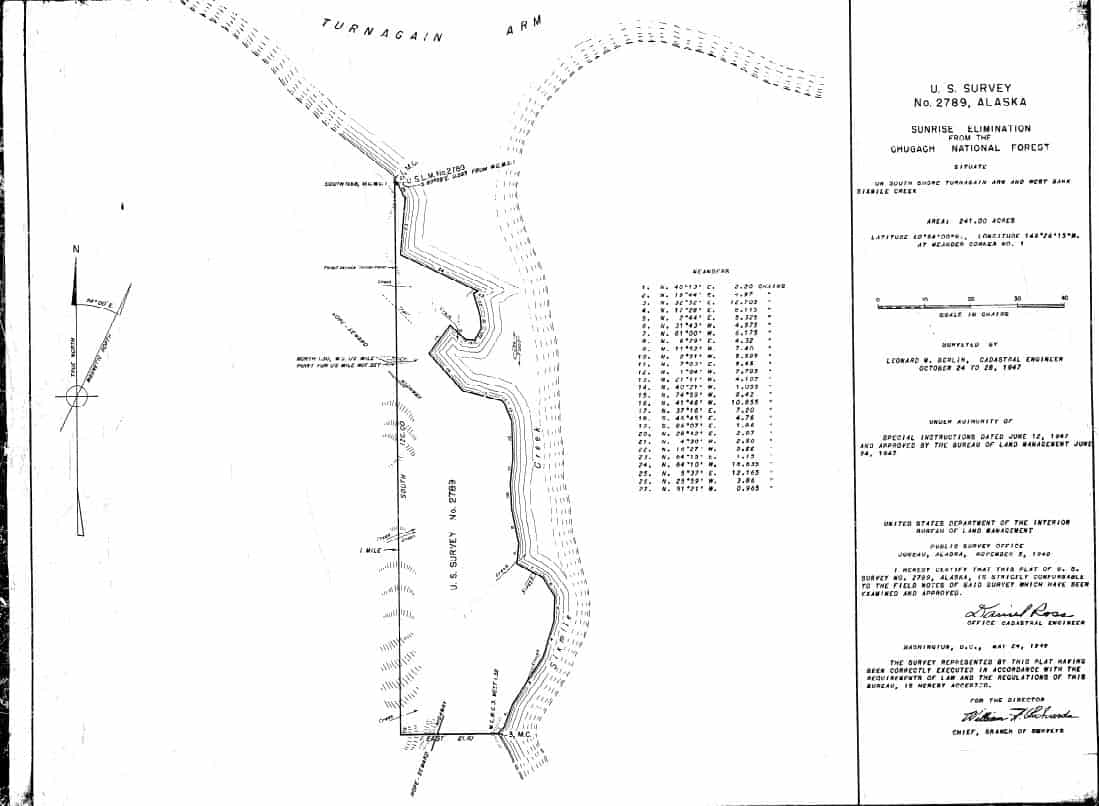
Just because I'm paranoid, doesn't mean they aren't out to get me.

I have read several post here about picking the lines. From my experience this creates the majority of the miss closes of which we speak. Cadd hands are notorious for picking the lines themselves to annotate them and to check the area and closure. This creates all kinds of problems if the line does not quite match the Node or center of the symbol at the point of monumentation.

Loyal, post: 453495, member: 228 wrote: How about this one?
Loyal
Seems like I read some years ago that you will not get a perfect closure on a GLO/BLM section due to the curvature of the East-West lines using the bearings and distances shown on the plat or in the notes.

Charles L. Dowdell, post: 453525, member: 82 wrote: Seems like I read some years ago that you will not get a perfect closure on a GLO/BLM section due to the curvature of the East-West lines using the bearings and distances shown on the plat or in the notes.
You will not get perfect closure if you check the closure on a plane. The bearings are geodetic.

Definitely request a closure report and make this part of the review process.
Sent from my iPhone using Tapatalk

Occasionally something goes array when I type old data into a traverse/cogo program and I have no idea why it doesn't close.
If it's important I'm like a dog with a bone.
If it says it's supposed to I assume it's either rigged or a bearing or distance error.
I type the 'closed' loop in a continuous fashion and then do cross checks from an intermediate point to both the start and the end.
Occasionly you'll find a corresponding common distance with, obviously, different bearings.
Then you can start looking at what may have induced an error.
I've solved riddles such as this and then use that to justify my reestablishment.
Cad makes life easy. All too easy to make other stupid mistakes. As [USER=10727]@Bushwhacker[/USER] says
Sometimes it's just plain cruddy work and I look for other ways to redefine the boundary.
Loyal, post: 453495, member: 228 wrote: How about this one?
Loyal
I ran this one out and for a BLM survey it has a good closure, 1:19717, S 88?ø51'31"E-0.016 links closing to to starting point (SW Corner)

Charles L. Dowdell, post: 453548, member: 82 wrote: I ran this one out and for a BLM survey it has a good closure, 1:19717, S 88?ø51'31"E-0.016 links closing to to starting point (SW Corner)
Right on Mr. Dowdell!
It "closes" nearly perfectly (if you know what you are doing).
Loyal
MightyMoe, post: 453496, member: 700 wrote: What is the date on it?
Field work 2009-2010, approved in 2012

Always draw your lines from point number to point number, and always do your annotations from point number to point number, then do your map check from point number to point number. Picking lines has always been where we find our mis-closures around here.

I'm not a CAD user, but it seems to me that it should offer a line that will only terminate on pre-existing points. No missed snapping.
Then that line should know it's length and not need any help beyond positioning the label. Don't they have that?

Loyal, post: 453495, member: 228 wrote: How about this one?
Loyal
decimal minutes???
Dan Patterson, post: 453596, member: 1179 wrote: decimal minutes???
Yup!
Loyal

lmbrls, post: 453414, member: 6823 wrote: I review plats from several states and have found that about 25% of the time the plat does not close. I don't mean a small error because of a flipped bearing, rounding or even unadjusted field error. I mean distances of several feet that were inadvertently left off the survey or bearing and distance that are just wrong. Many times the survey will appear professional and very detailed. They just don't close. I am not wanting the survey to have problems, so I can pat myself on the back. I actually want the survey to close. It pains me to see in many cases apparently much effort put into a survey to see it fall short because of the omission of a simple procedure. The error is so apparent that it is rare I can't determine where it is with very little effort. I was taught that a survey never leaves the office or is signed until a map check is performed. This is entering the bearing and distances taken from the hard copy of the survey. An area summary of the graphical file is not a map check. When I was in private practice, I had several technicians tell me that my old school approach was no longer necessary with the new software. The ones who learned the error of their ways had continued employment. Sorry for the rant. This is so basic and unnecessary.
Apparently the surveyors you work with haven't learned the "North Arrow Rule" of dealing with map checkers. I??ve checked a lot of maps and I have to admit that this worked on me every time: Just leave off the north arrow and the map checker will get so excited he won't see anything else.
Don

Don Blameuser, post: 453611, member: 30 wrote: Apparently the surveyors you work with haven't learned the "North Arrow Rule" of dealing with map checkers. I??ve checked a lot of maps and I have to admit that this worked on me every time: Just leave off the north arrow and the map checker will get so excited he won't see anything else.
Don
Here its the graphical scale. Years ago the FS here tried to record a drawing of an entire section. Depicting it on one sheet required a scale that was out of the range required by State statutes, so the Recorder would not accept it. The drafter changed the scale from feet to chains and it was recorded without hesitation!

Even when I did most of my surveys with a total station, there weren't many (any?) that I ever was able to run direct along the boundary, so reporting "measurements" from one monument to the next doesn't make much sense to me. Most (and by most I mean the exceedingly vast majority) of my calls are inverses between coordinates determined from measurements. They should close precisely.
I can only think of a couple of times in my career that I did not run the calls through a calculator program I wrote to check for closure and acreage. This includes lots in a subdivision. There have been a few times that I've found that I missed labeling a call (particularly in subdivision plats) that needed to be added.
Regarding CAD labels, one thing I have to be very careful of is turning off lines that are near the boundary when annotating. Fences are the worst. Sometimes the fence is drawn monument to monument (close enough to call them the same), but sometimes I have fence lines that are near the boundary but are not the same, this can get you into trouble quickly.
There are also a lot of people trimming boundary lines at their symbols to make hollow symbols. This isn't necessary with modern CAD symbols and is a bad idea anyway. Way too much chance of annotating a trimmed line instead of the real line.
I'd say that sending out a survey that doesn't close would have to be one of the most embarrassing things a surveyor could do, simply because it is avoidable and easily detected by related professionals with cheap software. Yikes.

Back in the day, I used to punch in from the plan for lot closures, and it's still a good habit. But I found that I'm good with a lot summary print-out, and then checking it against the plan. Someone showed me long ago to green-line what's good and red-line what's bad, and I think that it's been working pretty good for me.
Since most of the B-D come from the computer, you get far less of the mixed up bearings, NW instead of NE, than we did when everything was hand drafted.

Monte, post: 453576, member: 11913 wrote: Always draw your lines from point number to point number, and always do your annotations from point number to point number, then do your map check from point number to point number. Picking lines has always been where we find our mis-closures around here.
BOOM!
This is exactly right or at least how I do it.

The goal of the survey plat and property description is to help someone find the monuments on the ground. Is adjustment going to change the reported bearings and distances so much as to affect the retracement of the boundary on the ground? Sounds like there are some pretty poor measurements then.
Dave Karoly, post: 453628, member: 94 wrote: BOOM!
This is exactly right or at least how I do it.
Point numbers? You obviously pre-date the CAD generation. So do I