

Gene Kooper, post: 444399, member: 9850 wrote: The term is agoraphobia. My first wife suffered from it. I took her from our abode in urban Lincoln to the Sandhills to visit my folks many years ago. After a couple of days there (the nearest neighbor was over 3 miles away) she became more neurotic than usual. It was her only visit.
I use to spend my summers on my uncles cotton farm in south Hidalgo County, Tx. The term "flat nothing" has an almost religious meaning. I can remember running almost a mile with my cousins just to catch the shadow of the one cloud we had seen all day. The nearest neighbors were two miles away so you could see the top of their barn and their tv antenna (if you squinted) so it wasn't like it was desolate or anything like that.
Oh, and there was a power line to throw dirt clods at...

@ Gene Kooper.
Have spent a good bit of time with my Wife's family in Bassett, NE. I just have them put me to work. If you're not into farming or ranching there's not much to do if you don't enjoy the solitude and quiet. Once was told the natural sounds induce anxiety and lack of people and street noise is depressing. I avoided the nature VS. nurture debate...
Have to admit I miss tumbleweeds. Loved seeing them stuck to the grill of a passing car/truck where I grew up in ND...

paden cash, post: 444403, member: 20 wrote: At least the flowers are green. Walk a mile or two through those puppy's after a couple of frosts and you'll need a blood transfusion and a case of Band Aids.
Even though I agree the pits and mounds are probably "gone with the wind" and buried under 1/2 of s.e. Colorado you might still be surprised what you find. I found a quarter corner in the middle of a June wheat field south of Keyes that had been a pit and mound set originally. We found the remains of a rail tie that had been chain-sawed flush within a foot of a calculated position.
The old man that farmed the area wouldn't let us drive on it until he had cut the wheat. I talked to him about the rail tie and it indeed had been him that cut it down. It seems it cost him some repairs on a combine header a few years earlier. He had no idea what it was meant to be and thought it was just an old fence post. We never could figure out who had set the tie.
Look anyway, you might be surprised.
I ALWAYS look. You be surprised what you find. At this location I did locate a 3/4" bar, but it had been disturbed by the farming. Then if you look in the picture you see a railroad tie as a post. Turns out the owner put these up and he just guessed at the location. Pretty close for guessing. Now... a great find was this...
a charred stake that was set in a mount/pits. That stake was set in 1894 in "NO MAN'S LAND" and still in good condition. It was just laying at the location.
Then here is a zinc cone in place.


does that pipe have "1/4" on it in the right 1/3rd of the picture?- edit nevermind I can see it has 33 and "2W" on it plus what look to be grooves.
that's cool-
never seen or heard of one before.
Rankin_File, post: 444452, member: 101 wrote: does that pipe have "1/4" on it in the right 1/3rd of the picture?
I believe it says "T 2 N", with the T upright and the 2 N bein' "lazy". .
Here's a pot that enjoys a little more notoriety:
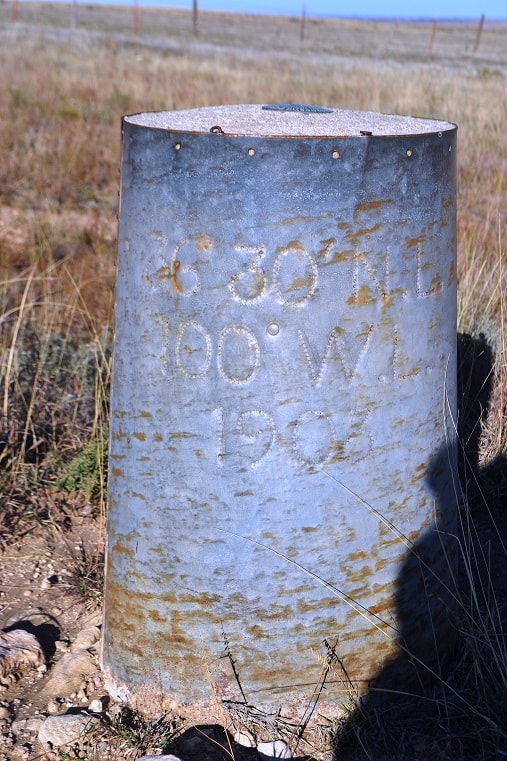
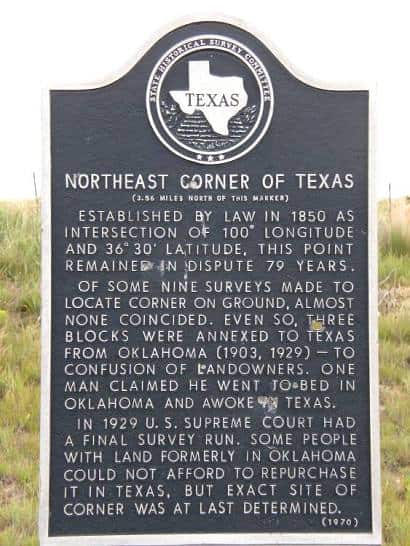
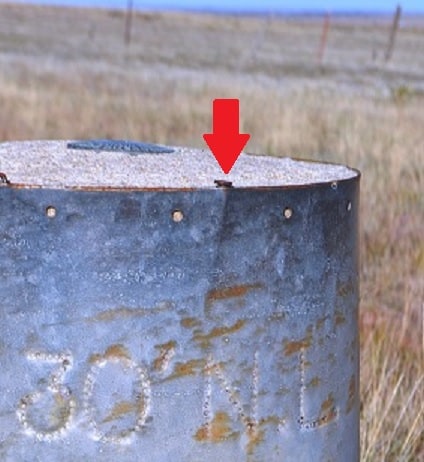
And as seen in this detail, I believe Kent has been working in the area. Apparently unable to dimple the concrete (with something surely made by Estwing) he opted to set the "true" corner thus:

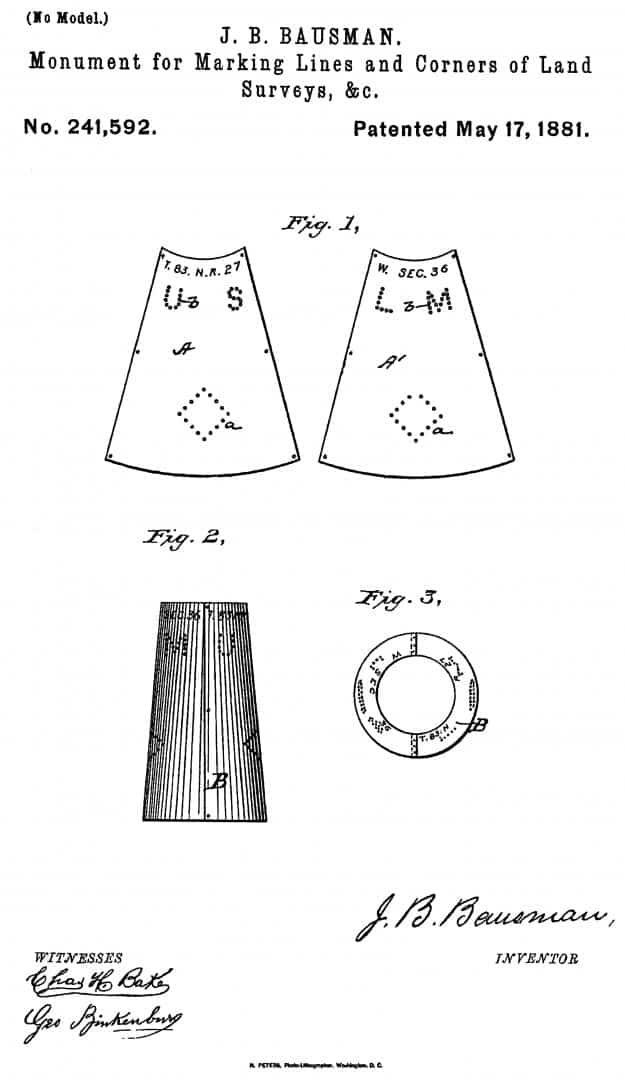
In my book "American Survey Monument Patents", I show the Bausman patent of 1881.

Scotland, post: 444450, member: 559 wrote: I ALWAYS look. You be surprised what you find. At this location I did locate a 3/4" bar, but it had been disturbed by the farming. Then if you look in the picture you see a railroad tie as a post. Turns out the owner put these up and he just guessed at the location. Pretty close for guessing. Now... a great find was this...
a charred stake that was set in a mount/pits. That stake was set in 1894 in "NO MAN'S LAND" and still in good condition. It was just laying at the location.Then here is a zinc cone in place.
Looks like a 4 x 5 which would place it at the SW Section 8, T2, R33? Very cool!!
MightyMoe, post: 444467, member: 700 wrote: Looks like a 4 x 5 which would place it at the SW Section 8, T2, R33? Very cool!!
Actually trying to remember, but I believe this one was on the township line between section 32 and 33, T 2 N, R 4 E and T 1 N, R 4 E. Couple of pictures of the same zinc cone on the other sides. Little bit of poor lighting..


[SARCASM]all banged up like that, it'd probably take some Texans quite awhile to get their exacto-mundo center determinizer oriented and operational in order to tie that thing.....thankfully all the fences appear low......[/SARCASM]

Loyal, post: 444331, member: 228 wrote: 66.06 ft. Same as required by the 1881 Manual (see pages 19 & 20 thereof).
Loyal
Why? I found that interesting. Jp
Scotland, post: 444472, member: 559 wrote: Actually trying to remember, but I believe this one was on the township line between section 32 and 33, T 2 N, R 4 E and T 1 N, R 4 E. Couple of pictures of the same zinc cone on the other sides. Little bit of poor lighting..
I see the S33 now, makes me scratch my head what the grooves mean, I suppose the 4 could mean 4 miles to the SE township corner, that would have to be the east side.
Rankin_File, post: 444479, member: 101 wrote: [SARCASM]all banged up like that, it'd probably take some Texans quite awhile to get their exacto-mundo center determinizer oriented and operational in order to tie that thing.....thankfully all the fences appear low......[/SARCASM]
LOL! Well... I don't quite work like Mr. Perfecto in determining the exact dimple point location or the patina of a stone. I had a great mentor tell me once about finding a stone and where was the correct location to survey to. His response was "Who the hell cares, you found the actual stone. 6" this way or that way ain't going to make a damn difference." That is how I consider descriptions and calls. They lead me to the correct location. Not as important out here in the west as downtown, over-priced Austin (or any other city).

Jp7191, post: 444495, member: 1617 wrote: Why? I found that interesting. Jp
According to the 1881 Manual (paraphrased)
So that "they" didn't have to pull harder than ~20 pounds to get 66.00 ft. (per pull).
It (1881) also requires the 2-pole chain to be 33.03 ft.
Loyal
Page 161 from Al White's "History of the Rectangular System".
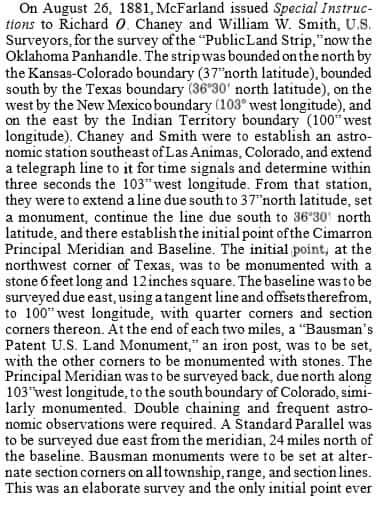
Thanks J Penry. Great info that I was looking for.
Loyal, post: 444500, member: 228 wrote: According to the 1881 Manual (paraphrased)
So that "they" didn't have to pull harder than ~20 pounds to get 66.00 ft. (per pull).
It (1881) also requires the 2-pole chain to be 33.03 ft.
Loyal
Thanks, that makes since. I learned something today! Jp

Have posted this pic before. It's the NW corner of the Texas Panhandle on the south side of the Oklahoma Panhandle. Looking to the SSE from OK into TX.
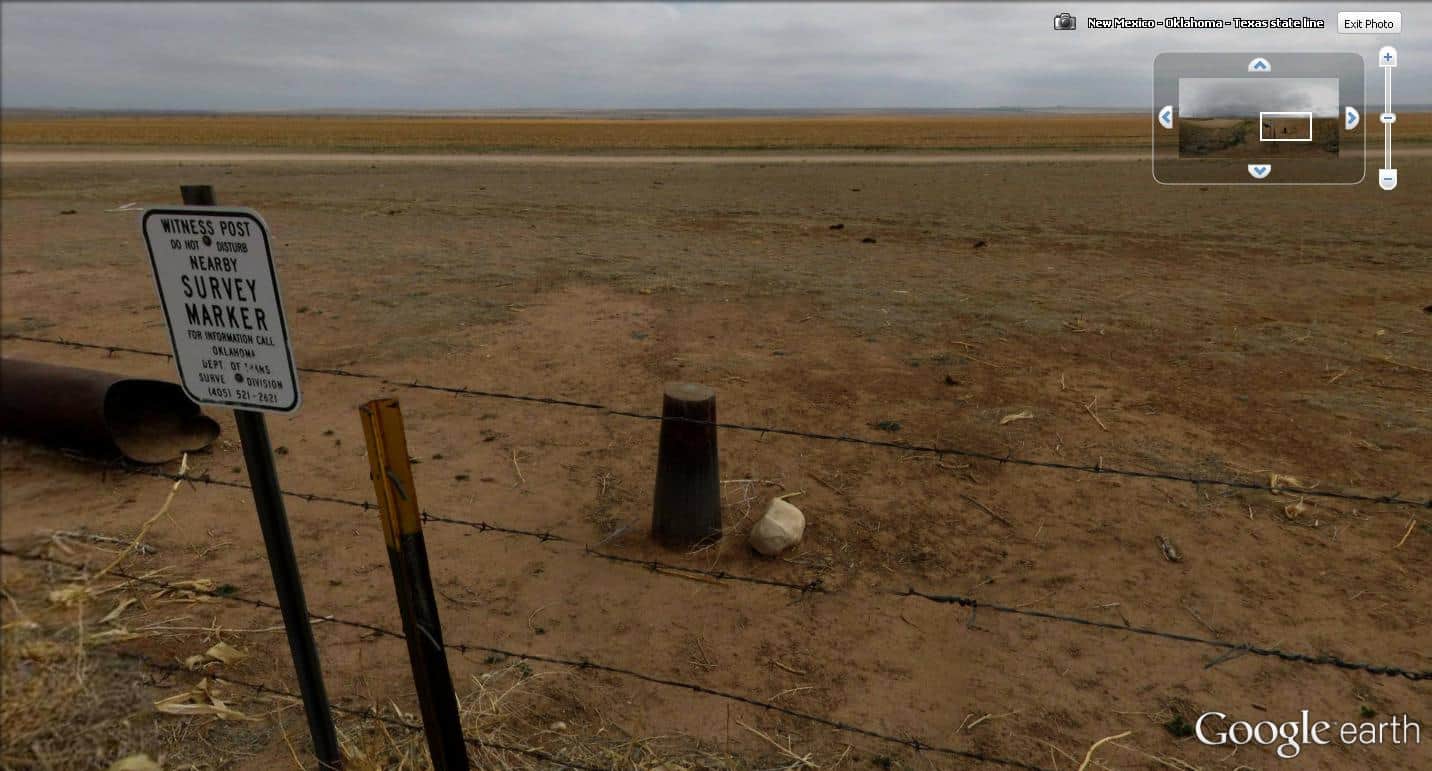
Holy Cow, post: 444579, member: 50 wrote: Have posted this pic before. It's the NW corner of the Texas Panhandle on the south side of the Oklahoma Panhandle. Looking to the SSE from OK into TX.
Actually the NW corner is 3 miles West.
OK. I got confused. The jog in the New Mexico border starts 3 miles further to the west. Right?