Reading RPLS is free for the whole profession. Members post, reply, and get the members-only rooms.

Notifications
Clear all

Topic starter
Translate
▼
English
Spanish
French
German
Italian
Portuguese
Russian
Chinese
Japanese
Korean
Arabic
Hindi
Dutch
Polish
Turkish
Vietnamese
Thai
Swedish
Danish
Finnish
Norwegian
Czech
Hungarian
Romanian
Greek
Hebrew
Indonesian
Malay
Ukrainian
Bulgarian
Croatian
Slovak
Slovenian
Serbian
Lithuanian
Latvian
Estonian
1960 ÛÒ Ma and Pa Belly are deeded the east 825 feet of the NE 1/4 NE 1/4 of Section 16.
1966 ÛÒ Plat of ÛÏBelly AcresÛ subdivides the east 825 feet of the NE 1/4 NE 1/4 of Section 16.
1976 ÛÒ Another surveyor finds that the plat left a gap on the north boundary between the monumented plat boundary and the section line:
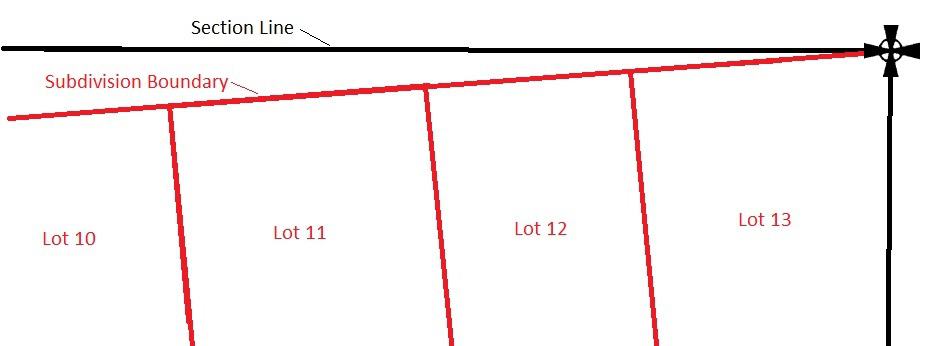
I looked this up in my 1986 copy of BrownÛªs Evidence and Procedures today to refresh my memory and Brown indeed states that the gap is retained by the subdividerÛ? the lot lines donÛªt extend to the section line (the book is at work, so IÛªm paraphrasing right now).
I was wondering if anyone has specific court cases that state this principleÛ? or the contrary?
Posted : November 16, 2016 9:59 pm

Translate
▼
English
Spanish
French
German
Italian
Portuguese
Russian
Chinese
Japanese
Korean
Arabic
Hindi
Dutch
Polish
Turkish
Vietnamese
Thai
Swedish
Danish
Finnish
Norwegian
Czech
Hungarian
Romanian
Greek
Hebrew
Indonesian
Malay
Ukrainian
Bulgarian
Croatian
Slovak
Slovenian
Serbian
Lithuanian
Latvian
Estonian
Sorry. Don't have your answer. But, I encountered something similar. Foolish people had a subdivision laid out on one end of an 80-acre aliquot. The only street platted was a quarter circle from the county road on the north side to the county road on the west side. Weird pie shaped tracts between the northwest corner and the street. Radiating outward from the street were a number of lots with their rear lines being straight rather than curved like the front lines were. The problem was there was an increasing area between the lots and the east side of the 80. Behind the very first lot was a triangle something like 250 long but only 10 feet wide at the base. Behind the next lot was a wedge something like 200 feet long and 10 feet wide on one end and maybe 25 feet wide on the other. At the third lot, that owner approached the subdividers and purchased the odd wedge behind him. That isolated the first wedge and the triangle and made them land locked. The county would send the subdividers a separate tax bill for that weird tract for something like $2.67 per year. This had been going on for over 20 years when I brought it to everyone's attention and the triangle was deeded to the first lot and the first wedge was deeded to the second lot.
Posted : November 16, 2016 10:49 pm

Translate
▼
English
Spanish
French
German
Italian
Portuguese
Russian
Chinese
Japanese
Korean
Arabic
Hindi
Dutch
Polish
Turkish
Vietnamese
Thai
Swedish
Danish
Finnish
Norwegian
Czech
Hungarian
Romanian
Greek
Hebrew
Indonesian
Malay
Ukrainian
Bulgarian
Croatian
Slovak
Slovenian
Serbian
Lithuanian
Latvian
Estonian
Mike Berry, post: 399983, member: 123 wrote: I looked this up in my 1986 copy of BrownÛªs Evidence and Procedures today to refresh my memory and Brown indeed states that the gap is retained by the subdividerÛ?
There is an Oregon case (can't find it just now, but I know it exists) in which the court states that the grantor could have had no intent to retain a tiny of sliver of land that could be of no use to them.
Posted : November 17, 2016 8:39 am

Translate
▼
English
Spanish
French
German
Italian
Portuguese
Russian
Chinese
Japanese
Korean
Arabic
Hindi
Dutch
Polish
Turkish
Vietnamese
Thai
Swedish
Danish
Finnish
Norwegian
Czech
Hungarian
Romanian
Greek
Hebrew
Indonesian
Malay
Ukrainian
Bulgarian
Croatian
Slovak
Slovenian
Serbian
Lithuanian
Latvian
Estonian
Do a search for 'strips and gores'. Escondido Servs. LLC v. VKM Holdings LP, Texas App. LEXIS 4260.
In short, the courts are unlikely to allow claim by the underlying owner in a useless strip not specifically reserved. It brings this problem in line with construing against the grantor...
Posted : November 17, 2016 8:54 am

Translate
▼
English
Spanish
French
German
Italian
Portuguese
Russian
Chinese
Japanese
Korean
Arabic
Hindi
Dutch
Polish
Turkish
Vietnamese
Thai
Swedish
Danish
Finnish
Norwegian
Czech
Hungarian
Romanian
Greek
Hebrew
Indonesian
Malay
Ukrainian
Bulgarian
Croatian
Slovak
Slovenian
Serbian
Lithuanian
Latvian
Estonian
I agree with Mark & Tom. If the intent was to make the north boundary of the subdivision coincident with the section line, then, chances are, there is no "gap".
Mike Berry, post: 399983, member: 123 wrote: I looked this up in my 1986 copy of BrownÛªs Evidence and Procedures today to refresh my memory and Brown indeed states that the gap is retained by the subdivider
I assume, as is usually the case, Brown, Robillard, etc. didn't provide any authoritative sources for their assertion?????
Posted : November 17, 2016 9:21 am

Translate
▼
English
Spanish
French
German
Italian
Portuguese
Russian
Chinese
Japanese
Korean
Arabic
Hindi
Dutch
Polish
Turkish
Vietnamese
Thai
Swedish
Danish
Finnish
Norwegian
Czech
Hungarian
Romanian
Greek
Hebrew
Indonesian
Malay
Ukrainian
Bulgarian
Croatian
Slovak
Slovenian
Serbian
Lithuanian
Latvian
Estonian
I look for general principles as vs cases addressing a specific set of facts. The most important principle being the intentions of the parties is the paramount consideration. Is there affirmative evidence that the subdivider intended to retain the strip? I'm not saying there isn't any but look for a separately occupied and possessed strip along with a separate tax parcel (as in Holy Cow's case). Bear in mind too, the monumented subdivision boundary may be the established location of the section line. It is not unreasonable to assume a section line run with compass was not straight and later surveys may be competent to prove where the original Surveyor walked (as held in recent California case law approving of a CJS Section I don't have before me right now). I'm only pointing out possibilities, not answers.
Posted : November 17, 2016 9:35 am

Translate
▼
English
Spanish
French
German
Italian
Portuguese
Russian
Chinese
Japanese
Korean
Arabic
Hindi
Dutch
Polish
Turkish
Vietnamese
Thai
Swedish
Danish
Finnish
Norwegian
Czech
Hungarian
Romanian
Greek
Hebrew
Indonesian
Malay
Ukrainian
Bulgarian
Croatian
Slovak
Slovenian
Serbian
Lithuanian
Latvian
Estonian
Mark Mayer, post: 400027, member: 424 wrote: There is an Oregon case (can't find it just now, but I know it exists) in which the court states that the grantor could have had no intent to retain a tiny of sliver of land that could be of no use to them.
Many moons ago, when I worked at a large NW engineering firm to remain unnamed, we ran into a similar situation in Washington County. I was not directly involved, it was Oran Abbot's project, but as I remember the sliver was prorated to the lots.
Posted : November 17, 2016 10:02 am

Translate
▼
English
Spanish
French
German
Italian
Portuguese
Russian
Chinese
Japanese
Korean
Arabic
Hindi
Dutch
Polish
Turkish
Vietnamese
Thai
Swedish
Danish
Finnish
Norwegian
Czech
Hungarian
Romanian
Greek
Hebrew
Indonesian
Malay
Ukrainian
Bulgarian
Croatian
Slovak
Slovenian
Serbian
Lithuanian
Latvian
Estonian
This is the example from Brown, et al. where the subdivision should not be extended to the parent tract boundary (circles are found original corners). This does not look like what you are describing in your situation
Brown also states that that the principle of not extending the lines to the parent boundary does not apply in cases where the gap is insignificant, where the original subdivision monuments cannot be found, or where there is a presumption that the subdivision was intended to be all of the original parcel.
The section is written poorly because it seem to use an example that is an uncommon situation to establish a "principle" then caveats the "principle" by stating that it does not apply in 99% of the situations where a gap would be likely to seem to exist between a subdivision and the parent tract boundary.
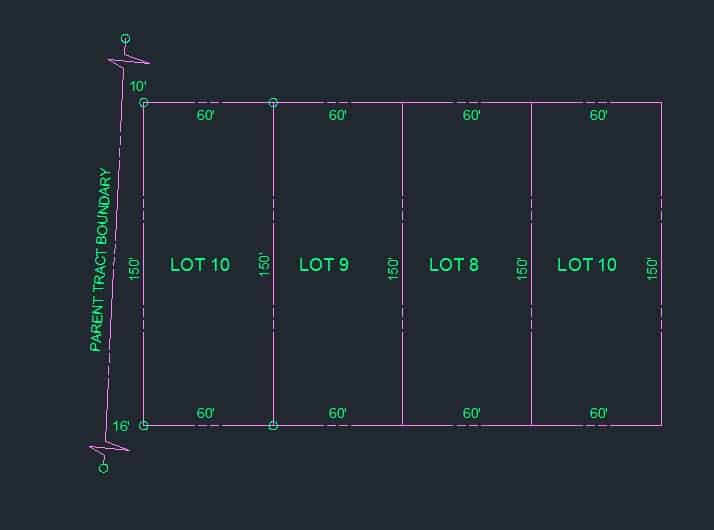
Edit....See kids, this is why you have to be careful with "cut & paste" in CAD. 😉
Posted : November 17, 2016 10:09 am

Translate
▼
English
Spanish
French
German
Italian
Portuguese
Russian
Chinese
Japanese
Korean
Arabic
Hindi
Dutch
Polish
Turkish
Vietnamese
Thai
Swedish
Danish
Finnish
Norwegian
Czech
Hungarian
Romanian
Greek
Hebrew
Indonesian
Malay
Ukrainian
Bulgarian
Croatian
Slovak
Slovenian
Serbian
Lithuanian
Latvian
Estonian
Does the plat show a strip? I assume not. Then the intent was to go to the section line. My concern would be did Belly give up the land to the adjoiner, being the same thought as Dave what is the history of the section line/property line. That is, does the owner to the North have any claim to the gap? A lot of time has passed since the subdivision created the property line.
Posted : November 17, 2016 10:11 am
Translate
▼
English
Spanish
French
German
Italian
Portuguese
Russian
Chinese
Japanese
Korean
Arabic
Hindi
Dutch
Polish
Turkish
Vietnamese
Thai
Swedish
Danish
Finnish
Norwegian
Czech
Hungarian
Romanian
Greek
Hebrew
Indonesian
Malay
Ukrainian
Bulgarian
Croatian
Slovak
Slovenian
Serbian
Lithuanian
Latvian
Estonian
In defense of Brown and Robillard, most of their writings predate the clear development of the strips and gores doctrine. They also predate the mindset of (most) Surveyors assisting owners in avoiding and resolving disputes.
There is another question on the table here as well. If the strip is to be divided among the owners it may not be by 'extension'. There are times proportionate frontage or area may apply.
We need to guide these folks to defensible solutions that meet Statutory and case law. The results need to be entered into the record in accordance with the law as well. The very cool tools we have gained in the last few decades don't all have buttons and screens. We have unprecedented access to information. Let's use it.
Posted : November 17, 2016 10:30 am

Translate
▼
English
Spanish
French
German
Italian
Portuguese
Russian
Chinese
Japanese
Korean
Arabic
Hindi
Dutch
Polish
Turkish
Vietnamese
Thai
Swedish
Danish
Finnish
Norwegian
Czech
Hungarian
Romanian
Greek
Hebrew
Indonesian
Malay
Ukrainian
Bulgarian
Croatian
Slovak
Slovenian
Serbian
Lithuanian
Latvian
Estonian
https://www.blm.gov/cadastral/casebook/fundprop.pdf
Hiatus. Perhaps what you are looking for will be found there.
As usual, just enough information to render an opinion but not enough for a solution. Mike, keep us informed as to what you decide. Remember, all are not surveyors or attorneys.
Posted : November 17, 2016 10:39 am
Translate
▼
English
Spanish
French
German
Italian
Portuguese
Russian
Chinese
Japanese
Korean
Arabic
Hindi
Dutch
Polish
Turkish
Vietnamese
Thai
Swedish
Danish
Finnish
Norwegian
Czech
Hungarian
Romanian
Greek
Hebrew
Indonesian
Malay
Ukrainian
Bulgarian
Croatian
Slovak
Slovenian
Serbian
Lithuanian
Latvian
Estonian
thebionicman, post: 400052, member: 8136 wrote: We have unprecedented access to information.
This sentence should be the foundation for everything we do. I have found this to be very true. Legal information is readily available and easier to access than ever before. What I can get in 15 minutes at the Law Library must've taken Curt Brown all day. It is helpful that I don't have to spend all day at a library table reading the books and taking down notes. I can take it home and read it at my convenience in the easy chair.
Posted : November 17, 2016 11:15 am

Translate
▼
English
Spanish
French
German
Italian
Portuguese
Russian
Chinese
Japanese
Korean
Arabic
Hindi
Dutch
Polish
Turkish
Vietnamese
Thai
Swedish
Danish
Finnish
Norwegian
Czech
Hungarian
Romanian
Greek
Hebrew
Indonesian
Malay
Ukrainian
Bulgarian
Croatian
Slovak
Slovenian
Serbian
Lithuanian
Latvian
Estonian
I'll answer with a question. Did the survey that laid out the subdivision survey the entire half mile and determine the section line? I would probably say no. He most likely survyed along some kind of occupation line such as a fence and called that the section line. At least thats the way they were done in my area. Surveyors get hung up on the idea lines have to be straight for a half mile. Maybe this created the so called gap in this case, or maybe not.
Posted : November 17, 2016 12:07 pm

Translate
▼
English
Spanish
French
German
Italian
Portuguese
Russian
Chinese
Japanese
Korean
Arabic
Hindi
Dutch
Polish
Turkish
Vietnamese
Thai
Swedish
Danish
Finnish
Norwegian
Czech
Hungarian
Romanian
Greek
Hebrew
Indonesian
Malay
Ukrainian
Bulgarian
Croatian
Slovak
Slovenian
Serbian
Lithuanian
Latvian
Estonian
Does the plat show the north line as being the section line? If so, that is the senior "call" on the subdivision plat. Like finding a pin, I would presume they meant for it to be the section line, and look for reasons to "not" assume they meant for it to be the section line.
Posted : November 17, 2016 1:06 pm

Translate
▼
English
Spanish
French
German
Italian
Portuguese
Russian
Chinese
Japanese
Korean
Arabic
Hindi
Dutch
Polish
Turkish
Vietnamese
Thai
Swedish
Danish
Finnish
Norwegian
Czech
Hungarian
Romanian
Greek
Hebrew
Indonesian
Malay
Ukrainian
Bulgarian
Croatian
Slovak
Slovenian
Serbian
Lithuanian
Latvian
Estonian
Where were the monuments found? That would certainly indicate the intent. How does the platted external boundary description read? Is there reference calls to the section line?
Posted : November 17, 2016 2:20 pm

Translate
▼
English
Spanish
French
German
Italian
Portuguese
Russian
Chinese
Japanese
Korean
Arabic
Hindi
Dutch
Polish
Turkish
Vietnamese
Thai
Swedish
Danish
Finnish
Norwegian
Czech
Hungarian
Romanian
Greek
Hebrew
Indonesian
Malay
Ukrainian
Bulgarian
Croatian
Slovak
Slovenian
Serbian
Lithuanian
Latvian
Estonian
Was the Subdivision line the best evidence of the section line when Mr 76 surveyor came along but he didn't want to put an angle point in it? Did the plat tie the section line on both ends? Government land in the subdivision? Mark is correct on the Oregon Case law stating the intent is for no gaps. I'll look for that.
Posted : November 17, 2016 5:42 pm
Translate
▼
English
Spanish
French
German
Italian
Portuguese
Russian
Chinese
Japanese
Korean
Arabic
Hindi
Dutch
Polish
Turkish
Vietnamese
Thai
Swedish
Danish
Finnish
Norwegian
Czech
Hungarian
Romanian
Greek
Hebrew
Indonesian
Malay
Ukrainian
Bulgarian
Croatian
Slovak
Slovenian
Serbian
Lithuanian
Latvian
Estonian
Mark Mayer, post: 400027, member: 424 wrote: There is an Oregon case (can't find it just now, but I know it exists) in which the court states that the grantor could have had no intent to retain a tiny of sliver of land that could be of no use to them.
http://law.justia.com/cases/oregon/supreme-court/1973/506-p-2d-686-4.html&apos ;">Hurd v. Byrnes 264 Or. 591, 506 P.2d 686
[INDENT]We have taken the view that where the conveyance or reservation of title to narrow strips of land is in question, the probable intent of the grantor is not to retain title if he does not own abutting land. Our previous cases recognizing this principle have involved conveyances bordering on a street or stream. We have assumed that in the absence of an express provision to the contrary the grantor, in conveying land described as bordering a street or stream, ordinarily intends to also convey his title to the street portion of the lot or to the bed of the stream. This rule of construction is also founded on policy considerations, including the prevention of vexatious litigation and the prevention of the existence of strips of land the title to which would otherwise remain in abeyance for long periods of time. Supporting this conclusion is the general rule that ambiguities in a deed are to be construed against the grantor.[/INDENT]
Posted : November 17, 2016 11:41 pm
Topic starter
Translate
▼
English
Spanish
French
German
Italian
Portuguese
Russian
Chinese
Japanese
Korean
Arabic
Hindi
Dutch
Polish
Turkish
Vietnamese
Thai
Swedish
Danish
Finnish
Norwegian
Czech
Hungarian
Romanian
Greek
Hebrew
Indonesian
Malay
Ukrainian
Bulgarian
Croatian
Slovak
Slovenian
Serbian
Lithuanian
Latvian
Estonian
Thanks for all the replies. For what it is worth, I don't have a dog in this semi hypothetical fight... another surveyor is pondering a somewhat similar situation and I mentioned the Brown take on this and figured I'd bring it to the brain trust to see if there's a pile of case law supporting it.
This example in Brown's "Evidence and Procedures", 3rd Edition, stuck in my craw in 1986 when I bought the book. Why would this mistake revert to the subdivider? A narrow uneconomic remnant strip returns to the subdivider for cultivating a couple rows of corn?
I think nowadays, with intent being key to how a lot of us puzzle through boundary retracements, it seems elementary that the mistake or inattention of the Belly's surveyor 50 years ago shouldn't put the Belly heirs and assigns back in the real estate business. Ma and Pa intended to divide up and sell all their land.
Posted : November 20, 2016 7:30 pm

Translate
▼
English
Spanish
French
German
Italian
Portuguese
Russian
Chinese
Japanese
Korean
Arabic
Hindi
Dutch
Polish
Turkish
Vietnamese
Thai
Swedish
Danish
Finnish
Norwegian
Czech
Hungarian
Romanian
Greek
Hebrew
Indonesian
Malay
Ukrainian
Bulgarian
Croatian
Slovak
Slovenian
Serbian
Lithuanian
Latvian
Estonian
Mike Berry, post: 400471, member: 123 wrote: Thanks for all the replies. For what it is worth, I don't have a dog in this semi hypothetical fight... another surveyor is pondering a somewhat similar situation and I mentioned the Brown take on this and figured I'd bring it to the brain trust to see if there's a pile of case law supporting it.
This example in Brown's "Evidence and Procedures", 3rd Edition, stuck in my craw in 1986 when I bought the book. Why would this mistake revert to the subdivider? A narrow uneconomic remnant strip returns to the subdivider for cultivating a couple rows of corn?
I think nowadays, with intent being key to how a lot of us puzzle through boundary retracements, it seems elementary that the mistake or inattention of the Belly's surveyor 50 years ago shouldn't put the Belly heirs and assigns back in the real estate business. Ma and Pa intended to divide up and sell all their land.
I agree Mike. To me the answer rests within the OP:
1966 ÛÒ Plat of ÛÏBelly AcresÛ subdivides the east 825 feet of the NE 1/4 NE 1/4 of Section 16.
1976 ÛÒ Another surveyor finds that the plat left a gap on the north boundary between the monumented plat boundary and the section line:
In my opinion the East 825 feet was platted, not a portion thereof. And the 1976 survey neither "found" nor "created" what he apparently perceived as a gap. Without any additional info I might be inclined to think the 1976 surveyor was too stuck on math and (probably) published distances. Resolving the boundary would definitely require a lot of evidence and insight. One paragraph in a reference book does not a rule make.
I probably bought my copy of Brown in the early '80s also. I also collected a good amount of other reference material. Over the years I have not only found cases where I disagreed with my reference material, some of it contradicted itself. Curt Brown was an insightful surveyor and had a remarkable logic. His writings are basically good information. But in boundary work there are really very few instances where the evidence is as clear and concise as examples in a reference book.
And while I'm orating I might say the same about Walt Robillard. He is an accomplished expert. But like all experts, someone will always disagree with their rigidity. I have listened to Walt and actually met him years ago. I try not to allow the fact that I think him to be a narrow-minded blowhard to detract from his accomplishments. Part of the problem I have with rule books in general is that we work in a profession where there are no hard and fast rules. To quote Curt, "Unless the contrary may be shown." And I believe the contrary can usually be shown if you look hard enough.
In or around the early '50s Brown published his book "Boundary Control for Surveyors in California". It was met with mixed reviews from the surveying community, friends and strangers alike. The book was reviewed for the ACSM by several surveyors and one of the critiques stuck in my mind:
Bauer:
I feel that experienced men who know that such matters must be
carefully weighed and judged will not need the book particularly, whereas the inexperienced will
get the completely erroneous idea that the rules are as inflexible and rigid as Mr. Brown makes
them out to be.
And I think therein is one problem we encounter when attempting to set out rules for surveying in a book. There is no control over what level of adhesion to said rules the reader applies to his or her real world problems. Probably the most dangerous thing in the surveying community is an impressionable young surveyor faced with a boundary dilemma...armed only with a copy of Brown & Robillard.
Posted : November 20, 2016 9:13 pm
Translate
▼
English
Spanish
French
German
Italian
Portuguese
Russian
Chinese
Japanese
Korean
Arabic
Hindi
Dutch
Polish
Turkish
Vietnamese
Thai
Swedish
Danish
Finnish
Norwegian
Czech
Hungarian
Romanian
Greek
Hebrew
Indonesian
Malay
Ukrainian
Bulgarian
Croatian
Slovak
Slovenian
Serbian
Lithuanian
Latvian
Estonian
Mike Berry, post: 399983, member: 123 wrote: I looked this up in my 1986 copy of BrownÛªs Evidence and Procedures today to refresh my memory and Brown indeed states that the gap is retained by the subdividerÛ? the lot lines donÛªt extend to the section line
I think perhaps you should read a little further in Brown. I don't have the 1986 edition but In Chapter 5 of the 2nd Edition (1969) of Boundary Control, at page 193, the following Principle appears:
Where the original subdivider failed to subdivide all his land as shown by found original monuments, do not extend the lot lines beyond the limits of the original monuments. Title to the unsubdivided land remains in the original subdivider.
Which, no doubt, is the Principle which you refer to. This is followed one paragraph later with the following amendment: The rule cannot apply to small insignificant errors or cases where the original subdivider's monuments cannot be found. He then goes on to mention a Washington case involving a 4-1/2 foot wide strip as an example of what might be considered insignificant.
Posted : November 20, 2016 9:59 pm
Page 1 / 2
Next