

Seb, post: 377845, member: 7509 wrote: I should get off my butt and contribute more.
Me too.

imaudigger, post: 377832, member: 7286 wrote: Seems like pictures with chalkboard would be useful...not sure about patient privacy issues.
Ooh ya, forgot about that one good catch digger!
I took a picture of the room number, the started at the door and took pics clockwise around the whole room back to the door. That did help with the visualization (when I drafted in the office). Phones take such good video now, I would prob just vid the room number, then walk it around each room instead of pics.

I would not consider doing it any other way than scanning. yes, there are a lot of setups, but each setup would take about 5 minutes max. Short distances, scanning can be done at low resolution.

Don't forget the floors will be polished and won't hold a tripod very well, and think of how you are going to mark your traverse points so the night cleaning crew doesn't remove them.

John Hamilton, post: 377899, member: 640 wrote: I would not consider doing it any other way than scanning. yes, there are a lot of setups, but each setup would take about 5 minutes max. Short distances, scanning can be done at low resolution.
One problem with scanning is hidden things where you have to manually open up false ceilings and built in cupboards. Nice to do scanning, but the amount of missing information is tedious.

The last building I (recently) measured was an outright nightmare.
Spanning about 100 years of additions floor levels had unnoticeable differences but a level showed 25 - 30 mm in best of places.
Walls were differing thicknesses.
Some walls had false walls in front.
Columns were boxed in and only way to see what really was happening was to peer under freezers and see an RHS, then measure in from both aisles under the freezers to work out location.
Parts where walls started in boxed and poured concrete with stud wall sitting on top.
Someone mentioned differing thicknesses and expectant architects, engineers etc.
That's common on older (old) buildings and yet designers expect surveyors to give accurate measurements not between X & Y mm.
Verticality mentioned is important if it's to be built against a "vertical" wall.
Soffits, plinths, cornices and scotias all are places easily overlooked but vital influence in some instances.
Like any survey for engineering purposes, it's vital to have an understanding of what the person is trying to achieve, what they're building, what will just be ripped out or removed.
Often designers know what they want but have little idea as to their requirements from surveyors to arrive at that outcome.
Getting that information can save heaps of time, frustration and ultimately cost.
Roads, bridges, buildings - all the same philosophy for me in my initial discussions, consultations etc.

I forgot to mention. With targets stuck on windows make sure they are a decent size, say 20cm. square. It is surprising how much dirt collects on glass, especially when you are viewing at an angle and small targets can be very difficult to see unless you are square on.
If you are being really accurate, don't forget to allow for glass thickness if you measure from outside, although I tend to intersect them from two external stations (ignore the refraction through the glass - this is a building survey) and then use direct measurement from inside.
If i remember next week I'll post a picture of a three pad and chain device I made for use on slippery floors.

Richard, post: 377929, member: 833 wrote: The last building I (recently) measured was an outright nightmare.
Spanning about 100 years of additions floor levels had unnoticeable differences but a level showed 25 - 30 mm in best of places.
Walls were differing thicknesses.
Some walls had false walls in front.
Columns were boxed in and only way to see what really was happening was to peer under freezers and see an RHS, then measure in from both aisles under the freezers to work out location.
Parts where walls started in boxed and poured concrete with stud wall sitting on top.
Someone mentioned differing thicknesses and expectant architects, engineers etc.
That's common on older (old) buildings and yet designers expect surveyors to give accurate measurements not between X & Y mm.
Verticality mentioned is important if it's to be built against a "vertical" wall.
Soffits, plinths, cornices and scotias all are places easily overlooked but vital influence in some instances.
Like any survey for engineering purposes, it's vital to have an understanding of what the person is trying to achieve, what they're building, what will just be ripped out or removed.
Often designers know what they want but have little idea as to their requirements from surveyors to arrive at that outcome.
Getting that information can save heaps of time, frustration and ultimately cost.
Roads, bridges, buildings - all the same philosophy for me in my initial discussions, consultations etc.
I have made it clear to clients that I am locating the finished interior surface. I have had at least two that tried to question me about what was behind the plasterboard and some structural queries; usually which direction any rafters, purlins or stringers were running. I was even asked if I could "map" plumbing and wiring. At that time I have to tell them that's up to them. As much as I may, or may not know; I'm leaving my area of expertise.
One out-of-state architect hired a local "home inspection" service to get some answers to his technical inquiries. I found out later the home inspector had missed a number of key issues. There is probably a niche there for some knowledgeable and capable people, but it ain't me.

Scab it!
Scan it. This is exactly what they are best at

chris mills, post: 377931, member: 6244 wrote: don't forget to allow for glass thickness
If they are double pane windows that don't open, it may not be easy to determine thickness. And you should try to take your measurements nearly perpendicular to the panes or you might have enough refraction offset to be significant.

The key to 5he method is the purpose of the survey. Is it a condo conversion, air quality model, real Estate brochure or addition? There are dozens if not hundreds more reasons that could drive this sort of project.
Any more I set the instrument in the middle of the room and hit each face reflector less a few dozen times. Run best fit lines the set the foot print. Run levels to each room and include a minus rod in a few spots on the cieling. Draft the cubes and snap in place per control ties and caliper measurements on the walls. That works if you do one every few years. If you do a lot of them invest in a scanner.

I wonder how many of the people who recommend a scanner for a job like this have ever used a scanner on such a job. While it is in theory possible to scan every room it usually would not be practical. On the job we just finished if we had to scan every room (about 200) with a scanner it would have tripled the time. That wouldn't even include processing the point clouds.
I just remembered a story about a structural survey done here in town about 16 or 17 years ago. It might be funny unless you worked for the survey outfit that did the survey.
The McFarlin United Methodist Church sits 2 blocks north of the University of Oklahoma. Built in 1925 it was a premier architectural achievement. It is a beautiful renaissance style structure and I listen to the bells every day.
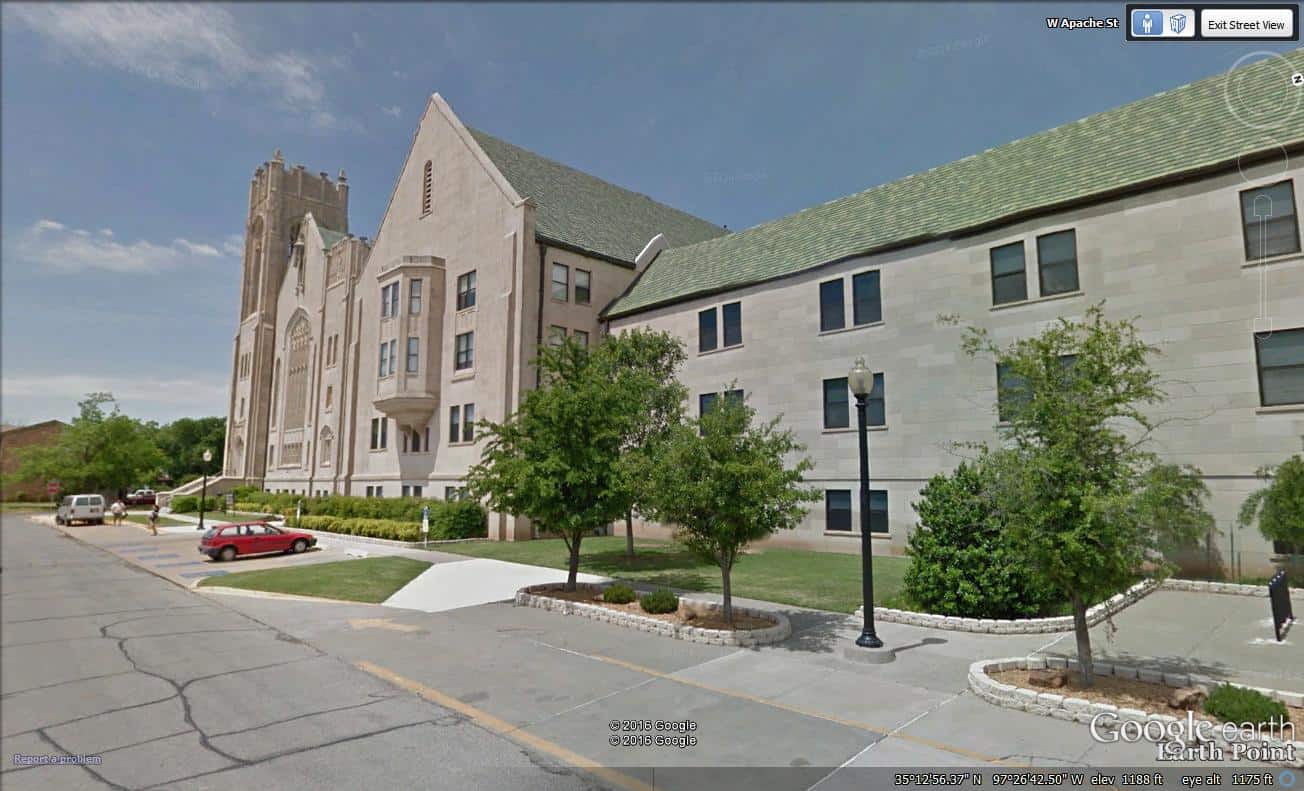
The original sanctuary and building is on the left of this pic. The building from about mid-frame to the right was added on in 1998-1999 and one of the "big boy" consulting firms around here was contracted to perform an in-depth survey for the planning of the multi-million dollar addition. One thing the architect was adamant about was precise elevations of the joints in the huge limestone blocks on the existing structure. Blocks were going to have to be quarried (at a great expense) to match and the architect wanted the masonry to "flow" seamlessly.
The outfit did a great job on the survey...except they busted the elevations on the existing limestone blocks, by about 0.25'. This wasn't discovered until the basement, foundation and grade beams were in place on the extension and the walls were fixing to go up.
I understand it cost the surveyors a tidy sum to "make things right"....
As promised, views of a tripod support I made (four in total so that traversing can be carried out on smooth surfaces).
The pads are from plywood, 12mm. thick and about 9cm x 6cm. The leg hole was drilled at 12mm, but stopped JUST as the point of the drill broke through, so there is a nice tapered socket for the leg point to sit in. The bottom is 3mm. neoprene sheet, stuck on with a rubber contact adhesive. Chains are galvanised from the local do-it-yourself store. The neoprene will slide easily if the weight is taken off, but grips very well once the load goes back on. this makes it easy to adjust the tripod position for centring but ensures it stays put when observing. They were made about 10 years ago, so have had plenty of use and no problems.
I suppose if you wanted to produce a really class job you would drill the legholes on a rake to match the tripod legs.
chris mills, post: 378241, member: 6244 wrote: As promised, views of a tripod support I made (four in total so that traversing can be carried out on smooth surfaces).
The pads are from plywood, 12mm. thick and about 9cm x 6cm. The leg hole was drilled at 12mm, but stopped JUST as the point of the drill broke through, so there is a nice tapered socket for the leg point to sit in. The bottom is 3mm. neoprene sheet, stuck on with a rubber contact adhesive. Chains are galvanised from the local do-it-yourself store. The neoprene will slide easily if the weight is taken off, but grips very well once the load goes back on. this makes it easy to adjust the tripod position for centring but ensures it stays put when observing. They were made about 10 years ago, so have had plenty of use and no problems.
I suppose if you wanted to produce a really class job you would drill the legholes on a rake to match the tripod legs.
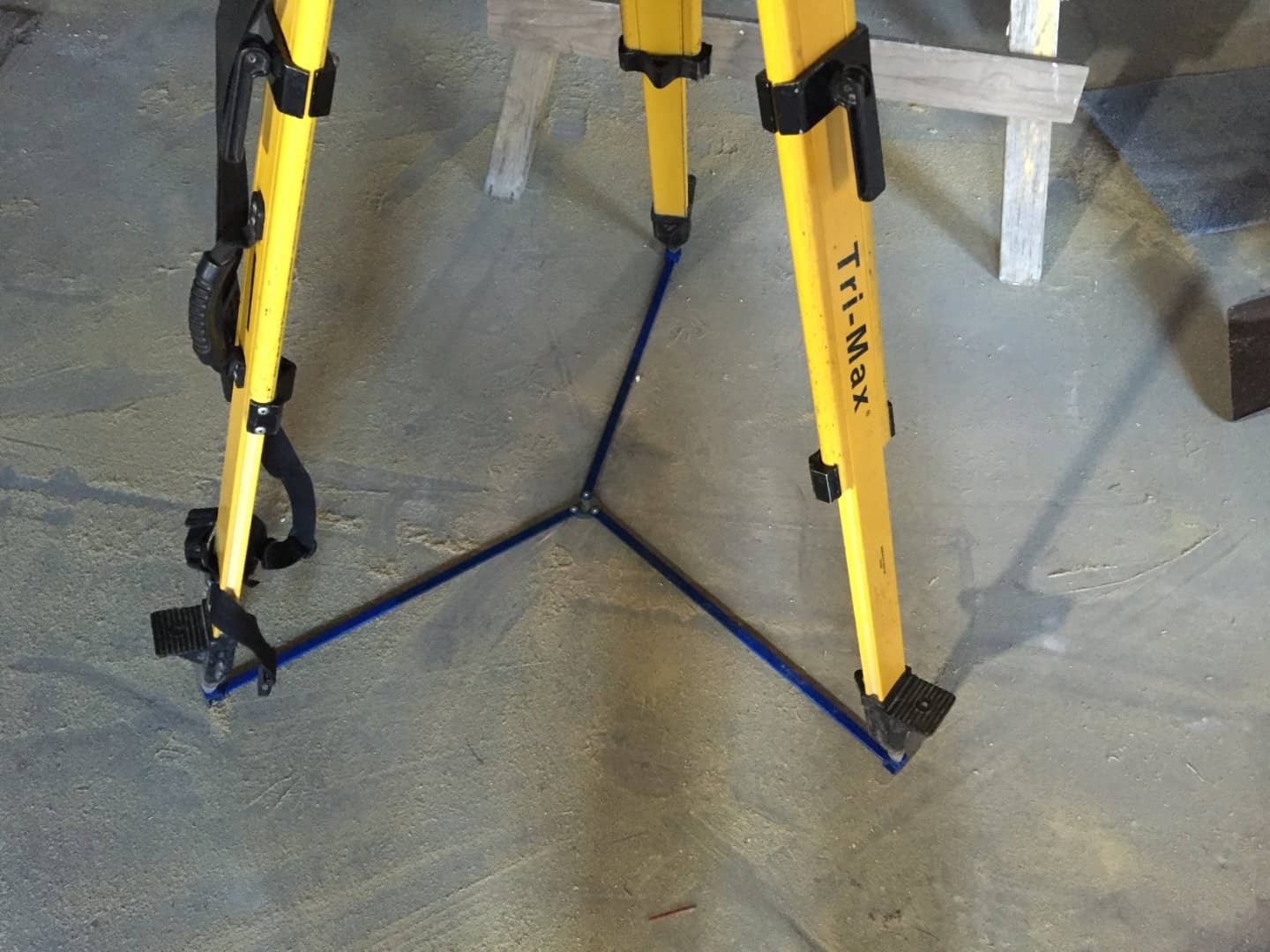
This is what we have which is pretty simple too. There is a central large washer attached to three pieces of flat bar which have small portions of square bar welded on the end. Each piece of square bar has a hole in the top for the leg tips. Each arm swivels about the rivet that holds it to the centre circle so it packs down nicely. One advantage of yours though is that it would be able to be used on uneven floors.
Here is another option that would be ideal for working inside buildings, just wheel it from room to room, no need to tear down and setup each time.
http://www.laserscanning-america.com/laser-scanner-tripod-dolly-080-50007/&apos ;">Tripod on wheels
Seb, post: 378891, member: 7509 wrote: One advantage of yours though is that it would be able to be used on uneven floors.
That's exactly why I made it that way, rather than buy a standard one with fixed bars. You can also pull the feet sideways, so it doesn't have to form an equilateral triangle - useful in tight corners.
The chains will grip quite well, even if they pass over cables and other obstructions. a small downside is that the leg length is fixed.

in addition to suggesting the ease and certainty of static scans, there are a few other less traditional options (without naming makes and models):
portable, handheld LIDAR
close range terrestrial photogrammetry combined with geotagging from a total station control survey
close range terrestrial photogrammetry with push broom LIDAR on a mobile cart setup

Seb, post: 378891, member: 7509 wrote: This is what we have which is pretty simple too. There is a central large washer attached to three pieces of flat bar which have small portions of square bar welded on the end. Each piece of square bar has a hole in the top for the leg tips. Each arm swivels about the rivet that holds it to the centre circle so it packs down nicely. One advantage of yours though is that it would be able to be used on uneven floors.
I have similar setup except mine connected with small chains.
Done a few of these jobs over the past year and they keep coming at us. Level, reflectors, and disto is what we primarily use. Lots of sketches. Like said above one per floor or main room. Break down the high detail small complex places.
Some of the places we had plans for. So we could just check measurements or make a note where something needed fixed. Having the existing old floor plan was easiest on some of these projects.
Time lots of time. Being a place of business or whatever it is. They have schedules and we had to work within in those schedules. Some were ok at 7am others at 7pm. Some required a security guard with us.
They can be a PITA but doing these in the winter I won't complain.