Reading RPLS is free for the whole profession. Members post, reply, and get the members-only rooms.

Notifications
Clear all
Strictly Surveying
18
Posts
13
Users
0
Reactions
2,043
Views

Topic starter
Translate
▼
English
Spanish
French
German
Italian
Portuguese
Russian
Chinese
Japanese
Korean
Arabic
Hindi
Dutch
Polish
Turkish
Vietnamese
Thai
Swedish
Danish
Finnish
Norwegian
Czech
Hungarian
Romanian
Greek
Hebrew
Indonesian
Malay
Ukrainian
Bulgarian
Croatian
Slovak
Slovenian
Serbian
Lithuanian
Latvian
Estonian
I have a closed loop traverse that one of my crews just finished. It was a pretty rough loop, and overall they did pretty good, but when closing out, they ended up crossing their initial backsight line.
Is there a good reference I can use to explain to the crews to explain how crossing traverse lines mess up the geometry? I want to make sure I explain this to my crews other than just because I said to do it this way.
Thanks in advance
Posted : December 20, 2016 10:31 pm

Translate
▼
English
Spanish
French
German
Italian
Portuguese
Russian
Chinese
Japanese
Korean
Arabic
Hindi
Dutch
Polish
Turkish
Vietnamese
Thai
Swedish
Danish
Finnish
Norwegian
Czech
Hungarian
Romanian
Greek
Hebrew
Indonesian
Malay
Ukrainian
Bulgarian
Croatian
Slovak
Slovenian
Serbian
Lithuanian
Latvian
Estonian
We all hope for nice routine shapes and it doesn't always work out that way.
Sometimes getting back to point #1 has to get creative.
I can see crossing previous traverse legs happening and have done it before myself.
The main elements are that you set up on the beginning backsite point and turn the closing angle and reshoot the first leg.
It is all in the closing numbers and the geometric shape should not make any difference in the corrections.
:bomb:
Posted : December 20, 2016 10:39 pm

Translate
▼
English
Spanish
French
German
Italian
Portuguese
Russian
Chinese
Japanese
Korean
Arabic
Hindi
Dutch
Polish
Turkish
Vietnamese
Thai
Swedish
Danish
Finnish
Norwegian
Czech
Hungarian
Romanian
Greek
Hebrew
Indonesian
Malay
Ukrainian
Bulgarian
Croatian
Slovak
Slovenian
Serbian
Lithuanian
Latvian
Estonian
Well, why not just tell them that if you don't begin and end on a line of known azimuth, it is not an adequately closed traverse?
In your case, I assume that the azimuth of the initial backsight line was either known or assumed. A traverse that crosses another line of the same traverse isn't the end of the world in the same way that what is intended to be a closes traverse that doesn't actually end on a point of known coordinates with an angle measured to a line of know azimuth is.
Posted : December 20, 2016 10:41 pm

Translate
▼
English
Spanish
French
German
Italian
Portuguese
Russian
Chinese
Japanese
Korean
Arabic
Hindi
Dutch
Polish
Turkish
Vietnamese
Thai
Swedish
Danish
Finnish
Norwegian
Czech
Hungarian
Romanian
Greek
Hebrew
Indonesian
Malay
Ukrainian
Bulgarian
Croatian
Slovak
Slovenian
Serbian
Lithuanian
Latvian
Estonian
Kent McMillan, post: 405167, member: 3 wrote: Well, why not just tell them that if you don't begin and end on a line of known azimuth, it is not an adequately closed traverse?
In your case, I assume that the azimuth of the initial backsight line was either known or assumed. A traverse that crosses another line of the same traverse isn't the end of the world in the same way that what is intended to be a closes traverse that doesn't actually end on a point of known coordinates with an angle measured to a line of know azimuth is.
Ok. I'll bite. I thought a traverse simply began and ended at the same point...the "POB"; that point not necessarily being on the end of a line of known azimuth. Can't you close a traverse regardless of orientation to the real world? And suppose some other leg in the middle of the traverse is the one you know the azimuth for (like if it's between two known control points way in the "back 40", but for convenience you start and end the traverse at the road to the property).
Posted : December 21, 2016 4:36 am

Translate
▼
English
Spanish
French
German
Italian
Portuguese
Russian
Chinese
Japanese
Korean
Arabic
Hindi
Dutch
Polish
Turkish
Vietnamese
Thai
Swedish
Danish
Finnish
Norwegian
Czech
Hungarian
Romanian
Greek
Hebrew
Indonesian
Malay
Ukrainian
Bulgarian
Croatian
Slovak
Slovenian
Serbian
Lithuanian
Latvian
Estonian
Imagine an extreme case where a long traverse forms a figure 8. The overall closure is acceptable but the relationship between the points on the outbound part and the points on the inbound part will be way out of acceptable limits unless they are tied together in the field and the 2 loops are balanced separately or better yet with least squares.
Posted : December 21, 2016 5:16 am

Translate
▼
English
Spanish
French
German
Italian
Portuguese
Russian
Chinese
Japanese
Korean
Arabic
Hindi
Dutch
Polish
Turkish
Vietnamese
Thai
Swedish
Danish
Finnish
Norwegian
Czech
Hungarian
Romanian
Greek
Hebrew
Indonesian
Malay
Ukrainian
Bulgarian
Croatian
Slovak
Slovenian
Serbian
Lithuanian
Latvian
Estonian
Not sure of their procedure, but this sort of thing seems to only happen when crews don't pre-set their traverse, but create it "on-the-fly", while running the traverse.
Maybe it's me, but I like to, recon, then setup, then run the traverse. It seems to make more sense, you see the site three times, and this type of stuff doesn't seem to happen much.
Plus, you'd hopefully have known about it before actually looking it the data, and thinking, WTF? I don't know about you, but I hate surprises.
Posted : December 21, 2016 6:53 am

Translate
▼
English
Spanish
French
German
Italian
Portuguese
Russian
Chinese
Japanese
Korean
Arabic
Hindi
Dutch
Polish
Turkish
Vietnamese
Thai
Swedish
Danish
Finnish
Norwegian
Czech
Hungarian
Romanian
Greek
Hebrew
Indonesian
Malay
Ukrainian
Bulgarian
Croatian
Slovak
Slovenian
Serbian
Lithuanian
Latvian
Estonian
ImagineOTE="Jimmy Cleveland, post: 405165, member: 91"]I have a closed loop traverse that one of my crews just finished. It was a pretty rough loop, and overall they did pretty good, but when closing out, they ended up crossing their initial backsight line.
Is there a good reference I can use to explain to the crews to explain how crossing traverse lines mess up the geometry? I want to make sure I explain this to my crews other than just because I said to do it this way.
Thanks in advance
Imagine a closed loop traverse shaped like a bowtie. How are you going to balance the interior angles prior to an adjustment? Maybe an open traverse, if you close on a line of know azimuth, would be acceptable.
Posted : December 21, 2016 6:54 am

Translate
▼
English
Spanish
French
German
Italian
Portuguese
Russian
Chinese
Japanese
Korean
Arabic
Hindi
Dutch
Polish
Turkish
Vietnamese
Thai
Swedish
Danish
Finnish
Norwegian
Czech
Hungarian
Romanian
Greek
Hebrew
Indonesian
Malay
Ukrainian
Bulgarian
Croatian
Slovak
Slovenian
Serbian
Lithuanian
Latvian
Estonian
Geometry is geometry, whether lines cross or not, so I do not understand your problem.
How many traverse points did they pass before tying in and how was their closure from and to the tie in point?
You definitely now have to show this traverse so we can understand your consternation.
Paul in PA
Posted : December 21, 2016 7:04 am
Translate
▼
English
Spanish
French
German
Italian
Portuguese
Russian
Chinese
Japanese
Korean
Arabic
Hindi
Dutch
Polish
Turkish
Vietnamese
Thai
Swedish
Danish
Finnish
Norwegian
Czech
Hungarian
Romanian
Greek
Hebrew
Indonesian
Malay
Ukrainian
Bulgarian
Croatian
Slovak
Slovenian
Serbian
Lithuanian
Latvian
Estonian
rfc, post: 405179, member: 8882 wrote: I thought a traverse simply began and ended at the same point.
There are two general categories of traverses: loop traverses and line traverses. A line traverse is simply a series of connected legs going from Point A to Point B. A line traverse is said to be closed if the coordinates of Points A and B are known in relation to each other and the angles measured on the traverse allow the computation of the relative angle between two lines whose azimuths are known in the same coordinate system.
Line traverses are quite common in some types of work, particularly when GPS positioning is avalable, both the determine the relative positions of Points A and B and the azimuths of lines radiating from A and B.
Posted : December 21, 2016 8:03 am
Topic starter
Translate
▼
English
Spanish
French
German
Italian
Portuguese
Russian
Chinese
Japanese
Korean
Arabic
Hindi
Dutch
Polish
Turkish
Vietnamese
Thai
Swedish
Danish
Finnish
Norwegian
Czech
Hungarian
Romanian
Greek
Hebrew
Indonesian
Malay
Ukrainian
Bulgarian
Croatian
Slovak
Slovenian
Serbian
Lithuanian
Latvian
Estonian
Thanks for all of the replies. As it turns out, after I posted this, I looked at the raw data more, and they actually ran through thier initial backsight point, and then added a few intermediate points between his initial backsight, and a point he used to run south along a road.
Here is a picture of the entire loop 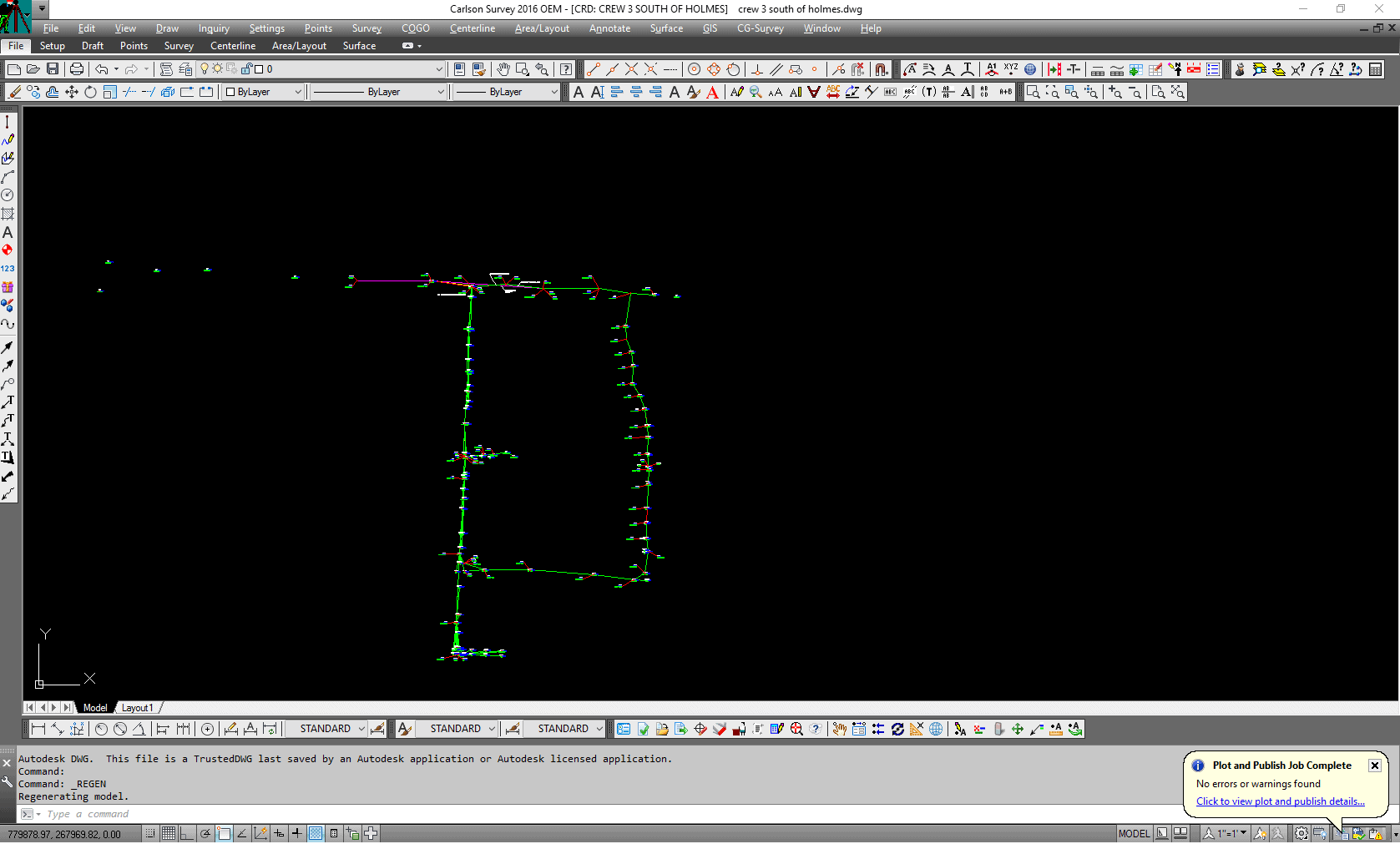
Here is an image of the area where the Party Chief made his error. They are out there now turning a set of angles between 377 and 378 to "close the loop".
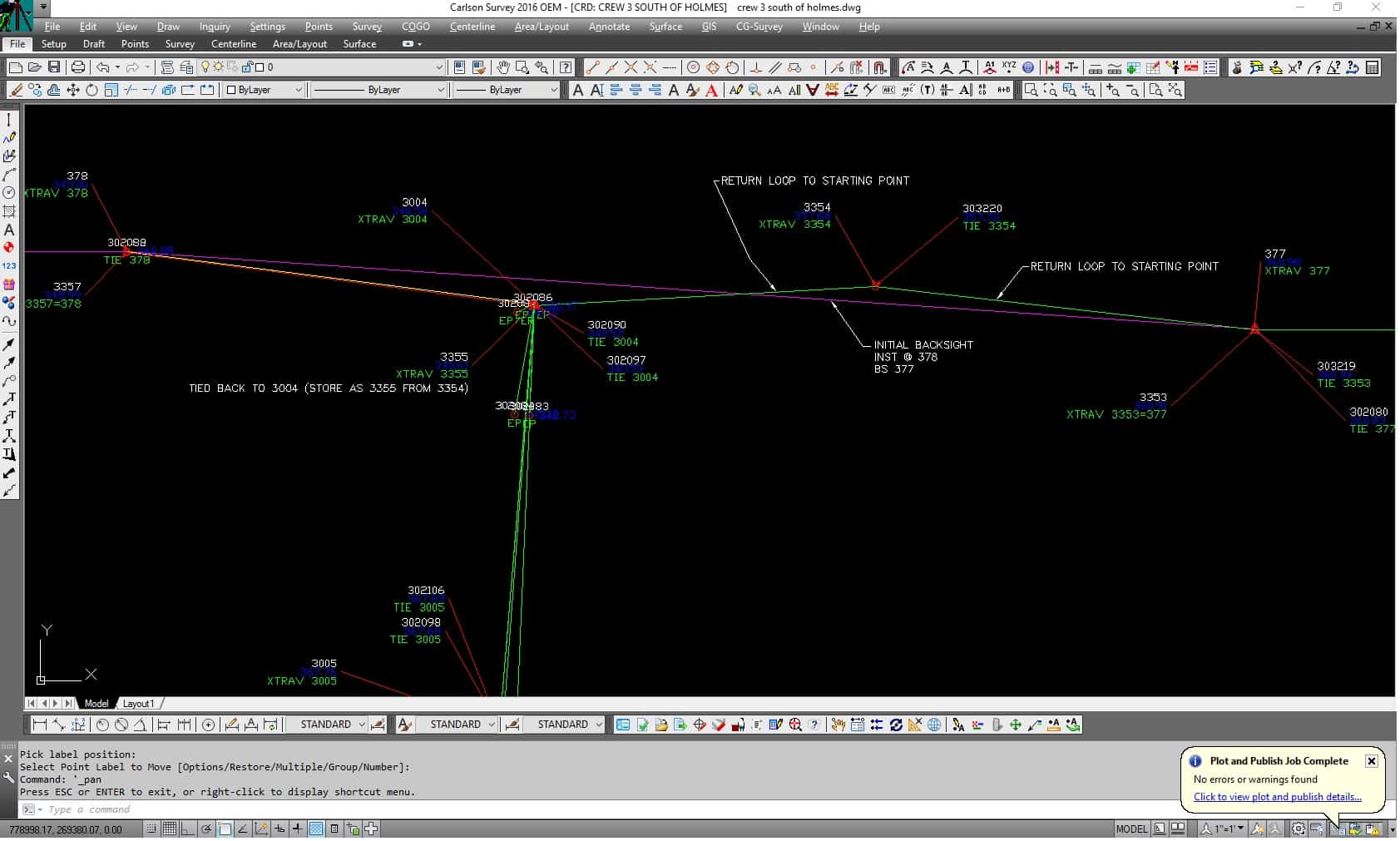
The PC initially set up on 378, BS 377, and turned sets of angles to 3004, and then proceeded to locate the road and run south. As they came back around, they ran through 377 (stored as 3353), and instead of turning sets of angles back to 378, he set 3354, and then occupied it, and "closed into 3004 (stored as 3355), and then turned sets of angles to 378 from 3355. He should have set on 3353, and turned sets of angles directly to 378, and he would have been okay. The geometry isn't that good for that last angle, but it is a tight corridor.
I got the crews together this morning, and went over some stuff with them, and I hope they have a better understanding of how to properly do this now. Rather than chew them out, I tried to use this as a teaching moment, and hopefully they will learn from it.
I will say that they did turn sets to another point running south from 3355, and I "could" close the loop that way, but I need those angles from 377 to 378. Those points came off of another adjusted loop that was ran along the road along the north line of this traverse.
Thanks again for the feedback.
Posted : December 21, 2016 8:26 am

Translate
▼
English
Spanish
French
German
Italian
Portuguese
Russian
Chinese
Japanese
Korean
Arabic
Hindi
Dutch
Polish
Turkish
Vietnamese
Thai
Swedish
Danish
Finnish
Norwegian
Czech
Hungarian
Romanian
Greek
Hebrew
Indonesian
Malay
Ukrainian
Bulgarian
Croatian
Slovak
Slovenian
Serbian
Lithuanian
Latvian
Estonian
If you cross a traverse line and still have a closed loop, the summation of the angles right will equal nX180 where "n" is the number of sides. Something I discovered fiddling around a long time ago. all interior angles without crossing the traverse (n-2)180, all exterior (n+2)180, a traverse crossed with some interior angles and some exterior n*180
Posted : December 21, 2016 9:02 am

Translate
▼
English
Spanish
French
German
Italian
Portuguese
Russian
Chinese
Japanese
Korean
Arabic
Hindi
Dutch
Polish
Turkish
Vietnamese
Thai
Swedish
Danish
Finnish
Norwegian
Czech
Hungarian
Romanian
Greek
Hebrew
Indonesian
Malay
Ukrainian
Bulgarian
Croatian
Slovak
Slovenian
Serbian
Lithuanian
Latvian
Estonian
Tom beat me to it. I think the "reason" is that you want to check the summation of all the interior angles of the closed polygon against the (n - 2) x 180å¡ equation. Not sure it really makes a difference if you check it against the other equation, but I believe that's the reason behind our convention of having non-crossing lines.
As far as RFC said, it is not closing back out to the starting point, but to the starting line. You have to have that redundant angular measurement of turning to the first line again not just the end point. Only then is it considered "closed",
Posted : December 21, 2016 9:11 am
Topic starter
Translate
▼
English
Spanish
French
German
Italian
Portuguese
Russian
Chinese
Japanese
Korean
Arabic
Hindi
Dutch
Polish
Turkish
Vietnamese
Thai
Swedish
Danish
Finnish
Norwegian
Czech
Hungarian
Romanian
Greek
Hebrew
Indonesian
Malay
Ukrainian
Bulgarian
Croatian
Slovak
Slovenian
Serbian
Lithuanian
Latvian
Estonian
Thanks Tom. That is interesting. I think the issue here is that they did not have a set between 377 and 378. That should clear up the problem, at least I hope it does.
Posted : December 21, 2016 9:13 am
Translate
▼
English
Spanish
French
German
Italian
Portuguese
Russian
Chinese
Japanese
Korean
Arabic
Hindi
Dutch
Polish
Turkish
Vietnamese
Thai
Swedish
Danish
Finnish
Norwegian
Czech
Hungarian
Romanian
Greek
Hebrew
Indonesian
Malay
Ukrainian
Bulgarian
Croatian
Slovak
Slovenian
Serbian
Lithuanian
Latvian
Estonian
Jimmy Cleveland, post: 405226, member: 91 wrote: Thanks Tom. That is interesting. I think the issue here is that they did not have a set between 377 and 378. That should clear up the problem, at least I hope it does.
Yes, I was a little confused on the issue @ hand, but I thought I would throw that out there.
Posted : December 21, 2016 10:45 am

Translate
▼
English
Spanish
French
German
Italian
Portuguese
Russian
Chinese
Japanese
Korean
Arabic
Hindi
Dutch
Polish
Turkish
Vietnamese
Thai
Swedish
Danish
Finnish
Norwegian
Czech
Hungarian
Romanian
Greek
Hebrew
Indonesian
Malay
Ukrainian
Bulgarian
Croatian
Slovak
Slovenian
Serbian
Lithuanian
Latvian
Estonian
It's an obsolete concern in some ways. This is the difference between condition equations and observation equations. In the old days there was not enough calculating power to turn the mobius traverse into observation equations so one was stuck with condition equations, the condition that the interior angles of the closed loop add up as the (n - 2) x 180å¡ equation. Modern desktop least squares like star*net turn everything into coordinates and then figure the corrected observations "backwards" from that. Since it's all coordinates the crossing lines are irrelevant and there's no need to go back out to the field unless there is simply not enough redundancy. Five minutes in the office vs. rolling a truck and a crew back out there.
Posted : December 21, 2016 12:19 pm

Translate
▼
English
Spanish
French
German
Italian
Portuguese
Russian
Chinese
Japanese
Korean
Arabic
Hindi
Dutch
Polish
Turkish
Vietnamese
Thai
Swedish
Danish
Finnish
Norwegian
Czech
Hungarian
Romanian
Greek
Hebrew
Indonesian
Malay
Ukrainian
Bulgarian
Croatian
Slovak
Slovenian
Serbian
Lithuanian
Latvian
Estonian
Why would he give a point different numbers? Each station should have one and only one designation.
Other than that I don't see any problem. As half bubble said, using least squares renders many of the old concerns about geometry moot.
Posted : December 21, 2016 12:53 pm

Translate
▼
English
Spanish
French
German
Italian
Portuguese
Russian
Chinese
Japanese
Korean
Arabic
Hindi
Dutch
Polish
Turkish
Vietnamese
Thai
Swedish
Danish
Finnish
Norwegian
Czech
Hungarian
Romanian
Greek
Hebrew
Indonesian
Malay
Ukrainian
Bulgarian
Croatian
Slovak
Slovenian
Serbian
Lithuanian
Latvian
Estonian
John Hamilton, post: 405295, member: 640 wrote: Why would he give a point different numbers? Each station should have one and only one designation.
Other than that I don't see any problem. As half bubble said, using least squares renders many of the old concerns about geometry moot.
If you are using Carlson, which doesn't allow you to call a point what it really is after you have already observed it once, you can use the point number substitution string in Carlson SurvNET to take care of that.
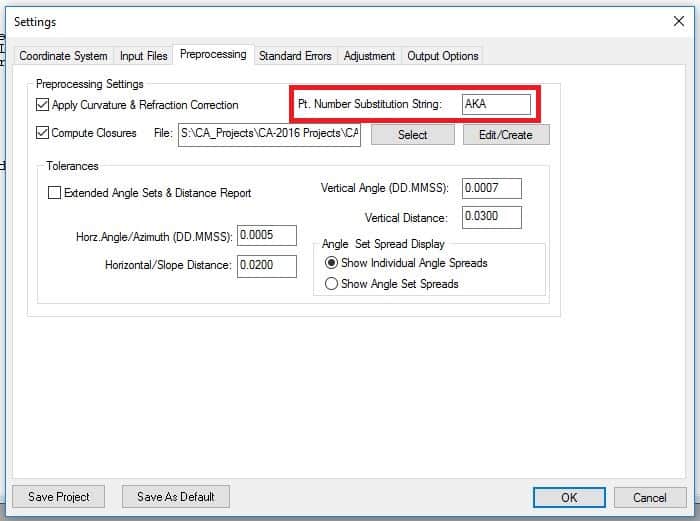
Let's say you are closing onto point number 337, but your next available point number is 3353 to store, just call it AKA337 in the description and SurvNET will make the substitution and will not create a point 3353 in the coordinate file that just clutters things up.
Posted : December 21, 2016 1:51 pm
Translate
▼
English
Spanish
French
German
Italian
Portuguese
Russian
Chinese
Japanese
Korean
Arabic
Hindi
Dutch
Polish
Turkish
Vietnamese
Thai
Swedish
Danish
Finnish
Norwegian
Czech
Hungarian
Romanian
Greek
Hebrew
Indonesian
Malay
Ukrainian
Bulgarian
Croatian
Slovak
Slovenian
Serbian
Lithuanian
Latvian
Estonian
I have seen many people do this, calling points different numbers every time they occupy it, supposedly so they can inverse to see the closure. I don't see the need for that, in my DC it will give me the misclosure whenever there is an existing coordinate. And when doing a least squares adjustment they must have one and only one unique identifier. I get data from others to process and adjust, and I have to spend a significant amount of time figuring out which point names need changed, etc. Fortunately I charge by the hour for that type of work.
Posted : December 21, 2016 2:01 pm