

I would be interested to hear opinions related to what registrants think their Boards thoughts are regarding the inclusion on a sealed document of information derived from persons not under their direct supervision.

The BOR expects that you apply seal to your work.
When you integrate the work of another into your project, you are assuming the liability.
Recently I had a client send me a copy from an unlicensed guy that came out and surveyed 3+ acres and made papers on 1ac severed from the south end.
The guy set new monuments and made a drawing and wrote a property description that had calls ie that stated "to SEC and being 0.03ft north and 0.02ft west of 1/2in rebar with orange cap marked XXXX and #YYYY".
He actually had a signature line that was labeled in red "FOR SURVEYOR'S REVIEW" and a copyright warning.
Still trying to learn the guy's identity and have ask around the local circle with no results to send notice to the BOR.
IMVHO, that is something that is in total violation in every state.
When I locate markings made by a utility location service, it is their liability for any implication that may arise from where they are.
My job is to show if they fall within the record easement.
A few years ago I surveyed a bank site.
There was a recorded sewer line easement with metes and bounds.
I showed the easement and the location of manholes near the north end and near the south end.
They did not fall in the easement and after opening them they were a vertical drop manhole so apparently the pipe was not within the easement either.
That also meant that the line passed under the bank building.
Title Company had a fit and expected me to correct it.
Yeah, nopie not my duty and definitely not my anything I am liable.
I did not make the original survey.
The correct thing to do was have the owner to do the necessary paperwork and create an asbuilt easement and have the utility to terminate the bogus one.
:gammon:

Jim Frame, post: 355245, member: 10 wrote: Quality level D comprises "information derived from existing records or oral recollections," and quality level C incorporates level D. A map marked up by a representative of a utility owner would constitute information derived from existing records, in my opinion.
In any case, I think the "verify" caution in my note provides more realistic protection from liability than does omitting information about the utility entirely. I figure I'm likely to get sued if something goes wrong one way or the other, and I'd rather be able to go into court saying "You were warned" rather than "Well, I didn't think the information available to me would be useful."
I appreciate your take on this and can't say it's wrong. We just have a different comfort level on that manner of info. I would handle it with notations stating that there are underground lines and/or facilities in the particular vicinity on my map, but that the utility company refused to provide field markings or maps.
Someone might ask "what's the difference between another party making field markings and someone making markings on your map?" I agree that it may be a fine distinction, but in the field, the person doing the locating is generally tracing the line via following an electronic or magnetic signal. The person making markings on my map by looking at their map and then drawing on mine may have no sense of scale and may not exercise enough care to make measurements on the maps as opposed to just eyeballing it in.
That's just a little too far out of my comfort range to consider it as having sufficient reliability. If that person wants to ink in a note on my drawing that they placed the markings accurately according to their record maps, sign it and stamp it as someone with some level of authority by position or by state licensing within the utility company, then that would bring it within my comfort zone as I can keep that marked up print as reliable evidence if need be. Un unsigned markup with no indication that it was actually done by appropriate personnel at the utility company does me no good if someone later questions the placement of those particular lines on my map.

I've began contemplating not labeling the lines as gas lines or water lines and just "blue" "yellow" "red" etc. Pertaining to the color markings in the field by the locator. And obv still keeping the disclaimer and who did the mark out on my plat. I also note that states the lines on the plat are only certified as the location of painted lines/flags and not of the utilities themselves.

Rich., post: 355417, member: 10450 wrote: I've began contemplating not labeling the lines as gas lines or water lines and just "blue" "yellow" "red" etc.
One solution is to legend your utility linetypes as "gas paint marks" , "water paint marks", etc.
Exactly. This way I'm not ever locating the utilities. Just locating paint which I can at least guarantee is accurate

Here's the thing about utility paint markings, they're basically raw data with no QA/QC process applied.
There are two main ways to induce current into utilities that are being tracked: 1) direct connection - where a clamp is applied to the utility, and 2) coil induction - where the technician "drops the box" over the suspected utility location and some of the energy emitted by the coils is transferred to the utility and tracked. The problem is that the later is both less precise (if there are multiple utilities in the area you can bleed over into them then wander from one to the other and its weaker so the signal fades faster) and so much easier and faster in the field. That's a dangerous combination.
About a year and a half ago I oversaw the QA/QC for 250,000 linear feet of utility locating pain marks. As a result I have little faith in paint alone (in the slang of the industry "spray and pray") and would no longer recommend one call design ticket level "locating" to a client. When you hire a subsurface utility engineering consultant to designate utilities the process, per the ASCE standards, involves the consultant painting the lines then surveying the paint marks and surface utility features. The consultant then sits down with the surveyed paint and features, plans (design, as-built, or both), and design specs to evaluate all the evidence and develop a professional opinion as to the location of the utilities.

Excavation -- vacuum extraction in particular -- seems to be the most cost-effective way of getting solid locations on underground utilities.
Ever since a particularly expensive break of a 20" chilled water line on a local university campus (my map showed the line using information straight out of the campus GIS, but it turned out to be about 140' wrong), the campus engineers now pothole any critical utility locations prior to finalizing design of new improvements.
eapls2708, post: 355377, member: 589 wrote: We just have a different comfort level on that manner of info.
Understood, and I don't fault anyone for declining to do something just because someone else is okay with it. There's a lot of room for different approaches within the standard of practice.
Jim Frame, post: 355444, member: 10 wrote: Excavation -- vacuum extraction in particular -- seems to be the most cost-effective way of getting solid locations on underground utilities.
Ever since a particularly expensive break of a 20" chilled water line on a local university campus (my map showed the line using information straight out of the campus GIS, but it turned out to be about 140' wrong), the campus engineers now pothole any critical utility locations prior to finalizing design of new improvements.
That's pretty much standard design practice here; plan information at 30% design, Level B designating at 60% to determine potential conflicts, and Level A locating (test holes) at 90% design. Last year when, as a subconsultant to AECOM, I wrote a new Subsurface Utility Engineering chapter for a DOT design manual update and that's the process I laid out as SOP.

Jim Frame, post: 355444, member: 10 wrote: Excavation -- vacuum extraction in particular -- seems to be the most cost-effective way of getting solid locations on underground utilities.
Ever since a particularly expensive break of a 20" chilled water line on a local university campus (my map showed the line using information straight out of the campus GIS, but it turned out to be about 140' wrong), the campus engineers now pothole any critical utility locations prior to finalizing design of new improvements.
I agree, wholeheartedly, that this is a good method. And on my surveys (ALTA or not) that show underground utilities, I always put a statement that explains how the locations were established and shown on my exhibits. I also include a statement that with any work done on the site, the contractor performing the work is responsible for a field verification of the actual utility locations (i.e. potholing) before commencing work.
Sadly, that is rarely done. My topography will be used by some other design firm and when a discrepancy happens, they call me and ask why my drawings "weren't right" even though I put a clear statement on those drawings.

James Fleming, post: 355463, member: 136 wrote: That's pretty much standard design practice here; plan information at 30% design, Level B designating at 60% to determine potential conflicts, and Level A locating (test holes) at 90% design. Last year when, as a subconsultant to AECOM, I wrote a new Subsurface Utility Engineering chapter for a DOT design manual update and that's the process I laid out as SOP.
This is exactly the approach that I propose with my Clients. Test holes can vary in price from $300 to $1K+ a hole. Collecting the data incrementally and analyzing the most cost effective approach as the project develops is the best way to utilize SUE services. I am also in agreement that the only way to know for a fact is to dig it up. One of the biggest problems with SUE is that the designer does not know how to use it.

Tell them you are driving rebar deep into the ground and boom you are an excavator........
Dan Patterson, post: 354726, member: 1179 wrote: They won't do the 811 mark out for us here. If you are not the contractor that is actually about to dig then they don't mark it out.
I agree about going over it with the client and making sure they know what utilities you will be able to show, to what level of detail, and what it's going to be based on.
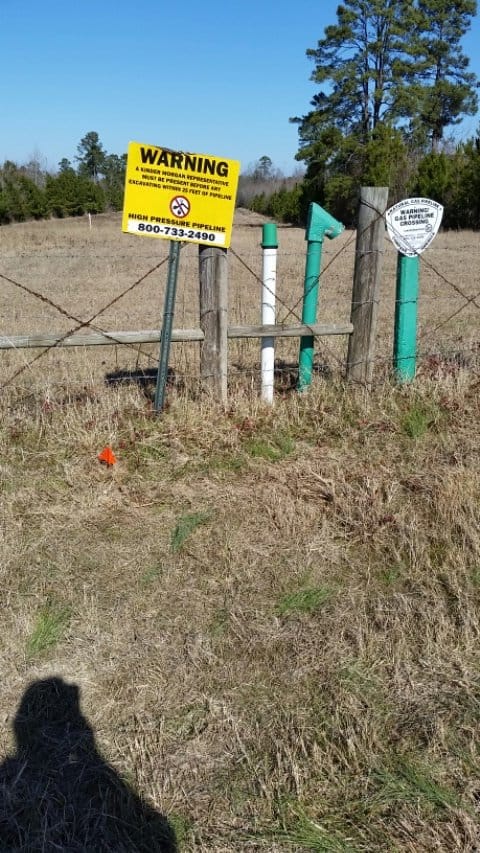
Opps, I set a 30in 1/2in rebar on r/w of TxDot road at the wire flag.
All these 5 pipelines are supposed to be a minimum of 48in underground.
I did stab a fiberglass probe before driving rebar in ground.
Usually I set a 6 1/2ft red tpost at least 2 1/2ft to 4ft deep by my monuments, not here

this issue relevant to 2021 Table A and Item 11 (a) and (b): the changes from 2016 to 2021 now include 11 (b) markings coordinated by the surveyor pursuant to a private utility locate request.
In Virginia, when we make a 811 or Miss Utility request to locate utilities, both public and private utilities are notified and must respond.
Since an 811 call is to mark all underground utilities in a given location, is this also a 'private utility locate request'?
curious what everyone's take is on this

It seems that the concern I had with the language in the 2016 standards was heard, and it has been altered.
For the record, it has been many years since I've actually called One-Call/811. It's a website now. I like that.
It has been taking up to a month after the request for them to get marks down, even though Oregon state law requires them to get it done in 10 days for pre-survey requests.

In my experience 811 locates cover only public or quasi-public utilities such as water, power, gas and sanitary. On-site private utilities such as landscape irrigation, storm drainage and such are not marked and require a private locate service. I routinely utilize private locate services when working on a pre-design project, at the owner's expense, but seldom on a simple ATLA.
The new wording on Table 'A' item 11 is a little vague in the 2021 standards. The 2016 item specifically noted 811 locates while in 2021 it mentions private utility locate requests. The confusing part is the 2021 note to 'clients, insurer and lender' that seems to infer that item 11b refers to 811 calls which are not private locates.
Fun note, neither Washington nor California will locate for pre-design surveys. In Oregon the 811 service is given up to 10 working days to locate for pre-design surveys.
Fun note, neither Washington nor California will locate for pre-design surveys.
I had fair luck getting locates in Clark County, WA while working out of Vancouver - with a Vancouver address and a 360 area code. Oregon people fail to appreciate how deep the resentment is that SW Washington people harbor for Oregonians.
Much as Oregonians do for Californians. We like Californians just fine as long as they confine themselves to California.

Washington's law changed a couple of years ago. Now they will give you a list of utilities but that is it.