Reading RPLS is free for the whole profession. Members post, reply, and get the members-only rooms.


Notifications
Clear all
GNSS & Geodesy
15
Posts
10
Users
0
Reactions
1,604
Views

Topic starter
Translate
▼
English
Spanish
French
German
Italian
Portuguese
Russian
Chinese
Japanese
Korean
Arabic
Hindi
Dutch
Polish
Turkish
Vietnamese
Thai
Swedish
Danish
Finnish
Norwegian
Czech
Hungarian
Romanian
Greek
Hebrew
Indonesian
Malay
Ukrainian
Bulgarian
Croatian
Slovak
Slovenian
Serbian
Lithuanian
Latvian
Estonian
Amazing how many surveyors will do work on a single project for the 10 years or more, and state on the drawings the datums are NAD83 and NAVD88 with coordinates on monuments. But they refuse to run a simple OPUS check. Using OPUS static I often find errors of 1-2ft in horizontal (vertical we always use local BM's). This has happened all over the US, on projects that I visited this year in NJ, MA, GA, and OH. I work for a large environmental company that flies me across the country to setup and verify datums for their GNSS equipment. Often when I bring this up to the original surveyor, they just tell me it's always been that way for years. Appears the project datum was established by NGS monuments or Power Authority monuments years before they had GPS. But in all the cases, either original monuments are gone, or they were never referenced in the control report. I suspect they ran traverse loops via EDM, but never used a CSF, or just never had a good angle closure, or any closure at all. The problem is I am stuck telling the Engineer and my clients that we must stay on this pseudo coordinate system, as we can NOT change all the CAD drawings at this stage of construction. I inform all that a note is required for any future drawings to explain the datum shift. Not sure what else I can do. Looking for a simpler way to explain this to my clients.
Such as:
The original survey was on the wrong datum, but we must note it and continue using the wrong datum, else the engineering drawings need to change.
The real problem exist when the button pushers come along with their Network GNSS system and never check an original control point or monument.
Posted : November 4, 2016 2:20 pm

Translate
▼
English
Spanish
French
German
Italian
Portuguese
Russian
Chinese
Japanese
Korean
Arabic
Hindi
Dutch
Polish
Turkish
Vietnamese
Thai
Swedish
Danish
Finnish
Norwegian
Czech
Hungarian
Romanian
Greek
Hebrew
Indonesian
Malay
Ukrainian
Bulgarian
Croatian
Slovak
Slovenian
Serbian
Lithuanian
Latvian
Estonian
Shifts due to the tectonic plate velocities in California of 1-2 feet in ten years would be expected, especially on the Pacific Plate. For long term projects, the State Plane coordinates, based on NAD83 at the time of the original control survey, become the "project coordinates" from that point through as-builts. Periodic checks need to be done to ensure that differential movement is not occurring, thus degrading the relative accuracy of the control. It is just something we must manage out here and why epoch dates (and meta data) are so important to us.
You are correct that, regardless of how the original coordinates were established, or how poorly they may fit to the reference frame now (or even when established) it is the relative accuracy that is important and the coordinates/pseudo datum must be retained for the life of the project. Either that, or all of the legacy data/maps/etc... need to be brought forward to "correct" a problem that may only be a problem because of more accurate tools and control being available now, versus when the original work was done.
I would be careful stating that the original work was "on the wrong datum", when it fact, it may have been referenced to the correct datum with the best available control, methods, and tools at the time. There are several flavors of NAD83, and some of the shifts between flavors have been substantial, especially between NAD83(1986) and NAD83(HARN).
I would simply report the differences between the original "NAD83" positions and those determined using NAD83(2011)2010.00 and let them know that all subsequent work needs continue to be done on the project coordinates, not on the current version of NAD83 (and assumedly the State Plane Coordinate derivative thereof) using CORS, OPUS, or whatever.
My 2 cents for a Friday.
Posted : November 4, 2016 2:47 pm

Translate
▼
English
Spanish
French
German
Italian
Portuguese
Russian
Chinese
Japanese
Korean
Arabic
Hindi
Dutch
Polish
Turkish
Vietnamese
Thai
Swedish
Danish
Finnish
Norwegian
Czech
Hungarian
Romanian
Greek
Hebrew
Indonesian
Malay
Ukrainian
Bulgarian
Croatian
Slovak
Slovenian
Serbian
Lithuanian
Latvian
Estonian
SPMPLS, post: 398485, member: 11785 wrote: I would be careful stating that the original work was "on the wrong datum", when it fact, it may have been referenced to the correct datum with the best available control, methods, and tools at the time. There are several flavors of NAD83, and some of the shifts between flavors have been substantial, especially between NAD83(1986) and NAD83(HARN).
What he said. Depending on when the control was set, it absolutely could have been correct and as good as it was possible to do at the time.
Posted : November 4, 2016 2:50 pm
Translate
▼
English
Spanish
French
German
Italian
Portuguese
Russian
Chinese
Japanese
Korean
Arabic
Hindi
Dutch
Polish
Turkish
Vietnamese
Thai
Swedish
Danish
Finnish
Norwegian
Czech
Hungarian
Romanian
Greek
Hebrew
Indonesian
Malay
Ukrainian
Bulgarian
Croatian
Slovak
Slovenian
Serbian
Lithuanian
Latvian
Estonian
I am not sure if you are licensed in all of the states you mentioned, but if your company flew you to California to do what you described, and you called the original surveyor to tell them that their work was "on the wrong datum" according to your OPUS static solution, the first thing you would be asked is if you are licensed California PLS (at least I would ask you that). If not, you would be practicing without a license. Setting geodetic control and/or using or establishing California State Plane Coordinates constitutes land surveying here. Movement in positions over time, relative to the reference frame, is the norm on the west coast, as is understanding the various versions of the reference frame itself, as realized on the ground.
Posted : November 4, 2016 3:08 pm

Translate
▼
English
Spanish
French
German
Italian
Portuguese
Russian
Chinese
Japanese
Korean
Arabic
Hindi
Dutch
Polish
Turkish
Vietnamese
Thai
Swedish
Danish
Finnish
Norwegian
Czech
Hungarian
Romanian
Greek
Hebrew
Indonesian
Malay
Ukrainian
Bulgarian
Croatian
Slovak
Slovenian
Serbian
Lithuanian
Latvian
Estonian
It may very well be NAD83 (1986) and be accurate with respect to that system.
I have been doing GPS since 1986. We did GPS networks at first on NAD27, then we did a lot of projects on NAD83 (now called NAD83 (86)). We had to use triangulation stations for control. Not until HARN came along in the early 90's did we start using a more "correct" version of NAD83.
In a lot of cases (most of the time) the GPS was more accurate than the control. That was fine in a small area, but once you started covering larger areas, and including multiple triangulation stations, it became very noticeable. Especially if the triangulation stations were not directly connected or were from different chains. I used to always solve for a scale and rotation between the control and the GPS, and put that in the report. It made it all fit better, but did result in some biases.
Posted : November 4, 2016 3:11 pm
Topic starter
Translate
▼
English
Spanish
French
German
Italian
Portuguese
Russian
Chinese
Japanese
Korean
Arabic
Hindi
Dutch
Polish
Turkish
Vietnamese
Thai
Swedish
Danish
Finnish
Norwegian
Czech
Hungarian
Romanian
Greek
Hebrew
Indonesian
Malay
Ukrainian
Bulgarian
Croatian
Slovak
Slovenian
Serbian
Lithuanian
Latvian
Estonian
SPMPLS, post: 398485, member: 11785 wrote: Shifts due to the tectonic plate velocities in California of 1-2 feet in ten years would be expected, especially on the Pacific Plate. For long term projects, the State Plane coordinates, based on NAD83 at the time of the original control survey, become the "project coordinates" from that point through as-builts. Periodic checks need to be done to ensure that differential movement is not occurring, thus degrading the relative accuracy of the control. It is just something we must manage out here and why epoch dates (and meta data) are so important to us.
You are correct that, regardless of how the original coordinates were established, or how poorly they may fit to the reference frame now (or even when established) it is the relative accuracy that is important and the coordinates/pseudo datum must be retained for the life of the project. Either that, or all of the legacy data/maps/etc... need to be brought forward to "correct" a problem that may only be a problem because of more accurate tools and control being available now, versus when the original work was done.
I would be careful stating that the original work was "on the wrong datum", when it fact, it may have been referenced to the correct datum with the best available control, methods, and tools at the time. There are several flavors of NAD83, and some of the shifts between flavors have been substantial, especially between NAD83(1986) and NAD83(HARN).
I would simply report the differences between the original "NAD83" positions and those determined using NAD83(2011)2010.00 and let them know that all subsequent work needs continue to be done on the project coordinates, not on the current version of NAD83 (and assumedly the State Plane Coordinate derivative thereof) using CORS, OPUS, or whatever.
My 2 cents for a Friday.[/QUOTE
SPMPLS,
We done projects in California, never had a problem there. Not sure why. We always hire a local PLS, often required for each project. They do original control along with QA/QC through out project. I'm there to setup the equipment and provide assistance in communication between Surveyors, Engineering, and Contractors. There are only a hand full of companies in the US that do this time of environmental clean up work.
Posted : November 4, 2016 4:36 pm

Translate
▼
English
Spanish
French
German
Italian
Portuguese
Russian
Chinese
Japanese
Korean
Arabic
Hindi
Dutch
Polish
Turkish
Vietnamese
Thai
Swedish
Danish
Finnish
Norwegian
Czech
Hungarian
Romanian
Greek
Hebrew
Indonesian
Malay
Ukrainian
Bulgarian
Croatian
Slovak
Slovenian
Serbian
Lithuanian
Latvian
Estonian
I live in a stable area but 40 miles from the nearest NGS station that has both classical NAD83(86) and any form of GPS data on the data sheet. OPUS-derived NAD83(2011 epoch 2010.0) coordinates of point around here seem to be most of a foot off of what GEOCON would predict.
Posted : November 4, 2016 5:03 pm
Translate
▼
English
Spanish
French
German
Italian
Portuguese
Russian
Chinese
Japanese
Korean
Arabic
Hindi
Dutch
Polish
Turkish
Vietnamese
Thai
Swedish
Danish
Finnish
Norwegian
Czech
Hungarian
Romanian
Greek
Hebrew
Indonesian
Malay
Ukrainian
Bulgarian
Croatian
Slovak
Slovenian
Serbian
Lithuanian
Latvian
Estonian
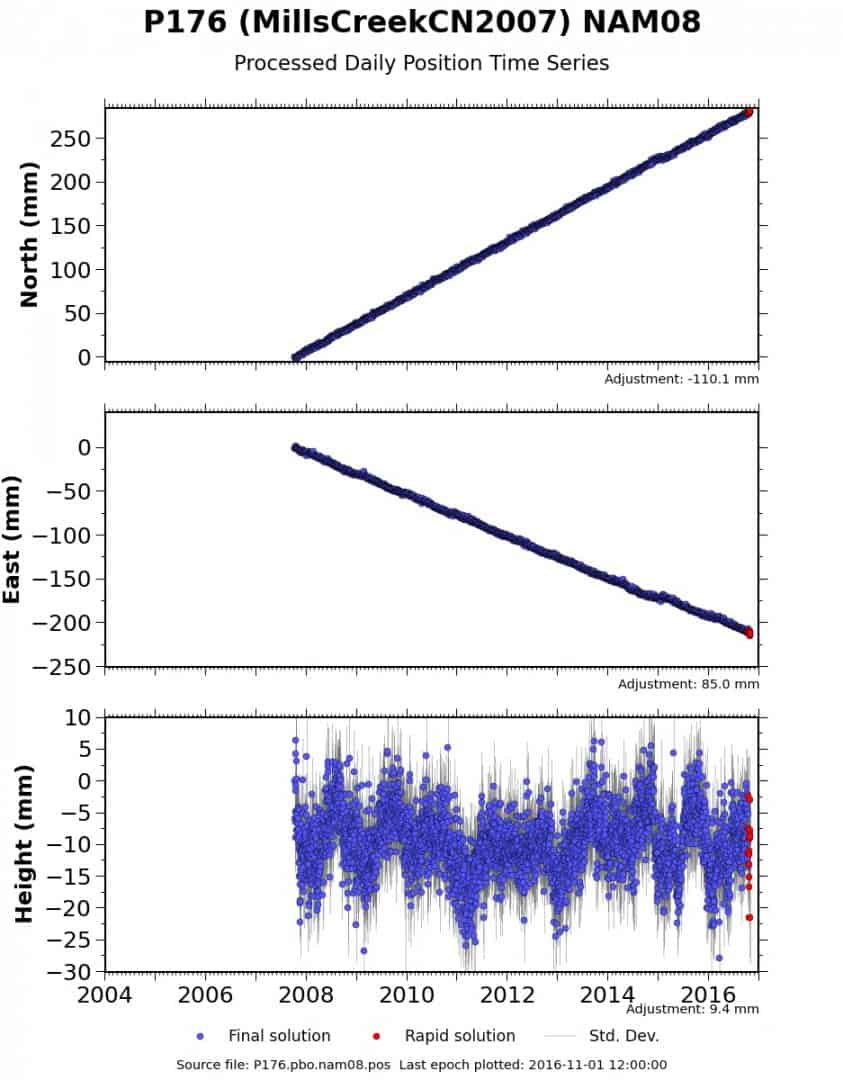
Here is a time series plot from a continuous GPS station that is on the Pacific Plate. You can see how fast and far it has moved in a northwesterly (negative east) direction relative to the reference frame. Even projects that only take a few years from start to finish in an area like this will have significant changes in the position of the control in that time. That is why we have to lock the project coordinates down to the date they were established, basically an epoch date, and manage the control over the life of the project to make sure it isn't breaking down, in a relative sense.
Posted : November 4, 2016 5:20 pm

Translate
▼
English
Spanish
French
German
Italian
Portuguese
Russian
Chinese
Japanese
Korean
Arabic
Hindi
Dutch
Polish
Turkish
Vietnamese
Thai
Swedish
Danish
Finnish
Norwegian
Czech
Hungarian
Romanian
Greek
Hebrew
Indonesian
Malay
Ukrainian
Bulgarian
Croatian
Slovak
Slovenian
Serbian
Lithuanian
Latvian
Estonian
Project control values supercede any newer realization. Using OPUS can cause all kinds of havoc.
Posted : November 4, 2016 5:44 pm
Topic starter
Translate
▼
English
Spanish
French
German
Italian
Portuguese
Russian
Chinese
Japanese
Korean
Arabic
Hindi
Dutch
Polish
Turkish
Vietnamese
Thai
Swedish
Danish
Finnish
Norwegian
Czech
Hungarian
Romanian
Greek
Hebrew
Indonesian
Malay
Ukrainian
Bulgarian
Croatian
Slovak
Slovenian
Serbian
Lithuanian
Latvian
Estonian
I checked the California projects. They were both on assumed coordinates, not SPC.
I can understand the shifts on the west coast, but I doubt the projects I encountered on the East Coast have that much movement.
All I can do is note the datum differences, and help to avoid future problems. At some point there may be no original control points left on a construction project. I feel an OPUS solution with the noted reference frame is a suitable method to re-establish the datum in the future. We can use the velocity tables as shown above to calculate the datum shift.
Posted : November 5, 2016 6:51 am

Translate
▼
English
Spanish
French
German
Italian
Portuguese
Russian
Chinese
Japanese
Korean
Arabic
Hindi
Dutch
Polish
Turkish
Vietnamese
Thai
Swedish
Danish
Finnish
Norwegian
Czech
Hungarian
Romanian
Greek
Hebrew
Indonesian
Malay
Ukrainian
Bulgarian
Croatian
Slovak
Slovenian
Serbian
Lithuanian
Latvian
Estonian
SPMPLS, post: 398512, member: 11785 wrote: Even projects that only take a few years from start to finish in an area like this will have significant changes in the position of the control in that time.
SPMPLS:
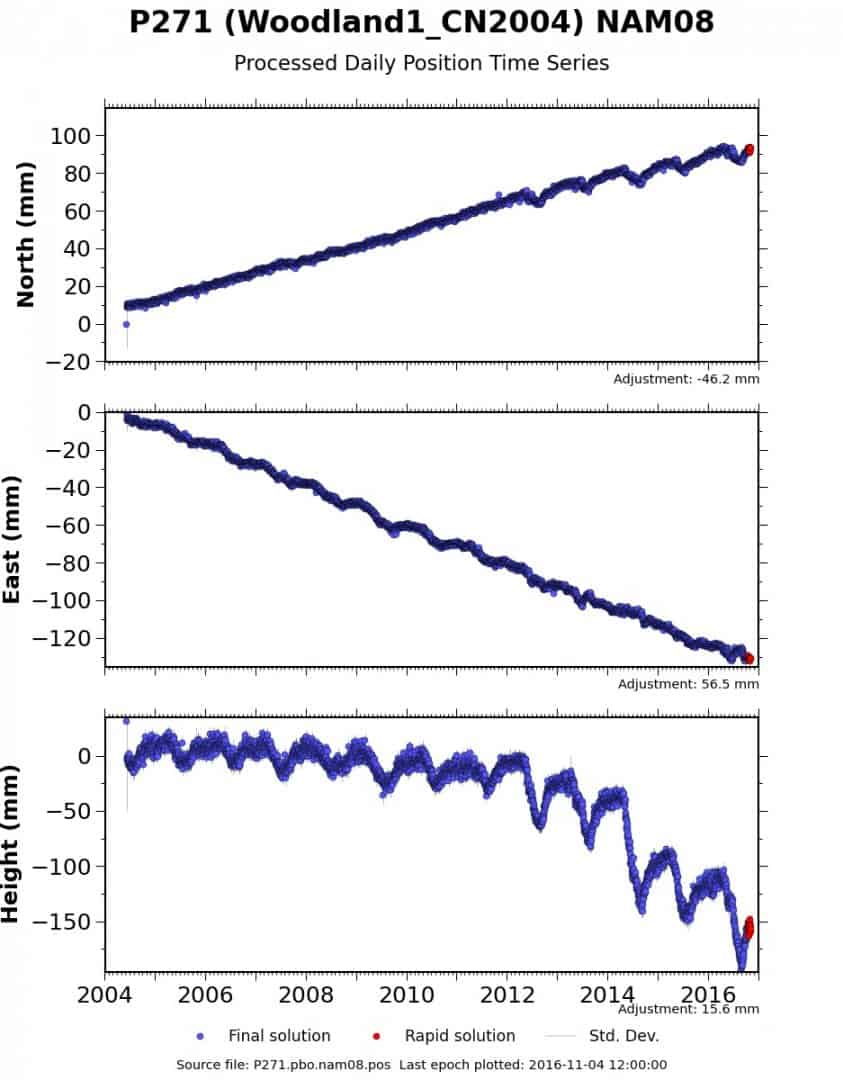
Don't want to take the thread too far off topic, but can you explain what the cyclical nature of the elevation means? It looks like there are actually two harmonics, one annual and another about every 10 years or so.
Posted : November 6, 2016 6:52 am
Translate
▼
English
Spanish
French
German
Italian
Portuguese
Russian
Chinese
Japanese
Korean
Arabic
Hindi
Dutch
Polish
Turkish
Vietnamese
Thai
Swedish
Danish
Finnish
Norwegian
Czech
Hungarian
Romanian
Greek
Hebrew
Indonesian
Malay
Ukrainian
Bulgarian
Croatian
Slovak
Slovenian
Serbian
Lithuanian
Latvian
Estonian
The "pattern" in the vertical component is primarily a seasonal influence. However, if you look at the scale, the low to high range is only about 30 mm, which is much less than for stations located in the valley areas (agriculture production) of California. Below is a time series plot for a station just northwest of Sacramento. Although hard to tell because of the scale, the seasonal range is about 4-5 cm from low to high, with a slight downward trend between 2004 and 2012. We entered into the now 5-6 year drought in about 2011, so the influence of the additional ground water pumping induced by the drought is seen in the sharp downward decline (subsidence) and more drastic seasonal highs and lows. There are some stations in the San Joaquin Valley where this is even more pronounced. So, not only do we have to account for the ever-present horizontal velocities, we also have to be aware of the possibility of downward movement in our control. Even in non-drought conditions, networks that are re-surveyed periodically (typical to monitor subsidence) are done at the same time of year each time, to help remove the seasonal noise in the vertical. If you look at the north plot, you will see a correlation between where is starts getting "bumpy" and the vertical plot below. When the vertical changes are extreme, they influence the horizontal position as well.
Posted : November 7, 2016 8:47 am

Translate
▼
English
Spanish
French
German
Italian
Portuguese
Russian
Chinese
Japanese
Korean
Arabic
Hindi
Dutch
Polish
Turkish
Vietnamese
Thai
Swedish
Danish
Finnish
Norwegian
Czech
Hungarian
Romanian
Greek
Hebrew
Indonesian
Malay
Ukrainian
Bulgarian
Croatian
Slovak
Slovenian
Serbian
Lithuanian
Latvian
Estonian
P271 is nearby and I use it a lot, but I *never* constrain it. During the 2014 drop shown in the plot above, the cluster of wells on a nearby ranch that were pumping water for a large-scale water sale (groundwater was being substituted for river water that was sold to a downstream buyer) was less than 3 miles from P271. The rebound was only partial, indicating permanent partial collapse of the aquifer. The 2014 drop was dramatic enough that pumping for a 2015 sale was distributed across a more widespread network of wells.
I'm not sure what's behind the 2016 drop. The nearby ranch didn't sell any water in 2016, so something else must be going on.
Posted : November 7, 2016 9:26 am

Translate
▼
English
Spanish
French
German
Italian
Portuguese
Russian
Chinese
Japanese
Korean
Arabic
Hindi
Dutch
Polish
Turkish
Vietnamese
Thai
Swedish
Danish
Finnish
Norwegian
Czech
Hungarian
Romanian
Greek
Hebrew
Indonesian
Malay
Ukrainian
Bulgarian
Croatian
Slovak
Slovenian
Serbian
Lithuanian
Latvian
Estonian
I ran into this the other day. The plant was off SW 63'. I suspect either control was established by a TDOT monument and they didn't know about the DA factor on the coordinates or it could have started as a scaled NAD 27 (which was probably OK at the time) and then the next consultant did a corpscon adjustment. This is why control still needs to be set on every job so it can be reproduced years later.
Posted : November 8, 2016 2:04 pm

Translate
▼
English
Spanish
French
German
Italian
Portuguese
Russian
Chinese
Japanese
Korean
Arabic
Hindi
Dutch
Polish
Turkish
Vietnamese
Thai
Swedish
Danish
Finnish
Norwegian
Czech
Hungarian
Romanian
Greek
Hebrew
Indonesian
Malay
Ukrainian
Bulgarian
Croatian
Slovak
Slovenian
Serbian
Lithuanian
Latvian
Estonian
leegreen, post: 398553, member: 2332 wrote: I checked the California projects. They were both on assumed coordinates, not SPC.
I can understand the shifts on the west coast, but I doubt the projects I encountered on the East Coast have that much movement.
All I can do is note the datum differences, and help to avoid future problems. At some point there may be no original control points left on a construction project. I feel an OPUS solution with the noted reference frame is a suitable method to re-establish the datum in the future. We can use the velocity tables as shown above to calculate the datum shift.
As John pointed out, the shift between the various realizations of NAD83 can be extreme and using the current velocities to predict the old values may not be a good option. Take the original NAD83 aka NAD83[86], I believe it was established without the use of any GPS observations. For the most part it was primarily a re-adjustment of triangulation data with some long base line work thrown into the mix and It is never going to fit within the current realizations with any accuracy. Oregon and Washington were lucky enough to have one of the first HARN, NAD83[91], with observations made in 1989. By the time the HARN was completed for the rest of the US it was determined that our original data was not sufficient for the first nation adjustment in 1998, the GPS constellation and equipment had been upgraded considerably since 1989. The differences between NAD83[91] and NAD83[98] were significant and unevenly spread out. Simply using the predicted velocities will not get you from 98 to 91.
Posted : November 22, 2016 5:07 pm