

Dave Karoly, post: 357580, member: 94 wrote: It's a coordinate system, not a religion.
All you have to do is get close enough for practical purposes.
Sounds like my kind of religion, close enough.

What Brad Ott said, more or less!

The locations I've been recording over the county as WGS84 using TxDot downloads and GNSS Solutions have been checked against OPUS with a consistent N72å¡å±E, 2meter difference according to the operator that did the checking.
I can live with that for what I am using GPS for, to land survey and keep my assorted networks tied together.

WGD, post: 357583, member: 8001 wrote: My first day ever in surveying I was told "the measure of a good surveyor is knowing how accurate he needs to be".
But you may later find that the question should have been "how accurate will it eventually need to be?" There are times a little overkill in the original work can save redoing it as new uses are found for the data.

Re accuracy etc. I'm not sure exactly what the original intention was meant to represent, but for me it sat well with me, but 'on my terminology', which has been picked up on and elaborated.
I (99.99%) of the time survey to an accuracy that I could safely go back and not have to repeat things due to sloppy, loosen or other methods.
But the reality is if I need to define the outcome to a client I wouldn't state mm's when they are say asking distance to the nearest house, driveway, or the length of a fence to enable purchase of materials etc. That, to me, would sound a Smart Alec response from "an expert in surveying".
I've been a firm believer of (generally) over survey a site. That's grown from years of 'Oh can you just go back and measure.... "
Questioning the client and perceiving needs can give an outcome far more satisfactory than returning for something later and taking more (paid) time up.
Somehow not sure that still fits in with' mythology of ground coordinates'?

In the "newbie" thread I have related my current project where I'm tying into a total of nine subdivisions in a very small area. Experience has taught me that it is wise to solve as many mysteries as possible at the same time even though I may be eating the time and expense for the "overkill". After 30 years of risking my own neck doing this, I can't count the number of times I have had a new project fall such that I need to tie into monuments from one or more prior projects. My new project SHOULD agree with the assumptions that I used on the previous projects. For example, if I did a proportion along a line in the past I don't want to be finding evidence today that dictates a different interpretation which would change how I would have set those old points if I had only known then what I know now.
How close IS close enough? Sometimes it's in the procedure, not the measurements.

A Harris, post: 357740, member: 81 wrote: The locations I've been recording over the county as WGS84 using TxDot downloads and GNSS Solutions have been checked against OPUS with a consistent N72å¡å±E, 2meter difference according to the operator that did the checking.
I can live with that for what I am using GPS for, to land survey and keep my assorted networks tied together.
I can't help myself...I have to ask:
WGS84???
WHY and HOW?
Also, I get ~1 meter S50å¡E and 1 meter UP between IGS08 (essentially WGS84(1674) to NAD83 in NE Texas.
Loyal
gschrock, post: 357802, member: 556 wrote: We get about 4.3' Hz and 1/3' V up here. Dru Smith had a slide (generalized) of the expected shifts from NAD83 - IGS/ITRF/WGS-ish in Friday's seminar (will get the whole thing posted soon).
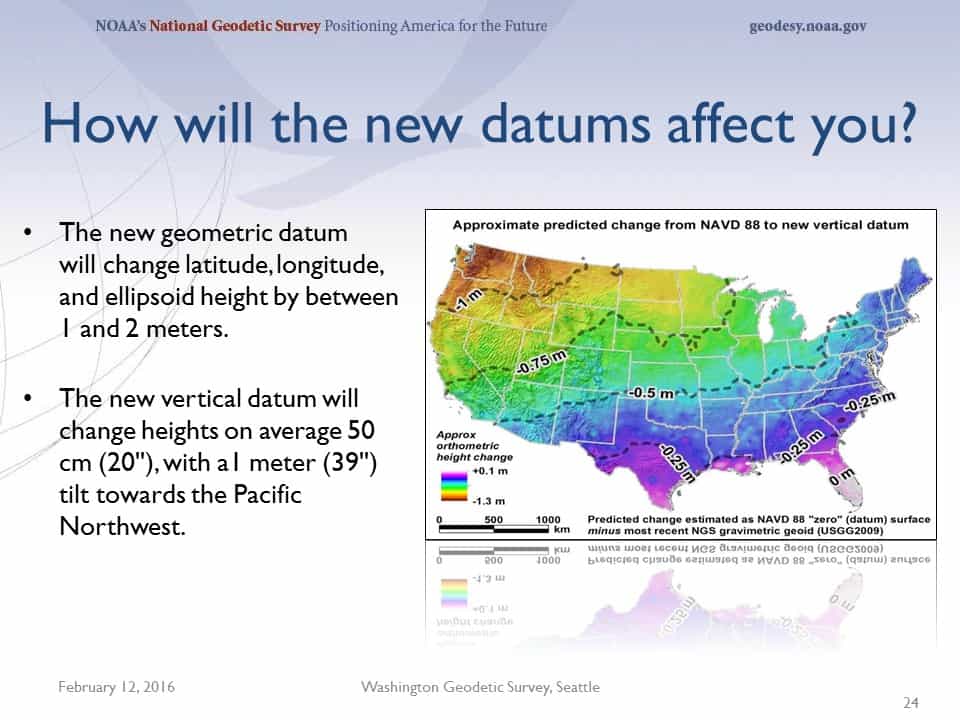
Gavin,
Yeah...I've followed the "NEW-NAD" pretty close for the last few years, personally...I can't [hardly] wait!
Interestingly, I participated in a Control Survey in Northwestern Utah last Fall, and the "predicted NEW-NAVD" numbers are quite close to the NGVD29 values. That's going to confuse some folks in a few years...
B-)
Loyal

Loyal, post: 357806, member: 228 wrote: the "predicted NEW-NAVD" numbers are quite close to the NGVD29 values.

When I began using Surveying Grade GPS the process of scale factor and ground to grid and such became impractical after I set my receivers to show the results in WGS84 and setting the datum as WGS84. After all, WGS84 was what my sport grade units were recording and what unit I was locating points from USGS Topo Maps and Google Earth and going into the field to look for. I was also plotting recorded points on these maps and sending to clients for updates on projects so they could have a map of showing where to look.
The results became that what I was locating on the ground with the TS with the data collector set for EC (earth curvature) correction as compared to what I was gathering with my PM3s using TxDot downloads and processing with GNSS Solutions were producing coordinate values that were practically the same and within 0.02å± ft horizontal.
I can live with that and it is very simple and all I need to do is convert Lats and Long to a working coordinate file for download into COGO.
Others in the area put everything on SP or UTM Zone 15 and run everything thru OPUS.
I keep going out on projects that have been surveyed by several different users of RTK systems and while they submit results that the distances are always equal between monuments, their resulting bearings are 1å¡30'å± different while they claim to be using the same basis of control. That is a lot of difference.
0.02
A Harris, post: 357809, member: 81 wrote: When I began using Surveying Grade GPS the process of scale factor and ground to grid and such became impractical after I set my receivers to show the results in WGS84 and setting the datum as WGS84. After all, WGS84 was what my sport grade units were recording and what unit I was locating points from USGS Topo Maps and Google Earth and going into the field to look for. I was also plotting recorded points on these maps and sending to clients for updates on projects so they could have a map of showing where to look.
The results became that what I was locating on the ground with the TS with the data collector set for EC (earth curvature) correction as compared to what I was gathering with my PM3s using TxDot downloads and processing with GNSS Solutions were producing coordinate values that were practically the same and within 0.02å± ft horizontal.
I can live with that and it is very simple and all I need to do is convert Lats and Long to a working coordinate file for download into COGO.
Others in the area put everything on SP or UTM Zone 15 and run everything thru OPUS.
I keep going out on projects that have been surveyed by several different users of RTK systems and while they submit results that the distances are always equal between monuments, their resulting bearings are 1å¡30'å± different while they claim to be using the same basis of control. That is a lot of difference.
0.02
Interesting, thanks for the explanation Mr. Harris.
Loyal

Robert Frost already covered this subject:
If I was to build a combined factor
I'd ask to know what I was scaling up and scaling down
And when I reach the intersection of the planes
I'd take the planar route less travelled.

Loyal, post: 357806, member: 228 wrote: Gavin,
Yeah...I've followed the "NEW-NAD" pretty close for the last few years, personally...I can't [hardly] wait!
Interestingly, I participated in a Control Survey in Northwestern Utah last Fall, and the "predicted NEW-NAVD" numbers are quite close to the NGVD29 values. That's going to confuse some folks in a few years...
B-)
Loyal
The 29 numbers got raised by 2.3-2.5 feet here. the predicted new numbers go lower by a bit over 2 feet.
We are putting together a survey for a chain store in a subdivision we did about 10 years ago with lots of flat "wet" lands near a creek.
10 years ago the FEMA maps were still based on NGVD29 with really good control so that's what the subdivision got.
Then a couple of years ago they finally got the new flood maps released so they are NAVD88 and this ALTA is "bumped" up 2.34'
Probably if a store goes in next door to this one in a few years, maybe just go back to the older drawings, so much fun.
But my guess is because of how difficult these FEMA maps were to get done, NAVD88 is going to be around for a long time.
MightyMoe, post: 357832, member: 700 wrote: NAVD88 is going to be around for a long time.
I hear ya Mighty!
I still work on projects that are expressed in NAD27 and/or NGVD29, and don't expect most of those to jump on the next datum either. The really fun ones are those (oh so many) burgs where the entire infrastructure is based on the Elevation STAMPED on the Brass Cap in the Court House Steps, which is rarely (if ever) the same as the adjusted Official Value (of which there may be MANY).
BUT...it works, ain't broke, and should NOT be fixed by some expert measurer with a shiny new Black Box.
🙂
Loyal

Bill93, post: 357744, member: 87 wrote: But you may later find that the question should have been "how accurate will it eventually need to be?" There are times a little overkill in the original work can save redoing it as new uses are found for the data.
That's part of knowing how accurate you need to be, IMHO.

Loyal, post: 357837, member: 228 wrote: I hear ya Mighty!
I still work on projects that are expressed in NAD27 and/or NGVD29, and don't expect most of those to jump on the next datum either. The really fun ones are those (oh so many) burgs where the entire infrastructure is based on the Elevation STAMPED on the Brass Cap in the Court House Steps, which is rarely (if ever) the same as the adjusted Official Value (of which there may be MANY).
BUT...it works, ain't broke, and should NOT be fixed by some expert measurer with a shiny new Black Box.
🙂
Loyal
This is exactly the issue that I am challenged by on a regular basis. We'll have a client that will have our firm do a civil plan set for their little commercial development. So we topo the site, engineering designs the plans, and then we go stake them. As every good surveyor knows, an elevation (for a local site) is pretty much completely arbitrary. You can call the elevation on the reference point 100.00, 103.275, or 999.00. As long as everything is correctly referenced from that point, it will all be fine.
Most projects simply aren't of a large enough scale that they need to be precisely on NAVD88 or NGVD29 or whatever "BFDatum" one wants to use.