

"....but the contrary may be shown."

Tom Adams, post: 440759, member: 7285 wrote: "....but the contrary may be shown."
That would be in a situation where the entire portion was conveyed from one adjacent landowner - or portions of varying widths from adjoiners.

James Fleming, post: 440737, member: 136 wrote: Ye Olde Common Law (Codified here in 1892)
REAL PROPERTY
TITLE 2. RULES OF CONSTRUCTION
Md. REAL PROPERTY Code Ann. ?? 2-114 (2017)
?? 2-114. Title to street or highway where land binding on it is granted(a) In general. -- Except as otherwise provided, any deed, will, or other instrument that grants land binding on any street or highway, or that includes any street or highway as 1 or more of the lines thereof, shall be construed to pass to the devisee, donee, or grantee all the right, title, and interest of the devisor, donor, or grantor (hereinafter referred to as the transferor) in the street or highway for that portion on which it binds.
(b) Property on opposite sides of street. -- If the transferor owns other land on the opposite side of the street or highway, the deed, will, or other instrument shall be construed to pass the right, title, and interest of the transferor only to the center of that portion of the street or highway upon which the 2 or more tracts coextensively bind.
(c) Exception. -- The provisions of subsections (a) and (b) of this section do not apply if the transferor in express terms in the writing by which the devise, gift, or grant is made, either reserves to the transferor or grants to the transferee all the right, title, and interest to the street or highway.
James and Warren: Are taxes assessed based on this concept?
Warren Smith, post: 440743, member: 9900 wrote: California's Statute since 1872:
Civil Code - CIV
DIVISION 2. PROPERTY [654 - 1422]
( Heading of Division 2 amended by Stats. 1988, Ch. 160, Sec. 13. )
PART 2. REAL OR IMMOVABLE PROPERTY [[755.] - 945.5]
( Part 2 enacted 1872. )
TITLE 3. RIGHTS AND OBLIGATIONS OF OWNERS [818 - 855]
( Title 3 enacted 1872. )
CHAPTER 1. Rights of Owners [818 - 834]
( Chapter 1 enacted 1872. )ARTICLE 2. Boundaries [829 - 835]
( Article 2 enacted 1872. )831.
An owner of land bounded by a road or street is presumed to own to the center of the way, but the contrary may be shown.(Enacted 1872.)
Are taxes assessed based on this concept?
Jim,
Taxes are not assessed on public rights-of-way in California.

Jim in AZ, post: 440792, member: 249 wrote: James and Warren: Are taxes assessed based on this concept?
No. However a number of more urban municipalities whose zoning regulations restrict develop based on Floor Area Ration (FAR) let you count this as part of your total site area for development purposes, giving you more destiny. All you have to do to get the FAR credit is show that the are in the road was never deeded fee simple to a government agency (our DOT, for example, takes all road "right of way" in fee)

Rankin_File, post: 440736, member: 101 wrote: your opinion of the quality of the survey doesn't change the fact that the owners paid for it and are relying on it to further their improvements, and undoubtably will use it in the future to convey their interests.....
I'm not sure this is the actual subject property, but it does seem to be representative of the area. I'm pretty sure you can hide 0.2' of right of way occupation here someplace. Or is it 0.1'?
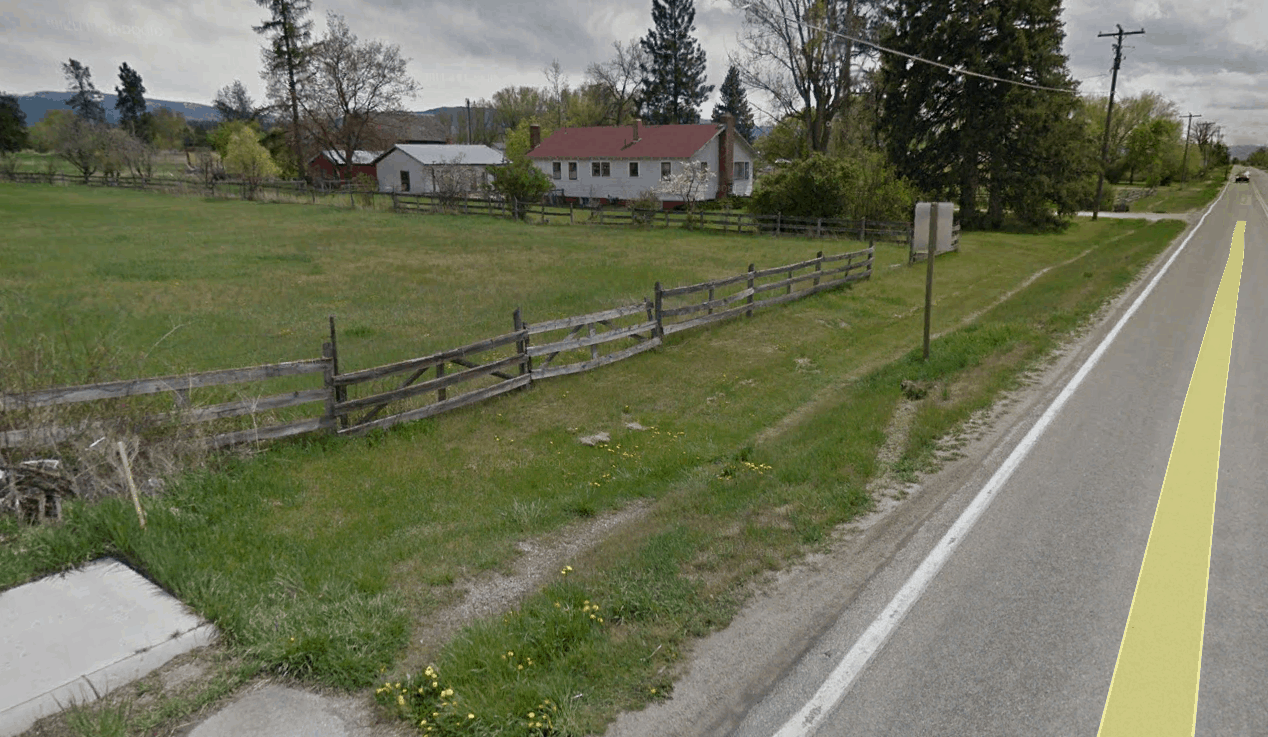

Mark Mayer, post: 440808, member: 424 wrote: I'm not sure this is the actual subject property, but it does seem to be representative of the area. I'm pretty sure you can hide 0.2' of right of way occupation here someplace. Or is it 0.1'?
I don't have to hide what I'm doing- I'm not a frightened fudger.... (thank you Christian Clausen for that AWESOME term)
Rankin_File, post: 440882, member: 101 wrote: I don't have to hide what I'm doing- I'm not a frightened fudger.... (thank you Christian Clausen for that AWESOME term)
.
.
remind me again of what we're doing here; retracing existing R/W as it hit the ground in 1939 or correcting it to the way it should be.....

http://www.writingondawal.com/MeridianDisplay/Articles/01RightOfWay.pdf
Link to a great article lest we forget.
Just be aware there are DOT surveyors on the forum that believe monuments set for an intended purpose and used for that purpose hold. Those who claim a big fat marker with a sign next to it inscribed ROW for the past 30 years is not the ROW marker have lost their way or been misguided.
Rankin_File, post: 440883, member: 101 wrote: remind me again of what we're doing here; retracing existing R/W as it hit the ground in 1939 or correcting it to the way it should be.....
I'm contending that right of way is of the width specified and not necessarily the width monumented. Especially when we are talking about 0.2' difference between the specified width and the monuments.
I'm contending that the monuments on the right of way lines are really references to the centerline. The centerline is called for in the deed while the monuments are not.
I'm contending that the argument that the adjacent private owners have occupied to the right of way monument doesn't really work, partly because their really isn't any clear occupation of any particular line at the right of way - which is common. Also because occupation by the adjacent owner can never ripen into title by adverse possession. If the state had no right of way acquisition of a 60' wide strip for the road by prescription would be duck soup, because 60'; is the statutory right of way width. But acquisition of an additional 0.2' wide strip would never be attempted, let alone perfected.
Monuments acquire dignity as controlling when they are called for, or good faith restorations of called for monuments. These are not. They acquire that dignity when owners on both sides of the line 1) have a disagreement about a lines location, 2) agree that certain monuments mark an unknown boundary, and 3) perform acts of occupation in reliance on them - none of which has happened (particularly the third, I see no 10' jog in the fence that is there, which fence is at 30', not 40' from the centerline). Or they acquire that dignity when an owner occupies adversely, which the private owner cannot do against the state, and which the state clearly has not done in the vicinity of the right of way line.
For all these reasons I assert that rights of way are of the specified width, no more, no less. The Wohl v. Missoula court stated that rather emphatically before making a contrary offhand comment. The ramifications of that comment were not at issue in that case, and were not argued. Survey to find the centerline, then offset that as appropriate.
I'm further contending that the first survey you posted is a P.O.S., and that although it's monuments may have been in the ground a long time there doesn't seem to have been much of anything done in reliance upon them, so the monuments have (perhaps) not acquired the dignity of being controlling through any of the unwritten transfer doctrines. It could be that the survey was done for the benefit of the bank and the owners don't even know that there are monuments out there. But this is an aside.
linebender, post: 440891, member: 449 wrote: Link to a great article lest we forget.
It is a great article and food for thought. But as you might expect I find fault with it. Starting with the assertion that rights of way are fee takings. Possibly that is true in Georgia. But not in Oregon/Washington. And not in Oklahoma where (almost) all section lines are the centerline of rights of way:
[INDENT]Organic Act ?? 1890, Oklahoma Territory Section Line width = 66?? ?? 23. Relating to public highways That there shall be reserved public highways four rods wide between each section of land in said Territory, the section lines being the center of said highway; but no deductions shall be made, where cash payments are provided for, in the amount to be paid for each quarter section of land by reason of such reservation. But if the said highway shall be vacated by any competent authority, the title to the respective strips shall inure to the then owner of the tract of which it formed a part of the original survey. May 2, 1890, c. 182, ?? 23, 26 Stat. 92
[/INDENT]
Quite a lot flows out of that fee? or easement? difference. Note that the Organic Act (and many tribal treaties which preceeded it) established the right of way at a definite width before any monuments were ever set on the side lines.

Mark Mayer, post: 440894, member: 424 wrote: I'm contending that right of way is of the width specified and not necessarily the width monumented. Especially when we are talking about 0.2' difference between the specified width and the monuments.
I'm contending that the monuments on the right of way lines are really references to the centerline. The centerline is called for in the deed while the monuments are not.
I'm contending that the argument that the adjacent private owners have occupied to the right of way monument doesn't really work, partly because their really isn't any clear occupation of any particular line at the right of way - which is common. Also because occupation by the adjacent owner can never ripen into title by adverse possession. If the state had no right of way acquisition of a 60' wide strip for the road by prescription would be duck soup, because 60'; is the statutory right of way width. But acquisition of an additional 0.2' wide strip would never be attempted, let alone perfected.
Monuments acquire dignity as controlling when they are called for, or good faith restorations of called for monuments. These are not. They acquire that dignity when owners on both sides of the line 1) have a disagreement about a lines location, 2) agree that certain monuments mark an unknown boundary, and 3) perform acts of occupation in reliance on them - none of which has happened (particularly the third, I see no 10' jog in the fence that is there, which fence is at 30', not 40' from the centerline). Or they acquire that dignity when an owner occupies adversely, which the private owner cannot do against the state, and which the state clearly has not done in the vicinity of the right of way line.For all these reasons I assert that rights of way are of the specified width, no more, no less. The Wohl v. Missoula court stated that rather emphatically before making a contrary offhand comment. The ramifications of that comment were not at issue in that case, and were not argued. Survey to find the centerline, then offset that as appropriate.
I'm further contending that the first survey you posted is a P.O.S., and that although it's monuments may have been in the ground a long time there doesn't seem to have been much of anything done in reliance upon them, so the monuments have (perhaps) not acquired the dignity of being controlling through any of the unwritten transfer doctrines. It could be that the survey was done for the benefit of the bank and the owners don't even know that there are monuments out there. But this is an aside.
You must have read a different Wohl v. Missoula. The one I read was a case where no monuments were found. How can you take a case in which no monuments where found, and in which it was stated that if monuments were found they would have controlled, to bolster your arguments that monuments don't control?
aliquot, post: 441107, member: 2486 wrote: You must have read a different Wohl v. Missoula. The one I read was a case where no monuments were found. How can you take a case in which no monuments where found, and in which it was stated that if monuments were found they would have controlled, to bolster your arguments that monuments don't control?
[INDENT]"The court found that the original subdivision plats, together with their associated certificates of dedication, clearly show that the grantors intended South Avenue to be 60 feet wide. The court observed there was no dispute that the 1905 R.M. Cobban Orchard Homes plat dedicated a portion of a 60-foot-wide right-of-way centered on the section line, and there was no evidence that the grantors of the 1909 and 1910 Car Line plats intended South Avenue's location and width to be any different. The court further found that the City had shown no convincing evidence that the Missoula County Commissioners accepted a right-of-way wider than 60 feet, and that the City also had established no legal basis for disregarding Montana law, which generally requires the width of public roads to be 60 feet. Section 1339, RCM (1907). The District Court thus ruled that South Avenue is a symmetrical, 60-foot-wide public right-of-way centered on the section line."
[/INDENT]
I've already posted this passage from Wohl in this thread once, and I've explained my position in detail at least twice. In review, these monuments are not called for in the deeds. The monuments found are not shown on the right of way map. No agreement line is possible. No exact occupation is present.
That's it for me. I'm out. But I leave you with one more thought. If the State of Montana set monuments and intended that they be held why didn't they call for them in the deeds?
Mark Mayer, post: 441112, member: 424 wrote:
[INDENT]"The court found that the original subdivision plats, together with their associated certificates of dedication, clearly show that the grantors intended South Avenue to be 60 feet wide. The court observed there was no dispute that the 1905 R.M. Cobban Orchard Homes plat dedicated a portion of a 60-foot-wide right-of-way centered on the section line, and there was no evidence that the grantors of the 1909 and 1910 Car Line plats intended South Avenue's location and width to be any different. The court further found that the City had shown no convincing evidence that the Missoula County Commissioners accepted a right-of-way wider than 60 feet, and that the City also had established no legal basis for disregarding Montana law, which generally requires the width of public roads to be 60 feet. Section 1339, RCM (1907). The District Court thus ruled that South Avenue is a symmetrical, 60-foot-wide public right-of-way centered on the section line."
[/INDENT]
I've already posted this passage from Wohl in this thread once, and I've explained my position in detail at least twice. In review, these monuments are not called for in the deeds. The monuments found are not shown on the right of way map. No agreement line is possible. No exact occupation is present.That's it for me. I'm out. But I leave you with one more thought. If the State of Montana set monuments and intended that they be held why didn't they call for them in the deeds?
This case is a case about how to determine the ROW when no monuments are found. The judge even said the result would have been different if monuments had been found. I entered this discussion hoping someone could come up with a case that justified holding a ROW width contrary to found monuments. This case is most definitely not it.