

aliquot, post: 440202, member: 2486 wrote: Per the previous discussed case this would be the wrong way to go in Montana.
I haven't fully digested this case yet, but this statement of the court is pretty emphatic.
[INDENT]"The court found that the original subdivision plats, together with their associated certificates of dedication, clearly show that the grantors intended South Avenue to be 60 feet wide. The court observed there was no dispute that the 1905 R.M. Cobban Orchard Homes plat dedicated a portion of a 60-foot-wide right-of-way centered on the section line, and there was no evidence that the grantors of the 1909 and 1910 Car Line plats intended South Avenue's location and width to be any different. The court further found that the City had shown no convincing evidence that the Missoula County Commissioners accepted a right-of-way wider than 60 feet, and that the City also had established no legal basis for disregarding Montana law, which generally requires the width of public roads to be 60 feet. Section 1339, RCM (1907). The District Court thus ruled that South Avenue is a symmetrical, 60-foot-wide public right-of-way centered on the section line."
[/INDENT]
Is there something else in there that I'm not seeing yet?

Mark Mayer, post: 440211, member: 424 wrote: I haven't fully digested this case yet, but this statement of the court is pretty emphatic.
[INDENT]"The court found that the original subdivision plats, together with their associated certificates of dedication, clearly show that the grantors intended South Avenue to be 60 feet wide. The court observed there was no dispute that the 1905 R.M. Cobban Orchard Homes plat dedicated a portion of a 60-foot-wide right-of-way centered on the section line, and there was no evidence that the grantors of the 1909 and 1910 Car Line plats intended South Avenue's location and width to be any different. The court further found that the City had shown no convincing evidence that the Missoula County Commissioners accepted a right-of-way wider than 60 feet, and that the City also had established no legal basis for disregarding Montana law, which generally requires the width of public roads to be 60 feet. Section 1339, RCM (1907). The District Court thus ruled that South Avenue is a symmetrical, 60-foot-wide public right-of-way centered on the section line."
[/INDENT]
Is there something else in there that I'm not seeing yet?
Yes, the part where they say that had ROW monuments been found they would control.
Proportioning or calculating a position when there are no monuments is a very diferrent thing than calculating a position different than a found monument.
There probably is a plausible legal argument to be made for holding the record width, but no one has presented one, and "that's how I role" is not an argument I would want to be making in court.
[INDENT].....had McCarthy found original monuments set by Bonner in South Avenue (or monuments set by others and known to perpetuate the positions of the original monuments set by Bonner), those monuments would have taken precedence over the plats in determining South Avenue's position and dimensions. https://scholar.google.com/scholar_case?case=6962552488510341410&q=Wohl+v.+Missoula+2013&hl=en&as_sdt=6,38&as_vis=1&apos ;">Tyson, 433 So.2d at 552-53
[/INDENT]
Yes, there is that. But Wohl v. Missoula is not a case about found right of way monuments disagreeing with record widths, and it is not a case about 0.2' differences between found and record. Also, the cited Florida case has nothing whatever to do about rights of way. So I'm not going to assign a lot of weight to the foregoing statement and make recovered right of way widths wiggle down the street.

Tom Adams, post: 440183, member: 7285 wrote: Rankin File's description is for a "right-of-way easement" which would not effect the property owner's boundaries. (maybe the right word would be "affect" - I think "effect" as I hijack my own sentence) I was confused as to if/what the description had to do with the case cite. It's not about the discussed "South Street" is it? At any rate, the owner of the underlying fee would be the same, and encumbered by an easement. If the adjoiner's were in a situation that involved "proration" it would have no bearing on the right-of-way width. I am a little confused what the description has to do with the discussion. (although) I don't think I've seen a strip description of a highway right-of-way easement before.
They are pretty standard here for that era- the problem now is that, the successors in interest to the parcels almost invariably were conveyed a parcel that ended at the R/W line.
Mark Mayer, post: 440152, member: 424 wrote: No mention of any monuments. The centerline is called for, and monuments are found which seem to fit the map from which the description was prepared. This confirms my thinking that the monuments you found are references to the centerline, and that the right of way is the exact width called for in the deed. That's how I roll.
ok- so you are going to put your pin touching the pipe, or just pincushion on paper?
Rankin_File, post: 440486, member: 101 wrote: so you are going to put your pin touching the pipe, or just pincushion on paper?
Probably on paper. Is this particular monument at a property corner or just a line stake?
Mark Mayer, post: 440487, member: 424 wrote: Probably on paper. Is this particular monument at a property corner or just a line stake?
corner

Rankin_File, post: 440485, member: 101 wrote: They are pretty standard here for that era- the problem now is that, the successors in interest to the parcels almost invariably were conveyed a parcel that ended at the R/W line.
Do you know how courts have handled that situation? If you call to the "right-of-way" line, that call would be presumed to be the center of the right-of-way. But from you you're saying, the call to the ROW Line is probably a distance call that would be to the edge of the ROW or the ROW LIMITS. I would hope that the call to the ROW Line would hold the distance to the center of the ROW and the distance call would give to the actual center.....(but I could see how that might not hold)
Rankin_File, post: 440488, member: 101 wrote: corner
Then the monument may control the side line of the private property. Even though it's likely not called for in their deeds either. But because those adjacent private owners can acquiesce to it as controlling their common line. Monuments don't acquire their dignity as controlling boundaries from the surveyor, and they don't acquire it by "being there a long time". They acquire it when they are called for in a written and properly acknowledged document, or when there is an unwritten agreement, in some form, between interested parties who are legally able to make such an unwritten agreement.
But given that a right of way is a form of easement, that the fee title remains in the adjacent private owner; that the state intended to acquire the specified width and only the specified width, no more and no less; and that if the monument was inside the specified width the state would, surely, expect to retain and exercise it's rights to the full width; that the state cannot be adversely possessed against, nor can an unwritten agreement be concluded because there must be at least 2 interested parties for there to be an agreement; and, finally, that no monuments are called in the deed of dedication, I'll be assigning the stated widths to rights of way.
I'll further state that as a surveyor who has worked mostly in recording jurisdictions, having seen many, many surveys of rights of way by others, and having prepared right of way recovery surveys for 2 state DOT's, I cannot recall a single instance where anything other than holding the full width and only the full width was ever done, by me or by anybody else. It's the common practice.
Tom Adams, post: 440489, member: 7285 wrote: Do you know how courts have handled that situation? If you call to the "right-of-way" line, that call would be presumed to be the center of the right-of-way. But from you you're saying, the call to the ROW Line is probably a distance call that would be to the edge of the ROW or the ROW LIMITS. I would hope that the call to the ROW Line would hold the distance to the center of the ROW and the distance call would give to the actual center.....(but I could see how that might not hold)
ummmm, no.
Here's the latest survey- the referenced deed it too old to be available online, so I'll have to pick it up at the courthouse.....
(the ROW break we're talking about is the break from 30'- 40ft in the SW corner of Parcel A
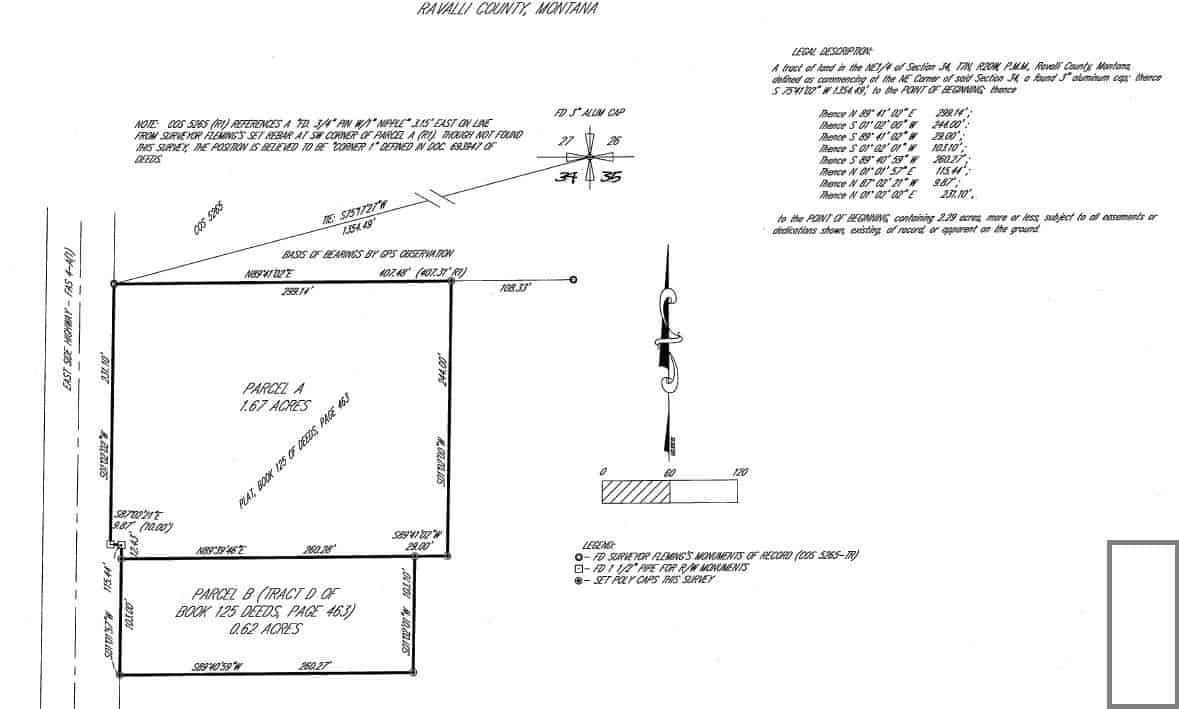

aliquot, post: 440024, member: 2486 wrote: But it is almost never 100.00' . I think it is much more ridiculous to think that the ROW moves every time someone measures a distance .01' different or decides to measure from something other than the monument. We have thousands of court cases telling us this is not how boundaries work.
My DOT says that none of those monuments controls the location of their strip...
Mark Mayer, post: 440497, member: 424 wrote: that the state cannot be adversely possessed against
The state could acquire that 0.2' strip of right of way by prescription. But in order to do so they would have to prove acts of possession within that 0.2' strip, a thing they are not likely to attempt, let alone succeed in doing.
Rankin_File, post: 440499, member: 101 wrote: Here's the latest survey ...
I don't find that to be a very impressive survey. Unless there is more to it which you have not shown us I can assure you that it would not pass muster in Oregon. The surveyor has not shown us how he developed the right of way line south of the 30/40 corner at all. The legal description makes no call to the right of way nor to any controlling monument other than the remote section corner. And "BASIS OF BEARING BY GPS OBSERVATION" is pretty much a red flag.
Mark Mayer, post: 440541, member: 424 wrote: I don't find that to be a very impressive survey. Unless there is more to it which you have not shown us I can assure you that it would not pass muster in Oregon. The surveyor has not shown us how he developed the right of way line south of the 30/40 corner at all. The legal description makes no call to the right of way nor to any controlling monument other than the remote section corner. And "BASIS OF BEARING BY GPS OBSERVATION" is pretty much a red flag.
This is one of those "this is the boundary because I say so" surveys, unless there was note explain the SW cor. of Tract B. There are times when not tying to something south on the ROW would be appropriate, but it certainly requires an explanation.
I do think the "10.00" ROW jog was treated correctly, but that basis of bearing statement makes it hard to give him the benifit of the doubt.
Tom Adams, post: 440489, member: 7285 wrote: Do you know how courts have handled that situation? If you call to the "right-of-way" line, that call would be presumed to be the center of the right-of-way. But from you you're saying, the call to the ROW Line is probably a distance call that would be to the edge of the ROW or the ROW LIMITS. I would hope that the call to the ROW Line would hold the distance to the center of the ROW and the distance call would give to the actual center.....(but I could see how that might not hold)
Tom - you state: "If you call to the "right-of-way" line, that call would be presumed to be the center of the right-of-way." Do you have anything to support that assertion?
Mark Mayer, post: 440497, member: 424 wrote:
I'll further state that as a surveyor who has worked mostly in recording jurisdictions, having seen many, many surveys of rights of way by others, and having prepared right of way recovery surveys for 2 state DOT's,.......
[SARCASM]I'm guessing that would be the Okies and the Smokies......[/SARCASM];)
Jim in AZ, post: 440724, member: 249 wrote: Tom - you state: "If you call to the "right-of-way" line, that call would be presumed to be the center of the right-of-way." Do you have anything to support that assertion?
My statement was pretty broad, I'll admit. Wattles address this somewhat, but does also reference doing what is custom to the area. Read the Beginning of Chapter eight. on 8.3 he says "Although the general assumption supported by various court cases is that the underlying fee title normally carries to the center of the road easement, similar to the thread of a stream, attendant conditions, information shown on the map and the format of the qualifying words are in the final analysis...." section 8.4 discusses utilizing what the custom is in the particular area you are working.
I don't have specific court case cites except what Wattles was referring to, and was only talking about the general rule (what my first presumption would be prior to further investigation)
Mark Mayer, post: 440541, member: 424 wrote: I don't find that to be a very impressive survey. Unless there is more to it which you have not shown us I can assure you that it would not pass muster in Oregon. The surveyor has not shown us how he developed the right of way line south of the 30/40 corner at all. The legal description makes no call to the right of way nor to any controlling monument other than the remote section corner. And "BASIS OF BEARING BY GPS OBSERVATION" is pretty much a red flag.
.
your opinion of the quality of the survey doesn't change the fact that the owners paid for it and are relying on it to further their improvements, and undoubtably will use it in the future to convey their interests.....
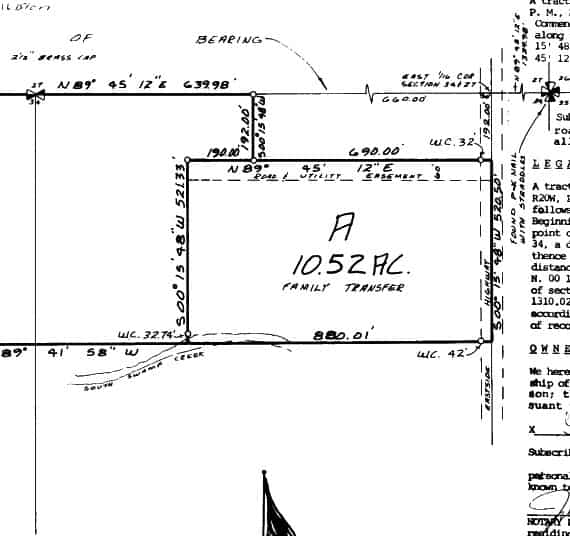
Here's the survey for the other side of the road...
..
..
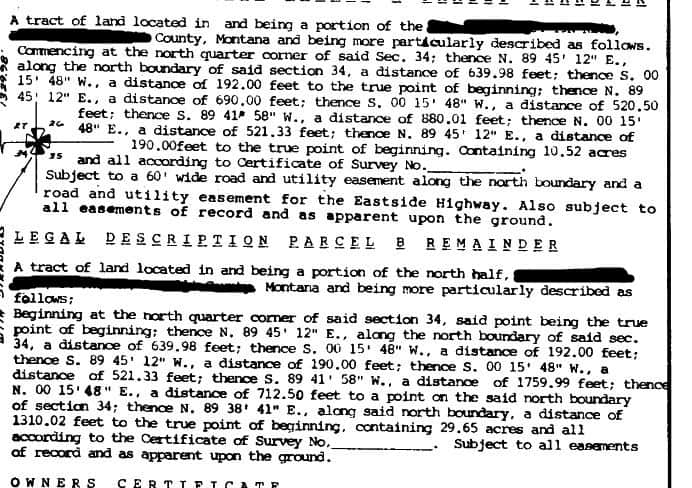
What are the odds that the centerline of the rd varies between the 2 surveys and where I would calculate it's position as now?
that's the beauty of imaginary boundary lines.....

Jim in AZ, post: 440724, member: 249 wrote: Tom - you state: "If you call to the "right-of-way" line, that call would be presumed to be the center of the right-of-way." Do you have anything to support that assertion?
Ye Olde Common Law (Codified here in 1892)
REAL PROPERTY
TITLE 2. RULES OF CONSTRUCTION
Md. REAL PROPERTY Code Ann. ?? 2-114 (2017)
?? 2-114. Title to street or highway where land binding on it is granted
(a) In general. -- Except as otherwise provided, any deed, will, or other instrument that grants land binding on any street or highway, or that includes any street or highway as 1 or more of the lines thereof, shall be construed to pass to the devisee, donee, or grantee all the right, title, and interest of the devisor, donor, or grantor (hereinafter referred to as the transferor) in the street or highway for that portion on which it binds.
(b) Property on opposite sides of street. -- If the transferor owns other land on the opposite side of the street or highway, the deed, will, or other instrument shall be construed to pass the right, title, and interest of the transferor only to the center of that portion of the street or highway upon which the 2 or more tracts coextensively bind.
(c) Exception. -- The provisions of subsections (a) and (b) of this section do not apply if the transferor in express terms in the writing by which the devise, gift, or grant is made, either reserves to the transferor or grants to the transferee all the right, title, and interest to the street or highway.

California's Statute since 1872:
Civil Code - CIV
DIVISION 2. PROPERTY [654 - 1422]
( Heading of Division 2 amended by Stats. 1988, Ch. 160, Sec. 13. )
PART 2. REAL OR IMMOVABLE PROPERTY [[755.] - 945.5]
( Part 2 enacted 1872. )
TITLE 3. RIGHTS AND OBLIGATIONS OF OWNERS [818 - 855]
( Title 3 enacted 1872. )
CHAPTER 1. Rights of Owners [818 - 834]
( Chapter 1 enacted 1872. )
ARTICLE 2. Boundaries [829 - 835]
( Article 2 enacted 1872. )
831.
An owner of land bounded by a road or street is presumed to own to the center of the way, but the contrary may be shown.
(Enacted 1872.)