

aliquot, post: 440100, member: 2486 wrote: What is the 60.2' between? The pipes that are supposed to be 10' apart?
the pipe at 30 ft lt and the pipe at 30 ft rt.

Rankin_File, post: 440097, member: 101 wrote: do you think they are monuments on the Right of way or merely references to the centerline?
I'd like to see the text of the acquisition deed before committing myself fully, but based on the map alone I would treat them as references to the centerline.
A caveat- In Mt we have the recent Wohl V City of Missoula

Rankin_File, post: 440117, member: 101 wrote:
A caveat- In Mt we have the recent Wohl V City of Missoula
Thanks for a good case. This case seems to support the theory that the ROW monuments prevail over a paper width.
"Had McCarthy found the original monuments set in South Avenue (Here, had McCarthy found original monuments set by Bonner in South Avenue (or monuments set by others and known to perpetuate the positions of the original monuments set by Bonner), those monuments would have taken precedence over the plats in determining South Avenue's position and dimensions. "
It does not, however, address the arguments of some that DOT monuments are not original monuments.
This is almost an endorsement of the principle of giving streets there platted width when proportioning. It is a practice I have usually followed, but have always been a little nervous about. I feel better about it now.

aliquot, post: 440050, member: 2486 wrote: If the real marker is of record there should be no confusion among surveyors, but I wonder how many land owners get into trouble because of that? How far away is the rebar from the concrete witness post?
Right alongside them, its goofy, you have to be careful when you're searching.

aliquot, post: 440127, member: 2486 wrote: Thanks for a good case. This case seems to support the theory that the ROW monuments prevail over a paper width.
"Had McCarthy found the original monuments set in South Avenue (Here, had McCarthy found original monuments set by Bonner in South Avenue (or monuments set by others and known to perpetuate the positions of the original monuments set by Bonner), those monuments would have taken precedence over the plats in determining South Avenue's position and dimensions. "
It does not, however, address the arguments of some that DOT monuments are not original monuments.
This is almost an endorsement of the principle of giving streets there platted width when proportioning. It is a practice I have usually followed, but have always been a little nervous about. I feel better about it now.
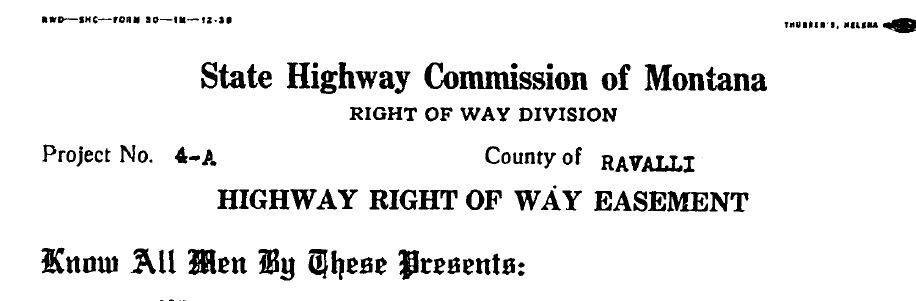
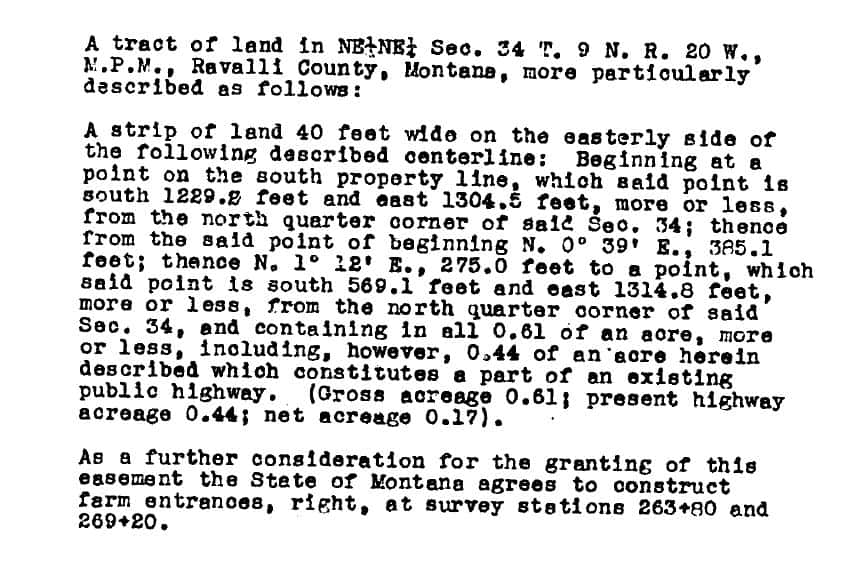
The above is a "right-of-way easement". The adjoining owners would own to wherever their common line and the easement would be over and through their land. If Proportioning were involved you not take the easement into account.
aliquot, post: 440127, member: 2486 wrote: Thanks for a good case. This case seems to support the theory that the ROW monuments prevail over a paper width.
What case are you talking about? I think I missed something.
Tom Adams, post: 440131, member: 7285 wrote: What case are you talking about? I think I missed something.
Wohl vs missoula
MightyMoe, post: 440136, member: 700 wrote: Wohl vs missoula
Thank you. I looked that up.

Wohl appears to be more of a title case than a location case to me. The Plats dedicated 60'; the city tried to cook up a theory that the dedication was 91' based on remote parallel streets being further north and south of South Street than indicated on the Plat. In the case of an excess the subdivider did not know common sense dictates it went to the adjoining lots, not the R/W dedication which any subdivider would keep to the legal minimum. If a description states a number it can't be changed by extrinsic evidence.
This is factually distinguishable from the case where Bonner's pipe (original surveyor) is found 30.2' from the centerline. The pipe establishes the 30' line imperfectly but this is not changing a stated number in a Deed, just further refining it. The Court is correct, the City gets 60' under the facts and law of the case.
I have taken only a few minutes to scan Wohl v. Missoula (2013). I point out that:
[INDENT]a) the strip of contested additional right of way is 20-30 feet wide, not a couple of tenths.
b) there were no original right of way monuments at all found within the contested right of way
c) the court ruled that the R/W was exactly the width stated on the plat, and the excess was to be distributed to the lots.
[/INDENT]
There is also Wohl v. Missoula (2014) & Wohl v. Missoula (2016), but these are concerned with attorney fees and just compensation for lands taken by eminent domain.
Mark Mayer, post: 440150, member: 424 wrote:
[INDENT]b) there were no original right of way monuments at all found within the contested right of way.[/INDENT]
[INDENT][/INDENT]
This is a very important factor that differentiates this case from what we have been talking about.
Rankin_File, post: 440117, member: 101 wrote:
A caveat- In Mt we have the recent Wohl V City of Missoula
No mention of any monuments. The centerline is called for, and monuments are found which seem to fit the map from which the description was prepared. This confirms my thinking that the monuments you found are references to the centerline, and that the right of way is the exact width called for in the deed. That's how I roll.
Mark Mayer, post: 440152, member: 424 wrote: No mention of any monuments. The centerline is called for, and monuments are found which seem to fit the map from which the description was prepared. This confirms my thinking that the monuments you found are references to the centerline, and that the right of way is the exact width called for in the deed. That's how I roll.
So you would pincushion a monument that was caused to be set by DOT and has been relied on to the extent a fence was built to it because of a measurment difference of 0.2' feet?
If a previous surveyor had already done that would you then establish a third position if you measured it at 60.10 feet?
Would you do the same with a lot corner?
aliquot, post: 440167, member: 2486 wrote: So you would pincushion a monument that was caused to be set by DOT
We have to accept that some monuments are controlling, and some aren't. No, I'm not going to just accept every monument I find as a corner.
Mark Mayer, post: 440173, member: 424 wrote: We have to accept that some monuments are controlling, and some aren't. No, I'm not going to just accept every monument I find as a corner.
But this was set by a party to a grant close to the time of the grant and relied upon by the adjoiner. What purpose is there to reject it, what is the benifit of moving a boundary by 0.2 feet?
Rankin File's description is for a "right-of-way easement" which would not effect the property owner's boundaries. (maybe the right word would be "affect" - I think "effect" as I hijack my own sentence) I was confused as to if/what the description had to do with the case cite. It's not about the discussed "South Street" is it? At any rate, the owner of the underlying fee would be the same, and encumbered by an easement. If the adjoiner's were in a situation that involved "proration" it would have no bearing on the right-of-way width. I am a little confused what the description has to do with the discussion. (although) I don't think I've seen a strip description of a highway right-of-way easement before.
One thing I notice about the fact statements in the Wohl case and numerous other cases I have read is they talk about the plat and the original survey and its monuments but they usually don't say if the monuments are explicitly mentioned on the plat. Sometimes mention is made of a few monuments but this doesn't mean others not mentioned don't exist. It doesn't seem to be a requirement as if the Court, using common sense, doesn't expect every last detail of the original survey to be mentioned on the plat. They presume there was a survey and that would've resulted in stakes being set. They say in dicta that if monuments of the original survey had been found on the side lines of south street then those would've controlled but I agree with them that remote monuments don't have the same effect.
aliquot, post: 440176, member: 2486 wrote: What purpose is there to reject it, what is the benefit of moving a boundary by 0.2 feet?
Why give away right of way just to hold a monument? Sometimes monuments are controlling. Sometimes they aren't. These ones are controlling - of the centerline.
Wh
Mark Mayer, post: 440187, member: 424 wrote: Why give away right of way just to hold a monument? Sometimes monuments are controlling. Sometimes they aren't. These ones are controlling - of the centerline.
Per the previous discussed case this would be the wrong way to go in Montana. I would suspect the same is true in many other states.