Reading RPLS is free for the whole profession. Members post, reply, and get the members-only rooms.

Notifications
Clear all

Topic starter
Translate
▼
English
Spanish
French
German
Italian
Portuguese
Russian
Chinese
Japanese
Korean
Arabic
Hindi
Dutch
Polish
Turkish
Vietnamese
Thai
Swedish
Danish
Finnish
Norwegian
Czech
Hungarian
Romanian
Greek
Hebrew
Indonesian
Malay
Ukrainian
Bulgarian
Croatian
Slovak
Slovenian
Serbian
Lithuanian
Latvian
Estonian
I have been doing some field data processing for a company I worked for in the past. They are using a Topcon/Sokkia reflector-less unit.
I use my own spreadsheet for computing the resulting coordinates. I noticed that once in a while - 1 out of every 500 shots - there would be
an error/wild shot. Either point is way out of project location or the elevation would be inconsistent with surrounding shots.
How reliable are the new reflector-less units? You also get those error shots?
Posted : September 23, 2016 2:12 am

Translate
▼
English
Spanish
French
German
Italian
Portuguese
Russian
Chinese
Japanese
Korean
Arabic
Hindi
Dutch
Polish
Turkish
Vietnamese
Thai
Swedish
Danish
Finnish
Norwegian
Czech
Hungarian
Romanian
Greek
Hebrew
Indonesian
Malay
Ukrainian
Bulgarian
Croatian
Slovak
Slovenian
Serbian
Lithuanian
Latvian
Estonian
I have an almost 15 year old Set 4 130 reflectorless TS and what you describe has happened to me since it was new. 1 out of 500 sounds about right. I've always just figured it was a blade of grass or something that reflected the signal stronger than the actual FS object. I never let it bother me too much. The error is obvious. I just delete the bogie and move on.
Posted : September 23, 2016 4:10 am

Translate
▼
English
Spanish
French
German
Italian
Portuguese
Russian
Chinese
Japanese
Korean
Arabic
Hindi
Dutch
Polish
Turkish
Vietnamese
Thai
Swedish
Danish
Finnish
Norwegian
Czech
Hungarian
Romanian
Greek
Hebrew
Indonesian
Malay
Ukrainian
Bulgarian
Croatian
Slovak
Slovenian
Serbian
Lithuanian
Latvian
Estonian
I am a fan of the Leica NARROW beam reflectorless.
I did a write up on it, on the old forum.
In a nutshell, a NARROW beam, has to be collimated with the cross hairs. This is a deep design change. The USER has to be able to keep those 2 playing nice together.
The route many mfrs (I know early Topcon is included in this) was to make a WIDE beam reflectorless.
This made it so the user never had to collimate it. Less things to go wrong... from a mfr standpoint. At a price. MORE can go wrong, from a USER standpoint. Shoot a building corner... and you really don't know where that return came from. Narrow beam has another problem. It has to be very concentrated. This makes it brighter... and not like a frosted lightbulb. This makes laser light warnings, and threats more problematic.
In short, I am a BIG fan of the narrow beam. Used properly, it trumps the wide, in USE, but not in simplicity, and design, and liability....
I am not presently current... I have not looked through my leica since I got my Javad, but I digress.
I still have it. It is a good gun.
Do your own testing.
Somebody also came up with a gun that would shoot what it was focused on... I don't remember who made it. But it was a good idea. Might be worth looking into.
N
Posted : September 23, 2016 5:49 am

Translate
▼
English
Spanish
French
German
Italian
Portuguese
Russian
Chinese
Japanese
Korean
Arabic
Hindi
Dutch
Polish
Turkish
Vietnamese
Thai
Swedish
Danish
Finnish
Norwegian
Czech
Hungarian
Romanian
Greek
Hebrew
Indonesian
Malay
Ukrainian
Bulgarian
Croatian
Slovak
Slovenian
Serbian
Lithuanian
Latvian
Estonian
The current line up of Topcon and Sokkia total stations and robotics (ES/CX series and up) use a phase style edm- the beam is extremely narrow and this has been our standard flag ship EDM for almost a decade. If there is an anomalous measurement often it is hitting an object that is out of focus but in line.
Posted : September 23, 2016 8:31 am

Translate
▼
English
Spanish
French
German
Italian
Portuguese
Russian
Chinese
Japanese
Korean
Arabic
Hindi
Dutch
Polish
Turkish
Vietnamese
Thai
Swedish
Danish
Finnish
Norwegian
Czech
Hungarian
Romanian
Greek
Hebrew
Indonesian
Malay
Ukrainian
Bulgarian
Croatian
Slovak
Slovenian
Serbian
Lithuanian
Latvian
Estonian
most large errors are due to some object between the instrument and the desired location that you want to collect.
Posted : September 23, 2016 9:53 am

Translate
▼
English
Spanish
French
German
Italian
Portuguese
Russian
Chinese
Japanese
Korean
Arabic
Hindi
Dutch
Polish
Turkish
Vietnamese
Thai
Swedish
Danish
Finnish
Norwegian
Czech
Hungarian
Romanian
Greek
Hebrew
Indonesian
Malay
Ukrainian
Bulgarian
Croatian
Slovak
Slovenian
Serbian
Lithuanian
Latvian
Estonian
I have found it useful to punch the distance button on the TS and getting a number before taking some shots that have other objects appearing thru the scope and near line to the object wanted located simply to see if the number is realistic.
Posted : September 23, 2016 11:37 am

Translate
▼
English
Spanish
French
German
Italian
Portuguese
Russian
Chinese
Japanese
Korean
Arabic
Hindi
Dutch
Polish
Turkish
Vietnamese
Thai
Swedish
Danish
Finnish
Norwegian
Czech
Hungarian
Romanian
Greek
Hebrew
Indonesian
Malay
Ukrainian
Bulgarian
Croatian
Slovak
Slovenian
Serbian
Lithuanian
Latvian
Estonian
A Harris, post: 392409, member: 81 wrote: I have found it useful to punch the distance button on the TS and getting a number before taking some shots that have other objects appearing thru the scope and near line to the object wanted located simply to see if the number is realistic.
Exactly what I've learned to do
Posted : September 23, 2016 12:46 pm

Translate
▼
English
Spanish
French
German
Italian
Portuguese
Russian
Chinese
Japanese
Korean
Arabic
Hindi
Dutch
Polish
Turkish
Vietnamese
Thai
Swedish
Danish
Finnish
Norwegian
Czech
Hungarian
Romanian
Greek
Hebrew
Indonesian
Malay
Ukrainian
Bulgarian
Croatian
Slovak
Slovenian
Serbian
Lithuanian
Latvian
Estonian
The biggest factor in a bad reflectorless shot is the type and color of a metal surface. Smooth and black will almost always give a bad distance, as will an oblique angle on a shiny surface. I use plain masking tape and craft sticks spray painted pink (for visibility) where possible. Blue masking tape will not work nearly as well. If you can't reach the metal object, you can always shoot the corner from two different points. The distance will be off but a plot connecting the dots and setup points will give a line-line solution. Or, extend a rod way up and under the corner.
Posted : September 23, 2016 2:23 pm

Translate
▼
English
Spanish
French
German
Italian
Portuguese
Russian
Chinese
Japanese
Korean
Arabic
Hindi
Dutch
Polish
Turkish
Vietnamese
Thai
Swedish
Danish
Finnish
Norwegian
Czech
Hungarian
Romanian
Greek
Hebrew
Indonesian
Malay
Ukrainian
Bulgarian
Croatian
Slovak
Slovenian
Serbian
Lithuanian
Latvian
Estonian
I'm not sure this is a reflectorless problem. I saw random wild busts in the 1980s with a Set2C, and I've read of similar problems with a variety of Sokkia guns ever since. I'm wondering if it might be a design issue common to all instruments of that brand.
Posted : September 23, 2016 3:46 pm

Translate
▼
English
Spanish
French
German
Italian
Portuguese
Russian
Chinese
Japanese
Korean
Arabic
Hindi
Dutch
Polish
Turkish
Vietnamese
Thai
Swedish
Danish
Finnish
Norwegian
Czech
Hungarian
Romanian
Greek
Hebrew
Indonesian
Malay
Ukrainian
Bulgarian
Croatian
Slovak
Slovenian
Serbian
Lithuanian
Latvian
Estonian
I had my topcon shoot to a leaf or branch the other day. I tried to locate a building corner through a small hole but it failed. On the other hand I located about 50 signs and trees across a street with continuous traffic with no problems other than the shots took a little longer. I'm a little new to reflectorless. I used some duct tape to locate building corners that were at an angle which worked pretty good. I need to find some light colored stickers for building corners, shadows through the gun are hard to see. I use tracking and turn the gun slowly to get the maximum or minimum distance. That works but slows down production if you have a lot to locate.
Posted : September 23, 2016 9:15 pm

Translate
▼
English
Spanish
French
German
Italian
Portuguese
Russian
Chinese
Japanese
Korean
Arabic
Hindi
Dutch
Polish
Turkish
Vietnamese
Thai
Swedish
Danish
Finnish
Norwegian
Czech
Hungarian
Romanian
Greek
Hebrew
Indonesian
Malay
Ukrainian
Bulgarian
Croatian
Slovak
Slovenian
Serbian
Lithuanian
Latvian
Estonian
We have an s7 and I use the reflectorless a LOT. I avoid trying to hit corners, but do best fit lines and fillet at zero. My taped checks work fantastic. I have only had issues when trying for ridiculously steep angles.
Posted : September 23, 2016 10:35 pm

Translate
▼
English
Spanish
French
German
Italian
Portuguese
Russian
Chinese
Japanese
Korean
Arabic
Hindi
Dutch
Polish
Turkish
Vietnamese
Thai
Swedish
Danish
Finnish
Norwegian
Czech
Hungarian
Romanian
Greek
Hebrew
Indonesian
Malay
Ukrainian
Bulgarian
Croatian
Slovak
Slovenian
Serbian
Lithuanian
Latvian
Estonian
thebionicman, post: 392488, member: 8136 wrote: We have an s7 and I use the reflectorless a LOT. I avoid trying to hit corners, but do best fit lines and fillet at zero. My taped checks work fantastic. I have only had issues when trying for ridiculously steep angles.
I wonder if your S7 has a narrower beam than the S6 it replaces.
We have both S6 and S8 units, and get bad distances if we are not very careful to avoid any obstructions in the line of sight.
We can't shoot through chain link fences, we have to avoid vegetation.
It seems that the S6 will take distances to the nearest thing in the beam - and that the beam is at least half the width of telescope view
Turning on the visible laser makes no difference - you can be bang on the building corner and still get the distance to the eave.
Our field procedures now require at least 3 clear shots to any wall or ridgeline
It has to be the single worst feature of the S6
Posted : September 24, 2016 2:54 am

Translate
▼
English
Spanish
French
German
Italian
Portuguese
Russian
Chinese
Japanese
Korean
Arabic
Hindi
Dutch
Polish
Turkish
Vietnamese
Thai
Swedish
Danish
Finnish
Norwegian
Czech
Hungarian
Romanian
Greek
Hebrew
Indonesian
Malay
Ukrainian
Bulgarian
Croatian
Slovak
Slovenian
Serbian
Lithuanian
Latvian
Estonian
[USER=10]@Jim Frame[/USER]
My experience with a Set 2C was rare but it was a 10 meter error. A miscount within the internal counting mechanism.
Posted : September 24, 2016 6:10 am
Translate
▼
English
Spanish
French
German
Italian
Portuguese
Russian
Chinese
Japanese
Korean
Arabic
Hindi
Dutch
Polish
Turkish
Vietnamese
Thai
Swedish
Danish
Finnish
Norwegian
Czech
Hungarian
Romanian
Greek
Hebrew
Indonesian
Malay
Ukrainian
Bulgarian
Croatian
Slovak
Slovenian
Serbian
Lithuanian
Latvian
Estonian
jim.cox, post: 392498, member: 93 wrote: I wonder if your S7 has a narrower beam than the S6 it replaces.
We have both S6 and S8 units, and get bad distances if we are not very careful to avoid any obstructions in the line of sight.
We can't shoot through chain link fences, we have to avoid vegetation.
It seems that the S6 will take distances to the nearest thing in the beam - and that the beam is at least half the width of telescope view
Turning on the visible laser makes no difference - you can be bang on the building corner and still get the distance to the eave.
Our field procedures now require at least 3 clear shots to any wall or ridgeline
It has to be the single worst feature of the S6
The s7 must be a bit different. I shot light bases that were 1/2 inch conduit from 200 feet. They all checked between 1.02 and 1.05 from a wall. The wall was plastered with 10 shots in about 100 feet span. It's too easy to get the data and be certain...
Posted : September 24, 2016 8:58 am

Translate
▼
English
Spanish
French
German
Italian
Portuguese
Russian
Chinese
Japanese
Korean
Arabic
Hindi
Dutch
Polish
Turkish
Vietnamese
Thai
Swedish
Danish
Finnish
Norwegian
Czech
Hungarian
Romanian
Greek
Hebrew
Indonesian
Malay
Ukrainian
Bulgarian
Croatian
Slovak
Slovenian
Serbian
Lithuanian
Latvian
Estonian
From the field crew viewpoint it seems kinda' baffling why you would attempt to complete an entire topo in reflectorless mode. But I guess it depends on what the topo consists of, or what you contracted for. There's quite a few tips to using reflectorless, having learned over the years, quite a bit depends on the accuracy you're expecting, whether the z component is required, and what instrument and data collection software you utilize. One in five hundred shots may be part of the bargain at that rate.
Posted : September 24, 2016 12:56 pm

Translate
▼
English
Spanish
French
German
Italian
Portuguese
Russian
Chinese
Japanese
Korean
Arabic
Hindi
Dutch
Polish
Turkish
Vietnamese
Thai
Swedish
Danish
Finnish
Norwegian
Czech
Hungarian
Romanian
Greek
Hebrew
Indonesian
Malay
Ukrainian
Bulgarian
Croatian
Slovak
Slovenian
Serbian
Lithuanian
Latvian
Estonian
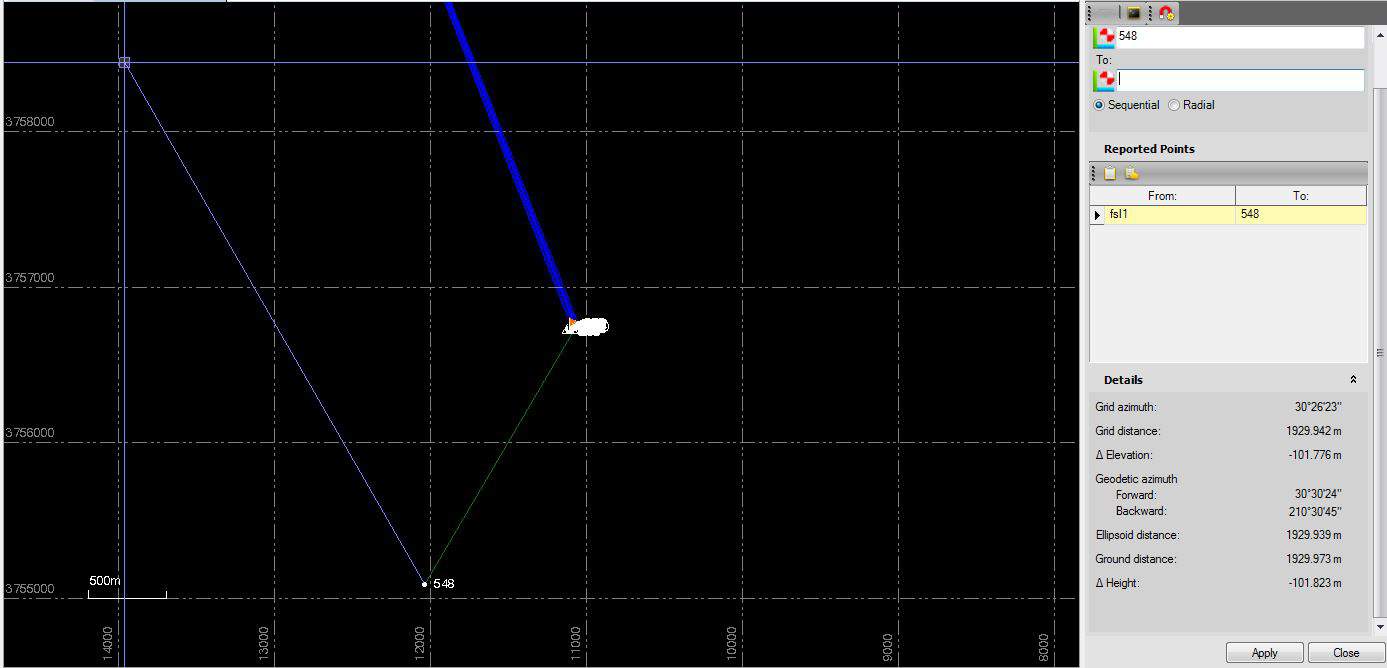
About 3 times a year I get a really bum shot from my S3, and I am not talking about something short due to an obstruction in the way, I am talking hundreds and even thousands of meters out..
Here is a screen grab from TBC showing one such bum shot, it is a reflector less shot 1929m , which is a physical impossibility as the laser is only rated to 300m, and i know you could do a 5000m shot in laser mode to a prism, but to discount that remote possibility, I plotted the points on goggle earth, it was on the other side a a mountain, so no possible visible line of site.
The shot was supposed to be to a building corner about 50m away .
This instrument has been in twice for this issue, no issues found.
It only happens a few times a year out of the thousands of shots we take with it, so the error is so obvious , its something to look forward to and have a laugh...
I have asked for an explanation, no one has ever given one, so I came up with my own one...
The laser on the s3 is phase shift, my s6 is time of flight, there must me an interruption in the phase shift pattern that causes the computer to incorrectly calculate there distance , I think the phase shift anomaly happens when the surface is a certain colour or texture that due to its contrast just confuses the s3.
I have learned to live with and always preferred my S6, thats until I l learned that the S6 laser is not truly co axial and that explains why you get bum corner wall shots and need to face 1 & face 2 reflectorless control placed on oblique surfaces.
Some day I will explain that story...
Posted : September 25, 2016 12:54 am

Translate
▼
English
Spanish
French
German
Italian
Portuguese
Russian
Chinese
Japanese
Korean
Arabic
Hindi
Dutch
Polish
Turkish
Vietnamese
Thai
Swedish
Danish
Finnish
Norwegian
Czech
Hungarian
Romanian
Greek
Hebrew
Indonesian
Malay
Ukrainian
Bulgarian
Croatian
Slovak
Slovenian
Serbian
Lithuanian
Latvian
Estonian
The S7 has a high power beam or whatever they call it.
All I know is the laser pointer is much smaller of a dot and is much harder for me to see than my laser pointer on my focus.
I actually prefer the easier to see, thicker laser pointer for reflectorless shots.
Posted : September 25, 2016 6:02 am
Translate
▼
English
Spanish
French
German
Italian
Portuguese
Russian
Chinese
Japanese
Korean
Arabic
Hindi
Dutch
Polish
Turkish
Vietnamese
Thai
Swedish
Danish
Finnish
Norwegian
Czech
Hungarian
Romanian
Greek
Hebrew
Indonesian
Malay
Ukrainian
Bulgarian
Croatian
Slovak
Slovenian
Serbian
Lithuanian
Latvian
Estonian
I'm also careful with my reflectorless shots.
If I'm shooting a house corner on a bad angle, aim in an inch of two and monitor the distance as u get closer to the corner. It should be very similar, if it goes back 8 tenths then something is wrong.
Sometimes I'll just shoot a half inch from the corner, and if I need a better location than that, I'll shoot a half inch in and use distance offset the half inch to get it closer
Posted : September 25, 2016 6:04 am

Translate
▼
English
Spanish
French
German
Italian
Portuguese
Russian
Chinese
Japanese
Korean
Arabic
Hindi
Dutch
Polish
Turkish
Vietnamese
Thai
Swedish
Danish
Finnish
Norwegian
Czech
Hungarian
Romanian
Greek
Hebrew
Indonesian
Malay
Ukrainian
Bulgarian
Croatian
Slovak
Slovenian
Serbian
Lithuanian
Latvian
Estonian
The S5,S6,S7,S8,S9 are all variations of options on the same basic instrument.
The S7 has the same laser/reflectorless as most of the recent S6 and S8 models - DR Plus.
The DR type is marked next to the eyepiece.
Posted : September 25, 2016 6:11 am
Translate
▼
English
Spanish
French
German
Italian
Portuguese
Russian
Chinese
Japanese
Korean
Arabic
Hindi
Dutch
Polish
Turkish
Vietnamese
Thai
Swedish
Danish
Finnish
Norwegian
Czech
Hungarian
Romanian
Greek
Hebrew
Indonesian
Malay
Ukrainian
Bulgarian
Croatian
Slovak
Slovenian
Serbian
Lithuanian
Latvian
Estonian
pdop 1.0, post: 392575, member: 459 wrote:
I have learned to live with and always preferred my S6, thats until I l learned that the S6 laser is not truly co axial and that explains why you get bum corner wall shots and need to face 1 & face 2 reflectorless control placed on oblique surfaces.Some day I will explain that story...
The S6 laser should be co-axial and can be adjusted using the provided torx screwdriver and target. You don't really need the target. Your dealer should do it as part of a calibration or the instructions are in the manual.
Posted : September 25, 2016 6:14 am
Page 1 / 2
Next