Reading RPLS is free for the whole profession. Members post, reply, and get the members-only rooms.

Notifications
Clear all
Strictly Surveying
26
Posts
11
Users
0
Reactions
3,144
Views

Topic starter
Translate
▼
English
Spanish
French
German
Italian
Portuguese
Russian
Chinese
Japanese
Korean
Arabic
Hindi
Dutch
Polish
Turkish
Vietnamese
Thai
Swedish
Danish
Finnish
Norwegian
Czech
Hungarian
Romanian
Greek
Hebrew
Indonesian
Malay
Ukrainian
Bulgarian
Croatian
Slovak
Slovenian
Serbian
Lithuanian
Latvian
Estonian
I have almost never seen elevations labeled on boundary monuments.
This month we are working on recovering and surveying sedimentation range monuments on a reservoir project, most of which are also boundary monuments, which were all set stones. We have a list that has a short description ("+ cut 5" X 6" set stone" or "+ cut on 2' X 1.3' boulder", etc) and also an elevation. The boundary mons all have NAD27 SPC as well, but those coordinates were determined by traverse in the late 30's and early 40's, so there is some slop in them.
In one case we found an iron pin in a yard where a set stone was called for. We were wondering whether to dig down, but it turned out the ground was 1.8 feet lower than what the top of stone was, so that was pretty obvious that it was gone (graded). At another site we traversed into the woods, found nothing on the surface, and it was described as a 4" X 4" set stone, 0.4' above ground. We found this:
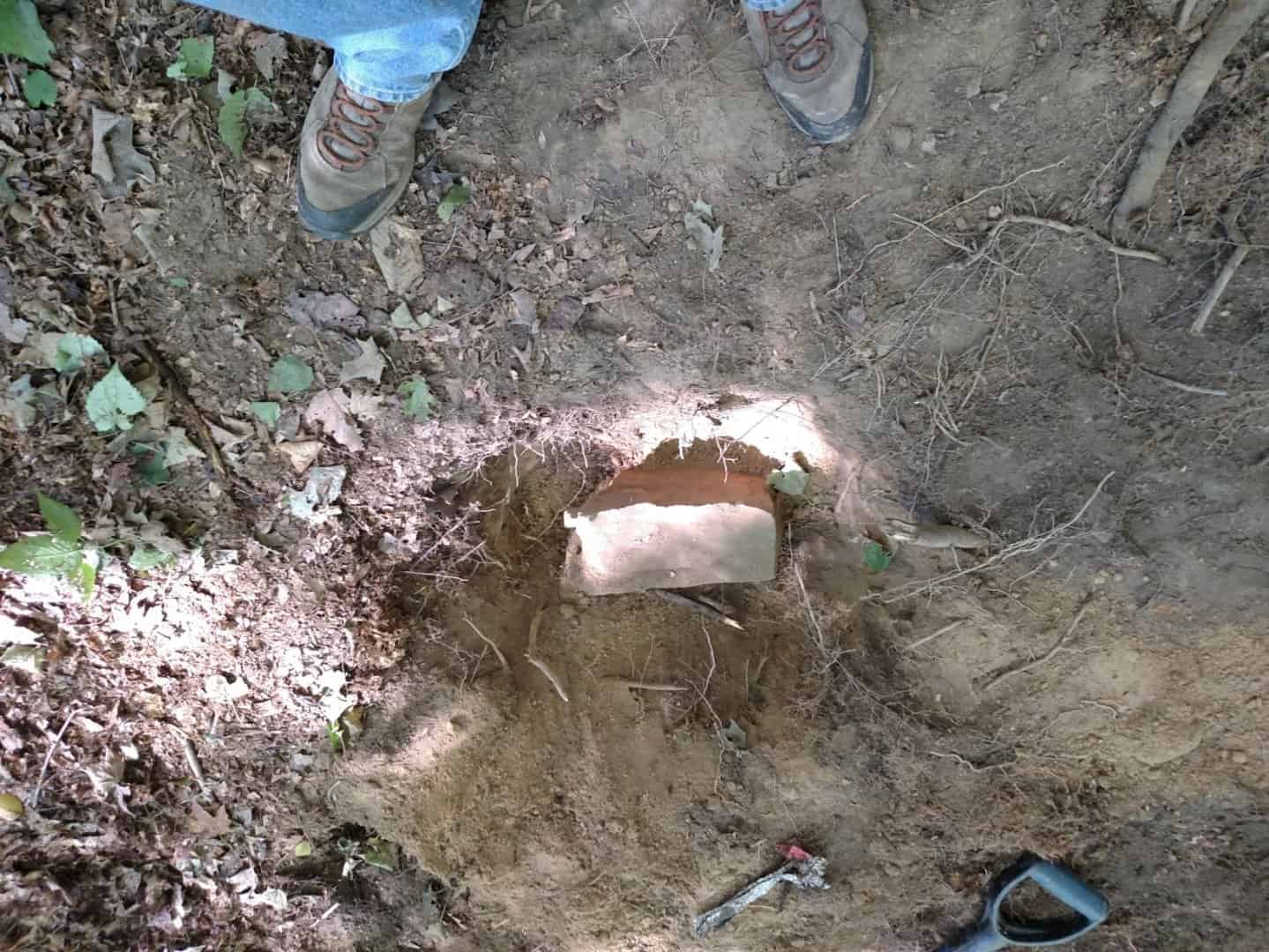
Obviously not 4" X 4", and other ones were always accurately described in their dimensions. This stone was in SOLID, so I assume it was probably the "set stone", but the dimensions don't match. Probably had a tapered top that came up above the surface that had been broken off. Note the nail with pink flagging and target material we found nearby. The elevation of the remaining top was too low by about 1 foot. another pic:
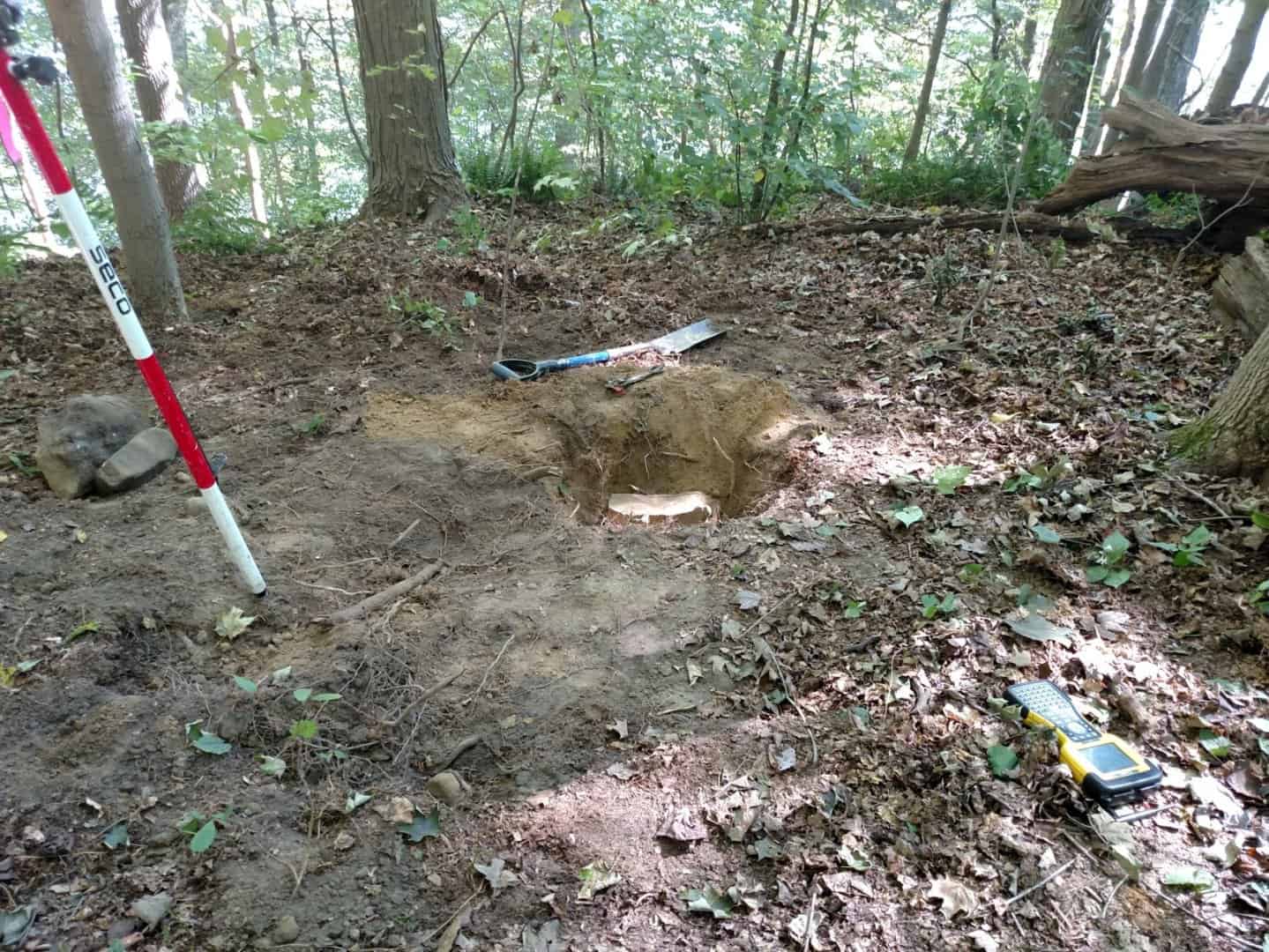
So, question is...since a lot of work is being done by GPS, why not put an elevation tag on the plan, wouldn't that make it easier to determine if the monument is under fill, or graded out?
Posted : September 27, 2016 3:31 pm

Translate
▼
English
Spanish
French
German
Italian
Portuguese
Russian
Chinese
Japanese
Korean
Arabic
Hindi
Dutch
Polish
Turkish
Vietnamese
Thai
Swedish
Danish
Finnish
Norwegian
Czech
Hungarian
Romanian
Greek
Hebrew
Indonesian
Malay
Ukrainian
Bulgarian
Croatian
Slovak
Slovenian
Serbian
Lithuanian
Latvian
Estonian
Nice find!
I have made it a practice to record rod heights/elevations on monuments for my own information. That way, if i ever suspect a monument of being tampered with, I have an X, Y, and Z to check.
When I make a map, I generally note if I found the monument at grade, or, how much +/- above/below it was at the time of the survey.
I think it adds an extra layer of useful information to a map to help someone in the future.
Posted : September 27, 2016 3:56 pm

Translate
▼
English
Spanish
French
German
Italian
Portuguese
Russian
Chinese
Japanese
Korean
Arabic
Hindi
Dutch
Polish
Turkish
Vietnamese
Thai
Swedish
Danish
Finnish
Norwegian
Czech
Hungarian
Romanian
Greek
Hebrew
Indonesian
Malay
Ukrainian
Bulgarian
Croatian
Slovak
Slovenian
Serbian
Lithuanian
Latvian
Estonian
Nice pic's, I note on my plat how far above or below grade the monument is. I have only done a few surveys where I didn't carry elevations. It's so easy and it provides an additional check in your work. It's not really been that useful to me, but once or twice it has paid off. I think it's a good practice. I haven't seen many other recorded plats in my area that reference the above/below or elevation of a monument, unless it was held as a benchmark.
Posted : September 27, 2016 4:24 pm

Translate
▼
English
Spanish
French
German
Italian
Portuguese
Russian
Chinese
Japanese
Korean
Arabic
Hindi
Dutch
Polish
Turkish
Vietnamese
Thai
Swedish
Danish
Finnish
Norwegian
Czech
Hungarian
Romanian
Greek
Hebrew
Indonesian
Malay
Ukrainian
Bulgarian
Croatian
Slovak
Slovenian
Serbian
Lithuanian
Latvian
Estonian
John Hamilton, post: 392848, member: 640 wrote: I have almost never seen elevations labeled on boundary monuments.
[...]
So, question is...since a lot of work is being done by GPS, why not put an elevation tag on the plan, wouldn't that make it easier to determine if the monument is under fill, or graded out?
My concern about that is the inappropriate use of elevations that may only be accurate within 0.10 ft. or worse. Description of boundary survey with elevations of boundary markers is used in conveying property and then Mr. Landowner or one of his consultants proceeds to rely upon the same elevations to establish the elevation of finish floor of a new building in a flood prone area.
I just don't see that as a winner for Mr. Surveyor if the building gets flooded, regardless of whether the elevations were correct or not. I suppose that ellipsoid heights would be a bit less immune to abuse, but similar reasons apply to them also.
Posted : September 27, 2016 4:34 pm
Topic starter
Translate
▼
English
Spanish
French
German
Italian
Portuguese
Russian
Chinese
Japanese
Korean
Arabic
Hindi
Dutch
Polish
Turkish
Vietnamese
Thai
Swedish
Danish
Finnish
Norwegian
Czech
Hungarian
Romanian
Greek
Hebrew
Indonesian
Malay
Ukrainian
Bulgarian
Croatian
Slovak
Slovenian
Serbian
Lithuanian
Latvian
Estonian
I see your concern, Kent. But I still think it would be useful info for future surveyors. I live in a very hilly area, and they are always moving dirt around, cutting, filling, and things erode away and we also have landslides.
Posted : September 27, 2016 5:11 pm
Translate
▼
English
Spanish
French
German
Italian
Portuguese
Russian
Chinese
Japanese
Korean
Arabic
Hindi
Dutch
Polish
Turkish
Vietnamese
Thai
Swedish
Danish
Finnish
Norwegian
Czech
Hungarian
Romanian
Greek
Hebrew
Indonesian
Malay
Ukrainian
Bulgarian
Croatian
Slovak
Slovenian
Serbian
Lithuanian
Latvian
Estonian
John Hamilton, post: 392872, member: 640 wrote: I see your concern, Kent. But I still think it would be useful info for future surveyors. I live in a very hilly area, and they are always moving dirt around, cutting, filling, and things erode away and we also have landslides.
I keep the elevations of all of the boundary markers I set in my private records and have, in fact, used them to prove that a monument I had previously found in place had been disturbed. One way around the elevation problem would be to express elevations in relation to some arbitrary level on the project just by knocking off a hundreds or thousands digit in the NGVD88 elevation. It wouldn't be as powerful as the actual elevation, but would still serve to leave a record of the RELATIVE heights of all the markers that would accomplish the same thing.
Posted : September 27, 2016 7:04 pm

Translate
▼
English
Spanish
French
German
Italian
Portuguese
Russian
Chinese
Japanese
Korean
Arabic
Hindi
Dutch
Polish
Turkish
Vietnamese
Thai
Swedish
Danish
Finnish
Norwegian
Czech
Hungarian
Romanian
Greek
Hebrew
Indonesian
Malay
Ukrainian
Bulgarian
Croatian
Slovak
Slovenian
Serbian
Lithuanian
Latvian
Estonian
John,
Since I work in mountainous terrain I use ellipsoidal heights instead of ortho heights. The geoid separations have varied by over a meter in some of my projects. Kent has bemoaned placing "elevations" on land survey plats for many years and he does have a point with potential misuse of elevations. My preference is to provide a table in ECEF X,Y,Z coordinates on the plat as a way of avoiding the issue. It also avoids any problem with U.S. Survey Feet vs. International Feet, etc. One can always provide 2D coordinates in SPC or a LDP.
As an example of demonstrating the movement of monuments, I have 16 and 11 years of documenting the movement of two stones in separate areas of a scree slope. The first was set in 1892. In 1932, the field notes of another mineral surveyor show that it had moved 5.6 ft. In 2001 my GPS observations indicated an additional movement of 9.7 ft. I also did RTK and static GPS observations of the stone in 2007, 2009 and Sunday. Here's what I found.
2001-2007 - Slope Dist. = 2.36'; Horz. Dist. = 2.04'; Vert. Dist. = -1.18'; with a slope angle of 30å¡
2007-2009 - Slope Dist. = 0.65'; Horz. Dist. = 0.60'; Vert. Dist. = -0.25'; with a slope angle of 22.5å¡
2009-2016 - Slope Dist. = 2.59'; Horz. Dist. = 2.19'; Vert. Dist. = -1.38'; with a slope angle of 32å¡
The stone has moved 20.1 feet in 124 years for an annual average velocity of 0.16 ft. per year. The stone is still in an upright position although I found the top portion had been broken off by rock fall from above. The slope angles approx. the angle of repose for loose sand and the movement is within a couple of degrees of the calculated fall line in that area of the scree slope. I will make a note on the plat of both the vertical and horizontal displacements that I have measured for the next surveyor that visits the site in 80 some years.
The other stone is approx. 1900 feet north and 275 higher than the first stone. There has been approx. 13.9 feet of movement over the 84 years since it was set. The chiseling on the stone is still horizontal indicating that it has not rotated too much over the years. Unsurprisingly, the average velocity is 0.165 ft. per year.
Both stones were sent on erosional noses of the scree slope. When I get a chance I'll write this up in more detail and post with some photos showing the slopes and stones in a thread I started on how to re-monument corners that fall in unstable terrain and still abide by the Colorado statutes and Board Rules.
Posted : September 27, 2016 8:59 pm
Topic starter
Translate
▼
English
Spanish
French
German
Italian
Portuguese
Russian
Chinese
Japanese
Korean
Arabic
Hindi
Dutch
Polish
Turkish
Vietnamese
Thai
Swedish
Danish
Finnish
Norwegian
Czech
Hungarian
Romanian
Greek
Hebrew
Indonesian
Malay
Ukrainian
Bulgarian
Croatian
Slovak
Slovenian
Serbian
Lithuanian
Latvian
Estonian
Gene: wow, extreme case!
Posted : September 28, 2016 5:14 am

Translate
▼
English
Spanish
French
German
Italian
Portuguese
Russian
Chinese
Japanese
Korean
Arabic
Hindi
Dutch
Polish
Turkish
Vietnamese
Thai
Swedish
Danish
Finnish
Norwegian
Czech
Hungarian
Romanian
Greek
Hebrew
Indonesian
Malay
Ukrainian
Bulgarian
Croatian
Slovak
Slovenian
Serbian
Lithuanian
Latvian
Estonian
I have this discussion all the time with other surveyors. Sure, a single HR measure-up doesn't take much time. But it's a pain to do it constantly on a large traverse, when you know that it's just a boundary survey. And then at the end, say your traverse closure is fine, but your elevation closure is off a foot or more, do you then spend a bunch or time trying to figure it out, or just let it fly, knowing that this isn't a topo/elevation survey?
I don't think that even once in 25 years of surveying I've had a project where I'd later wished that I'd carried elevations on a strictly boundary job.
Bottom line, I don't see much merit in doing something that isn't really part of the scope of the current job.
Posted : September 28, 2016 5:47 am
Translate
▼
English
Spanish
French
German
Italian
Portuguese
Russian
Chinese
Japanese
Korean
Arabic
Hindi
Dutch
Polish
Turkish
Vietnamese
Thai
Swedish
Danish
Finnish
Norwegian
Czech
Hungarian
Romanian
Greek
Hebrew
Indonesian
Malay
Ukrainian
Bulgarian
Croatian
Slovak
Slovenian
Serbian
Lithuanian
Latvian
Estonian
JPH, post: 392909, member: 6636 wrote: I have this discussion all the time with other surveyors. Sure, a single HR measure-up doesn't take much time. But it's a pain to do it constantly on a large traverse, when you know that it's just a boundary survey. And then at the end, say your traverse closure is fine, but your elevation closure is off a foot or more, do you then spend a bunch or time trying to figure it out, or just let it fly, knowing that this isn't a topo/elevation survey?
I don't think that even once in 25 years of surveying I've had a project where I'd later wished that I'd carried elevations on a strictly boundary job.
In my experience, carrying elevations in a boundary survey is ridiculously easy. As far as identifying HT or HI measure-up errors on a traverse, those should pop right up when the backsight measurements are taken since the computed deltaH values back and forward, mark-to-mark won't agree.
The beauty of having a conventional survey in 3D form is that it makes it possible to adjust GPS vectors and the conventional measurements in combination. The deltaH values between GPS points computed from the conventional work validate the GPS-derived positions and, over sufficiently large distances, the other way around. Where there is significant relief in the terrain over which the survey is made, knowing the heights of all of the points makes rigorous reduction to some projection surface possible. If one is working on some standard projection, this is iessential if you want to eliminate the errors that result from using a one-size-fits-all scale factor in reducing measured distances to grid distances.
Posted : September 28, 2016 6:47 am

Translate
▼
English
Spanish
French
German
Italian
Portuguese
Russian
Chinese
Japanese
Korean
Arabic
Hindi
Dutch
Polish
Turkish
Vietnamese
Thai
Swedish
Danish
Finnish
Norwegian
Czech
Hungarian
Romanian
Greek
Hebrew
Indonesian
Malay
Ukrainian
Bulgarian
Croatian
Slovak
Slovenian
Serbian
Lithuanian
Latvian
Estonian
I've thought about this quite a bit myself. We've been keeping heights for boundary work for more than a decade. It simply became easier to keep up with the heights than to try to ignore them. Also, in many instances during the housing bubble, we would survey a property that would ultimately be developed, so performing the initial boundary with elevations established the control that we'd end up needing.
I've used elevations several times as you've described. Come to a point and find that either the stake is now buried 2 feet deep (when previously it was flush to ground surface) or that the ground had been excavated and the stake was clearly removed. We've always kept these values to ourselves though. Like Kent, I would be concerned a little about the added exposure to liability. Also, some monuments don't lend themselves to precise elevations which would require some additional explanation on the map or in the description.
To avoid the issue of absolute accuracy, I thought that perhaps giving the vertical difference in each call might be a good method. For example:
N 12å¡34'56" E 1234.56' U+7.89'
There is no datum in this case. But the downside would be that perhaps a corner is a fence corner post or a tree. What height do you use?
It's a nice idea with some definite practical benefits. But I'm not sure the practical benefits outweigh the issue of liability and ease of communication.
Posted : September 28, 2016 7:22 am
Topic starter
Translate
▼
English
Spanish
French
German
Italian
Portuguese
Russian
Chinese
Japanese
Korean
Arabic
Hindi
Dutch
Polish
Turkish
Vietnamese
Thai
Swedish
Danish
Finnish
Norwegian
Czech
Hungarian
Romanian
Greek
Hebrew
Indonesian
Malay
Ukrainian
Bulgarian
Croatian
Slovak
Slovenian
Serbian
Lithuanian
Latvian
Estonian
I agree, Kent. In fact, I have found that the vertical component is usually more accurate than the horizontal component in a traverse with relatively short legs. We usually don't set anything on intermediate stations (i.e. use HI of 0.196 m for instrument, 0.083 m for prism, 0.033 m for GPS on adapter, 0.139 m for GPS on top of prism), which eliminates a source of error at these stations.
Also, when we do have a ground point we measure the HI to the lower mark of the instrument (S6) and/or to the HI mark on a rotatable optical plummet (none of our tribrachs have an optical plummet), which are both the same. I know that at normal setup heights the difference between that slope measurement and a true vert to the prism is a constant 0.042 m. So there are checks on every step.
Since I adjust everything in 3-D, it is essential to have good vertical in a traverse to go along with the 3D vectors from GPS.
Posted : September 28, 2016 7:28 am
Translate
▼
English
Spanish
French
German
Italian
Portuguese
Russian
Chinese
Japanese
Korean
Arabic
Hindi
Dutch
Polish
Turkish
Vietnamese
Thai
Swedish
Danish
Finnish
Norwegian
Czech
Hungarian
Romanian
Greek
Hebrew
Indonesian
Malay
Ukrainian
Bulgarian
Croatian
Slovak
Slovenian
Serbian
Lithuanian
Latvian
Estonian
John Hamilton, post: 392907, member: 640 wrote: Gene: wow, extreme case!
Yep, and elevations are important to show that movement.
As for traversing, I too carry heights. I use Leica gear and the height hook that comes with my GPS gear works great for HI's (+/- 0.5 mm).
Posted : September 28, 2016 8:11 am

Translate
▼
English
Spanish
French
German
Italian
Portuguese
Russian
Chinese
Japanese
Korean
Arabic
Hindi
Dutch
Polish
Turkish
Vietnamese
Thai
Swedish
Danish
Finnish
Norwegian
Czech
Hungarian
Romanian
Greek
Hebrew
Indonesian
Malay
Ukrainian
Bulgarian
Croatian
Slovak
Slovenian
Serbian
Lithuanian
Latvian
Estonian
is the issue here not whether or not to carry elevations for your (or a colleague's) future reference, but that of publishing elevations on a recorded document? i have good Zs on every point we shoot, but i'll be damned if a recorded title survey, subdivision plat, easement, or license agreement is going to show them. like kent (and others) have alluded to, the opportunity to get hung by a rope reserved for somebody else is just too great.
engineers and builders and whoever else that has a less than ideal grasp of datum variations (or that differences even exist), the purpose of elevations on differing points- ****or even the difference between a corner and a traverse point***- are invariably going to go use their walmart garmin to go dig up a nail in a field, assume your corner elevation, and set a slab or a flowline a foot too high or too low. guess who's gonna get blamed for that.
Posted : September 28, 2016 8:30 am
Topic starter
Translate
▼
English
Spanish
French
German
Italian
Portuguese
Russian
Chinese
Japanese
Korean
Arabic
Hindi
Dutch
Polish
Turkish
Vietnamese
Thai
Swedish
Danish
Finnish
Norwegian
Czech
Hungarian
Romanian
Greek
Hebrew
Indonesian
Malay
Ukrainian
Bulgarian
Croatian
Slovak
Slovenian
Serbian
Lithuanian
Latvian
Estonian
I admit my point of view is different than most, as I do very little work (if any) for individual property owners. So I am looking at it from a retracement viewpoint. Almost all of my work is done for government entities, and any boundary work would be likely the federal government. In that case, the audience is restricted. In fact, since the USACE often deals with water elevations and may acquire lands based on XX feet above a spillway, then the elevation becomes CRITICAL and is a necessary component of the position. In those cases the elevations are referenced to a datum, same as any other control point.
So, if I put an accurate elevation on a point, how is that assuming a liability for someone potentially misusing it?
I can't think of any project where I only give horizontal locations. I give 3-D, with appropriate 3-D error estimates based on least squares and procedures used, control used, etc. If someone wants to take an elevation I establish to å±0.03 m accuracy and build a super-collider, that is on them.
Posted : September 28, 2016 8:43 am
Translate
▼
English
Spanish
French
German
Italian
Portuguese
Russian
Chinese
Japanese
Korean
Arabic
Hindi
Dutch
Polish
Turkish
Vietnamese
Thai
Swedish
Danish
Finnish
Norwegian
Czech
Hungarian
Romanian
Greek
Hebrew
Indonesian
Malay
Ukrainian
Bulgarian
Croatian
Slovak
Slovenian
Serbian
Lithuanian
Latvian
Estonian
John Hamilton, post: 392943, member: 640 wrote: If someone wants to take an elevation I establish to å±0.03 m accuracy and build a super-collider, that is on them.
you're right, it is on them. however, i have little faith that after the dust settles from those physicists opening up a black hole due to using your .03... the attorneys who managed to strap on their anti-gravity suits are gonna leave you immune to having to disprove your culpability.
Posted : September 28, 2016 8:47 am
Translate
▼
English
Spanish
French
German
Italian
Portuguese
Russian
Chinese
Japanese
Korean
Arabic
Hindi
Dutch
Polish
Turkish
Vietnamese
Thai
Swedish
Danish
Finnish
Norwegian
Czech
Hungarian
Romanian
Greek
Hebrew
Indonesian
Malay
Ukrainian
Bulgarian
Croatian
Slovak
Slovenian
Serbian
Lithuanian
Latvian
Estonian
If I were surveying in the mountains, I would include elevations. Horizontal distances without elevations don't mean much with big differences in elevation.
Where I work, this isn't an issue.
Posted : September 28, 2016 10:08 am

Translate
▼
English
Spanish
French
German
Italian
Portuguese
Russian
Chinese
Japanese
Korean
Arabic
Hindi
Dutch
Polish
Turkish
Vietnamese
Thai
Swedish
Danish
Finnish
Norwegian
Czech
Hungarian
Romanian
Greek
Hebrew
Indonesian
Malay
Ukrainian
Bulgarian
Croatian
Slovak
Slovenian
Serbian
Lithuanian
Latvian
Estonian
I always carry elevations on my traverse and any other "control" that I shoot such as property corners. I use it for my own information, but I have never considered putting it on the map before.
Posted : September 28, 2016 10:41 am

Translate
▼
English
Spanish
French
German
Italian
Portuguese
Russian
Chinese
Japanese
Korean
Arabic
Hindi
Dutch
Polish
Turkish
Vietnamese
Thai
Swedish
Danish
Finnish
Norwegian
Czech
Hungarian
Romanian
Greek
Hebrew
Indonesian
Malay
Ukrainian
Bulgarian
Croatian
Slovak
Slovenian
Serbian
Lithuanian
Latvian
Estonian
elevations get put on everything, but aren't given out for everything
Posted : September 28, 2016 11:04 am
Translate
▼
English
Spanish
French
German
Italian
Portuguese
Russian
Chinese
Japanese
Korean
Arabic
Hindi
Dutch
Polish
Turkish
Vietnamese
Thai
Swedish
Danish
Finnish
Norwegian
Czech
Hungarian
Romanian
Greek
Hebrew
Indonesian
Malay
Ukrainian
Bulgarian
Croatian
Slovak
Slovenian
Serbian
Lithuanian
Latvian
Estonian
flyin solo, post: 392940, member: 8089 wrote: is the issue here not whether or not to carry elevations for your (or a colleague's) future reference, but that of publishing elevations on a recorded document? i have good Zs on every point we shoot, but i'll be damned if a recorded title survey, subdivision plat, easement, or license agreement is going to show them. like kent (and others) have alluded to, the opportunity to get hung by a rope reserved for somebody else is just too great.
It's your license, so your decision. For me, I place elevations on my deposited Land Survey Plats for two reasons, my client and the next surveyor to survey the property. Obviously, I don't work down in the flat lands. Placing elevations on the plat does not subject me to needless liability. No builder, engineer, etc. is going to traipse up 400 feet into a scree slope so they can misuse the elevation I listed for the top of a stone on my plat.
While Kent keeps elevations to help him decide if a monument has been disturbed, he has chosen (as you flyin solo, Shawn, and others) not to publish them on his plat. Perhaps he freely shares his unpublished elevations with other surveyors. For me, we survey in a 3D world today and listing elevations may be beneficial for other surveyors. If folks are worried about abuse and liability, I suggested above that a table of coordinates in ECEF should keep builders, engineers and architects at bay. If those that publish SPCs and combined scale factors used oodles of significant figures AND include the metadata for their computation of the Earth's radius, another surveyor could unravel the elevations.
I don't discount others concerns. They just don't apply to my surveys.
Posted : September 28, 2016 9:10 pm
Page 1 / 2
Next