

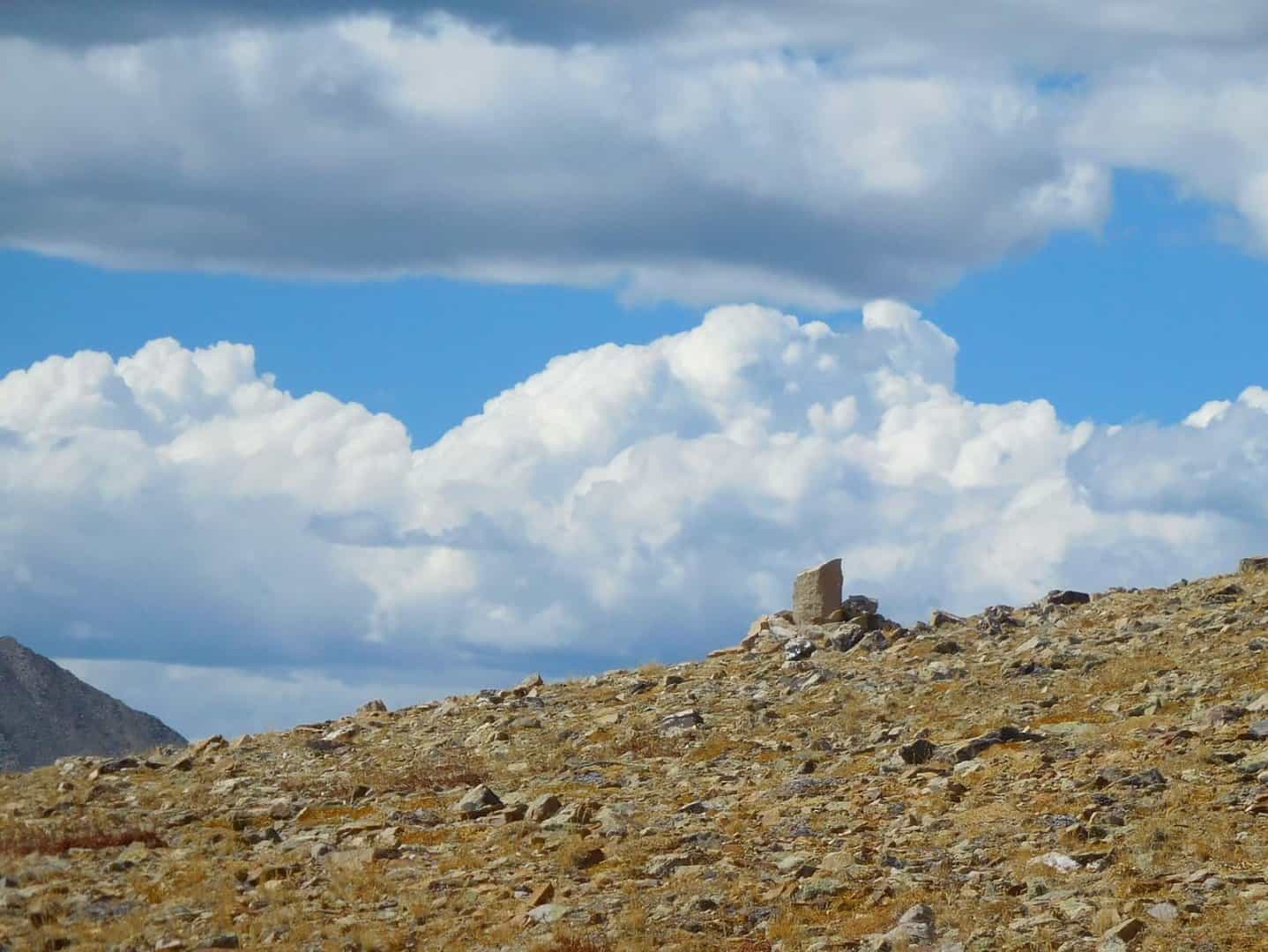
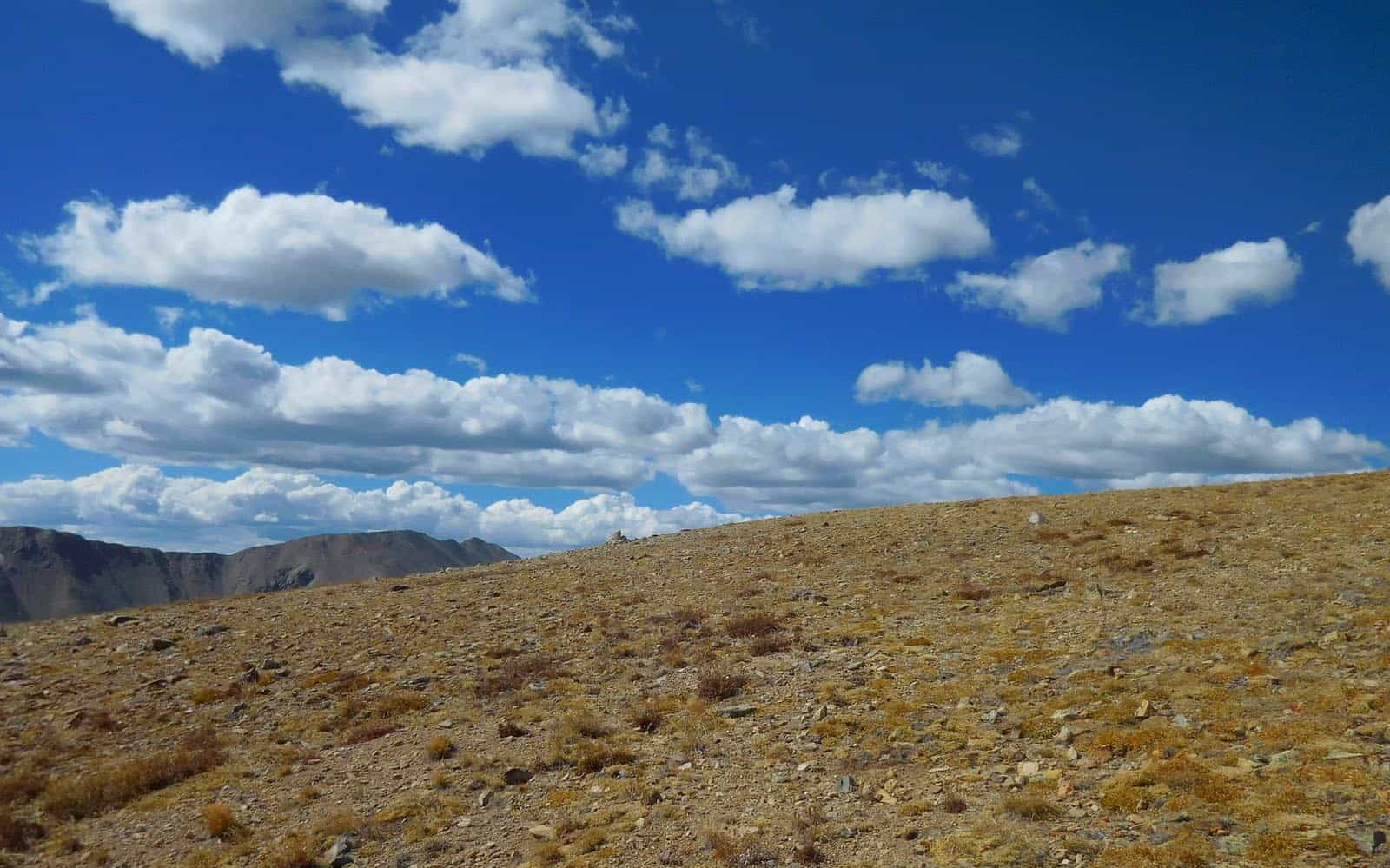
Don't know why I can't edit the previous post to add a couple of photos....oh, well.
From today's outing, a close-up and photo of Cor. No. 3, Social Fund Lode, ellipsoid height = 13,403.64 ft.; orthometric height (from GEOID12A) = 13,445.68 ft, NAVD88

Shawn Billings, post: 392964, member: 6521 wrote: If I were surveying in the mountains, I would include elevations. Horizontal distances without elevations don't mean much with big differences in elevation.
Where I work, this isn't an issue.
Actually, just quoting the CSF at intermediate points along some boundary is perfectly adequate for retracement purposes. It's understood that errors of +/-20 ft. in elevation only make +/-1ppm difference in some grid distances projected to ground scale, right? So, while I'm sure we all want to appear to worry about uncertainties of +/-0.005 ft. per mile on a land boundary, I can't imagine that ever happening in reality.

I like your idea about ECEF coordinates, Gene. That way only a knowledgeable person could use it (and that would leave out some surveyors as well). I can just see it now...they would belittle our work because the elevation is listed as 4,611,105.345 meters.


Kent McMillan, post: 393098, member: 3 wrote: Actually, just quoting the CSF at intermediate points along some boundary is perfectly adequate for retracement purposes. It's understood that errors of +/-20 ft. in elevation only make +/-1ppm difference in some grid distances projected to ground scale, right? So, while I'm sure we all want to appear to worry about uncertainties of +/-0.005 ft. per mile on a land boundary, I can't imagine that ever happening in reality.
In mountainous terrain (which I have not practical experience surveying in) I'd think simply providing the elevations of each monument would allow a competent surveyor to determine the combined factor as needed, as well as providing the elevation of the surface to which the horizontal distances were related. I suppose listing multiple combined factors in an description would work as well.
Before talking with Loyal a few years ago, I'd never considered how a survey could misclose significantly when using only the classical means of calculating horizontal distances from point to point (discounting elevation above the curved Earth). It's not something I experience here in East Texas, but it's interesting nonetheless.
Shawn Billings, post: 393171, member: 6521 wrote: In mountainous terrain (which I have not practical experience surveying in) I'd think simply providing the elevations of each monument would allow a competent surveyor to determine the combined factor as needed, as well as providing the elevation of the surface to which the horizontal distances were related.
Actually, what works well in the mountains is expressing the distances as grid distances in some standard projection and quoting the CSF at either each corner or when it changes significantly. That allows a survey following the work conventionally to readily compute the surface distance between corners, which will, of course vary depending upon the station from which the distance is measured.
That same scheme works perfectly well over large projects where the CSF changes significantly.
I've attached a pdf of a metes and bounds description of a fairly good-sized tract in far West Texas as an example.