

Brian McEachern, post: 367689, member: 9299 wrote: Unfortunately the county does not show any recorded reference monuments for the section corners on record. The county does however publish NAD90 coords for each with the specified scale factor. Unfortunately the stamp RTK on it joke holds true for many...
"NAD90" Oh Boy.... (I pretty much know what they "mean," but that ain't what they "say.")
Loyal

What the heck is NAD90?
Dave Karoly, post: 367693, member: 94 wrote: What the heck is NAD90?
Dave,
I'm pretty sure that "they" are referring to the 1990 Florida HPGN/HARN adjustment.
It's still NAD83, but as we all know, there is multiple realizations (flavors) of NAD83.
Loyal

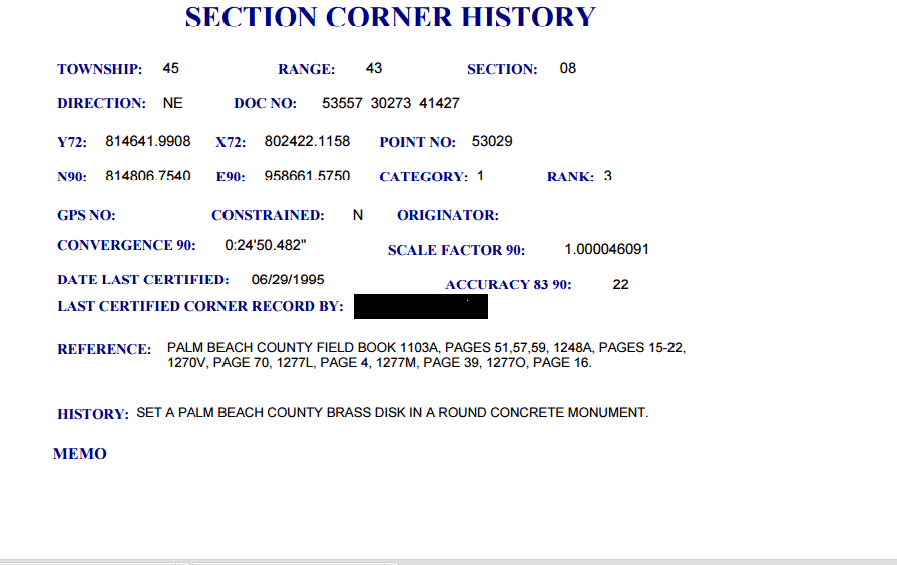
Here is the county corner record.
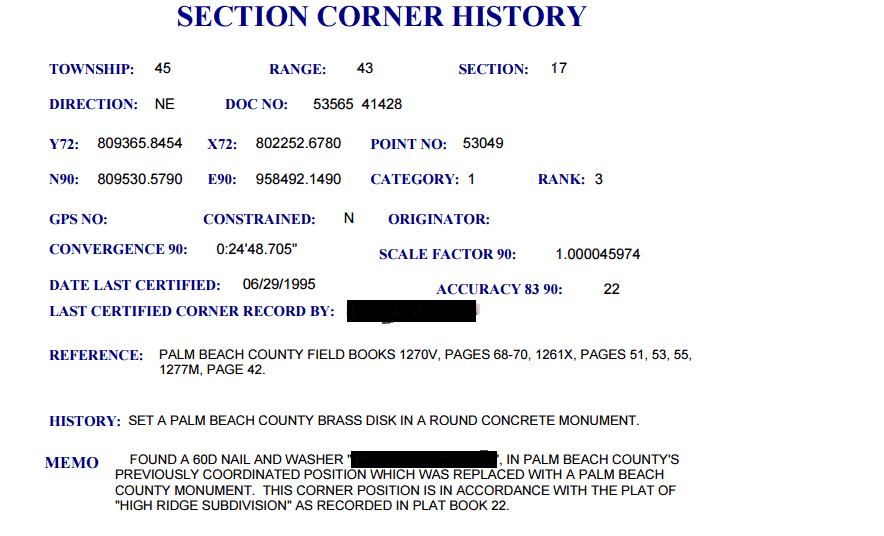
Here is the record referencing the '90 adjustment Loyal is talking about.

I like to think I understand the pincushion argument but I would like one thing clarified is that in a non reporting state, how do you know the mark you found is actually correct?
What happens if the previous surveyor has done a poor job and your method is better?
By this question I'm asking about differences that do not fall within the realms of purely measurement issues.

The most common way to research monuments is to read the history of deed descriptions of the adjoining property as well as the property being surveyed.
Discovering the former surveyor is a plus and and to have common knowledge of what other surveyors of your area set for monuments.
Senior and junior rights come into the picture and the part of being the original surveyor or not is another factor.
Most of the time, being better at measuring has nothing to add to the location of the corner. That is how most pin cushions happen.
That and the fact of not finding any monument and setting one that happens to be right next to the existing one.
Then there are the goat stakes that people place that start out driven a little in the ground and then most out of the ground to locate the monument after the weeds have overgrown and then thru the years are driven down farther and farther until they are practically identical to the level and location of the actual monument. goat stakes are usually not what a surveyor would normally set, then again, they are the same. Then your expert measuring skills come into play.
😉

X72, Y72?, is that a county coordinate system? I see it was done in 95 on a NAD83 (90) system. Here the big shift in coordinates was (86) to (93), one local county has a 88 system, and no they aren't confusing NAVD88 with NAD83 it's just when they got the system going. These coordinates were done conventially, not GPS?

Dave Karoly, post: 367693, member: 94 wrote: What the heck is NAD90?
https://www.google.com/?gws_rd=ssl#q=90+nad+to+us+dollars&apos ;">About $6.18

Two is better than none.
MightyMoe, post: 367710, member: 700 wrote: X72, Y72?, is that a county coordinate system? I see it was done in 95 on a NAD83 (90) system. Here the big shift in coordinates was (86) to (93), one local county has a 88 system, and no they aren't confusing NAVD88 with NAD83 it's just when they got the system going. These coordinates were done conventially, not GPS?
Apparently it was done conventionally with class II accuracy. Not too much more to go off of.
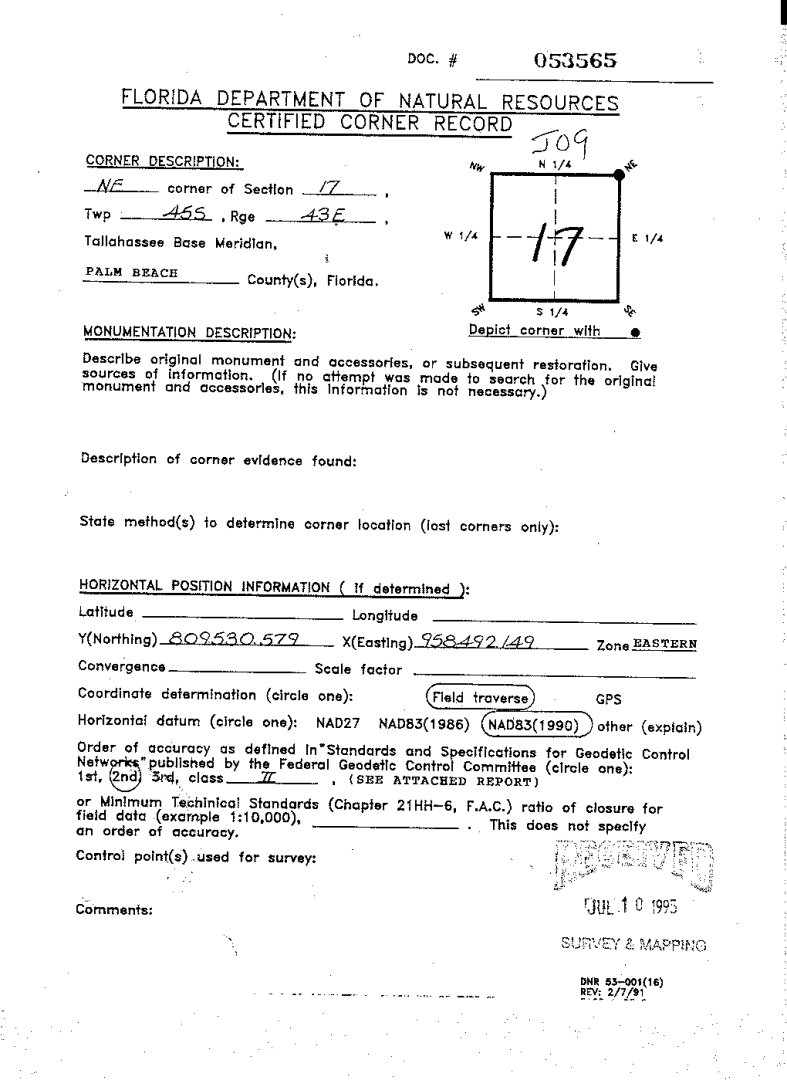

Brian McEachern, post: 367717, member: 9299 wrote: Apparently it was done conventionally with class II accuracy. Not too much more to go off of.
So this looks likes a record of somebody developing a geographic position for the corner.
Are there no records of how the monument itself was established?
Sure makes me glad to work in a recording state where corner history is easier to develop and verify (usually).

Kevin Samuel, post: 367727, member: 96 wrote: Are there no records of how the monument itself was established?
I'm going to guess that the basis for re-establishment of that corner is indicated by the following note that appears in the "Section Corner History" record above:
"This corner is in accordance with the plat of 'High Ridge Subdivision' as recorded in Plat Book 22"
What I get out of that is that the section corner was shown in relation to some monumented corners of lots or blocks on the plat of High Ridge Subdivision and ties from those provided the control from which the section corner was determined. The multiple opinions may reflect the position of the section corner as determined from alternate subsets of subdivision monuments. Just a guess, though. It would be interesting to know.
Looks good to me, they replaced an existing monument with a new one.
They show it on the county control network, presumably a state plane system, East zone. 1995, conventional equipment, tied to record, supported to an existing subdivision, a nice monument,,,,,,,,,,,,,,,

Requiring state plane coordinates is a pile of stinking BS. That burden should not exist.
Thousands of you will disagree. That's OK. But that indicates you are either privileged, employed by someone else or in deep debt.
One more roadblock for the new startup.
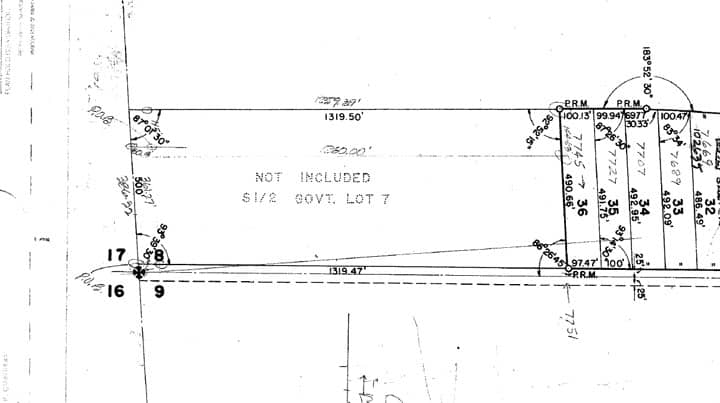
Here's a pdf of the plat of "High Ridge Subdivision" from 1947, courtesy of Palm Beach County.
This detail shows what appear to be the origins of this misadventure in monumentation:

Seb, post: 367704, member: 7509 wrote: .... in a non reporting state, how do you know the mark you found is actually correct?
There are no recorded surveys but there is the original PLSS field notes and plats, subdivision plats, and deed descriptions. So you check measure to whatever is available and deduce what you can.
Kevin Samuel, post: 367727, member: 96 wrote: Are there no records of how the monument itself was established? Sure makes me glad to work in a recording state where corner history is easier to develop and verify (usually).
That CCR looks very much like the CCRs used in Oklahoma. (Similar records are an option in lieu of Records of Survey - in specific circumstances - in Washington State). Most of the time you get a statement of what is present at a corner with some references and not much more. Largely, roads follow section lines and when you find something that looks like a monument at or near a CL/CL intersection you do your happy dance.
Holy Cow, post: 367733, member: 50 wrote: Requiring state plane coordinates is a pile of stinking BS. That burden should not exist. [...] One more roadblock for the new startup.
As inexpensive as GPS gear is, why in the world would any "new startup" even consider not having that capability? Once you have GPS, state plane coordinates are essentially free and a natural choice. They add huge value to the long-term utility of any survey. While I'm sure that there may be a dozen people who think that all a surveyor should need to practice is a total station and a few who would say "fiberglass tape", that train left the station years ago.
Wow!!
They did a state plane survey,,,,,,,without GPS!!!!!!!!
Real surveyors I say
Ah, but many people that do surveying work do not have a need to actually learn anything about GPS except how to push a button, if even that much. They work at surveying every day and feel very qualified to provide virtually every kind of service for which they have much experience, but have no need to comprehend ellipsoids, projections, etc. They have laid out thousands of subdivision lots and resurveyed thousands of existing tracts with no need for that extra, higher level of thinking, type of experience. But, if they dare to take on a job where the publishing of state plane coordinates is mandatory, their confidence level plummets and their cost of operation goes up. They can do the job very competently. They may skip that opportunity simply because of one extra layer of BS being required that is not necessary to meet the requirements of their client. It is an impediment. It is also easy for those who use a certain tool every day to criticize those who do not. To hell with elitists who firmly believe their method is the only acceptable method. Perhaps we should return to the days where a degree in engineering plus passing of the professional engineer's exam be required to be allowed to practice land surveying. Put the shoe on the other foot. Perhaps a second degree in geodesy should be required before allowing one to stake out new houses on existing lots.