

Surveyors are focused on two things:
1) Precision, we love precision. We love it so much we can find it in an Appellate Opinion that says nothing about precision.
2) Fences, oh my gawd can't hold the fence don't wanna be a fenceline surveyor, I know for sure it's not the fence, gotta be somewhere else, can't be the fence.
The ground is supposed to control the paper but records are easy to find and math and measurements are easy to apply.

Are any of the references in as shown on the back side of the ccr 41428? ftp://146.201.97.137/ccr/bydocno/ccp04/00414282.tif
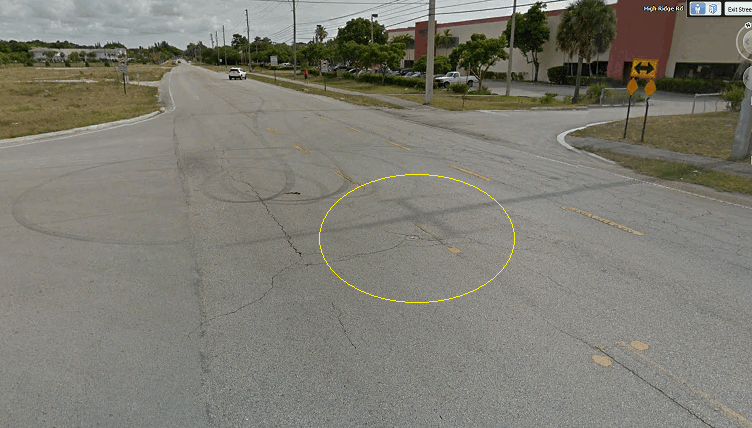
I think the monument is visible in Google Street view.

Dave Karoly, post: 367879, member: 94 wrote: Surveyors are focused on two things:
1) Precision, we love precision. We love it so much we can find it in an Appellate Opinion that says nothing about precision.
2) Fences, oh my gawd can't hold the fence don't wanna be a fenceline surveyor, I know for sure it's not the fence, gotta be somewhere else, can't be the fence.The ground is supposed to control the paper but records are easy to find and math and measurements are easy to apply.
[SARCASM]Just stop it, you're getting silly...[/SARCASM]

makerofmaps, post: 367901, member: 9079 wrote: Are any of the references in as shown on the back side of the ccr 41428? ftp://146.201.97.137/ccr/bydocno/ccp04/00414282.tif
Unfortunately unless there are any recent ones set, the part of the intersection where those references are was just re-done and widened considerably.
Dave Karoly, post: 367938, member: 94 wrote: I think the monument is visible in Google Street view.
It sure is!

Holy Cow, post: 367777, member: 50 wrote: Again, what fraction of the overall examination process dictates the examinee already be proficient in geodesy and statistics?
The problem comes from those outside the survey profession who insert BS requirements into the surveyor's work for no other reason than it might be convenient for them someday. The client needs something rather simple but some bureaucracy has decided that simple is bad. So, the surveyor must provide information that is of no value to the client who is the one paying for the project. Cutting a two by four to a certain length can be accomplished successfully with a hand saw and a carpenter's square. But, if the bureaucracy dictates all such lumber is to be laser cut with the aid of a micrometer, the cost of doing business just went through the roof.
I agree in my area we are required to list the state plane coordinates on everything from subdivision plats to public easement plats. So that the county can add the information to the gis system, which is a rediculous requirement that has nothing to do with the purpose of plat. It's just like having a county planning tech tell me to add an arrow to a row dedication from my note which has an asterisk as the symbol denoting the acreage and dedication on an already congested plat. Anyone with any common sense can see that the asterisk in the area being dedicated is referring to the note with an asterisk above is stating the area being dedicated. But in order to get anything approved in my area you must bow down to your masters.

The monument has a pre-punch mark when set and then a surveyor decides he didn't set it close enough and adds another. I have found many like that set by the highway department but the funny thing is, if you locate the monument on the other side of the right-of-way and there could be a couple of tenths of error. Monuments move with time, it's just a fact. In my younger days I would pound rocks adjacent to a rebar until it was within a hundredth thinking that would help with movement just to discover a few years later the monument had moved. Now I strive to set the monument as perpendicular to the ground as possible and with the least resistance possible. There was a thread sometime back about the accuracy of set vs found monuments. I always use monuments I found before monuments I set for control. A monument found is less likely to move then a monument that was located when it was set. Getting back to the punch mark, this surveyor thought he needed to be more accurate and not accept the pre-punch mark for a few hundredths but he didn't leave his identification, not to mention the township and range. If the coordinates were that important he should have accepted the existing punch mark as the section corner and then reported the coordinate values.
Just my .02
billvhill, post: 368076, member: 8398 wrote: The monument has a pre-punch mark when set and then a surveyor decides he didn't set it close enough and adds another. I have found many like that set by the highway department but the funny thing is, if you locate the monument on the other side of the right-of-way and there could be a couple of tenths of error. Monuments move with time, it's just a fact. In my younger days I would pound rocks adjacent to a rebar until it was within a hundredth thinking that would help with movement just to discover a few years later the monument had moved. Now I strive to set the monument as perpendicular to the ground as possible and with the least resistance possible. There was a thread sometime back about the accuracy of set vs found monuments. I always use monuments I found before monuments I set for control. A monument found is less likely to move then a monument that was located when it was set. Getting back to the punch mark, this surveyor thought he needed to be more accurate and not accept the pre-punch mark for a few hundredths but he didn't leave his identification, not to mention the township and range. If the coordinates were that important he should have accepted the existing punch mark as the section corner and then reported the coordinate values.
Just my .02
Or was it another surveyor coming back years later who did not agree with the position of the locally accepted corner? I would think that the surveyor would have at least made mention of not using the factory center punch in the certified corner record if he set a different punch hole.