

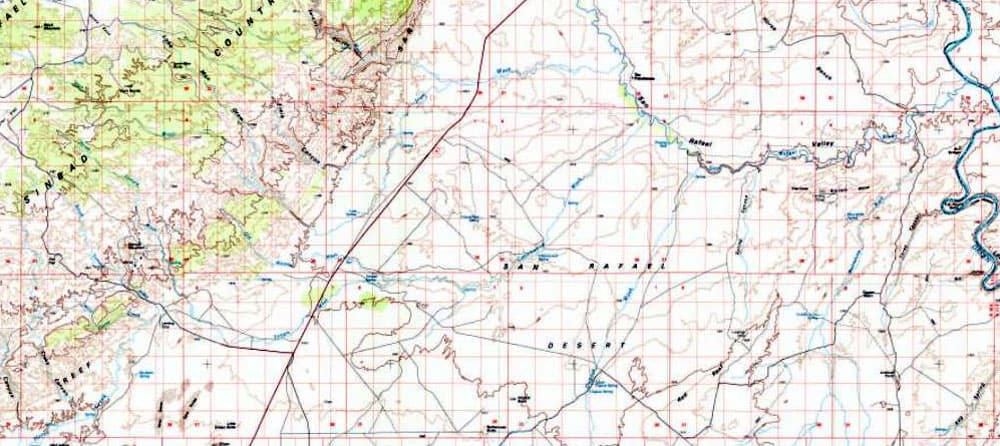
And San Rafael Desert Quadrangle in Utah also looks pretty typical:

Scott Ellis, post: 440558, member: 7154 wrote: I am sure I would enjoy the retracing mineral survey, however I would also get very bored of seeing squares all day long.
I will admit the work you do is not in the normal PLSS survey, it takes more Skill and I am sure is difficult at times.
My preference is to think that each state has its unique challenges, quirks and nuances, but that in general land surveyors from different states have a lot in common. I'm sure that surveying in a Houston subdivision is not too much different than surveying in a Denver subdivision. I also realize that metes and bounds surveys most often require more research, time and thought than more orderly surveys. I choose to not define the extra effort as being complex.
I'll stop with my screeching about what is complex or simple and post a couple of examples in the Cripple Creek area that demonstrate some of the uniqueness of mineral surveys. Please feel free to comment.
Besides, the Cripple Creek examples will likely be cathartic for Kent. I'm sure he will have fun commenting on my blizzards of lines! 🙂



Kent McMillan, post: 440476, member: 3 wrote: Well, in a typical PLSS township, if you wanted to verify whether there was any unsurveyed state or federal land adjoining some section of land that was the object of your survey, what beyond an examination of the township plat and the records of patents issued by reference to it would you feel obliged to do?
You sure as hell better look at the Master Title Plat! The Indian Reservation Grants are also critical, as are the Mexican Land Grants.
Scott Ellis, post: 440559, member: 7154 wrote: What percentage would you say was already surveyed before the PLSS system?
It is not a claim of superiority, but a stated and know fact that Thomas Jefferson invented the PLSS to make Surveying easier.
He actually invented it in order to keep an organized record of what Federal Lands had been disposed of so that they were not sold twice, and to establish a proper cadastre. The elegant system he came up with was the result.
Scott Ellis, post: 440559, member: 7154 wrote: What percentage would you say was already surveyed before the PLSS system?
It is not a claim of superiority, but a stated and know fact that Thomas Jefferson invented the PLSS to make Surveying easier.
He actually invented it in order to keep an organized record of what Federal Lands had been disposed of so that they were not sold twice. The elegant system he came up with was the result.

Face it, Texas has the Surveyor's Full Employment Act with their deliberate hodge-podge of "subtractive" lands. So much for protecting the public.
"Mine is more complex than yours!" says I'm working in a stupider system.
And I'll bet you will never find a "square" in the PLSS.
Dave Lindell, post: 440578, member: 55 wrote: Face it, Texas has the Surveyor's Full Employment Act with their deliberate hodge-podge of "subtractive" lands. So much for protecting the public.
You're right that the system of land grants adopted in Texas does take a higher class of surveyors to make it work well. The system shifts the burden to licensees rather than offering a saw to cut some corners.
"Mine is more complex than yours!" says I'm working in a stupider system.
Yes, simplicity is pretty much always a mark of high intelligence. This is why as many things need to be idiot-proofed as possible, because of the high intelligence of the users.
And I'll bet you will never find a "square" in the PLSS.
Well, as long as there's a fence post or a county road pavement nearby, does it really matter?

paden cash, post: 440549, member: 20 wrote: I think he's trying to compensate for the fact his momma used to have to tie a pork chop around his neck just to get the dog to play with him. 😉
LOL

here is another try at the same theme as my first attempt:
Colonists: Existing metes and bounds system is HARD
Colonists-turned-founding-fathers: Lets invent something EASY, like square townships, square miles, square quarter sections........what could be hard about that?
warren ward PLS CO OK, post: 440623, member: 12536 wrote: here is another try at the same theme as my first attempt:
Colonists: Existing metes and bounds system is HARD
Colonists-turned-founding-fathers: Lets invent something EASY, like square townships, square miles, square quarter sections........what could be hard about that?
Except Thomas Jefferson's ideas about the rectangular survey also embodied a simple means of organizing settlement, one that occurred in universal space without the particulars of topography to interfere. This is why the PLSS looks more regular (with named townships) until you get to California where nothing is ever regular.

Thanks very much for all the responses.
It seems to me that IF a PLSS area was adequately monumented, and competently measured then subsequent retracement or subdivision would have been money for jam. Sounds nice in theory.
Many folks give Thomas Jefferson sole credit for developing the PLSS system. In general terms, his vision of a rectangular survey system was adopted. However, if he had not assumed the post of Minister to France when his "plan" was finally adopted, the PLSS may have looked quite different.
The Continental Congress in December 1783 instructed a committee headed by Thomas Jefferson to prepare a report on dispositions of public lands and other issues. The committee's report (including a recommendation for a rectangular method of dividing the land) was submitted to Congress and approved in April 1784.
Jefferson's committee had proposed a decimal-based system where the land was first divided into a Jeffersonian Hundred. The Hundred was 10 geographic miles square and composed of 100 lots, each being 1 geographic mile square. The lots were numbered starting at the northwest corner of the Hundred and increased to the east. The second tier was number from west to east as lots 11 through 20 with this pattern repeated for the remaining 8 tiers (Lot 100 was in the southeast corner of the Hundred). The area of each lot (1 geographic mile square) was to be 1000 (reformed) acres (850.4 acres), with lineal dimensions of 100 (reformed) chains equaling 1 geographic mile.
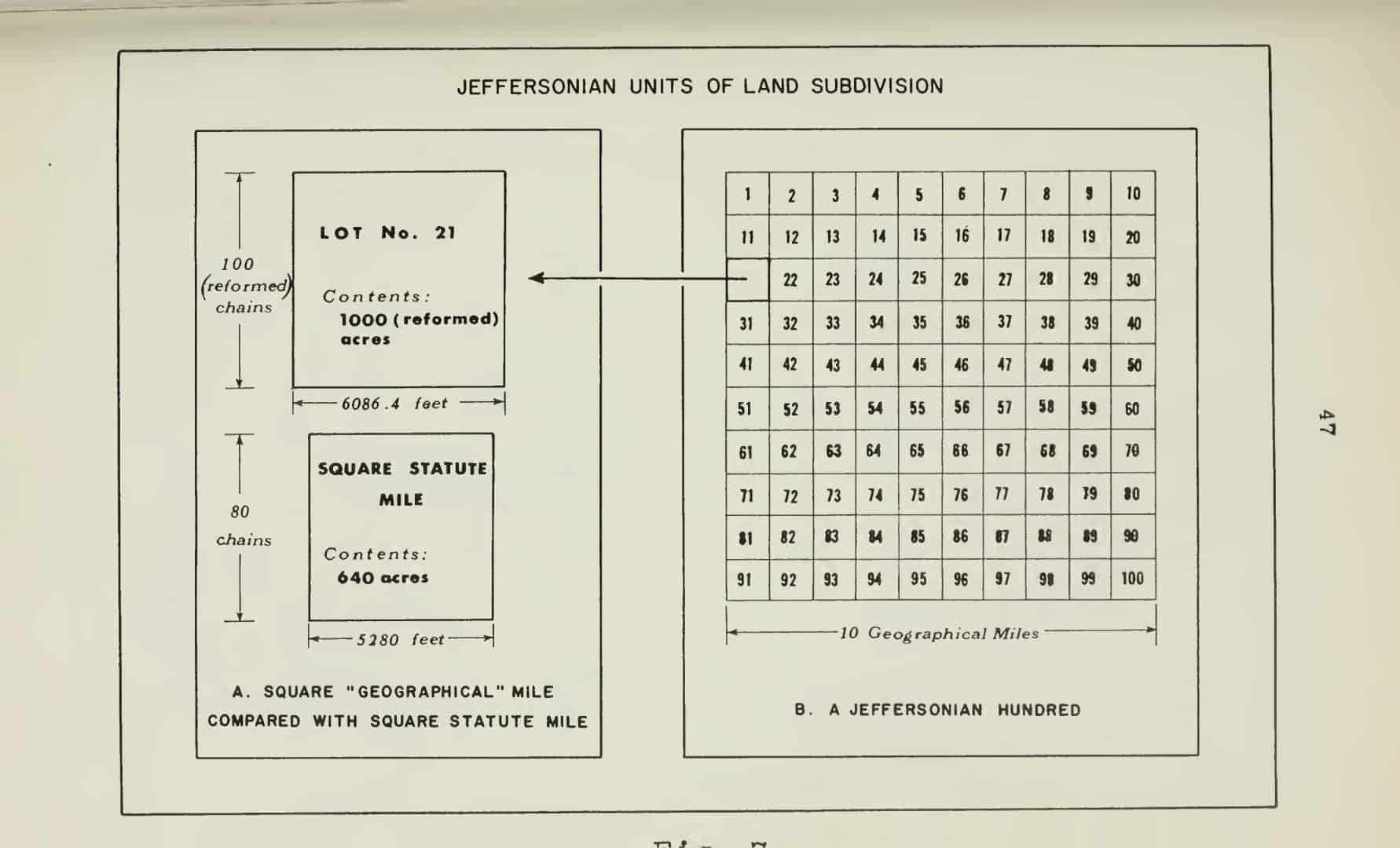
Attribution: "Beginnings of the American Rectangular Land System", William D. Pattison, Univ. of Chicago Press, 1957, page 47.
On March 4, 1785 with Jefferson in France, Congress submitted the Jefferson committee's report to a new committee headed by William Grayson. The new committee scraped the decimal system favored by Jefferson, who was keen to have the land system mimic his desire for a decimal-based coinage system. Grayson's committee submitted the revised report in April and on May 20, Congress passed the Land Ordinance Act of 1785.

One of my old mentors had a saying that in the Colonial System you surveyed the land where it was located and in the PLSS System you surveyed it where it was supposed to be located.

Jim in AZ, post: 440576, member: 249 wrote: He actually invented it in order to keep an organized record of what Federal Lands had been disposed of so that they were not sold twice, and to establish a proper cadastre. The elegant system he came up with was the result.
Metes and Bounds could have also been used to keep track of Federal Land being sold, PLSS was used because it is easier.
What is Elegant about rows and and rows of squares?
gschrock, post: 440567, member: 556 wrote: Would not matter if it was 5% or 10%, or whatever, folks in PLSS states still have to know how to work in both PLSS and metes and bounds situations. And there are enough peculiarities in states of all kinds (e.g. we have some very peculiar riparian rights issues here) that present surveying challenges anywhere.
How many surveys have you performed in your state, that was surveyed first by metes and bounds, and not in the PLSS system?
If you tell a skilled surveyor that he has it easy you will get extremely knowledgeable people offended by downplaying their knowledge or skill. I think I heard Ty is surveying in Texas now, I wonder how that sits in Kent and Kent-Junior's craw. We know that everything's bigger in Texas...but I'm not sure if that just means that everyone's ego is bigger down there. You know guys....if you don't like that Texas is not the largest State, they could just cut Alaska in half .... and Texas could be the 3rd largest state (that was an old joke floating around back in 1959 according to my dad)
I have never meet a Texan that was bothered that Alaska is bigger than Texas, the only thing Texas had to do when Alaska became a State was change a line from the State Song.
I do not know who Ty is, but I hope he Surveys like Kent, someone who take the time to do the proper research, willing to go back to the courthouse or the GLO to do more research based on what he does or does not find in the field. Looks for all of the property corners on the subject and adjoining tracts. Takes the time to find the center of the monument not just say hey great I have a 2 foot diameter rock pile, I can use the 2 feet to throw any error I need into the 2 feet. Sets monuments that permanent and retractable. Also willing to share his field notes with a Surveyor who is surveying near by.
I can see why some surveys who take short cuts or just plan lazy, do not like the way Kent surveys, Kent makes them look bad. I know quite a few Surveyors in Texas that survey the same way Kent does.

Scott Ellis, post: 440675, member: 7154 wrote: How many surveys have you performed in your state, that was surveyed first by metes and bounds, and not in the PLSS system?
That number would be zero. While that may make a difference in the research phase I doubt that it makes any difference thereafter. Plenty of metes and bounds parcels have been cut by description only from sectional lands.
Scott Ellis, post: 440677, member: 7154 wrote: I do not know who Ty is ...
Ty is a surveyor from Shawnee, Oklahoma, unlicensed at the time he was most active, who was a very regular poster to an earlier iteration of this discussion group. He tended to assert his opinions very strongly and get quite "emotional" when anyone contradicted him, which was often. I doubt that he surveys like Kent.

Scott Ellis, post: 440677, member: 7154 wrote: I have never meet a Texan that was bothered that Alaska is bigger than Texas, the only thing Texas had to do when Alaska became a State was change a line from the State Song.
Texans have a unique reputation of thinking they are the biggest and the best. I'm sure that was the basis of the joke. (note to self....make sure and explain your jokes to your Texas surveyor brethren)
I do not know who Ty is, but I hope he Surveys like Kent, someone who take the time to do the proper research, willing to go back to the courthouse or the GLO to do more research based on what he does or does not find in the field. Looks for all of the property corners on the subject and adjoining tracts. Takes the time to find the center of the monument not just say hey great I have a 2 foot diameter rock pile, I can use the 2 feet to throw any error I need into the 2 feet. Sets monuments that permanent and retractable. Also willing to share his field notes with a Surveyor who is surveying near by.
I can see why some surveys who take short cuts or just plan lazy, do not like the way Kent surveys, Kent makes them look bad. I know quite a few Surveyors in Texas that survey the same way Kent does.
I think you nailed ty to a tee. I don't think he was quite that good when he worked out of OK, but once he mastered OK Surveying he moved up to Texas.
It sounds like Texas Surveyors are a style of Engineer wanna-be's. They want to run around telling surveyors they are superior but had to figure out what makes themselves "not-a-surveyor". I always wondered about guys that think they have to explain how intelligent and superior they are.
Okay, enough. I swore I wouldn't get into this little better-than-thou discussion, and then I jumped right in feet-first.
Yes, you surveyors in Texas are very good. The metes-and-bounds system is very complicated and the Texas m-&-b system is extra hard.