

Me too, they are the first called for in the description.

This discussion reminds me a bit of the old "stone vs. pipe" discussion courtesy of Deral in Oklahoma a few years back.
Arguments can be made for either option. I would probably go with the monuments set and called for in the description for several of the reasons others have already mentioned. The surveyor's assumption that these were placed along a certain easement line is what appears to be in error.
We have an odd circumstance in my home county involving a railroad right-of-way. Every other line constructed anywhere near here has a standard total width of 100 feet, being 50 feet either side of the center line of the tracks. Exceptions would occur in areas where cuts and fills were required, of course. There is one railroad where this is not true. The right-of-way is a total of 200 feet, being 100 feet either side of the center line of the tracks. There was even a State supreme court decision upholding that width many years ago. However, nearly every fence constructed parallel to the tracks over the past 140+ years has been placed and maintained at 50 feet from the center of the tracks. Many tracts have been severed such that one side is stated as being along the railroad right-of-way line. When we set our monuments 50 feet from existing fences and tree lines, someone normally gets inquisitive. This is usually the seller who is selling by the acre and wants to gain some extra payment for land that is not his land.

I agree that there is simply not enough evidence found yet.
Why was the area condemned? For what purpose? What are all the specifics of the condemnation? Why did it apparently need to extend to the easement? Or did it "need" to extend to the easement? In other words, why was the easement boundary even a consideration in the original conveyance?
The latent ambiguity allows us, no, requires us to leave the deed - we need to find intent. To do that we need to place ourselves in the time and circumstances of the parties to the conveyance.
Keep digging. Hopefully it will become clearer.

What are you going to find out? At most the government screwed up by not acquiring enough property. I don't think they get another 25' because of their screw up. This is an action in eminent domain, not an ordinary deed transaction. If they failed in their due diligence then that is on them. I think the answer is clear enough by staying within the four corners of the description.
They paid for 210 acres, they got 210 acres. There is really no need to muddy the waters.

lmbrls, post: 345995, member: 6823 wrote: To be clear. There is no ownership gap either way. Ga Power has an easement. They are not the owner. The line described in the deed was created by the Declaration of Taking. The Defendant had a remainder piece. The Defendant later sold their property to another entity and the deed uses the monumented line. If the easement line had been an existing property line, it would be a slam dunk.
If there isn't a gap and the monuments represent occupation, then I would go with the monuments. I originally envisioned a partially occupied easement with landowners not paying homage to the monuments.
Steve

I have witnessed many a land owner that did not pay homage to existing monuments......

The call is to the marker. The marker was set on what was BELIEVED to be the RW at the time it was written. That is, the scrivener, saw NO difference between where the markers were set, and where he placed them. So, he did it in good faith. So, I say, MARKERS HOLD. I would however note the difference, on my plat, and place into my "REPORT OF SURVEY" that I believe I am following what the person who ESTABLISHED of the line meant. And, I'd show the actual RW line.
Another way to say it, is I'd give my opinion, but I'd leave a paper trail behind, so that somebody that differed could climb over my logic, if they wished. But that would not change my logic.
N

Unfortunately, all the descriptions in this area have been very bad. This one at least made an attempt to establish a point of beginning. Most just start at a poorly described corner and give a mixture of compass and transit bearings relating to partial resurveys from the 50's for original surveys from the 30's. Tracts are crossing a County Line with no mention of which calls are in which County. This Deed was at least good enough for us to determine that there is ambiguity. It is bad when the deed are so bad that the errors are hidden. The saving grace is that the lines have been marked and maintained since the 50's.

For something like this there is usually a story that explains it, some history pertaining to the monuments. I'm working on almost the exact thing now. The story explains it, I'd imagine it does here too

The monuments are physical and agree with the B-D. As long as the grantor owned the land represented by the description, that's what he sold and where the boundary is.
So, they were mistaken as to the location of the easement. That's unfortunate, but doesn't change the boundary location, in my opinion. You can see the monuments, you can't see the easement boundary. It'd be different if it were a lake, stream, or road, something that you could physically see.
I've seen other situations where the dividing surveyor placed a boundary line along what he thought was the edge of a power line easement, based on the CL pole locations. He set rods at the new lot corners. Then I'm retracing it, and discover that the easement has its own M-B, not centered on the poles, which aren't the original anyway. So even though the plat and deed for lot 1B indicate no power easement, with its boundary along Lot 1A and the power easement, I'm holding the B-D deed description and rods, and there actually is an easement over lot 1B. I'm not going to hold the easement boundary instead, just because the other surveyor didn't read the easement deed, located the it incorrectly, and used that as his lot division line.
I appreciate everyone's comments. As I look back, my original post was severely lacking important information. It was an omission on my part and not an attempt to add more information for a gotch you. I will attempt to try to sum up the information.
Evidence and process to date:
- We have reviewed the Title Report related to the Declaration of Taking.
- A researcher from our office who happens to be an attorney performed a title search from the 1900's forward. His report was the most excellent complete report that I have ever reviewed. This courthouse had a fire in 1910 and of course Mr. Sherman burn it to the ground in his march to the sea.
- We contacted Ga. Power and received their information.
- We performed field work and located the property and easement evidence.
Some of you have indicated that we need to get more evidence. I will be going back to the courthouse and coming from the 1900 to current just to make sure (CYA). The deeds are very poorly indexed and several corporate exchanges within large timber companies makes an accurate chain of title challenging. Ok can anyone think of something else we should do? I put this issue on the site to get a 360 review.
Facts of the issue:
- The parcel was created by the Declaration of Taking. The parcel came out of a larger piece so the condemnee had a remaining parcel.
- In a Condemnation, the need for the action must be justified and just compensation must be given.
- The monuments were used when the original condemnee solded the remaining parcels.
- Does the monuments or the true easement line best represent the intent of the deed?
My thoughts:
- The calls and area described in the deed evidenced by the monuments best reflect intent which I will explain in 2.
- I am not at liberty to give the exact Federal Facility in question. I will say that expansion areas limits that we are currently surveying are based on extensive modeling to provide justification for possible additional condemnations. This would indicate that they would have a hard time justifying the additional 25 feet. We are using power easement lines in other areas as the purpose of the facility is not something that should be done around power transmission lines. Therefore, I believe the original intent was to simply stay off the powerline easement. Also, the 25 foot strip between 150 and 200 foot easement represents almost 2 acres for which the government did not give just compensation. in my experience with condemnations, the area is a big deal. Attorneys would ask that the area be checked and double checked. The area to be condemned would be a part of the original filing and a change later in the area was a major problem which sometime resulted in having to refile.
- The monuments were relied upon by others.
- If the true easement line was a line where there was a change in ownership, I would completely agree that the intent was not to leave a strip. The call to and along the easement definitely would give intent. Ok the question is when the call is to an easement and not a change in ownership or anything that even benefits an adjoining owner, and the easement shown is proven to be in error, how does that override a monumented line that has been relied upon by both owners?
I have been looking up court cases and have not found anything that clearly (in my mind) addresses these issues. In the end, this is clearly an ambiguity in the deed. I can show it and have an opinion; however, I am not the judge and jury. Is the fact that this was created by a Declaration of Taking and not by agreement of two parties have an affect on this issue? I don't honestly have complete assurance that my understanding is supported by the opinions of the courts. I would be glad to see a clear court opinion on this.

Sounds like good reasoning to me. I may or may not have landed in the same spot, although with the knowledge that these monuments have been relied upon, I'm not as convinced I'd go with the easement line. I certainly can't fault you for the interpretation you've come to.
Also I believe estoppel may be in operation here. The government made a representation to the Court and the defendant of the size and extent of the taking and they marked it with concrete monuments. They are probably estopped from claiming an additional 25' of land due to their mistake of fact as to the location of the power line easement.

Dave,
I appreciate everything you say/said. However, it is conceivable that you could lay out the property to the "easement" line, and with all the other calls end up with the same area and not an additional 25'.
Regardless, I do see it as ambiguous. Coming to a resolution might be the best answer.

Looked at my "new pocket addition" of Black's, it doesn't carry the definition of along. This definition comes with appellate cites.
http://thelawdictionary.org/along/&apos ;">Along

Sounds like you've got enough to go with the monuments. The additional research you mention won't hurt, but not likely to turn up anything new given that you already had a competent researcher cover pretty much the same material.
Your reasoning seems solid.

lmbrls, post: 345983, member: 6823 wrote: Can anyone cite a case to dealing with the original intent of the deed as it relates to the following description? I have a very strong opinion as to how this should be handled, which I will state later. Here is the situation. The following description is taken from a condemnation involving a Federal Agency. The underlined calls are the ones being questioned by this Agency. The call is to a concrete monument set along a Ga Power Easement and then along the Easement to another concrete monument. We found the monuments and the measurement checkout in reason for this area with the deed calls. The point where I am being challenged is that the monument are not on the Ga. Power Easement. On the plat not referenced in the deed, the original surveyor called for a 200 foot Ga Power Easement. The Ga. Power Easement deed calls for a 150 foot easement, which places the monuments 25 feet from the easement. The Agency has asserted that the property line may be along the easement and not defined by the monuments found. What say you? A strong ruling by the courts would be greatly appreciated.
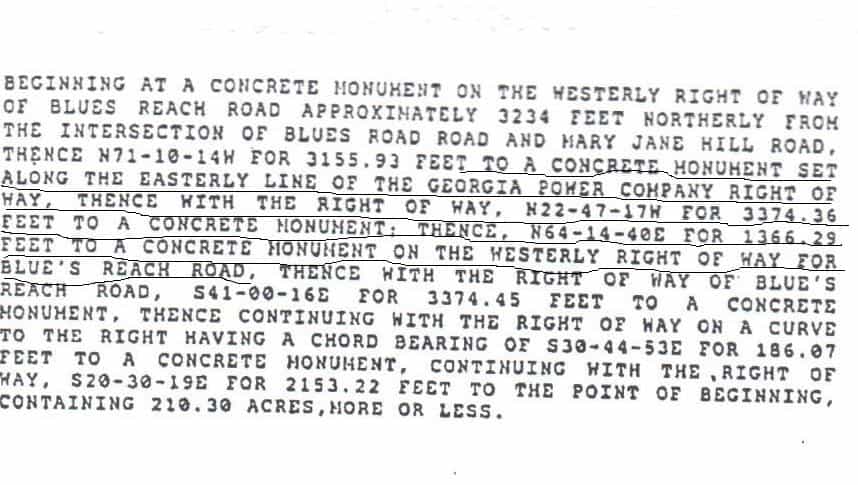
Unlike other boundary retracement, a taking is strictly construed to the measurements if possible. Here you have monuments that corroborate the measurements (note in a deed retracement you would say that the other way). The fact that some other call for a record monument is in conflict with the measurements is irrelevant. The government can't take an area it has not paid for. This is constitutional law, not contract law (deed).
Can't determine intent of a bargained for exchange when there hasn't been one. There is a mathematically written figure administratively taken from a citizen and no measurement error or additional verbiage can add or subtract from the area taken.
If you want to find a court case on it you will have to look at constitutional law cases, not boundary cases. Key words might be eminent domain, condemnation, etc..
As a rule and by law that is correct.
By practice the Government honors their new monument whether it was placed correctly or not.
In witness I know they are holding lands that they never purchased where original monuments and natural witness references prove their monuments to be wrong.
By the Government's virtue, they must agree with the wrong to allow the wrong to be righted.
Like that is gonna happen.........
Duane Frymire, post: 346642, member: 110 wrote: Unlike other boundary retracement, a taking is strictly construed to the measurements if possible. Here you have monuments that corroborate the measurements (note in a deed retracement you would say that the other way). The fact that some other call for a record monument is in conflict with the measurements is irrelevant. The government can't take an area it has not paid for. This is constitutional law, not contract law (deed).
That's a bit hard to swallow. If a legal description for a "taking" calls to or along a line, I would think that is a legitimate call. And you are saying that following a deed that comes from a "taking" is not a deed retracement? Are you saying that if the deed says "containing 7.000 acres" that you have to hold the acreage if it does not match the metes and bounds? If that is the case, what bearing and distances to you change to meet the acreage calls? If it calls to a property line and along that line, are you saying that that is not a significant call? If a taking is for 7 acres and they pay owner "B" for the 7 acres but half of the description is in owner "A"s property, are you saying that they still get 7 acres from Owner B?
Obviously you know the law better than I do, but I have a hard time with what you are saying.

Originally I was thinking you could go to the easement line, but the more responses I have read and the more I've thought about it I think you have to stop at the monuments. Those are pretty specific distances and you found the monument as called for. Perhaps the easement moved?