

The Georgia Power Company right of way is a called for record monument that should control. Another example would be a survey along a public or private road which used the wrong right of way width resulting in set monuments outside of the right of way. I would never in that case leave a gap between the parcel and the road right of way, if it was called for.

Apples and oranges. The Georgia Power Right of Way is an easement. They do not hold title to the land. They have the right to maintain and operate a transmission line. The easement line is not a property line. The owner has some rights (although very limited) within the easement. I would not leave a gap on a road right of way either.

Two different things.
A call to a public road shows the intent to provide access to the property.
A call to a private easement provides nothing. If the Federal property adjoins or does not adjoin the easement the feds have gained or lost nothing, they have no right to use of the private easement.

I use locative to mean it gets you in the general vicinity. Determinative means the object or record entity controls the boundary.
I have a survey where there are meanders done as early as 1906. They generally fit a ridge from modern Sectional control. Also the ridge wanders more the meanders would indicate, the 1906 Surveyor averaged the ridge to minimize angle points. I consider the ridge to be the boundary monument (because that is how they logged in 1906, down from the ridges) and the meanders are locative, they get you on the correct ridge and the ridge is determinative of the boundary location. The Deed doesn't call for the ridge but our adjoiner agrees with me (eventually this will become a BLA).
Bearings and distances in Deeds are usually locative, the monuments which fit within reason are determinative.
lmbrls, post: 345983, member: 6823 wrote: Can anyone cite a case to dealing with the original intent of the deed as it relates to the following description? I have a very strong opinion as to how this should be handled, which I will state later. Here is the situation. The following description is taken from a condemnation involving a Federal Agency. The underlined calls are the ones being questioned by this Agency. The call is to a concrete monument set along a Ga Power Easement and then along the Easement to another concrete monument. We found the monuments and the measurement checkout in reason for this area with the deed calls. The point where I am being challenged is that the monument are not on the Ga. Power Easement. On the plat not referenced in the deed, the original surveyor called for a 200 foot Ga Power Easement. The Ga. Power Easement deed calls for a 150 foot easement, which places the monuments 25 feet from the easement. The Agency has asserted that the property line may be along the easement and not defined by the monuments found. What say you? A strong ruling by the courts would be greatly appreciated.
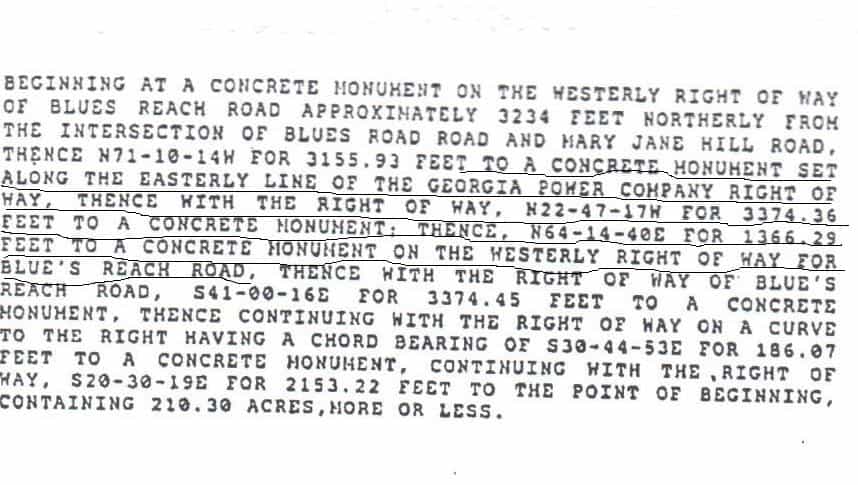
Just a gripe about that description...it should say "along the easterly line of the Georgia Power Company right-of-way as described in Book XXX/Page YYY of Records of ZZZ County"
I suspect that if the original surveyor had pulled that deed, to be able to include it in the description, we wouldn't be having this discussion.

I don't think you have enough info. Since a call to a RW is often treated as a call to a monument, and you've discovered that the monuments are not on the edge of the RW, I don't think that it's quite as clear cut as holding the physical monuments, wherever they may be. You've discovered a latent ambiguity (outside of the deed) that the monuments and the edge of the RW do not coincide as the deed writer presumed. Since latent ambiguities like this are discovered by the application of extrinsic facts, they must be resolved by seeking additional extrinsic facts to explain them.
What records were they working from when the deed to the parcel you are surveying was written?
Was it written based upon a field survey?
Were the monuments set by GP as part of the process of acquiring RW? Did the RW start at one width or location at the beginning of the acquisition process and then get moved or narrowed by the time it was actually acquired?
Were the monuments placed by mistake? Are they in a location such that they mark some other ownership or easement boundary?
What reasoning would the parties have had when the parcel was created to set the boundary at the edge of the easement? What reasoning would there have been to set it at the monuments? Do either of those just seem to not make sense with respect to land use and ownership?
I think that the answer to the question will turn largely on what records existing when the description was written show with regard to the monuments and whether or not it was written with the benefit of a field survey by which the monuments had been located.
If it was written based upon record, that record shows the monuments at the edge of easement, and the easement is shown correctly, then the edge of easement likely prevails. If the record existing when the description was written shows the monuments and edge of easement at different locations, then that places them at equal footing again, and it's best resolved by comparison to other description elements. (i.e. do the dimensions take you to the monuments or to the easement?)
If a field survey was performed in connection with the conveyance for which the deed was written, then they di, or presumably would have located the monuments in the field. In that case, the monuments control.
In the case of your meanders and the ridge, the meanders appear to approximate the ridge. In that case, you don't really have any conflict, simply the difference between the approximated meander courses and the more sinuous natural feature they were meant to approximate
The OP has discovered an actual conflict in the information provided in the description. According to the OP, the monuments appear to be clearly not set at the RW, or barring some systematic error causing a 25' off parallel placement, not set intending to mark the RW in its actual position. Unlike the expected differences between simplified courses of meanders compared to the natural feature they represent, there is a systematic and seemingly verifiable difference in location between the monuments and the easement rather than a difference that can be readily explained by reasonable differences in measurements. That makes it a very different problem.
May or may not be different things. First, most road RWs are also easements, the exceptions being where the RW conveyance document expressly states that it is a fee conveyance, or where statute or local ordinance provides that road RWs acquired by the state or local govt are to be presumed to be fee conveyances.
Second, the power easement may allow for distribution lines as well as transmission lines, in which case, service or intent to provide to individual properties may be a consideration.
Third, for purposes of this problem, I don't see the fact that the line called to as an easement line, or whether access to adjacent properties are really determinative factors. Whether or not access to adjacent properties was a consideration in establishing the boundary of the parcel being surveyed may be one fact considered in discovering which line they really meant to describe, but in itself is insufficient to resolve the ambiguity.
There is a conflict between the call for the easement and the call for the concrete monuments. The OP states the bearings and distances are accurate in that they fit the concrete monuments within reason. The description also states an area (which I haven't checked). From all this it appears that the government received what it paid for therefore the call for the easement should be disregarded because of the fact that all the other elements fit together and the call for the easement does not fit.
This is based only on the information given in the post; further research could change the answer.
Walsh v. Hill, 38 Cal. 481, 487 (1869): ÛÏIn conclusion, upon this branch of the case we deem it proper to say, that in the construction of written instruments, we have never derived much aid from the technical rules of the books. The only rule of much value - one which is frequently shadowed forth, but seldom, if ever, expressly stated in the books - is to place ourselves as near as possible in the seats which were occupied by the parties at the time the instrument was; then, taking it by its four corners, read it.Û
WHITE v. CLAUS SPRECKELS,, 75 Cal. 610 (1888): "What are boundaries is a matter of law; but where they are is a matter of fact. ( Bolton v. Lann, 16 Tex. 96.)"

Was the original survey and monuments set prior to the power easement being perfected?
The original easement survey could have been for a 200' easement and then it was changed to 150'. This could occur because the line construction method and/or voltage were switched. Poles instead of towers, etc.
I have surveyed along a tower line that was in what I found to be two side by side power easements. I imagine the original easement was for a pole line and when the switch was made to towers additional width was acquired. The towers were in the center of the combined easement. I have seen surveys along that same line were surveyors too lazy to do adequate research were calling for the original inadequate width centered on the tower line.
I take it the Feds want more land. Assuming that I imagine the line crosses to the far side of the easement and the Feds want to blow past the monuments to the easement.
Paul in PA

Shawn Billings, post: 346045, member: 6521 wrote: "Thence with the right of way" seems pretty determinative.
With or along ?
The bearings and distances misclose 0.011'N x 0.021'E and the area is 210.281 acres. The description doesn't give the curve radius but it could be calculated. The area is based on the chord data given. The record area is 210.30 acres. The curve would add area.

I don't doubt that the monuments agree with the measurements. The question is 'Do the monuments and measurements agree with the intent?' The intent must be gleaned from within the four corners of the deed. If the monuments don't agree with the intent within the allowable error budget for the original survey, then the monuments are in error.

I would go with the monuments, If the original survey called for a 200' easement then the boundary as surveyed is on that 200' easement. I would show the existing easement with a note showing the conflicting lines between the easement right-of-way and the monumented boundary.
Assuming the curve is tangent, the delta is 20-29-57, the radius is 522.855', the area of the pie is 48,904sf, the area of the triangle formed by the radial lines and the chord is 47,867sf, therefore the area between the curve and the chord is 1,037sf which is 0.024acres. Adding that to the 210.281 acres calculated before equals 210.305 acres.
Where elements of a description are in conflict then the conflicting elements need to be evaluated to determine which is most likely to be in error, here, in my opinion the call for the right-of-way is most likely to be in error since everything else fits. It also makes sense that the government paid for 210.30 acres and they received 210.30 acres. It would be an unjust result for the government to receive an addition 1.937 acres (3374.36 x 25) which it did not pay for.
In a condemnation the government sues for the ground and the court sets the value, now it appears they are attempting to take an additional 25' without pursuing a proper condemnation proceeding. The property owner may have a strong claim in inverse condemnation if the government persists in pursuing its claim.
Acreage is at the bottom of the dignity of calls. I would argue that the government purchased the tract owned by the grantor, regardless of area.
But I get what you are saying. And I wouldn't bet my life on it, one way or the other.
Acquiescence would be an important question as well, as it may solidify what the original grantor and grantee intended.
Yes acreage is normally low on the list. It would be interesting to see the FOC.
Just seems the registered could have easily written a more certain description by dispensing with:
"Thence N 71-10-14 W 3155.93 feet to a concrete monument set along the Easterly line of the Georgia Power Company right of way.."
and replaced it with an unequivocal:
Thence N 71-10-14 W 3155.93 feet to the Easterly line of a 200' Georgia Power Company right of way, a concrete monument set
Thence N 71-10-14 W 3155.93 feet, at the Easterly line of a 200' Georgia Power Company right of way, a concrete monument set
Thence N 71-10-14 W 3155.93 feet, a concrete monument set on the Easterly line of a 200' Georgia Power Company right of way
Even using the word "the" with Georgia Power Company right of way also seems out of place, in a matter of context, when that certain "Easterly line" or right of way hadn't been previously mentioned earlier in the description, as though Georgia Power Company had only one "Easterly line".
What may seem like a matter of semantic has a certain value when you have a problem proving you had intended, or actually, reached a certain place.
I don't think "with" works to unsettle the balance of the evidence.
This is just musings from the field crew