

Mike Berry, post: 438836, member: 123 wrote: Mark- those have vexed us east of the mountains for years...
Here is an explanation of reserve strips as they exist in our area-
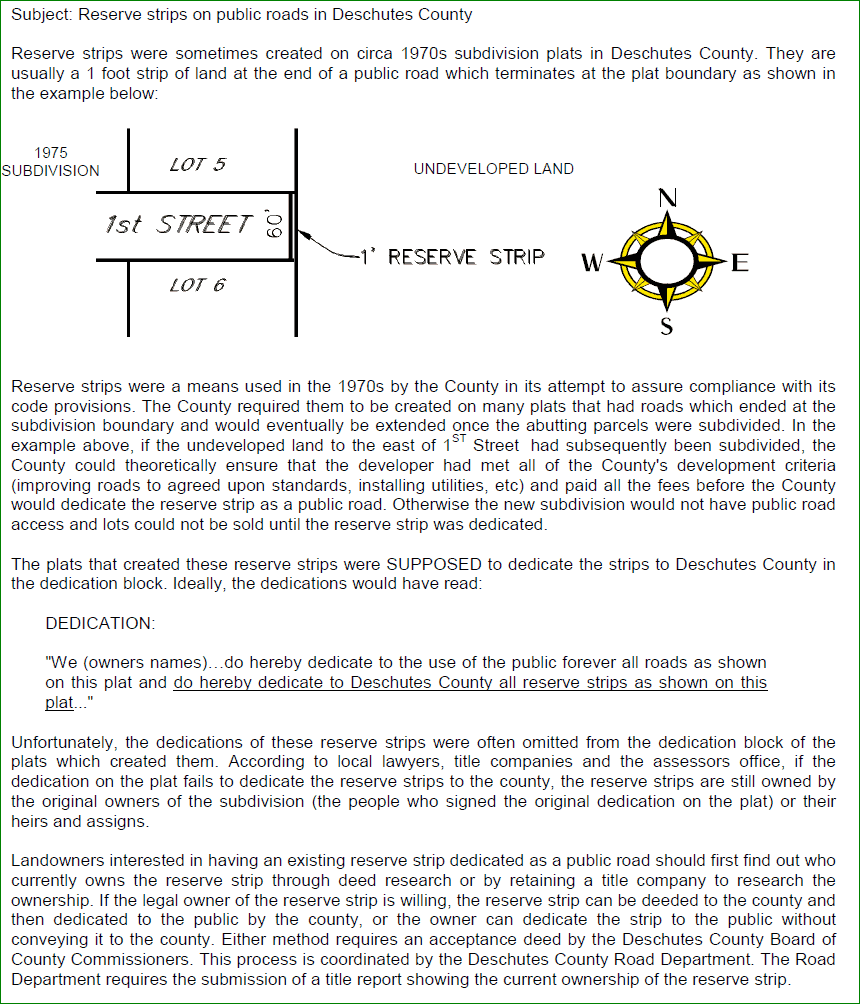


This is what they use in Medford Oregon. Problem is if the street is ever vacated it leaves a 1' strip of land that does not inure back to the abutting lot owners.
Jp
Jp7191, post: 438907, member: 1617 wrote: Problem is if the street is ever vacated it leaves a 1' strip of land that does not inure back to the abutting lot owners.
Jp
Exactly Jon. These "spite strips" or "reserve strips" or "street plugs" (more like b*** plugs) are the ill-conceived ill managed white elephant gifts that keep on giving. We had one notoriously sleazy developer from the 70s rear his ugly head 10 years ago when it was discovered he still owned one of these and decided to hold a nice couple hostage to the tune of 10k for 60 sq.ft. of land so they could readily access their abutting property. They found a different route after going round and round with this unscrupulous S.O.B. of a poltroon. So he still sits on it bidding his time...

Couple of comments Mike,
1) Since in Oregon plats are not only reviewed by the local jurisdiction but approved by them, it would seem to me that the not was at least accepted by the city if not required. Thus it would appear to me that on the face of the plat, the developer as granted and the City has accepted the strip.
2) Since when did the title companies become the final say in these matters. Until a court rules on the matter, or at minimum the AG issues an opinion, I would say the title companies' opinions are just that, opinions. Title companies seem to act like they have more power than they do and we just let them role over us. I just had a Jackson County title officer tell me that a 1981 'minor' land partition plat recorded in the County's volume 4 of 'Minor Land Partitions' was not a legally recognized partition plat because the term minor partition is not referenced in the current ORS. The terms minor and major were removed from the titles to simplify the process. Rant over.
3) It seems to me that the original developer would have any solid ground to stand on trying to prove ownership of the strip. There is signed, notarized and recorded documentation of his intent to release ownership. I'm also guessing that the developer has not been paying taxes on the property. Sounds like a great case of adverse possession at the least.
4) Given the fact that local jurisdiction wants this road to go through, why not just condemn the strip. True market value can not be that much since they are unbuildable lots with delinquent taxes. The new owner should then be allowed to sue for damages.
John Putnam, post: 438974, member: 1188 wrote: Couple of comments Mike,
Good Comments John. Regarding acceptance, the County's approval signature on the plat does indeed constitute statutory acceptance of all public declarations on the plat in accordance to ORS 92.014, but the rub is that these are 1 foot wide strips of land clearly designated as "Reserve Strips", not necessarily roadway. Sort of akin to today's use of tracts on Oregon plats, they are not lots, they are not roads. The plats expressly denote them as strips of land being reserved for something.
The involvement of title companies in this process is identifying who owns lands. They determine the lots are all owned by various individuals through the title chain. The roads are public as stated on the plat. If the one-foot wide tracts of land represented on the plat have not been dedicated or conveyed, then they were reserved by the declarant who still owns them (or, most likely, the heirs and assigns now do). When these one-foot strips are brought to the attention of the Assessor, they will create them into tax lots. I don't think they try to determine the heirs and assigns, they just put it in the name of the declarant and send a tax bill to them if they still have a valid address. It the owners don't pay taxes on them after, I think, seven years, they are foreclosed on by the sheriff.
Regarding comment 3, this is actually a signed, notarized and recorded documentation of his intent to reserve ownership when no other mention of the strips were stated on the plat. Again, this reserve strip concept was not properly implemented as conceived. On the plats where the Dedication properly stated "and hereby dedicate to Deschutes County the one-foot reserve strips" there have been no problems. Although it turns out they weren't really needed to guarantee compliance because in short order Oregon planning laws became, well, what they are today. The thin chapter 92 in the 60s and early 70s had little direction and primarily directed local government to develop codes. Before the stricter 1970s Oregon planning laws began to evolve, Central Oregon was the poster child for Tom McCall's fabled "sagebrush subdivisions" where developers would lay out lots, file a plat, blade a road in, sprinkle cinders on it, sell lots and head back down to California in their Caddy's, lighting cigars with $20 bills. The hapless owners were left to figure out septic, water systems, even power. People complained. Loudly. Fixes like reserve strips were contemplated as a stopgap. Sadly nobody paid attention to the proper execution of these during the platting process.
The attorneys I've worked with have found no Oregon case law on these. I recall hearing that one of the counties on the west side had their commissioners order that all platted reserve strips were hereby foreclosed on and declared public roads. I'm not sure when this allegedly happened, but kudos to the commission to make such a ballsy move. Even though almost all of these are unknown by the owners to be in existence, such a decree could be considered repugnant to the US and Oregon constitutions... an unlawful uncompensated taking of private land. Just imagine if such a tact were to be attempted today... NIMBYs and 1000 Friends and a host of others would be on the County like stink on $hit.
John Putnam, post: 438974, member: 1188 wrote: 4) Given the fact that local jurisdiction wants this road to go through, why not just condemn the strip.
I haven't been involved with any of these where a govt. entity was being hindered. Just a dozen of so private citizens or developers trying to gain access across a reserve strip. If a local agency needed one removed I bet they'd consider paying top dollar. The condemnation process is long and expensive.
John Putnam, post: 438974, member: 1188 wrote: I just had a Jackson County title officer tell me that a 1981 'minor' land partition plat recorded in the County's volume 4 of 'Minor Land Partitions' was not a legally recognized partition plat because the term minor partition is not referenced in the current ORS.
That's sad. This link will show them the laws that were on the books in 1981 when the land was partitioned (spoiler alert, there are 11 occurrences of the term "minor partition" in chapter 92):
https://archives.oregonlegislature.gov/
(more specifically https://archives.oregonlegislature.gov/ORS_Archives/1979-Chapter-092.pdf )

Paul in PA, post: 438733, member: 236 wrote: The Plat was filed and is on record. The city is the record owner of the street whether a deed was proffered or not. By record language the claimed owner is estopped from preventing it's use as a street. The street in it's totality is dedicated to the public. That the city does not have title to that one foot merely puts the burden of constructing that one foot of roadway on the prior developer.
23 years of not paying taxes on that 1' parcel can negate any claim of ownership.
The best the claimed owner can expect is that the new developer offers to pay for the 1' of street and the removal and restoration of any temporary turnaround.
Have fun.
Paul in PA
"23 years of not paying taxes on that 1' parcel can negate any claim of ownership."
That is not true in my state.
Mike Berry, post: 439001, member: 123 wrote:
That's sad. This link will show them the laws that were on the books in 1981 when the land was partitioned (spoiler alert, there are 11 occurrences of the term "minor partition" in chapter 92):
https://archives.oregonlegislature.gov/(more specifically https://archives.oregonlegislature.gov/ORS_Archives/1979-Chapter-092.pdf )
Yeah Mike, I sent the title office a copy of the 1981 ORS pointing out the definition spelled out. He gave me some cocky answer that in his 25 years in the business he had always done it that way and that the County Surveyor agrees with him. I wanted to strangle the little %&@*!! over the phone but my wife reminded me I was on vacation and that maybe I should just have a greyhound instead. Hell, I was just creating an easement for an engineering friend who was buying two of the three parcels and wanted to have a path from his property down to Lithia Park across the third parcel which was owned by the seller. I think my friend just ended up writing his own to quite the guy up. He had bigger issues since the seller is English and had to travel to US Consulate in London to sign the documents and the title officer would not issue insurance on the easement.
The little guy also tried to tell me I should not use a strip descriptions. What the hell.
Okay, time to stop drinking coffee and start with the bloody marys.
Mike,
One thing I would disagree with you is the local jurisdictions involvement. I would say that it is in there interest that the land is developed and that the roads are established in locations that meet their overall plan. The city of Forest Grove got hammered in court recently by a local developer because of the way they dealt with and adjacent development and how it effected the plaintiff's project.
Maybe this is an issue that needs to be addressed in the legislation.
John Putnam, post: 439040, member: 1188 wrote: One thing I would disagree with you is the local jurisdictions involvement
John, that's a compelling argument. 25 years ago when I got involved with these, a citizen would call and say they couldn't use a road because of an unresolved reserve strip. We would research them, find the owners, draw up the deeds - quitclaims, dedications, whatever worked - and shepherd them through the commissioners for acceptance and recording at the clerk. Our attorneys put the kibosh on that after two or 3 iterations. The reasoning was along the lines of "It is a civil matter between two private parties... the owner of a tract of land (the reserve strip) and the neighbor who wants to have access over it". The county's purpose is not to campaign for one person's desire (neighbor) over another's property rights (reserve strip owner). No access to the neighbor's property was at this location before the land was platted with the reserve strip. It is convenient for the neighbor to use this since a road has been built to within a foot of their boundary, but their historical pre-plat access is still available. If they want to use this, it is up to them to work it out"
That's why I drafted up the explanation above - to explain what the situation was to citizens who got sucker punched with the reality of a reserve strip and how they can try to resolve it. So like it or not, that's how it is handled where I work. In the 35 other Oregon Counties it might be approached differently. Likely.
And by the way, a glaring falicy with this is that it is obvious that the plan at the time was to eventually provide access. Otherwise a cul-de-sac bulb would have terminated the road.

Since I made the original posting I have learned a thing or 2 about the background of this particular case:
1. That the owner of the 1994 subdivision and the land to the north that is now being developed had a long history prior to 1994.
2. The owner of the land to the north made things as difficult as he could for the 1994 subdivider to develop his land.
3. The owner of the land to the north has since passed away, but the land is still in family hands.
4. The family isn't really inclIned to fight paying the $15k ransom. They've known this day was coming, although they didn't know just what number the 1994 subdivider had in mind until this week.

I gotta ask. If the lots and tracts in this (or any) subdivision are created simultaneously by subdivision platting. Are not the lots and tracts subject to all the conditions and restrictions on said plat? If the answer is yes than how can Tract A remain in private hands without passing through the entity (the city) who it was declared on the plat to go to?
Thanks Mark, Mike and John.
Daniel Ralph, post: 439114, member: 8817 wrote: how can Tract A remain in private hands without passing through the entity (the city) who it was declared on the plat to go to?
The plat declared an intention to deed the Tract A to the city, but it did not, itself, dedicate it to the public as it did the road. Or perhaps the intention is enough, I don't know. I'm a surveyor, not an attorney.

Daniel Ralph, post: 439114, member: 8817 wrote: I gotta ask. If the lots and tracts in this (or any) subdivision are created simultaneously by subdivision platting. Are not the lots and tracts subject to all the conditions and restrictions on said plat? If the answer is yes than how can Tract A remain in private hands without passing through the entity (the city) who it was declared on the plat to go to?
Thanks Mark, Mike and John.
Statute of Frauds.
Mark Mayer, post: 439081, member: 424 wrote: Since I made the original posting I have learned a thing or 2 about the background of this particular case:
1. That the owner of the 1994 subdivision and the land to the north that is now being developed had a long history prior to 1994.
2. The owner of the land to the north made things as difficult as he could for the 1994 subdivider to develop his land.
3. The owner of the land to the north has since passed away, but the land is still in family hands.
4. The family isn't really inclIned to fight paying the $15k ransom. They've known this day was coming, although they didn't know just what number the 1994 subdivider had in mind until this week.
15k sounds cheap. They should jump on it.
Mark Mayer, post: 439081, member: 424 wrote: 1. That the owner of the 1994 subdivision and the land to the north that is now being developed had a long history prior to 1994
So, it appears the 1994 developers were setting up their northern neighbors! And duping the city!
Given the bad blood I wonder if they convinced a gullible city mucky muck to let them create the access restriction tract (instead of just dedicating the road up to the boundary in 1994 and being done with it) and told them that after the plat was recorded they'd then deed the tract to the city? But instead they just sat on their hands for 23 years. Brilliant! They're probably members of the legislature and respected by all.