Reading RPLS is free for the whole profession. Members post, reply, and get the members-only rooms.

Notifications
Clear all

Topic starter
Translate
▼
English
Spanish
French
German
Italian
Portuguese
Russian
Chinese
Japanese
Korean
Arabic
Hindi
Dutch
Polish
Turkish
Vietnamese
Thai
Swedish
Danish
Finnish
Norwegian
Czech
Hungarian
Romanian
Greek
Hebrew
Indonesian
Malay
Ukrainian
Bulgarian
Croatian
Slovak
Slovenian
Serbian
Lithuanian
Latvian
Estonian
If one wishes to communicate (via staking), to an excavation contractor the contour of the lip of a pond, and from that "edge" downward into the pond "x" feet of slope distance with a slope no greater than "Y", what would be the proper way to stake this?
Posted : August 3, 2015 10:34 am

Translate
▼
English
Spanish
French
German
Italian
Portuguese
Russian
Chinese
Japanese
Korean
Arabic
Hindi
Dutch
Polish
Turkish
Vietnamese
Thai
Swedish
Danish
Finnish
Norwegian
Czech
Hungarian
Romanian
Greek
Hebrew
Indonesian
Malay
Ukrainian
Bulgarian
Croatian
Slovak
Slovenian
Serbian
Lithuanian
Latvian
Estonian
rfc, post: 330208, member: 8882 wrote: If one wishes to communicate (via staking), to an excavation contractor the contour of the lip of a pond, and from that "edge" downward into the pond "x" feet of slope distance with a slope no greater than "Y", what would be the proper way to stake this?
In general, you would set stakes around the perimeter of top of bank of the pond with cuts noted at various offsets. ie/ Cut 0.00'@10', Cut 5.00@20' , Cut 10.00@30', etc. The excavator's grade hop would then measure off your stakes as the excavator digs it out.
Posted : August 3, 2015 10:43 am

Translate
▼
English
Spanish
French
German
Italian
Portuguese
Russian
Chinese
Japanese
Korean
Arabic
Hindi
Dutch
Polish
Turkish
Vietnamese
Thai
Swedish
Danish
Finnish
Norwegian
Czech
Hungarian
Romanian
Greek
Hebrew
Indonesian
Malay
Ukrainian
Bulgarian
Croatian
Slovak
Slovenian
Serbian
Lithuanian
Latvian
Estonian
Like Norman said if you are not providing a cross section.
Posted : August 3, 2015 10:47 am

Translate
▼
English
Spanish
French
German
Italian
Portuguese
Russian
Chinese
Japanese
Korean
Arabic
Hindi
Dutch
Polish
Turkish
Vietnamese
Thai
Swedish
Danish
Finnish
Norwegian
Czech
Hungarian
Romanian
Greek
Hebrew
Indonesian
Malay
Ukrainian
Bulgarian
Croatian
Slovak
Slovenian
Serbian
Lithuanian
Latvian
Estonian
rfc, post: 330208, member: 8882 wrote: If one wishes to communicate (via staking), to an excavation contractor the contour of the lip of a pond, and from that "edge" downward into the pond "x" feet of slope distance with a slope no greater than "Y", what would be the proper way to stake this?
My first thought is to ask the contractor how he wants it. If he has no preference then Norman's approach is the way to go.
Andy
Posted : August 3, 2015 11:32 am
Translate
▼
English
Spanish
French
German
Italian
Portuguese
Russian
Chinese
Japanese
Korean
Arabic
Hindi
Dutch
Polish
Turkish
Vietnamese
Thai
Swedish
Danish
Finnish
Norwegian
Czech
Hungarian
Romanian
Greek
Hebrew
Indonesian
Malay
Ukrainian
Bulgarian
Croatian
Slovak
Slovenian
Serbian
Lithuanian
Latvian
Estonian
If the excavator is machine control capable he would likely want a DTM model of the proposed shape, followed up with an as-built survey.
Posted : August 3, 2015 12:07 pm

Translate
▼
English
Spanish
French
German
Italian
Portuguese
Russian
Chinese
Japanese
Korean
Arabic
Hindi
Dutch
Polish
Turkish
Vietnamese
Thai
Swedish
Danish
Finnish
Norwegian
Czech
Hungarian
Romanian
Greek
Hebrew
Indonesian
Malay
Ukrainian
Bulgarian
Croatian
Slovak
Slovenian
Serbian
Lithuanian
Latvian
Estonian
rfc, post: 330208, member: 8882 wrote: If one wishes to communicate (via staking), to an excavation contractor the contour of the lip of a pond, and from that "edge" downward into the pond "x" feet of slope distance with a slope no greater than "Y", what would be the proper way to stake this?
I have attached a sketch showing what I do for roads. A dam would be no different. The trick is setting enough stakes so the dirt guy knows which direction is perpendicular/radial to what is being built. Then it's just a matter of using a rag tape and a hand level and a little brain power to build it.
As you can see, I don't like to use the term cut or fill, unless that is what is actually happening relative to the existing ground. I use plus or minus when driving them to the top cut/toe fill.
EDIT: I see I made a mistake with subgrade shoulder vs. finish grade shoulder...but you get the idea.
Posted : August 3, 2015 12:27 pm

Translate
▼
English
Spanish
French
German
Italian
Portuguese
Russian
Chinese
Japanese
Korean
Arabic
Hindi
Dutch
Polish
Turkish
Vietnamese
Thai
Swedish
Danish
Finnish
Norwegian
Czech
Hungarian
Romanian
Greek
Hebrew
Indonesian
Malay
Ukrainian
Bulgarian
Croatian
Slovak
Slovenian
Serbian
Lithuanian
Latvian
Estonian
I would just set an offset to the contour line that has a cut/fill @ 5' to "top" then a Cut XX.X at 2:1 or 3:1 or whatever it's designed at. to the toe.
IE: 5 o/s top, Cut 0.2 @ 5' top//C- 3.5@ 2:1 toe.
the 2 slashes mean "and then" so they would cut 0.2' @ 5' and then C- 3.5@ 2:1 toe
Posted : August 3, 2015 12:27 pm
Topic starter
Translate
▼
English
Spanish
French
German
Italian
Portuguese
Russian
Chinese
Japanese
Korean
Arabic
Hindi
Dutch
Polish
Turkish
Vietnamese
Thai
Swedish
Danish
Finnish
Norwegian
Czech
Hungarian
Romanian
Greek
Hebrew
Indonesian
Malay
Ukrainian
Bulgarian
Croatian
Slovak
Slovenian
Serbian
Lithuanian
Latvian
Estonian
imaudigger, post: 330232, member: 7286 wrote: I have attached a sketch showing what I do for roads. A dam would be no different. The trick is setting enough stakes so the dirt guy knows which direction is perpendicular/radial to what is being built. Then it's just a matter of using a rag tape and a hand level and a little brain power to build it.
As you can see, I don't like to use the term cut or fill, unless that is what is actually happening relative to the existing ground. I use plus or minus when driving them to the top cut/toe fill.
EDIT: I see I made a mistake with subgrade shoulder vs. finish grade shoulder...but you get the idea.
You guys rock. Definitely no machine control on this "project".:-D I'll probably have to explain what I write on the stakes to the contractor, but at least I'll know (a little) about what I'm writing. Thanks!
Posted : August 3, 2015 12:46 pm

Translate
▼
English
Spanish
French
German
Italian
Portuguese
Russian
Chinese
Japanese
Korean
Arabic
Hindi
Dutch
Polish
Turkish
Vietnamese
Thai
Swedish
Danish
Finnish
Norwegian
Czech
Hungarian
Romanian
Greek
Hebrew
Indonesian
Malay
Ukrainian
Bulgarian
Croatian
Slovak
Slovenian
Serbian
Lithuanian
Latvian
Estonian
Some contractors want all the distances and cuts from the offset stake. So using T-Ray's example;
T-Ray, post: 330233, member: 1611 wrote: IE: 5 o/s top, Cut 0.2 @ 5' top//C- 3.5@ 2:1 toe.
would be marked - "5 o/s top / Cut 0.2 @ 5' top / C- 3.7 @ 12' toe"
note the single slashes.
Posted : August 3, 2015 1:50 pm

Translate
▼
English
Spanish
French
German
Italian
Portuguese
Russian
Chinese
Japanese
Korean
Arabic
Hindi
Dutch
Polish
Turkish
Vietnamese
Thai
Swedish
Danish
Finnish
Norwegian
Czech
Hungarian
Romanian
Greek
Hebrew
Indonesian
Malay
Ukrainian
Bulgarian
Croatian
Slovak
Slovenian
Serbian
Lithuanian
Latvian
Estonian
imaudigger, post: 330232, member: 7286 wrote: I have attached a sketch showing what I do for roads. A dam would be no different. The trick is setting enough stakes so the dirt guy knows which direction is perpendicular/radial to what is being built. Then it's just a matter of using a rag tape and a hand level and a little brain power to build it.
As you can see, I don't like to use the term cut or fill, unless that is what is actually happening relative to the existing ground. I use plus or minus when driving them to the top cut/toe fill.
EDIT: I see I made a mistake with subgrade shoulder vs. finish grade shoulder...but you get the idea.
Another small typo.
Left side example bottom item labeled as Right of Design Centerline
Posted : August 3, 2015 2:39 pm

Translate
▼
English
Spanish
French
German
Italian
Portuguese
Russian
Chinese
Japanese
Korean
Arabic
Hindi
Dutch
Polish
Turkish
Vietnamese
Thai
Swedish
Danish
Finnish
Norwegian
Czech
Hungarian
Romanian
Greek
Hebrew
Indonesian
Malay
Ukrainian
Bulgarian
Croatian
Slovak
Slovenian
Serbian
Lithuanian
Latvian
Estonian
You mentioned slope distances in your OP-
Just to make sure you understand- there should be NO slope distances on anything- everything should be horizontal distances and vertical distances.
Posted : August 3, 2015 2:44 pm
Topic starter
Translate
▼
English
Spanish
French
German
Italian
Portuguese
Russian
Chinese
Japanese
Korean
Arabic
Hindi
Dutch
Polish
Turkish
Vietnamese
Thai
Swedish
Danish
Finnish
Norwegian
Czech
Hungarian
Romanian
Greek
Hebrew
Indonesian
Malay
Ukrainian
Bulgarian
Croatian
Slovak
Slovenian
Serbian
Lithuanian
Latvian
Estonian
Rankin_File, post: 330268, member: 101 wrote: You mentioned slope distances in your OP-
Just to make sure you understand- there should be NO slope distances on anything- everything should be horizontal distances and vertical distances.
Ya. Understood. Horizontal distances. Thanks.
Posted : August 3, 2015 2:45 pm
Translate
▼
English
Spanish
French
German
Italian
Portuguese
Russian
Chinese
Japanese
Korean
Arabic
Hindi
Dutch
Polish
Turkish
Vietnamese
Thai
Swedish
Danish
Finnish
Norwegian
Czech
Hungarian
Romanian
Greek
Hebrew
Indonesian
Malay
Ukrainian
Bulgarian
Croatian
Slovak
Slovenian
Serbian
Lithuanian
Latvian
Estonian
Fixed. Typically I stake to sub-grade, but for the purposes of understanding what my be written on a slope stake, it will have to do.
The back side of the lath may have the RP elevation written on it as well.
Posted : August 3, 2015 2:47 pm

Translate
▼
English
Spanish
French
German
Italian
Portuguese
Russian
Chinese
Japanese
Korean
Arabic
Hindi
Dutch
Polish
Turkish
Vietnamese
Thai
Swedish
Danish
Finnish
Norwegian
Czech
Hungarian
Romanian
Greek
Hebrew
Indonesian
Malay
Ukrainian
Bulgarian
Croatian
Slovak
Slovenian
Serbian
Lithuanian
Latvian
Estonian
rfc, post: 330208, member: 8882 wrote: If one wishes to communicate (via staking), to an excavation contractor the contour of the lip of a pond, and from that "edge" downward into the pond "x" feet of slope distance with a slope no greater than "Y", what would be the proper way to stake this?
Here are some pages from the publication "Handbook of Survey Notekeeping by F. William Pafford that also may give you some help.
Posted : August 3, 2015 2:54 pm

Translate
▼
English
Spanish
French
German
Italian
Portuguese
Russian
Chinese
Japanese
Korean
Arabic
Hindi
Dutch
Polish
Turkish
Vietnamese
Thai
Swedish
Danish
Finnish
Norwegian
Czech
Hungarian
Romanian
Greek
Hebrew
Indonesian
Malay
Ukrainian
Bulgarian
Croatian
Slovak
Slovenian
Serbian
Lithuanian
Latvian
Estonian
I would hand plot the points staked on the grading plan with cut fill information then make a copy for the contractor. This would really help in the conditions you describe. A picture is worth a thousand words. Jp
Posted : August 3, 2015 3:13 pm

Translate
▼
English
Spanish
French
German
Italian
Portuguese
Russian
Chinese
Japanese
Korean
Arabic
Hindi
Dutch
Polish
Turkish
Vietnamese
Thai
Swedish
Danish
Finnish
Norwegian
Czech
Hungarian
Romanian
Greek
Hebrew
Indonesian
Malay
Ukrainian
Bulgarian
Croatian
Slovak
Slovenian
Serbian
Lithuanian
Latvian
Estonian
I have had the benefit of years of laying out ponds/slopes and then watching men use those stakes. I have noted the following commonalities.
1. The grade hop will have a 4' level, a 25' tape marked in INCHES and ( in most cases ) access to a laser level.
2. With a 4' level and a tape he can be taught quickly to measure a slope ratio of 4:1, 3:1 etc and thus continue down the slope if dealing with moderate depths of pond. Around here verticals of 3' to 12' cover most ponds/slopes.
3. Too many marks on a lath just bewilder him. He has no concept of "tenths of feet" ( might as well be metric ).
4. He will hook his tape onto the top of a lath no matter what direction or degree of lean. He will string 50' between lath and blithely measure down from a catenary (while exerting tremendous force on your lath ).
So now I stake a 4' offset back from top of slope. Give even foot cut/fill mark , I prefer to give C-1 marks so they can use that level with a fair degree of comfort. I stake 3 point minimum on a curve and more if they get over 10' apart. I never go more than 35' on a tangent and ALL lath are driven to refusal or 1'min. and in a safe place nearby I drive a hub to grade for laser setup. I tell the guy what PC and PT mean and now he thinks he is surveying. I can finish staking curbs and whatnot. Later (on deeper ponds) I can come back and stake the bottom of slope.
When I first meet the operator I can tell after a few minutes conversation how much he needs/doesn't need from me. Seldom do they need/want more than outlined above.
chain
Posted : August 14, 2015 3:30 pm

Translate
▼
English
Spanish
French
German
Italian
Portuguese
Russian
Chinese
Japanese
Korean
Arabic
Hindi
Dutch
Polish
Turkish
Vietnamese
Thai
Swedish
Danish
Finnish
Norwegian
Czech
Hungarian
Romanian
Greek
Hebrew
Indonesian
Malay
Ukrainian
Bulgarian
Croatian
Slovak
Slovenian
Serbian
Lithuanian
Latvian
Estonian
Rankin_File, post: 330268, member: 101 wrote: Just to make sure you understand- there should be NO slope distances on anything- everything should be horizontal distances and vertical distances.
Over here we'd do just that. Slope stake batters.
Maybe I've lost something in interpretation?
Party Chief threw in some phrases I'd guess at.
I'm assuming you have a fixed slope cut/ batter grade but the part where pond meets ground is rolled over" or a series of short grades resembling an arc.
Outside of machine control, I get asked to stake the place where the cut slope intersects natural surface.
I've found most operators will cut the pond/ embankment on grade, then come back later and "trim" the top of the batter (as we call it) to soften the effect or for whatever reason.
I was bought up on batter profiles.
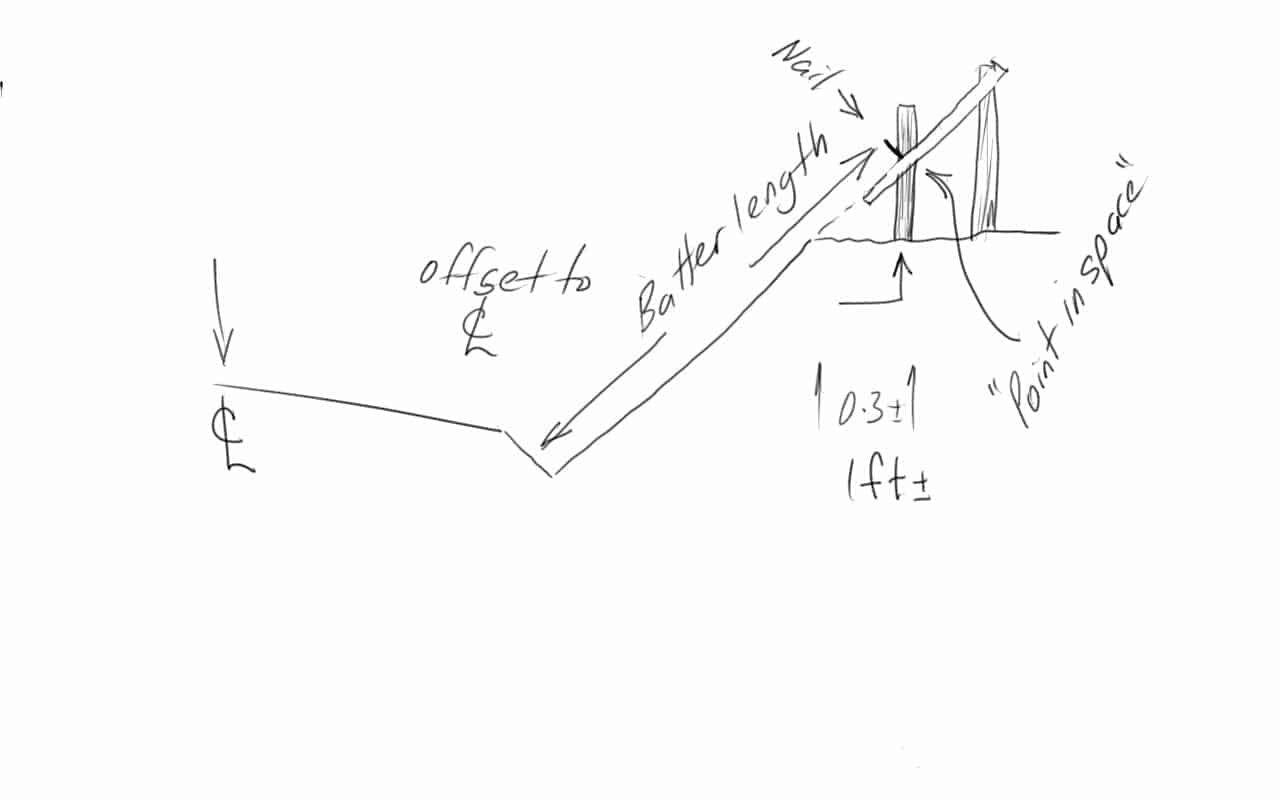
Our roadworks software was quite neat and calculated a "point in space" that was an extension of the cut batter (excavation line on grade) back into thin air.
It calculated a point on that line that was about 0.5 metres above the ground.
We'd drive a stake there (stout peg 2" thick, 1" wide about 4' long) and Mark that elevation on the side of stake.
We'd drive a similar stake about 2.5 - 3 feet behind it and then nail a straight piece of timber to both stakes at correct grade such that it was on the previously marked front stake.
The resulting s
Posted : August 15, 2015 3:43 am
Translate
▼
English
Spanish
French
German
Italian
Portuguese
Russian
Chinese
Japanese
Korean
Arabic
Hindi
Dutch
Polish
Turkish
Vietnamese
Thai
Swedish
Danish
Finnish
Norwegian
Czech
Hungarian
Romanian
Greek
Hebrew
Indonesian
Malay
Ukrainian
Bulgarian
Croatian
Slovak
Slovenian
Serbian
Lithuanian
Latvian
Estonian
Well what a bummer. I accidentally hit post and then the time to edit expired just as I hit post and all was lost.
Posted : August 15, 2015 4:04 am
Translate
▼
English
Spanish
French
German
Italian
Portuguese
Russian
Chinese
Japanese
Korean
Arabic
Hindi
Dutch
Polish
Turkish
Vietnamese
Thai
Swedish
Danish
Finnish
Norwegian
Czech
Hungarian
Romanian
Greek
Hebrew
Indonesian
Malay
Ukrainian
Bulgarian
Croatian
Slovak
Slovenian
Serbian
Lithuanian
Latvian
Estonian
Part 2 with apologies.
The profile would have the chainage, length of batter (from nail to change of grade, be it next bench in large cuts or the table drain or toe of cut/ batter.
Often we'd write offset to road centre.
The profile pointed to centreline.
We'd drive a small peg (dumpy) at base of profile for future reference if needed, which was rare.
Fills treated same, but placed such that the profile board was about 5' above ground = eye heightå±.
Only issue with fills were odd boulder or similar rolling over batter and knocking the profile.
Then it was easy check from dumpy previously set.
100's of kms road were built using this method.
Anything over a 3-4' cut saw a profile erected.
25 years of that was enough for me and I'm thankful I don't get much call on that now.
Machine control has taken on, thankfully.
I'll try and post a sketch from my tablet.
Posted : August 15, 2015 4:40 am
Translate
▼
English
Spanish
French
German
Italian
Portuguese
Russian
Chinese
Japanese
Korean
Arabic
Hindi
Dutch
Polish
Turkish
Vietnamese
Thai
Swedish
Danish
Finnish
Norwegian
Czech
Hungarian
Romanian
Greek
Hebrew
Indonesian
Malay
Ukrainian
Bulgarian
Croatian
Slovak
Slovenian
Serbian
Lithuanian
Latvian
Estonian
Richard, post: 331989, member: 833 wrote: Part 2 with apologies.
The profile would have the chainage, length of batter (from nail to change of grade, be it next bench in large cuts or the table drain or toe of cut/ batter.
..(truncated)...
25 years of that was enough for me and I'm thankful I don't get much call on that now.
Machine control has taken on, thankfully.I'll try and post a sketch from my tablet.
Man that is a lot of work.:beer::beer::beer:
I am sort of lucky in that my slopes (here in Florida) are mainly in stormwater retention ponds.
We don't bother with chamfered/filleted transitions because all slopes 6:1 or steeper and berms get sodded.
We use a slope meter on our dozer so the operator has a constant reference. Really, they just need a good starting point.
The Civil Engineer calls out slope ratio on the plans so every one knows what is happening. As long as the berm elevation equals ( or slightly exceeds ) plan and volume is achieved everything is good.
We call them "cut slope" and "fill slope. "What you describe seems more like our "catch point" or "pivot point" which we stake with 1 lath. I don't even have to take off my shoes to count the number of times I staked them.
Posted : August 15, 2015 9:01 am
Page 1 / 2
Next