Reading RPLS is free for the whole profession. Members post, reply, and get the members-only rooms.

Notifications
Clear all
Strictly Surveying
21
Posts
12
Users
0
Reactions
1,156
Views

Topic starter
Translate
▼
English
Spanish
French
German
Italian
Portuguese
Russian
Chinese
Japanese
Korean
Arabic
Hindi
Dutch
Polish
Turkish
Vietnamese
Thai
Swedish
Danish
Finnish
Norwegian
Czech
Hungarian
Romanian
Greek
Hebrew
Indonesian
Malay
Ukrainian
Bulgarian
Croatian
Slovak
Slovenian
Serbian
Lithuanian
Latvian
Estonian
Hey yall,
Out on an old metes and bounds description and find this bent ore about 1.2'x0.4' out from our calcs. What say ye?
Sorry in advance if this is the wrong thread but seemed to be the relevant spot.
Thanks!
Posted : August 2, 2023 9:56 am

Translate
▼
English
Spanish
French
German
Italian
Portuguese
Russian
Chinese
Japanese
Korean
Arabic
Hindi
Dutch
Polish
Turkish
Vietnamese
Thai
Swedish
Danish
Finnish
Norwegian
Czech
Hungarian
Romanian
Greek
Hebrew
Indonesian
Malay
Ukrainian
Bulgarian
Croatian
Slovak
Slovenian
Serbian
Lithuanian
Latvian
Estonian
Nothing to say. Not enough info.
about 1.2'x0.4' out from our calcs
and?...
Posted : August 2, 2023 10:02 am

Translate
▼
English
Spanish
French
German
Italian
Portuguese
Russian
Chinese
Japanese
Korean
Arabic
Hindi
Dutch
Polish
Turkish
Vietnamese
Thai
Swedish
Danish
Finnish
Norwegian
Czech
Hungarian
Romanian
Greek
Hebrew
Indonesian
Malay
Ukrainian
Bulgarian
Croatian
Slovak
Slovenian
Serbian
Lithuanian
Latvian
Estonian
How does it fit the adjoiners? When something douesn't fit well enough to the description you need to check a larger area.
Posted : August 2, 2023 10:02 am

Translate
▼
English
Spanish
French
German
Italian
Portuguese
Russian
Chinese
Japanese
Korean
Arabic
Hindi
Dutch
Polish
Turkish
Vietnamese
Thai
Swedish
Danish
Finnish
Norwegian
Czech
Hungarian
Romanian
Greek
Hebrew
Indonesian
Malay
Ukrainian
Bulgarian
Croatian
Slovak
Slovenian
Serbian
Lithuanian
Latvian
Estonian
If it can be proven to be original, it doesn't matter how far "out" it is...
Aside from that, I'm with Norm. Not enough info.
Posted : August 2, 2023 10:06 am

Translate
▼
English
Spanish
French
German
Italian
Portuguese
Russian
Chinese
Japanese
Korean
Arabic
Hindi
Dutch
Polish
Turkish
Vietnamese
Thai
Swedish
Danish
Finnish
Norwegian
Czech
Hungarian
Romanian
Greek
Hebrew
Indonesian
Malay
Ukrainian
Bulgarian
Croatian
Slovak
Slovenian
Serbian
Lithuanian
Latvian
Estonian
what is a bent ore?
Is "it" bent in the direction you miss "it"?
Posted : August 2, 2023 10:32 am

Translate
▼
English
Spanish
French
German
Italian
Portuguese
Russian
Chinese
Japanese
Korean
Arabic
Hindi
Dutch
Polish
Turkish
Vietnamese
Thai
Swedish
Danish
Finnish
Norwegian
Czech
Hungarian
Romanian
Greek
Hebrew
Indonesian
Malay
Ukrainian
Bulgarian
Croatian
Slovak
Slovenian
Serbian
Lithuanian
Latvian
Estonian
Correct is an identity, not a distance...
Posted : August 2, 2023 10:55 am

Translate
▼
English
Spanish
French
German
Italian
Portuguese
Russian
Chinese
Japanese
Korean
Arabic
Hindi
Dutch
Polish
Turkish
Vietnamese
Thai
Swedish
Danish
Finnish
Norwegian
Czech
Hungarian
Romanian
Greek
Hebrew
Indonesian
Malay
Ukrainian
Bulgarian
Croatian
Slovak
Slovenian
Serbian
Lithuanian
Latvian
Estonian
This definitely COULD be the marker that was set.
Or, it could be the marker set but then moved for some reason by an adjoiner
Or, it could have been intentionally set 1.0 feet off the true corner due to an obstruction that existed at the time and so noted on the survey plat
Or, it could be something someone just happened to stick there one time to tie a hungry goat to.
Errors do happen. Surveyors are not now nor have never been as precise as they report on their paperwork. But, if it is the original, then wherever it is, is the intended corner.
Recommend comparing this to everything else found plus comparing to how you would have set it if you were starting that survey from scratch. Not that how you would do it today would necessarily agree with how a surveyor did it 70 years previously.
Posted : August 2, 2023 11:01 am

Translate
▼
English
Spanish
French
German
Italian
Portuguese
Russian
Chinese
Japanese
Korean
Arabic
Hindi
Dutch
Polish
Turkish
Vietnamese
Thai
Swedish
Danish
Finnish
Norwegian
Czech
Hungarian
Romanian
Greek
Hebrew
Indonesian
Malay
Ukrainian
Bulgarian
Croatian
Slovak
Slovenian
Serbian
Lithuanian
Latvian
Estonian
Correct is an identity, not a distance...
The hard part is whether to assign that identity...then what to do with that identity.
Posted : August 2, 2023 11:06 am

Translate
▼
English
Spanish
French
German
Italian
Portuguese
Russian
Chinese
Japanese
Korean
Arabic
Hindi
Dutch
Polish
Turkish
Vietnamese
Thai
Swedish
Danish
Finnish
Norwegian
Czech
Hungarian
Romanian
Greek
Hebrew
Indonesian
Malay
Ukrainian
Bulgarian
Croatian
Slovak
Slovenian
Serbian
Lithuanian
Latvian
Estonian
A monument governs if it is called for and undisturbed. A bent iron has clearly been disturbed (I'm assuming that the deed does not call for a bent iron). It is quite possible for a mass of earth to be moved a couple of feet, iron and all, by a 'dozer. It is also possible for the base of a bent rod to be very close to the original position. Furthermore, calc's are very easy to screw up.
Posted : August 2, 2023 11:07 am

Translate
▼
English
Spanish
French
German
Italian
Portuguese
Russian
Chinese
Japanese
Korean
Arabic
Hindi
Dutch
Polish
Turkish
Vietnamese
Thai
Swedish
Danish
Finnish
Norwegian
Czech
Hungarian
Romanian
Greek
Hebrew
Indonesian
Malay
Ukrainian
Bulgarian
Croatian
Slovak
Slovenian
Serbian
Lithuanian
Latvian
Estonian
Only off by a foot? It's good, hold it and move on.
Let's say you are in a rural area. The original surveyor was using a transit and tape, and was only required to have a closure of 1/5000 by state statue. If he traversed 5000 feet, he could be off 1 foot at the end, and everything would be fine. (ok, using round numbers for an easy example. Don't get picky with math and start talking about adjustments. 50 years ago some surveyors were just looking at closure. And if it closed, just left it at that.) The point I'm making is, we can measure so much better than surveyors of yesteryear. If the neighbors have been living up to this bent "ore" for decades, and you want to say it is "off", guess who is wrong? This is what causes the pin cushion effect. But yeah, called for monuments, yada yada yada.
Not everyone was as good in the field as we were, haha!
Posted : August 2, 2023 11:33 am
Translate
▼
English
Spanish
French
German
Italian
Portuguese
Russian
Chinese
Japanese
Korean
Arabic
Hindi
Dutch
Polish
Turkish
Vietnamese
Thai
Swedish
Danish
Finnish
Norwegian
Czech
Hungarian
Romanian
Greek
Hebrew
Indonesian
Malay
Ukrainian
Bulgarian
Croatian
Slovak
Slovenian
Serbian
Lithuanian
Latvian
Estonian
I can recall dragging a 100-foot steel tape for a half mile on a 30-foot offset from the apparent quarter section line, then do a 3-4-5 triangle with the tape to get back on line so as to measure the half mile from the road to the apparent center corner. That is how it was done. You can come up with all sorts of reasons why that will not produce a "correct" answer. Nevertheless, some method was needed, and that was it. The old fence with 100 year-old trees sort of blocked a direct path, you see.
Posted : August 2, 2023 11:39 am
Translate
▼
English
Spanish
French
German
Italian
Portuguese
Russian
Chinese
Japanese
Korean
Arabic
Hindi
Dutch
Polish
Turkish
Vietnamese
Thai
Swedish
Danish
Finnish
Norwegian
Czech
Hungarian
Romanian
Greek
Hebrew
Indonesian
Malay
Ukrainian
Bulgarian
Croatian
Slovak
Slovenian
Serbian
Lithuanian
Latvian
Estonian
Imagine 95 F plus 90 percent humidity and using a pencil, slide rule, book of logs and or trignometric values to calculate where you really are. Same problem with heavy gloves and 5 F with blowing snow.
Posted : August 2, 2023 11:42 am
Topic starter
Translate
▼
English
Spanish
French
German
Italian
Portuguese
Russian
Chinese
Japanese
Korean
Arabic
Hindi
Dutch
Polish
Turkish
Vietnamese
Thai
Swedish
Danish
Finnish
Norwegian
Czech
Hungarian
Romanian
Greek
Hebrew
Indonesian
Malay
Ukrainian
Bulgarian
Croatian
Slovak
Slovenian
Serbian
Lithuanian
Latvian
Estonian
what is a bent ore?
Is "it" bent in the direction you miss "it"?
Sorry all! Missed the attachment. See image.
Posted : August 2, 2023 11:49 am
Translate
▼
English
Spanish
French
German
Italian
Portuguese
Russian
Chinese
Japanese
Korean
Arabic
Hindi
Dutch
Polish
Turkish
Vietnamese
Thai
Swedish
Danish
Finnish
Norwegian
Czech
Hungarian
Romanian
Greek
Hebrew
Indonesian
Malay
Ukrainian
Bulgarian
Croatian
Slovak
Slovenian
Serbian
Lithuanian
Latvian
Estonian
That rod could also be a witness stake to the true monument that is buried. If you can wiggle the square rod out of the ground, use the metal detector again to see if there is anything else buried. If you can't, dig down around it, you might find the true corner. If my corner monument were buried, I'd be very tempted to drive a stake in next to it that I could easily find in the future.
Posted : August 2, 2023 11:57 am

Translate
▼
English
Spanish
French
German
Italian
Portuguese
Russian
Chinese
Japanese
Korean
Arabic
Hindi
Dutch
Polish
Turkish
Vietnamese
Thai
Swedish
Danish
Finnish
Norwegian
Czech
Hungarian
Romanian
Greek
Hebrew
Indonesian
Malay
Ukrainian
Bulgarian
Croatian
Slovak
Slovenian
Serbian
Lithuanian
Latvian
Estonian
Did you locate it at the top bent portion or where it went into the ground. I found a bar just like that which was bent over a lot more than that. Now the position where it went into the ground was about.8 ft off. But not in direction it was bent. A bush hog caught it i am sure. Now they did the survey and ran a line 2500 ft. 800 ft along a creek. Pulling a steel tape. The point where it went into ground matched a distance off fence line and to a line tree blazed. It was accepted as good to go. .
Posted : August 2, 2023 12:07 pm
Translate
▼
English
Spanish
French
German
Italian
Portuguese
Russian
Chinese
Japanese
Korean
Arabic
Hindi
Dutch
Polish
Turkish
Vietnamese
Thai
Swedish
Danish
Finnish
Norwegian
Czech
Hungarian
Romanian
Greek
Hebrew
Indonesian
Malay
Ukrainian
Bulgarian
Croatian
Slovak
Slovenian
Serbian
Lithuanian
Latvian
Estonian
We had about 100 years between GLO and our recording laws. The folks writing descriptions with monument calls were a distinct minority during that time.
If I have evidence of reliance by owners the monument is in, record or not.
Determining if something is disturbed is more involved. Many corners here were monumented with 30 inch long rebar. A mower can bend the crap out of the top, leaving the rest in the original position.
I would definitely check to see if this is a memorial, but you also need to see what else from the period was used as a monument. You could very well be looking at a monument marking the corner.
As for the accuracy of the original survey, it is good information but does not govern my current work. My job is to recover or place the monument where it was first set, not where some mathemagical process says it should have been set. Anything else is reassigning property from one party to another.
Posted : August 2, 2023 12:57 pm
Translate
▼
English
Spanish
French
German
Italian
Portuguese
Russian
Chinese
Japanese
Korean
Arabic
Hindi
Dutch
Polish
Turkish
Vietnamese
Thai
Swedish
Danish
Finnish
Norwegian
Czech
Hungarian
Romanian
Greek
Hebrew
Indonesian
Malay
Ukrainian
Bulgarian
Croatian
Slovak
Slovenian
Serbian
Lithuanian
Latvian
Estonian
A monument governs if it is called for and undisturbed. A bent iron has clearly been disturbed (I'm assuming that the deed does not call for a bent iron). It is quite possible for a mass of earth to be moved a couple of feet, iron and all, by a 'dozer. It is also possible for the base of a bent rod to be very close to the original position. Furthermore, calc's are very easy to screw up.
Thanks for the definitive answer!
Posted : August 2, 2023 1:50 pm
Translate
▼
English
Spanish
French
German
Italian
Portuguese
Russian
Chinese
Japanese
Korean
Arabic
Hindi
Dutch
Polish
Turkish
Vietnamese
Thai
Swedish
Danish
Finnish
Norwegian
Czech
Hungarian
Romanian
Greek
Hebrew
Indonesian
Malay
Ukrainian
Bulgarian
Croatian
Slovak
Slovenian
Serbian
Lithuanian
Latvian
Estonian
Are other monuments for this and/or adjoining parcels also square bars?
Is the curve of that bar a reasonable result of having been hit by machinery, or was it already nicely curved when it landed there?
Posted : August 2, 2023 1:56 pm
Translate
▼
English
Spanish
French
German
Italian
Portuguese
Russian
Chinese
Japanese
Korean
Arabic
Hindi
Dutch
Polish
Turkish
Vietnamese
Thai
Swedish
Danish
Finnish
Norwegian
Czech
Hungarian
Romanian
Greek
Hebrew
Indonesian
Malay
Ukrainian
Bulgarian
Croatian
Slovak
Slovenian
Serbian
Lithuanian
Latvian
Estonian
Sorry all! Missed the attachment. See image.
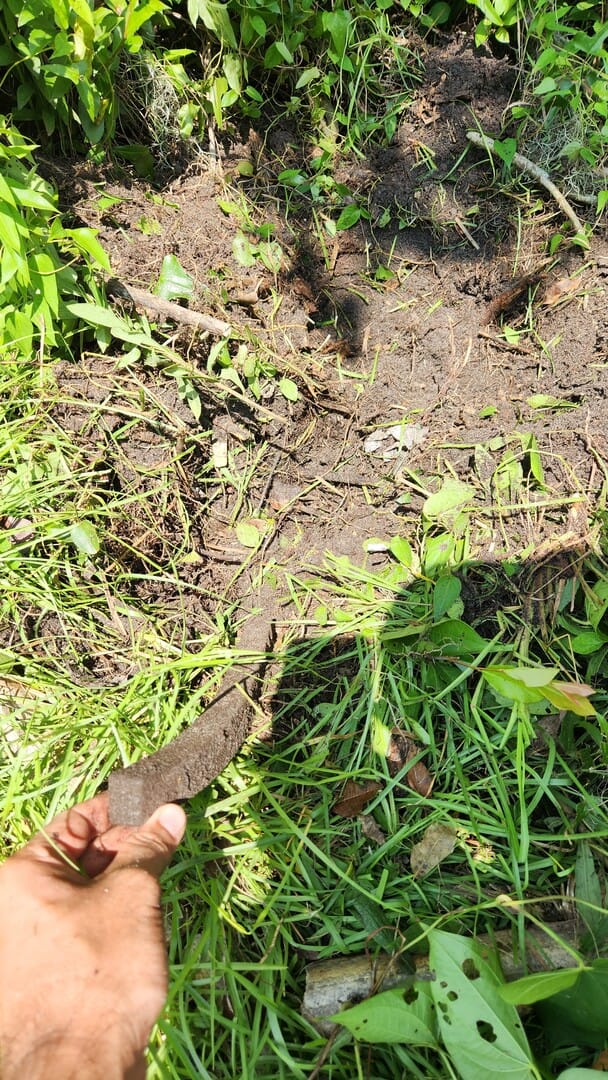
It is rare for a monument to be set with its top sticking out of the ground by a foot or more. I second the suggestion that this may be a guard stake. Is this type of bar in common usage in your area? It is worth it to keep digging.
Posted : August 2, 2023 2:51 pm
Translate
▼
English
Spanish
French
German
Italian
Portuguese
Russian
Chinese
Japanese
Korean
Arabic
Hindi
Dutch
Polish
Turkish
Vietnamese
Thai
Swedish
Danish
Finnish
Norwegian
Czech
Hungarian
Romanian
Greek
Hebrew
Indonesian
Malay
Ukrainian
Bulgarian
Croatian
Slovak
Slovenian
Serbian
Lithuanian
Latvian
Estonian
@dmyhill Don't go trying to push my maxim into the platitude pile..
Seriously, that's the point. Figure out what to do with evidence before rejecting it with mythical (and often inferior) evidence...
Posted : August 3, 2023 12:53 pm
Page 1 / 2
Next