

I do site calibrations for machine control all the time. Sometimes it's because the control given is some local system not at all related to SPC. Sometimes it's because the control is supposed to be on SPC but it's not really. Had a job where coordinates were off about 100' because they had used the wrong scale factor swapping back and forth between SPC and project coordinates. Had another one where the original 2 control monuments were correct, but the rest of the control was 7-8' off, probably because somebody did a "here" at some point, then ran with it. Have one now where all the elevations are off about 6', probably a rod height issue. In every one of those cases, the existing topo and the proposed design were done using the control provided, so whether you like it or not, you will use it. If you are going to use gps, I don't know any other way than to calibrate to it. I'm also told that with machine control, the calculations required to use a calibration for split second response by numerous sensors to control a blade are simpler than the calculations required to use a geoid. You are not looking for a couple hundredths vertical here, hopefully all the calibration points will be within a tenth.

eddycreek, post: 451461, member: 501 wrote: I do site calibrations for machine control all the time. Sometimes it's because the control given is some local system not at all related to SPC. Sometimes it's because the control is supposed to be on SPC but it's not really. Had a job where coordinates were off about 100' because they had used the wrong scale factor swapping back and forth between SPC and project coordinates. Had another one where the original 2 control monuments were correct, but the rest of the control was 7-8' off, probably because somebody did a "here" at some point, then ran with it. Have one now where all the elevations are off about 6', probably a rod height issue. In every one of those cases, the existing topo and the proposed design were done using the control provided, so whether you like it or not, you will use it. If you are going to use gps, I don't know any other way than to calibrate to it. I'm also told that with machine control, the calculations required to use a calibration for split second response by numerous sensors to control a blade are simpler than the calculations required to use a geoid. You are not looking for a couple hundredths vertical here, hopefully all the calibration points will be within a tenth.
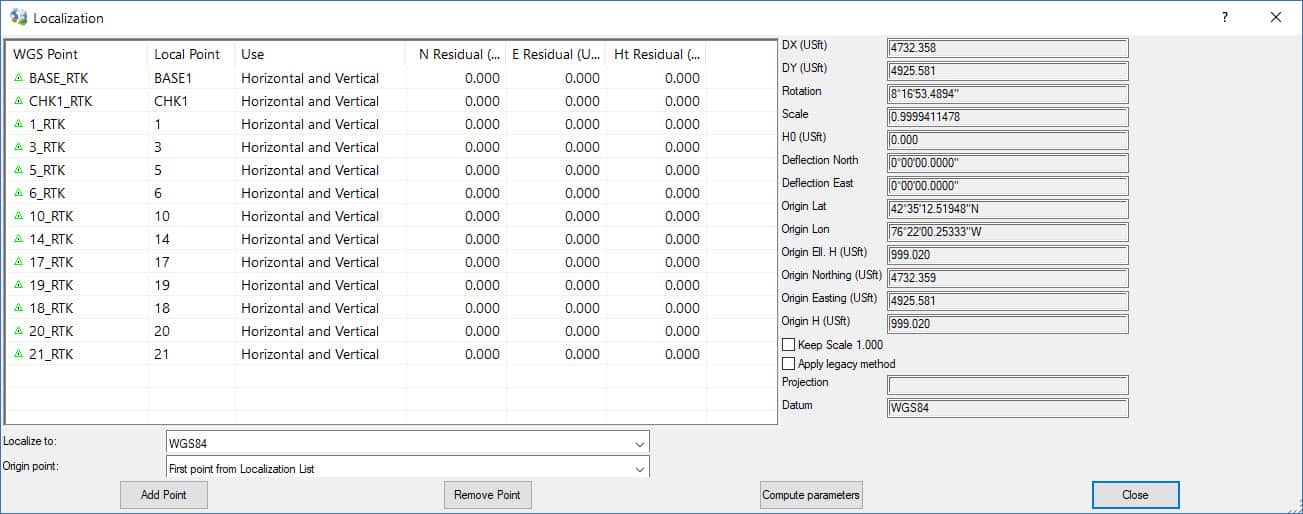
Once you have verified the correct location of the control points, you may have to create the localalization due to a datum shift in the original control. But this should not be the case on a DOT project. I see this where novice has errors in control datum. Is so then you can create the "in-house" localization to marry your verified Latitudes, Longitudes, Ellispoidal Heights, with the project Northing, Easting, Elevations that you have confirmed are in harmony. When done correctly the residuals will all be 0.00
I would not accept errors of a 0.10ft per point. A general rule of thumb, if you take the absolute value for each RMS error per point, then take the sum of all error. This sum is the amount of error you may have at a single position. You will need to decide if you can accept that much error at a single point.

As far as I can see a lot of the companies that we work with(not all but most) the grading foreman became the gps guy. These companies were sold gps not by survey equipment companies but by heavy equipment companies. I think at some point someone took the path of least resistance and said ok how do we make this simple for people that have no idea that there are multiple vertical and horizontal datum. I cant find it but I thought I remember our DOT had some language in the gps work plan that you had to calibrate and to not use a geoid. It??s pretty much the standard that contractors will calibrate I don??t see this being a problem as long as a through thoughtful qc check has been done on the control.
I wouldnt accept .10 per point either. But if they all agree .05 + or - vertically the calibration is as good as the rtk machine control is gonna get
leegreen, post: 451478, member: 2332 wrote: I would not accept errors of a 0.10ft per point. A general rule of thumb, if you take the absolute value for each RMS error per point, then take the sum of all error. This sum is the amount of error you may have at a single position. You will need to decide if you can accept that much error at a single point.
nt

Most of the above scenarios described above can be taken care of without calibrations. Older DOT guidelines would want the use of calibrations because the geoid models were basically unworkable. That isn't so today.
I guess if a calibration will allow machine control to work faster for some reason it makes some sense, but otherwise it's introducing error that doesn't need to be introduced.
As far as a here point being used or a datum 6' high or low those can be used as it, or used buy applying simple shifts to the data, think about it, that's kinda what a calibration is doing and if you figure it out yourself you not only have the survey in the newest system, just shifted to the older one, you also have a record and metadata for the survey. Doing a calibration in those situations creates a file that only you or someone with your same system can use. You end up with the Trimble guy doing his calibration, the Lecia guy doing his and the Javad guy doing a third one all on the same job, you know they are all different.

There are absolutely times for calibrations. Specifically when GPS is needed on an older local base. The hat trick is understanding, and most don't, that the second you do this, you create a polygon that you cannot go outside of very far. So long as the residuals are excellent and you sat in the "box", machine control on a calibration should do fine.
That being said, I normally avoid this type of "adjustment". I really like scaling older projects to the grid, and then making independent observations with the GPS and determining a decent rotation. I used to get all worked up in Helmert and other transformations, and they're fine and have their place, but if I can't scale the old stuff to the grid, set up, rotate between two points, and nail the rest of them, the initial data (assuming you've done everything with the GPS right) has a problem and you shouldn't be relying on it. We've had this very thing happen and opted to resurvey the tract totally rather than try to find the issue.
It should be noted my MSL is between 200 and 800 (max and a small area) and I'm normally within 30 miles of the zone line. This makes it easy to get and stay on the grid. If I was in areas like [USER=228]@Loyal[/USER] or others, then I think the LDP may be the way to go and rinse and repeat my stuff to fit that rather than calibrate. I have more than a few legacy projects where I wish to hell I'd never done them because they are a PITA to work with a decade later. I don't have that issue with SPC projects.

Skeeter1996, post: 451429, member: 9224 wrote: I seem to remember one point calibration translates, two points rotates and three points warps the whole system by some secret method that even Trimble people don't understand. I use two points calibration s quite frequently, but have had some weird results with more than two points.
How do you do calibrations without a GPS position on the points you're configuring to?
One point gives no way to really check anything, but is ok if you are collecting data to review later.
Two Points gives you a check on a line only.
Three points Defines the "Plane" so any vertical distortion will Tilt that plane to fit. It will show as ZERO residuals since it's just forcing the plane to fit the points like a piece of glass. That can get seriously bad Fast!
Four or more points will show you actual 3-d residuals. That's how you know if you have bad data to start with.
I have no idea how to do a "calibration" without using measured values as compared to published (provided) numbers. That's kinda the whole point of doing one, I think.

Sorry for the absence, guys, and tahnks for the replies.
Yes, we are using VRS to check the control points (no base whatsoever). Apparently the control points are 'OK' and we double-checked the spreadsheet with the signed plans (by a RPLS) that were provided to us.
I'll continue to post with more info.
This is what properly performed "In House Site Calibration" should look.

Been reading through this thread. I know it was a few months ago.
I tried using a geoid on machine control not that long ago and it did not work. The machine controller demanded a calibration to operate.
This was a simple job, I setup my site in scs900 and used a geoid to do the topo, went into tbc to design the surface. Then when I went to export machine files there was no calibration file, because I didnt do a calibration obviously, and the machine controller would not function. I ended up doing another topo with a calibration and using an arbritary elevation of 100?? and adjusting my surface design elevations down to 100?? and everything worked good.