

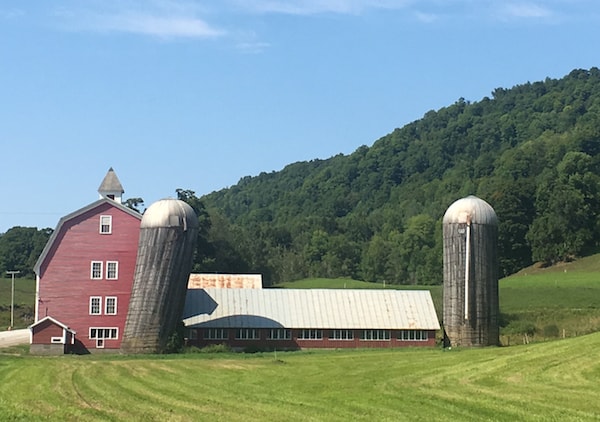
rfc, post: 389828, member: 8882 wrote: I drive by this barn almost every day. I think the silo has been moving more lately. I've read about long term dam/bridge monitoring projects.
I'm thinking I might put a hub at my observation point and then set one vertically directly below the center cap at the top, and in front of the silo. Either that, or just take a back sight on the cupola.
Then, periodically return and see if it's moved. I think the center of mass still has quite a ways to go before it gets critical. Any thoughts?
If the silo has bolts going vertically up one side then set up a baseline that will give you a 90 degree intersection from 2 stations, and intersect some selected bolts from top to bottom from your 2 stations. Discover the usefulness and accuracy of well conditioned intersections. Even with your total station, if you take care to orient the circle in the same absolute position each time at each station then you may achieve relative accuracies on the bolts of a few mm, provided you are able to pick something well defined enough to consistently sight to. Any 2 well defined spots on the bottom and top will do though. Feed the obs through star*net as different point numbers each time and get a nice time series going.

Conrad, post: 389948, member: 6642 wrote: If the silo has bolts going vertically up one side then set up a baseline that will give you a 90 degree intersection from 2 stations, and intersect some selected bolts from top to bottom from your 2 stations. Discover the usefulness and accuracy of well conditioned intersections. Even with your total station, if you take care to orient the circle in the same absolute position each time at each station then you may achieve relative accuracies on the bolts of a few mm, provided you are able to pick something well defined enough to consistently sight to. Any 2 well defined spots on the bottom and top will do though. Feed the obs through star*net as different point numbers each time and get a nice time series going.
No vertical bolts I can see at all. I think these things are built like the 1970's Northern California Hippie Hot Tubs....basically barrels, with staves and hoops. But to be honest I've never seen one built.
I was surprised in the video posted above, that the thing did not topple...it fell vertically once enough staves were removed. It could be that as the thing leans more and more, the tension in the hoops increases (because they're being elongated), creating a "tensile" structure...in effect, making it stiffer than when it was vertical. It could be that it will go (or has gone) as far as it's going to go and sit there for another 50 years.
My wife is picking up maple syrup this week from the farmer; I've asked her to ask him how old it is, when he thinks it will go, and to ask permission to do some "observation".

Tall objects don't tend to "topple" because of angular momentum. The stresses in accelerating parts of the structure at different heights to different speeds will make it tend to break in the middle and fall closer to the base than expected. Any pictures of a radio tower collapse will demonstrate this, as will experiments with a pile of child's toy blocks.

Those boards making up the silo are likely clear redwood or cedar. A very valuable re-sawn commodity if salvaged.

Daniel Ralph, post: 389990, member: 8817 wrote: Those boards making up the silo are likely clear redwood or cedar. A very valuable re-sawn commodity if salvaged.
Sadly we'll probably see it on a Discovery Channel episode of "Silo Salvage" next season...

Bill93, post: 389972, member: 87 wrote: Tall objects don't tend to "topple" because of angular momentum. The stresses in accelerating parts of the structure at different heights to different speeds will make it tend to break in the middle and fall closer to the base than expected. Any pictures of a radio tower collapse will demonstrate this, as will experiments with a pile of child's toy blocks.
Remember 9/11...