Hey Gene, do you feel like you stepped in to the stuff on this one? I am glad it is you that is following this one and not me. I have a few mineral surveys under my belt but not as many as you do I am sure. It will be interesting to see how this shakes out.

Paul in PA, post: 437557, member: 236 wrote: The Mill Site calls for the Old Lode line, not vice versa. Any adjustment is to the Mill Site or not at all.
Because of the call, the Mill Site has some color of title to the excess, but the surveyor cannot give it to the owner. The Mill Site has a superior right over any other third part to claim, compensate and acquire the excess at fair value.
Paul in PA
I'm not necessarily disagreeing with you Paul. However, the only solution listed in how to deal with "gaps and overlaps" not of record in Chapter X of the 2009 Manual is to bend the line (in this case the senior line) through the intermediate monuments. Some may disagree with my assumption for option #4 that "gross error, fraud or mistake" was not found. A falling of 74 feet creates quite the bend and some may say that is gross error. Keith Williams was fond of saying that, "I know gross error when I see it."
At this point I don't think the mill site owner would be able to acquire the excess at fair value. The question is whether the mill site owner has always owned the gap or if it has always been Public Lands. There is a DOI Land Decision that deals with theoretical exclusions. One might be able to make a case for the situation that the mill site owner was precluded from acquiring the gap in 1902 because of a flawed policy. Therefore, the call to the senior line shall be held, Cors. Nos. 1 and 2 of the mill site will be treated as closing corners and the gap is theoretical.

I'm a bit confused, if the two monuments in question are closing corners why is the line between them drawn or even shown? A closing corner by its nature should be reset at the intersection, or are these not closing corners? I can't recall ever seeong a line shown between two offline closing corners, maybe I'm misreading the facts presented, but a closinng corner that far off doesnt create a property line between them nor bend the senior line to them.

Treated as closing corners, not that they are closing corners.
I would agree that an acquisition, most likely a patent or quit claim deed, clears up the mess.
Paul in PA
Jerry Hastings, post: 437560, member: 9996 wrote: Hey Gene, do you feel like you stepped in to the stuff on this one? I am glad it is you that is following this one and not me. I have a few mineral surveys under my belt but not as many as you do I am sure. It will be interesting to see how this shakes out.
MightyMoe, post: 437567, member: 700 wrote: I'm a bit confused, if the two monuments in question are closing corners why is the line between them drawn or even shown? A closing corner by its nature should be reset at the intersection, or are these not closing corners? I can't recall ever seeong a line shown between two offline closing corners, maybe I'm misreading the facts presented, but a closinng corner that far off doesnt create a property line between them nor bend the senior line to them.
Sorry, I worded that poorly. Cors. Nos. 1 and 2 of the mill site were not labeled as closing corners in the original survey of 15000 A&B. What I meant to say is that as the resurveyor, I may decide to treat them as closing corners based on the fact that they were purposely set at the theoretical intersections rather than the true intersections. I don't recall ever running across an example where a mineral survey corner was labeled a closing corner. I have seen many instances where the best way of treating an original mineral survey corner is as a closing corner. Hope that clarifies what I buggered up.

Point of order:
Mill sites are regarded as mining claims and are first defined in the 1872 U.S. Mining Law. While the authority to issue patents for lode and placer claims is the 1866 Mining Law, mill site patents are authorized under the 1872 Mining Law.
Actually, Placer Claims (and Patents thereto) where not authorized until the "Placer Act" of July 9, 1870.
Carry on...
Loyal
Gene Kooper, post: 437577, member: 9850 wrote: Sorry, I worded that poorly. Cors. Nos. 1 and 2 of the mill site were not labeled as closing corners in the original survey of 15000 A&B. What I meant to say is that as the resurveyor, I may decide to treat them as closing corners based on the fact that they were purposely set at the theoretical intersections rather than the true intersections. I don't recall ever running across an example where a mineral survey corner was labeled a closing corner. I have seen many instances where the best way of treating an original mineral survey corner is as a closing corner. Hope that clarifies what I buggered up.
Yes, that does make a difference,,,thanks:)
Jerry Hastings, post: 437560, member: 9996 wrote: Hey Gene, do you feel like you stepped in to the stuff on this one? I am glad it is you that is following this one and not me. I have a few mineral surveys under my belt but not as many as you do I am sure. It will be interesting to see how this shakes out.
I uncovered the "Binger Policy" by accident. Back in 2001, I searched my alma mater's library for books on mining and mineral surveys. The Colorado School of Mines library had received a large gift comprising a collection of books, manuscripts, maps, photographs, etc. on mining history. In my catalogue search I found several sets of instructions for the survey of mineral lands. While looking through those instructions, I found a bunch of ephemera folded and glued into a set of instructions owned by Colorado mineral surveyor, James Dyson. Among them I found the circular that I posted earlier entitled, "CO_Surveyor_General_Circular_June20_1899.pdf" (post #28).
https://surveyorconnect.com/community/threads/how-would-you-treat-this-gap.331340/page-2#post-437389
The circular so intrigued me that I decided to visit the National Archives in Denver to see if I could find the rest of the letter (see the same post for that letter entitied, "CO_Surveyor_General_Circular_June20_1899.pdf". Over the last 16 years I have made numerous trips to the Archives (they used to be a 10 minute drive) and either Xeroxed or scanned over 2000 pages of Departmental letters that describe how the policy was enforced for individual surveys in Colorado, I found the research intriguing because the topic hadn't been researched in nearly 100 years and I had the original source documents that described and defined the evolution of the policy until Congress finally ended the "evil foisted upon the mining industry" with the Act of April 28, 1904. What more could a researcher ask for; a topic buried for 100 years whose understanding is sometimes vital in understanding not only what was done but why it was done. 🙂
As an example of what I found at the archives is the below case involving the No Name and Dorina Lodes and The No Name Mill-Site, Sur. No. 14222 A&B. It was a survey conducted in 1900 by A.J. Ventress. His survey was approved by the Colorado Surveyor General later in 1900 and upon review, the Washington office found "errors" in his survey. Below is a link to the plat with additional notes in an, "ink of distinctive color", that being blue and a link to the Departmental letters and field notes submitted by Deputy Ventress correcting his error and a sketch showing the patented and ground positions for an old lode called the Seaton Lode (Sur. No. 235). This correspondence shows that Mr. Ventress was very aware of the policy and that is why he placed the Old Lode in its patented position on the plat and described in his field notes of Sur. No. 15000 A&B. See page 7 of 9 of the PDF file for Mr. Ventress' confession that, "I have found the [survey] in error as regards the patented position of Sur. No. 235 being omitted...."
https://glorecords.blm.gov/details/survey/default.aspx?dm_id=269072&sid=fvaidn2u.zam&surveyDetailsTabIndex=1&apos ;">No Name and Dorina Lodes and The No Name Mill-Site, Sur. No. 14222 A&B
https://app.box.com/s/cz9wvcvpcc4xfk6cy7npgbd04ab6fyzl&apos ;">GLO_Letter_6075_et_al
Loyal, post: 437579, member: 228 wrote: Point of order:
Actually, Placer Claims (and Patents thereto) where not authorized until the "Placer Act" of July 9, 1870.
Carry on...
Loyal
Loyal,
I agree that placers were added to lode claims by the "Placer Act" of July 9, 1870. However, if you look at the GLO Records for patents of placer claims (also the CDI) you will find that they state the authority to patent placer claims is the July 26, 1866 Mining Law. I know. It was strange to me also. The only thing I can say is that the 1870 act amends the 1866 act.
Gene Kooper, post: 437585, member: 9850 wrote: Loyal,
I agree that placers were added to lode claims by the "Placer Act" of July 9, 1870. However, if you look at the GLO Records for patents of placer claims (also the CDI) you will find that they state the authority to patent placer claims is the July 26, 1866 Mining Law. I know. It was strange to me also. The only thing I can say is that the 1870 act amends the 1866 act.
Yes, exactly...
We also see the 1866 act cited AFTER the enactment 1872 General Mining Law in later patents as well, just say'in.
Loyal
Let me further flesh out how the Colorado Surveyor General and the various U.S. Deputy Mineral Surveyors implemented the Binger Policy. By that, I am attributing the policy to the Hon. Commissioner of the General Land Office whose stamped signature was placed on the letter, Binger Hermann. The term may also be used as the verb, to binger which has a connotation similar to the acronym FUBAR!
I've mentioned before that the policy was like playing the child's game, Pin the Tail on the Donkey. The mineral surveyor would go about his field work, accurately measuring the lines of the survey and setting monuments. For any prior official survey that was believed to be in conflict, the mineral surveyor would survey the positions of the PLSS corner(s) and/or USLMs that the previous official surveys were connected to. He would then turn on his computer, load his ACAD ver. 1 and draw up the record dimensions and PLSS connection for each senior conflicting claim. He would then snap the PLSS connection to the position he determined by his field survey for the PLSS corner and presto, he would show the record position of the senior claim without having to survey any of its corners.
He would then use his CAD tool that measures between two points to get the intersection distances of each senior line and the bearing and distance from one of the corners of the senior line to the intersection. Finally, he would transcribe the CAD measured intersections and and corner ties into his field notes, calculate the conflict areas, sign and send in his returns for approval. The product will meet with approval in Washington because the positions of any senior claims would match their records perfectly.
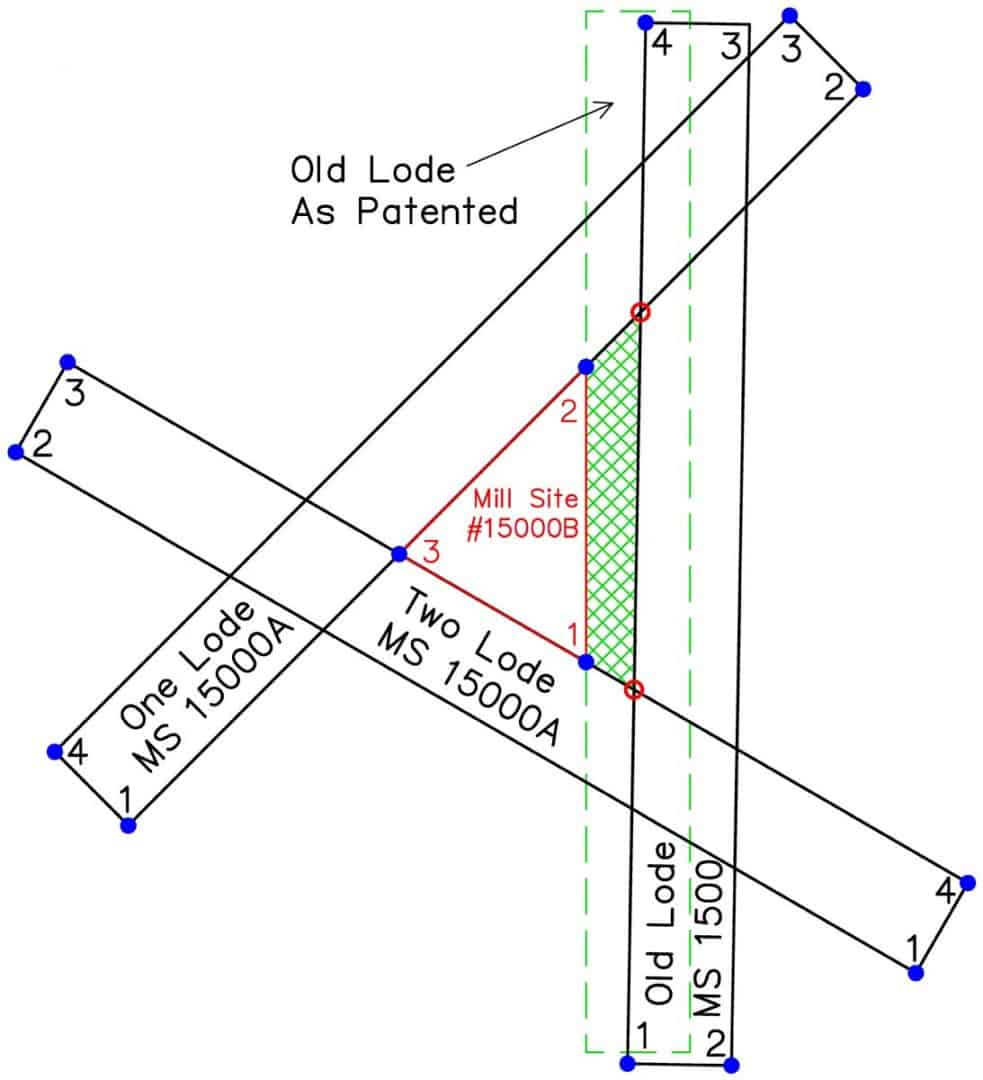
Below is how Deputy Ventress did just that for Sur. No. 15000 A&B.
This sketch shows the claims and ties to the south township line for both surveys before playing Pin the Tail on the Donkey.
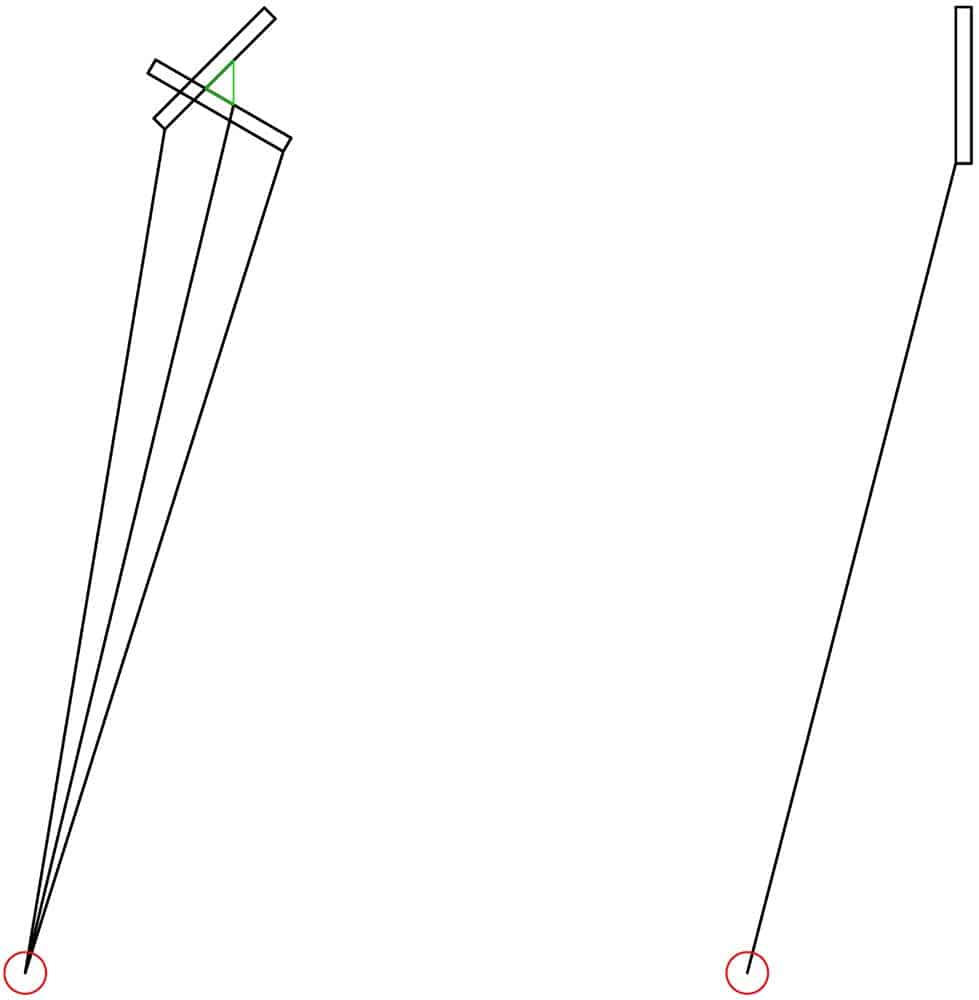
This sketch shows the patent position for the Old Lode after "snapping" it to the corner on the township line (red circles are coincident). This shows how the claim positions in the initial sketch in the OP were established.
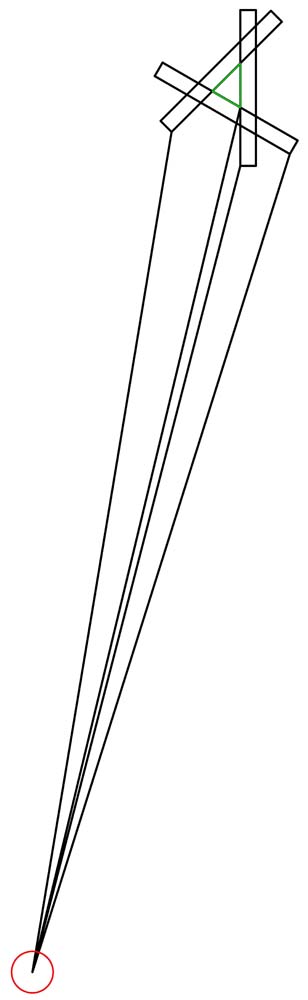
This sketch shows that Deputy Ventress placed Cors. Nos. 1 and 2 on the patent position of Line 4-1 of the Old Lode to be in compliance with the Binger Policy. He had already ran into trouble for erroneously not showing the patent position of the Seaton Lode on the Dorina Lode in 1900. The red circles show where Deputy Ventress would have placed Cors. Nos. 1 and 2 of the mill site before and after the Binger Period.
GIS at its best!
Yep, just CAD and a blizzard of lines, eh?!? 😉
To follow up, I have a theory for why the ground position of the Old Lode does not match the record. From the information in the OP, it appears that the mineral surveyor made a mistake of 1?ø in his determination of the true meridian. That may have occurred due to an error in the adjustment of the solar attachment or an error in a reading. I've never used a solar transit, let alone an 1880 vintage one so I am not sure how likely a 1?ø error is.
The general area has many mineral surveys and errors, esp. in ties to a distant PLSS corner were creating problems with the relative positions of the approved mineral surveys in the 1870s and early 1880s. In order to improve the accuracy of the PLSS connections, a triangulation network was established in 1882. There are a couple of triangulation stations approx. halfway between the township line and and the Old Lode.
Looking at the record tie between Cor. No. 1 of the Old Lode (S 14?ø27' W, 8010.83 ft.) and my tie of (S 14?ø 53' 40" W, 8010.14 ft.) it appears that the mineral surveyor tied into one of those two triangulation stations and then added the latitude and departure from it to the section corner on the south township line to compute his connection to the township line. The field notes do not include a tie to the triangulation station, but that was not uncommon for the time. Ties to intermediate control stations were not required to be in the field notes only the tie to the PLSS corner or U.S. Location Monument.
So, now that I finally explained how the Binger Policy was applied and the fact that the originally established corners of the mill site were purposely set at the patent position of the Old Lode, would you still hold the found monuments? Or would the fact that they were not allowed to be set at the true intersections mean that their positions should be rejected. I realize that this is an odd position to take, that being a monument set in its originally established position not only can be rejected, it should be rejected as marking the original corner. If the client wishes to pursue this, I will likely submit the survey to the BLM with a request for an official position on whether they regard the "gap" to be a gap or whether it passed under the patent to my client.
There is a provision in the Federal Land Policy and Managment Act of 1976 that permits the Secretary of the Interior to correct an obvious error in a patent. The provision states,
Under section 316 of the Federal Land Policy and Management Act of 1976, 43 U.S.C. (Paragraph) 1746 (2000), the Secretary has the authority to correct errors in patents and conveyance documents where an error in fact requires correction and considerations of equity and justice favor such correction.
It may be one method to correct a Bingered boundary. I don't know whether the costs to seek this remedy would override the benefits, but it appears to be a way to cure an error in a patent.

Gene Kooper, post: 437606, member: 9850 wrote: To follow up, I have a theory for why the ground position of the Old Lode does not match the record. From the information in the OP, it appears that the mineral surveyor made a mistake of 1?ø in his determination of the true meridian. That may have occurred due to an error in the adjustment of the solar attachment or an error in a reading. I've never used a solar transit, let alone an 1880 vintage one so I am not sure how likely a 1?ø error is.
The general area has many mineral surveys and errors, esp. in ties to a distant PLSS corner were creating problems with the relative positions of the approved mineral surveys in the 1870s and early 1880s. In order to improve the accuracy of the PLSS connections, a triangulation network was established in 1882. There are a couple of triangulation stations approx. halfway between the township line and and the Old Lode.
Looking at the record tie between Cor. No. 1 of the Old Lode (S 14?ø27' W, 8010.83 ft.) and my tie of (S 14?ø 53' 40" W, 8010.14 ft.) it appears that the mineral surveyor tied into one of those two triangulation stations and then added the latitude and departure from it to the section corner on the south township line to compute his connection to the township line. The field notes do not include a tie to the triangulation station, but that was not uncommon for the time. Ties to intermediate control stations were not required to be in the field notes only the tie to the PLSS corner or U.S. Location Monument.
So, now that I finally explained how the Binger Policy was applied and the fact that the originally established corners of the mill site were purposely set at the patent position of the Old Lode, would you still hold the found monuments? Or would the fact that they were not allowed to be set at the true intersections mean that their positions should be rejected. I realize that this is an odd position to take, that being a monument set in its originally established position not only can be rejected, it should be rejected as marking the original corner. If the client wishes to pursue this, I will likely submit the survey to the BLM with a request for an official position on whether they regard the "gap" to be a gap or whether it passed under the patent to my client.
There is a provision in the Federal Land Policy and Managment Act of 1976 that permits the Secretary of the Interior to correct an obvious error in a patent. The provision states,
It may be one method to correct a Bingered boundary. I don't know whether the costs to seek this remedy would override the benefits, but it appears to be a way to cure an error in a patent.
Fascinating stuff Gene. I still don't like 3. Even if a mill site is a claim of sorts, it seems to me the rule mentioned was contemplated to be used between lode or placer claims. It seems like it all hinges on whether the government wants to claim the gap. If they don't, then I would include it in the mill site and problem doesn't exist. Well, until another surveyor rejects that and goes with #3:)

"Under section 316 of the Federal Land Policy and Management Act of 1976, 43 U.S.C. (Paragraph) 1746 (2000), the Secretary has the authority to correct errors in patents and conveyance documents where an error in fact requires correction and considerations of equity and justice favor such correction."
Thanks Gene for sharing all of this, very interesting stuff. This story and the beautiful pictures you've posted kinda makes me want to re-locate to Colorado and get into mineral surveying.
The more I hear about this history and the Binger policy, the more convincing it is becoming to me that the only authority one has as a retracing surveyor is to deem ownership to the monumented line. All of this obscure office calculations and cooking of the books, so to speak, which has complicated the record leads me to think that if this were to be tried before a judge, that they'd fall back to the more basic elements of the claim, being the monuments actually set in the ground.
For the original patentee, the fact that the legal description called to this senior line had no effect on his enjoyment of the claim. In other words, there weren't any damages. The claim was staked on the ground, and as demonstrated by your survey, he got about the right acreage that he paid for. There doesn't seem to be a problem with equity or justice.

I agree with whatever Kent says

1 and move on. 🙂
Kris Morgan, post: 437669, member: 29 wrote: 1 and move on. 🙂
I did the first part of your suggestion, Kris. However, I will likely come up with more reasons to visit the site instead of moving on.
Columbine nestled among the pines and located on the gap.


This thread shows how the Binger Policy was implemented from 1899 to 1904. In Colorado, nearly 4000 mineral survey orders were issued during that time. If you do a mineral survey, there's approx. a 1 in 7 chance it will be bingered. The above example is one of two situations that you may encounter. That being where the patented position of the senior claim is "encountered" before its true position. The corners of the mill site were set on the patented line of the Old Lode.
One might think that only the patented position would control, but that is not the case. Here is an example where the true position is controlling, but not shown on the plat. In other words, the patent position of the senior claim is shown on the plat with a gap between it and the true line whichis coincident with the lines of the junior claims.
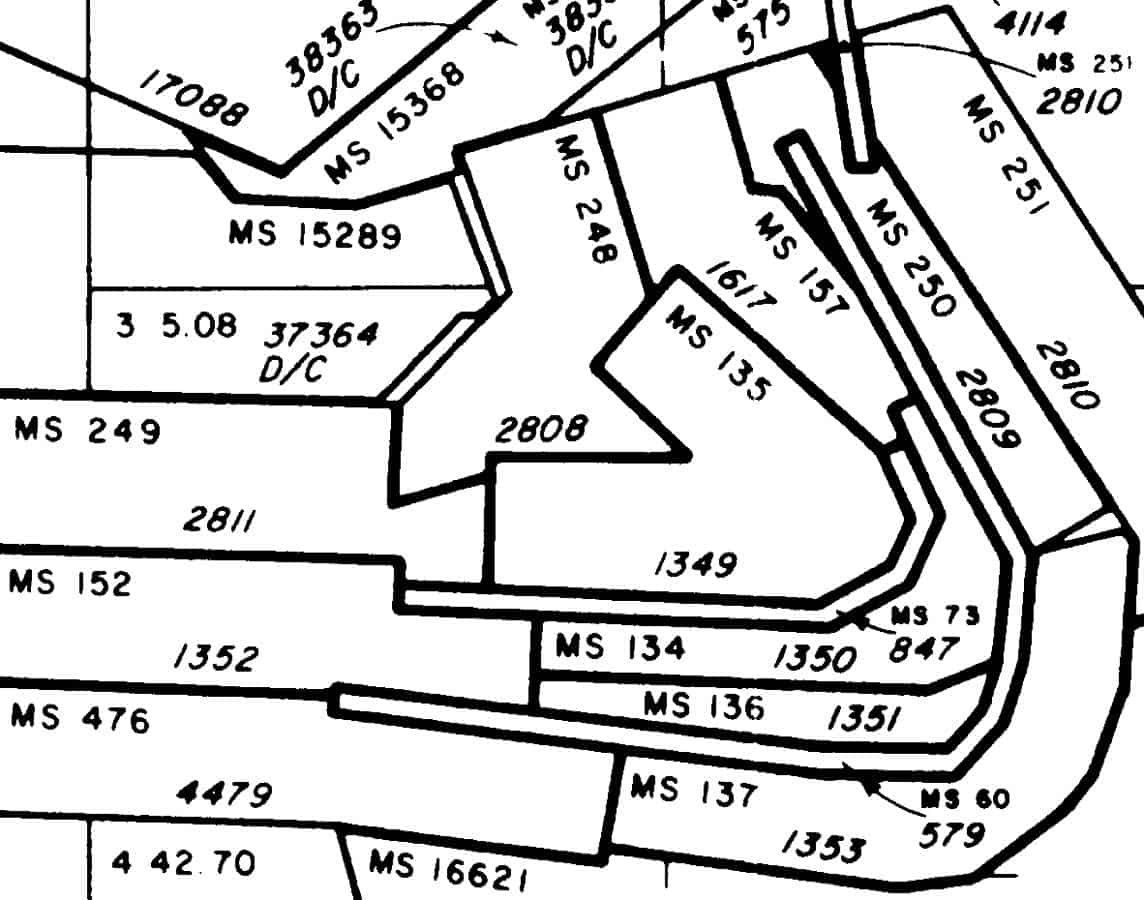
This example is on the east side of Mt. Bross. Here are the links for the https://glorecords.blm.gov/details/survey/default.aspx?dm_id=194981&sid=odzjdafp.jq0&surveyDetailsTabIndex=1&apos ;">Polaris Lode, MS248 and the https://glorecords.blm.gov/details/survey/default.aspx?dm_id=271488&sid=ilzgf034.nz3&surveyDetailsTabIndex=1&apos ;">October and Triangle Lodes, MS15289. There are two gaps between the Polaris and the October and Triangle lodes. Please note that the lengths of the side lines are 1175.1 ft. and 1078.2 ft., both well below the statutory limit of 1500 ft. So why not extend those two claims to the side line shown for the Polaris Lode?
The first image is a supplemental master title plat showing several odd shaped lode claims. Two oddities stand out to me on the plat, those being the small gaps between MS 248 and MS 15289.
Here is a sketch showing the three claims as depicted on the plat of Sur. No. 15289
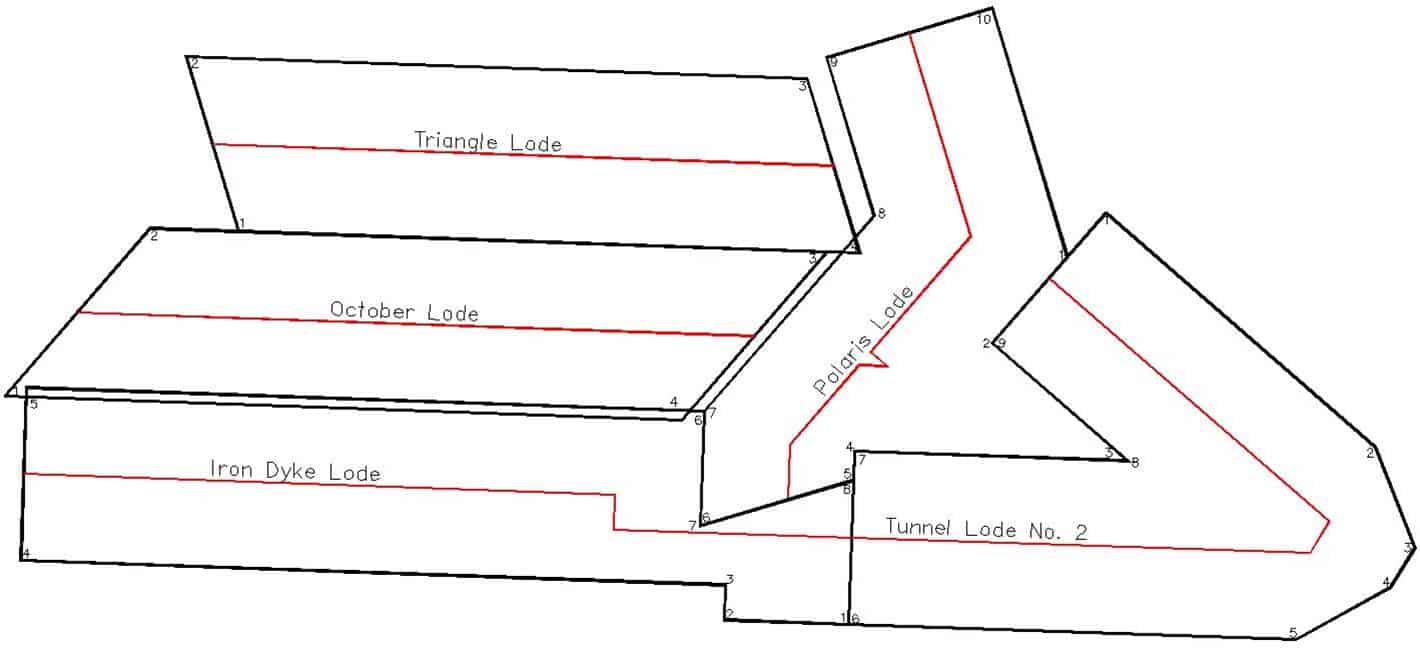
The lode lines (red) for the Polaris, Iron Dyke and Tunnel Lode No. 2 are geological oddities, esp. the zig-zag in the Polaris Lode. That is simply explained by one of the requirements of lode claim locations. Both side lines must be 150 ft. from the lode line. If you go 150 ft. northeast of the zig you will be at Line 2-3 of the Polaris, and if you go 150 ft. south of the zag you will be on Line 3-4 of the Polaris. The zig-zag is a fabrication that allows the Polaris to completely fill the triangle and be coincident to the Tunnel Lode No. 2. The Polaris was approved in 1877 before the GLO forbade constructs not based on an actual mineralized vein.
If you look at the plat for the Polaris, you will note that it has a tie to the N1/4 Cor. of Sec. 3, T. 9 S., R. 78 W. of S. 7?ø13' E., 10627.77 ft. The plat for the October and Triangle lodes shows a tie to the same corner of S. 11?ø4' E., 10455.7 ft. The staked position of Cor. No. 4 of the October is identical to the staked position of Cor. No. 7 of the Polaris and Cor. No. 6 of the Iron Dyke (all on the same stone). The October and Triangle lodes were surveyed by W.H. Powless who had to chain nearly two miles so that he could could then use the two-mile patented connection for the Polaris, which show it being 43.4 ft. to the northeast of two lodes!
The common corner to the October, Iron Dyke and Polaris is at the top of the ridge at 13800 ft. (photo looking north)
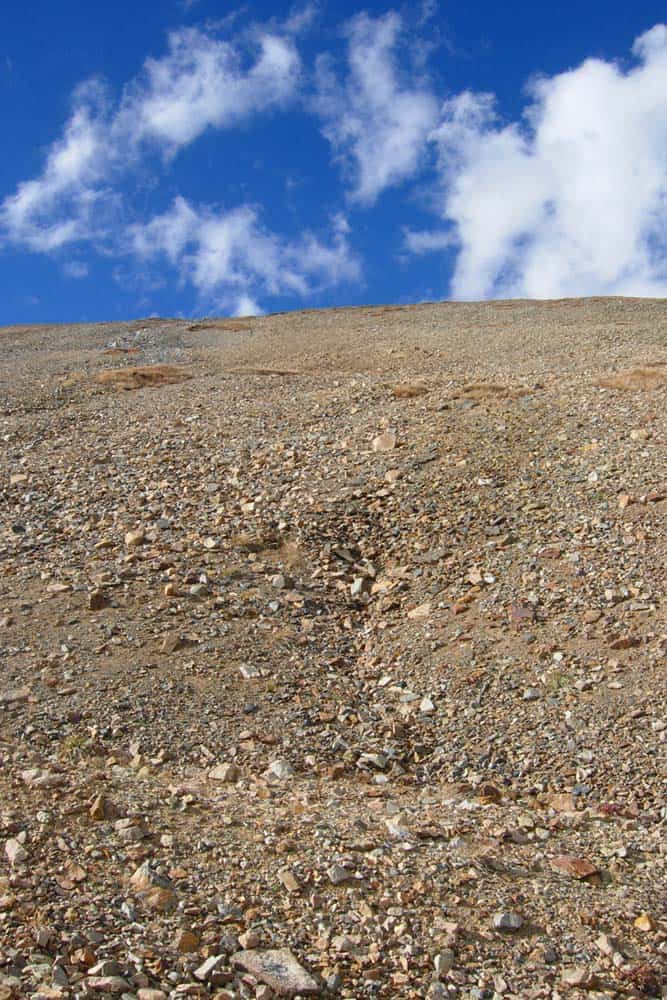
Turning around and looking south at the terrain that Dep. Powless chained across, the Qtr. Cor. is approx. 1.7 miles at an elevation of 11,700 ft.
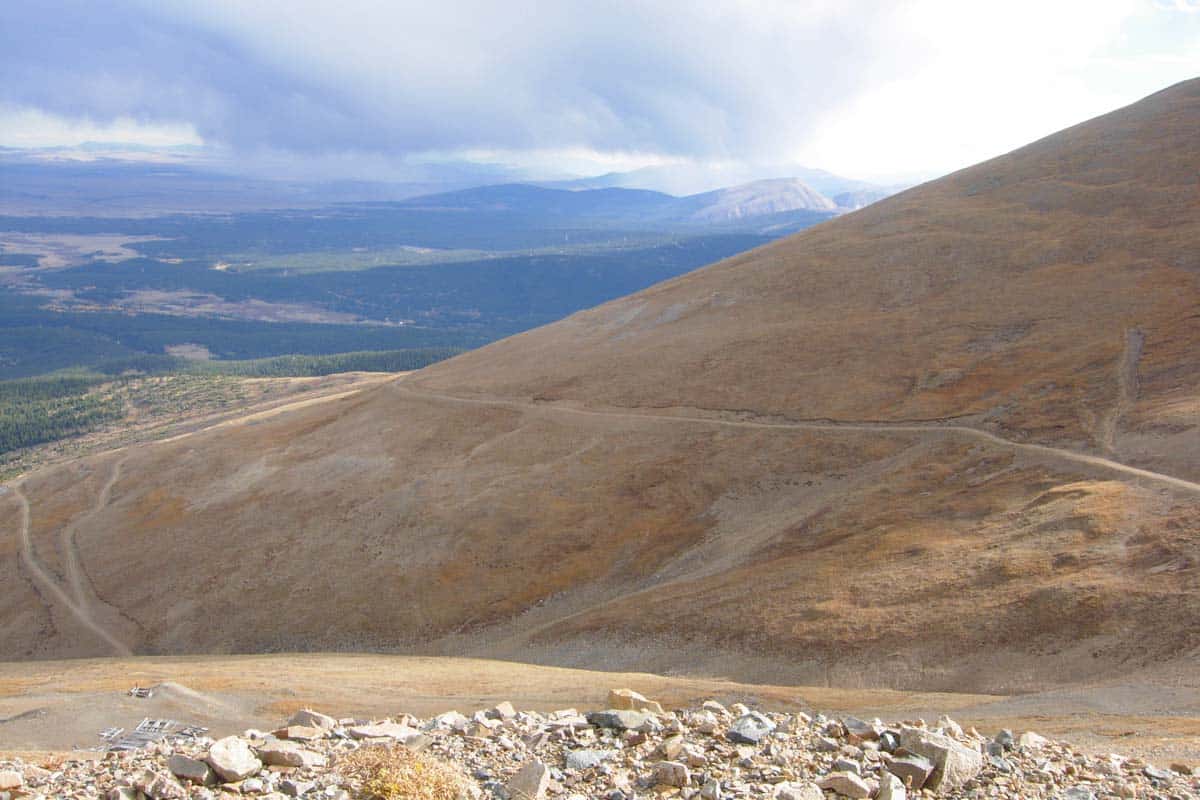
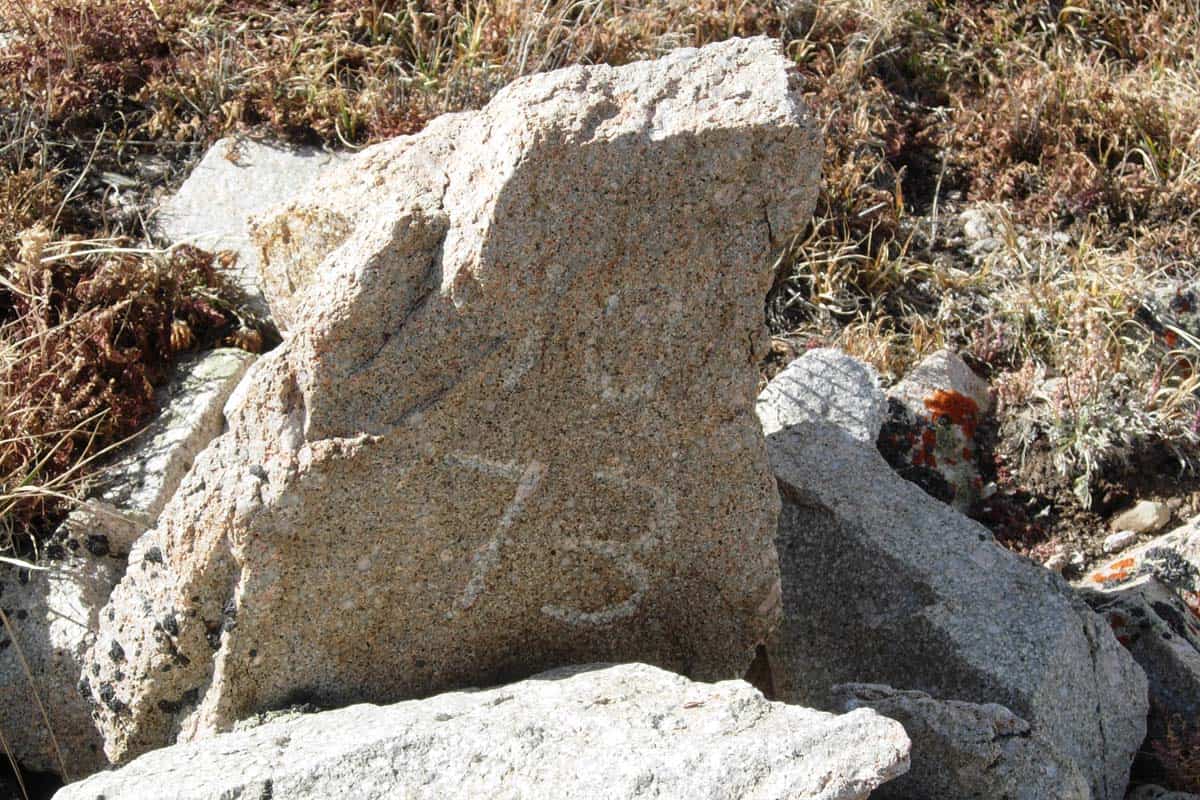
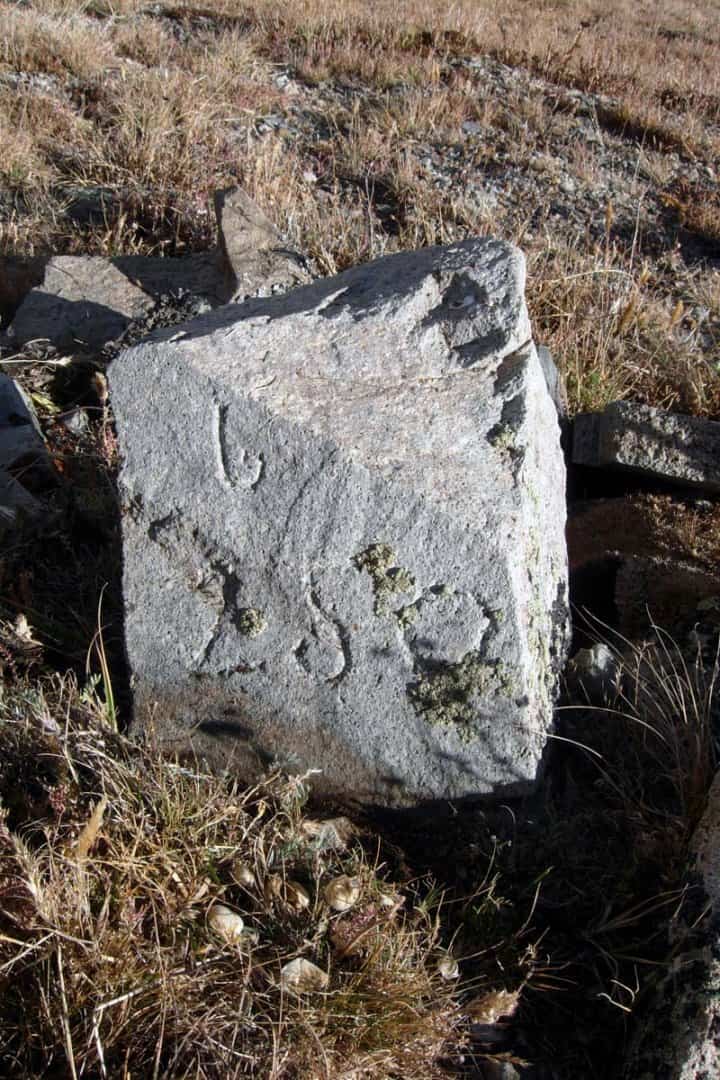
Here are a couple of nearby stone corners for Cor. No. 10 of the Hiawatha, MS 73 and Cor. No. 6 of the Friday, MS 250 that are to the south and east of the claims.