

Gene Kooper, post: 437381, member: 9850 wrote: The mining claims were sold. The price paid by the claimant of Sur. No. 15000 A&B was $50 for the lode claims ($5 per acre; acreage rounded up) and $5 for the mill site ($2.50 per acre; acreage rounded up).
Yes, Roger. The mill site acreage from my field survey is 1.314 acres (patent is for 1.316 acres)
The government would say patents are construed in their favor so the government gets the gap.

Gene Kooper, post: 437381, member: 9850 wrote: The mining claims were sold. The price paid by the claimant of Sur. No. 15000 A&B was $50 for the lode claims ($5 per acre; acreage rounded up) and $5 for the mill site ($2.50 per acre; acreage rounded up).
Yes, Roger. The mill site acreage from my field survey is 1.314 acres (patent is for 1.316 acres)
If that's the case and without being an expert in this area, I think I'd be hesitant to tell my client that he owns to the senior line. The 0.82 acre gap would push the parcel over 2 acres rounded up to three, but he only paid for two. As a practical solution, I'd probably advise the client to either live with the monumented parcel, or pay to pursue the issue with the BLM to get an official opinion and/or quitclaim deed of the gap.

Dave Karoly, post: 437372, member: 94 wrote: If the senior line is discoverable then it can't be moved.
The case could be made that in the case of a conflict between a call for a monument and a call for a line the patent would be limited by the call for the monument. I think this fails to take into account the superior rule, the intentions of the patent is the paramount consideration, that is to leave no gap.
Sorry, I'm now going to invoke something specific to mineral surveys. The passage of the Act of April 28, 1904 by Congress is pertinent to your question. Here is the entire text of the Act (30 USC Sec. 34), which consists of two paragraphs.
The description of vein or lode claims upon surveyed lands shall designate the location of the claims with reference to the lines of the public survey, but need not conform therewith; but where patents have been or shall be issued for claims upon unsurveyed lands, the Director of the Bureau of Land Management in extending the public survey, shall adjust the same to the boundaries of said patented claims so as in no case to interfere with or change the true location of such claims as they are officially established upon the ground. Where patents have issued for mineral lands, those lands only shall be segregated and shall be deemed to be patented which are bounded by the lines actually marked, defined, and established upon the ground by the monuments of the official survey upon which the patent grant is based, and the Director of the Bureau of Land Management in executing subsequent patent surveys, whether upon surveyed or unsurveyed lands, shall be governed accordingly.
The said monuments shall at all times constitute the highest authority as to what land is patented, and in case of any conflict between the said monuments of such patented claims and the descriptions of said claims in the patents issued therefor the monuments on the ground shall govern, and erroneous or inconsistent descriptions or calls in the patent descriptions shall give way thereto.
I mentioned this Act several times in a previous thread on interpreting the resurvey instructions for mineral surveys in Chapter X. One main question I asked in that thread was whether a call to a senior line would mean that the monuments defining that senior line govern what mineral land is patented (emphasis underlined). Some may believe that the call to the senior line is to be rejected when inconsistent with the other monuments (emphasis in boldface).
Kent McMillan, post: 437374, member: 3 wrote: So what you're saying is that you found a particular recipe that was well understood to be part of the cookbook as used at an earlier date? That is exactly what I suspected.
WRONG, Kent.

Gene Kooper, post: 437385, member: 9850 wrote: WRONG, Kent.
Well, if I'm wrong, I'll readily admit it, but invariably the problems you describe revolve around obscure, but formulaic, recipe book solutions (Aha! these instructions require all measurements of pepper as set forth in the recipes as published to be doubled!) and I'm going to keep my pile of chips on just that until the contrary is demonstrated. I'd love to be proven wrong, though.
Kent McMillan, post: 437380, member: 3 wrote: Well, if ultimately this isn't merely a matter of using the right recipe as recognized at the time of the survey and grant of the Mill Site, I'll be honestly surprised. People do collect cookbooks for a reason, you know.
Sorry, Kent. Your baseless opinion doesn't matter and is of no value to the discussion. I addressed you screed on cookbooks earlier, but please continue with your trolling of this thread. The Ignore feature eliminates the clutter for me. Please feel free to start a conversation in case you decide to post something of value to the discussion. Thanks. I'll appreciate reading your input.
Gene Kooper, post: 437387, member: 9850 wrote: I addressed you screed on cookbooks earlier, but please continue with your trolling of this thread.
I'd prefer to be shown to be wrong, but, as I said, won't bet on it.
Well, the Ignore feature sure cleaned things up. 🙂
I had mentioned earlier an obscure circular sent by the U.S. Surveyor General for Colorado published for the information of applicants for surveys of mineral claims (also included U.S. Deputy Mineral Surveyors). I attached a copy of the "circular" to this post. It consists of two paragraphs from a Department letter from the Commissioner to the Colorado Surveyor General, dated June 17, 1899. I have also attached a copy of the full letter. Page two shows a large right bracket "}" in the right margin and shows the source of the two-paragraph circular.
Certainly not a Cookbook recipe, but an extract from the GLO Commissioner's correspondence addressing a specific survey, that the Colorado SG then issued as a guidance for anyone wishing to apply for a mineral survey order. In fact, one year later, the Commissioner's office chastised the CGO for issuing the circular without seeking approval from Washington. I also attached a letter from an attorney, C.T. Pease who used to be a mineral surveyor in the Cripple Creek district to James Dyson, a mineral surveyor in Silverton. See the third attachment to this about how mineral surveyors were instructed to deal with the Commissioner's letter.
Eventually, the informal policy extended to other western states. I have found examples in South Dakota, Montana, Wyoming, Oregon, Nevada, Idaho, Utah, Arizona and New Mexico. No written instructions, just an informal policy perpetuated by the obedient servants of the GLO Commissioner and Secretary of Interior. Eventually, one DOI Land Decision addressed the issue in 1901, the Mono Fraction Lode Land Decision (31 LD 121) from South Dakota. I did find the following wailful mourn of Edward H. Anderson, the U.S. Surveyor General for Utah that he included in his 1901, 1902 and 1903 annual reports to the GLO Commissioner. Here is an extract from his vain attempt to get back to sanity.
The Department of Interior holds that courses & distances once incorporated into a patent must be recognized in all subsequent conflicting & adjacent surveys, notwithstanding actual conditions on the ground to the contrary. This means a perpetuation of the error, if any exist, in the former patented survey, and the deputy who makes the latter survey is compelled to falsify his returns to conform to such error. The courts hold that the monuments and markings on the ground govern.
Gene Kooper, post: 437389, member: 9850 wrote:
I had mentioned earlier an obscure recipe sent by the U.S. Surveyor General for Colorado published for the information of applicants for surveys of mineral claims (also included U.S. Deputy Mineral Surveyors). I attached a copy of the "recipe" to this post. It consists of two paragraphs from a Department letter from the Commissioner to the Colorado Surveyor General, dated June 17, 1899.
And why is this not an example of cookbook surveying par excellence? You've just made a deep dive and found a recipe, but it's still a formulaic resolution. This is very different from the sorts of problems that surveyors deal with in states where there is no cookbook beyond the statutes and case law of the state. Just sayin'.
A footnote. Attached is the Departmental letter a year after the June 20, 1899 "circular, where the Assistant Commissioner, W.A. Richards chastised the Colorado SG. I enjoyed the part that the letter wasn't about the circular from a year before, but the bulk of the letter was devoted to pointing out the Surveyor's General error in issuing it.

Gene Kooper, post: 437352, member: 9850 wrote: Here is an interesting twist on a gap not of record. While the parcels are three lode mining claims and a mill site, please consider that the solution is not dependent upon a specialized knowledge of mining claims.
In 1882, the Old Lode (MS 1500) was surveyed by U.S. Dep. Mineral Surveyor, Albert E. Chase with a solar transit and 500 ft. steel tape. The plat shows it to be 1500 feet long and 150 feet wide. The plat and field notes show a connection between Cor. No. 1 and a section corner on the south township line to be S14?ø27'W, a distance of 8010.8 ft. All four corners are chiseled stones surrounded with a mound of stone. The patent was issued in 1885 and it does not state any conflicts or exclusions with other claims (acreage of 5.165 acres).
In 1902, the One and Two lode claims and a mill site (MS 15000 A&B) were surveyed by U.S. Dep. Mineral Surveyor, A.J. Ventress with a Gurley Light Mountain transit and 500 ft. steel tape. The true meridian was determined by direct solar observations. The plat shows both lode claims to be 1500 feet by 150 feet and the mill site boundary is coincident with the side lines of the Old, One, and Two lodes. The plat and field notes show connections between Cors. Nos. 1 of the One and Two lodes and Cor. No. 1 of the mill site and a section corner on the south township line (same PLSS corner as MS 1500) to be S9?ø24'W, 8194.3 ft, S17?ø27'W, 8251.6 ft., and S13?ø31'W, 8556.5 ft., respectively.
All 8 lode claim corners and Cors. No. 2 and 3 of the mill site are chiseled stones surrounded by mounds of stone. Cor. No. 1 of the mill site falls on a 8 x 3 ft. boulder, standing 2 ft. above the ground and marked with a chiseled "+". The patent was issued in 1904 and it expressly excepts and excludes from the patent that portion of the Old Lode (MS1500) in conflict with the One and Two lodes (acreage of 9.661). The patent states that the mill site has an acreage of 1.316 acres.
Plat for Sur. No. 15000 A&B showing conflict with Old Lode, Sur. No. 1500.
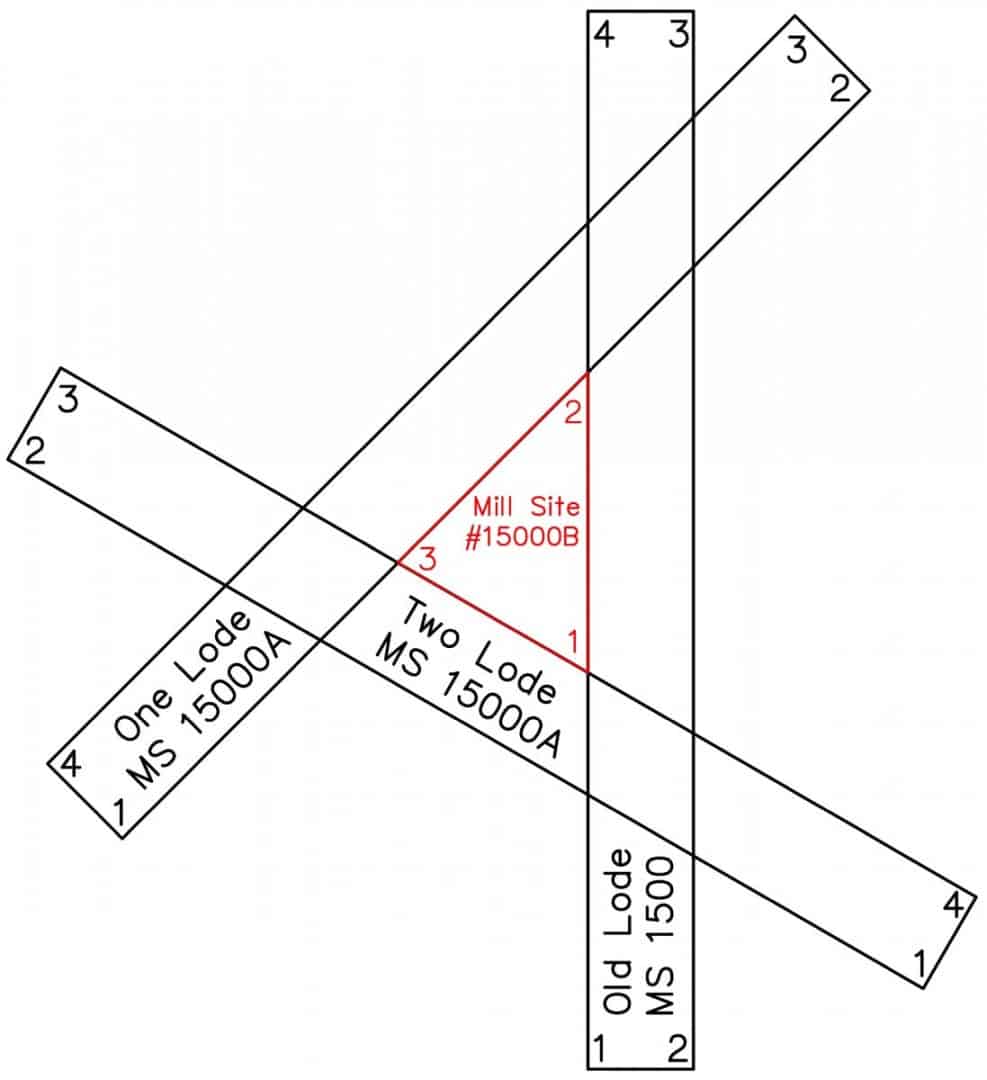
I conducted a field survey and found all of the original corners either firmly set or reestablished from the stone mound or original accessories). The exception is Cor. No. 3 of the Old Lode, which currently falls in a road. The measured courses and distances "reasonably" match the record dimensions for Sur. No. 15000 A&B. The distances of the Old Lode reasonably match the record. Line 1-2 of the mill site matches record of N0?øE, but Line 4-1 of the Old Lode is S1?øW. The mining improvements for the Old Lode fit the found position, not the position shown on Sur. No. 15000 A&B. The area is covered in pine forest and there are no improvements placed on any of the boundary lines (i.e. no fences). My client owns the mill site and wants to build a cabin. There is an existing road that provides access from the north to the Old Lode.
Cors. Nos. 3 and 2 of the mill site create two angle points in Line 1-2 of the One Lode with fallings of 0.4 ft. and 0.6 ft. respectively. Cors. Nos. 3 and 1 of the mill site create two angle points in Line 3-4 of the Two Lode with fallings of 0.3 ft. for both corners. Instead of being coincident, Line 4-1 of the Old Lode is approx. 74 ft. east of Line 1-2 of the mill site.
The field notes for the mill site (MS 15000B) clearly state that Cor. No. 1 is a chiseled "+" in a boulder and was set at the intersection of Line 4-1 of the Old Lode and Line 3-4 of the Two Lode. The field notes continue, "Thence north along Line 4-1 of the Old Lode a distance of 425.2 ft. to Cor. No. 2 at the intersection with Line 1-2 of the One Lode." There is a gap of 0.82 acres.
Preliminary plat showing the found positions of the 3 lode claims and mill site.
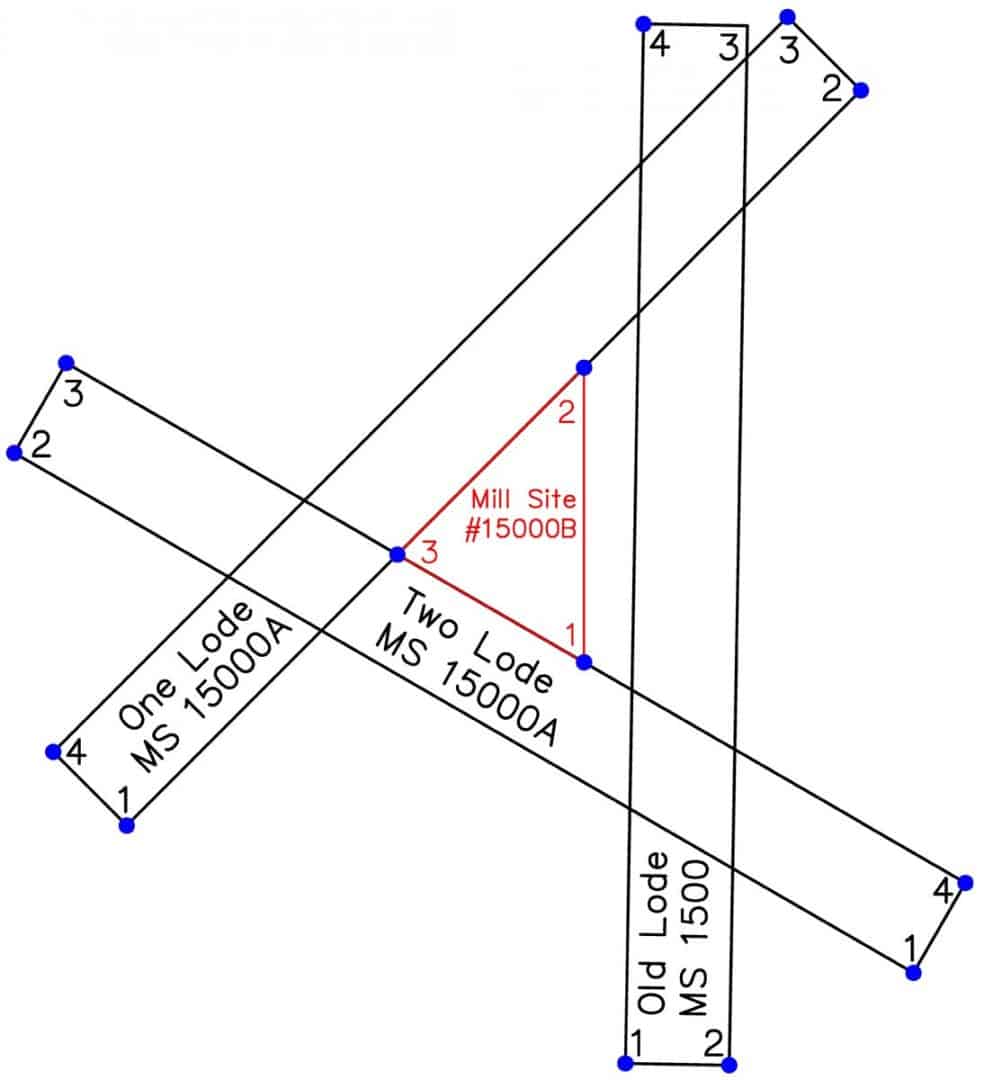
These claims are private inholdings within a national forest located somewhere in Colorado. What would you do with the "technical gap" (i.e. it is not of record).
- The monuments are still in their originally established positions. Hold everything and show the gap. The gap is Federal interest land.
- Hold the call to the senior line over the original monuments. They are closing corners. Set new monuments at the true intersections.
- Despite the suspected blunder of Dep. Ventress there is no gross error or fraud and since the other criteria of "mistake" is not defined in Chapter X of the 2009 manual, it is appropriate to bend Line 4-1 of the Old Lode through Cors. Nos. 2 and 1 of the mill site. This is in keeping the general rule that no gap in the record, no gap on the ground. (Sorry, this one is specific to mineral surveys.)
- Call your buddies at the USFS and BLM.
- Other solutions?
I'm for #1 because federal lands and mill site is not a mining claim so #3 would not apply. But I would also use #4 before finalizing an opinion.

The Old Lode is Senior, why would you bend it's West line to the Junior Mill Site?
You do not show what was actually occupied for use by the Mill Site.
Paul in PA
Gene Kooper, post: 437391, member: 9850 wrote: A footnote. Attached is the Departmental letter a year after the June 20, 1899 "circular, where the Assistant Commissioner, W.A. Richards chastised the Colorado SG. I enjoyed the part that the letter wasn't about the circular from a year before, but the bulk of the letter was devoted to pointing out the Surveyor's General error in issuing it.
Was the east line of the Mill Site set based on its record location and not where it was actually located?
E.g. the monuments where set so far off because of Binger?

The Mill corners will not control the old lode line. The only question is will there be a gap. The plat in existence at patent doesnt show one. Operations of law between the crown snd citizens are all but nonexistent.
No gap and the old lode line is straight. No fourth parcel either.

#2 (protect the plat)
#4 will be interesting but usually doesn't supply a solution, I would be sure to start with a field guy;)
This sounds like it's resolved, what was your final answer?
Gene Kooper, post: 437387, member: 9850 wrote: Sorry, Kent. Your baseless opinion doesn't matter and is of no value to the discussion. I addressed you screed on cookbooks earlier, but please continue with your trolling of this thread. The Ignore feature eliminates the clutter for me. Please feel free to start a conversation in case you decide to post something of value to the discussion. Thanks. I'll appreciate reading your input.
I am reminded of a discussion from my time in seminary. A relative repeatedly chimed in with his expert opinion on where I had read the General Epistles incorrectly. Nevermind he was an atheist who had never opened a Bible. He was convinced of his superior status and knowledge to the point he could not shut up.
Duane Frymire, post: 437398, member: 110 wrote: I'm for #1 because federal lands and mill site is not a mining claim so #3 would not apply. But I would also use #4 before finalizing an opinion.
Duane,
Mill sites are regarded as mining claims and are first defined in the 1872 U.S. Mining Law. While the authority to issue patents for lode and placer claims is the 1866 Mining Law, mill site patents are authorized under the 1872 Mining Law. Mill sites have one unique characteristic. By law they can only be located on land that is non-mineral in character, albeit within lands deemed to be mineral lands by the fact that they are more valuable for their minerals than for other purposes such as agriculture.
Going into the weeds a bit, the lode claim lines that are common to the mill site boundary are side lines. By rule mill sites cannot have a line common with the end line of an existing lode claim. By definition a lode claim has a mineralized vein that goes through both endlines. Therefore, it is not possible to prove that a mill site is non-mineral in character if it shares a common boundary line with the end line of a lode claim.
Let's keep #3 still in play.
Edit to add: Once a patent has been issued for a mill site, any minerals found on the mill site belong to the patentee. A mill site patent does not include a reservation for the minerals. There are two "types" of mill site. A mill site of up to 5 acres can be claimed with one or more lode or placer claims (placer claims with a mill site were approved in the 1960s). For these cases, the mineral survey number has "A&B" added to it. The lode claims have an "A" added to the survey number and the mill site has a "B" added to the survey number. Mill sites can also be a separate claim. These are called independent mill sites. A "B" is not added to the survey number. The rules are slightly different for the two. In the past, mill sites were allowed to be any shape and were defined by metes-and-bounds description. The acreage can not exceed 5 acres. Now two aliquot parts of 2-1/2 acres are permitted.
Paul in PA, post: 437399, member: 236 wrote: The Old Lode is Senior, why would you bend it's West line to the Junior Mill Site?
You do not show what was actually occupied for use by the Mill Site.
Paul in PA
For technical gaps or overlaps, Chapter X of the 2009 Manual allows the resurveyor to bend a mining claim line through intermediate monuments. The first condition to be met is that there is not gap in the record. The remaining conditions are that the intermediate monuments were not set in gross error, fraud, or mistake. The old mill (now only a foundation) is well within the boundaries of the mill site. An earlier post mentions that none of the lines have any improvements placed on them (e.g. no fence lines).
I agree with bionicman that it is a real stretch (pun intended) to interpret the text in sections 10-224 and 10-225 and bend Line 4-1 of the Old Lode through the intermediate monuments (Cors. Nos. 2 and 1 of the mill site). Besides, doing that takes two triangular areas from the One and Two lodes and "gives" them to the Old Lode. Something not contemplated in Chapter X because once those three lode claims were patented, the BLM no longer has jurisdiction over them.
The Mill Site calls for the Old Lode line, not vice versa. Any adjustment is to the Mill Site or not at all.
Because of the call, the Mill Site has some color of title to the excess, but the surveyor cannot give it to the owner. The Mill Site has a superior right over any other third part to claim, compensate and acquire the excess at fair value.
Paul in PA
Dave Karoly, post: 437407, member: 94 wrote: Was the east line of the Mill Site set based on its record location and not where it was actually located?
E.g. the monuments where set so far off because of Binger?
Yes, Dave this is a Bingered survey. I thought it would be interesting to discuss the situation where the original surveyor purposely set corners somewhere other than where they are described as being set. I'll go into the details of why Cors. Nos. 1 and 2 of the mill site were set where they were instead of at the true intersections of the Old Lode with the One and Two lodes.
thebionicman, post: 437423, member: 8136 wrote: The Mill corners will not control the old lode line. The only question is will there be a gap. The plat in existence at patent doesnt show one. Operations of law between the crown snd citizens are all but nonexistent.
No gap and the old lode line is straight. No fourth parcel either.
I don't believe that there should be a gap. In my view, there is no clear answer as to how to proceed.
MightyMoe, post: 437448, member: 700 wrote: #2 (protect the plat)
#4 will be interesting but usually doesn't supply a solution, I would be sure to start with a field guy;)
This sounds like it's resolved, what was your final answer?
At this point there is no resolution. If my client wants to pursue this, I would first recommend asking the BLM to provide a written opinion on the gap. I have a definite opinion on what I would like to see happen, knowing the circumstances and the fact that Deputy Ventress purposely falsified his returns to show that Line 4-1 of the Old Lode is coincident with Line 1-2 of the mill site. Regarding my statement about Deputy Ventress, I'll include information on a previous survey of his where the Commissioner directly instructed him to show the patent position of a senior claim. It is a good example of the case-by-case way that the policy was enforced. There definitely were no official and published set of instructions on how to follow the policy.