

surv8r, post: 414619, member: 4 wrote: Several years ago, a GDOT (Georgia DOT) Engineer told me.... "The road itself is the controlling monument. Split the roadway pavement to establish the centerline, then measures the distances either side of that centerline to establish your R/W lines"
I was preparing a boundary survey on a parcel that the existing state highway that had recently widen and the R/W monuments were less than a month old. There was discrepancies between the R/W monuments and the R/W plans that varied by 10-15 feet. I contacted the district DOT office to get more info and was told that statement.....
I would think a Land Surveyor would understand boundary better than an engineer employee. He's telling you some mechanics he uses as an engineer. You are qualified to form an opinion as to legal location of a property.

aliquot, post: 414661, member: 2486 wrote: I think it is well established that monuments placed close to the time of conveyance are to be considered original. A surveyor is not anymore a "party to the conveyence" then the contractor. Both are agents of their client. The adjacent land owner has the same ability to protest the location of the monuments in both cases.
That would not be true in Texas. The control of monuments depends upon their being identifiable objects that the parties had in view and that were embraced by the writing of the deed. Markers that were set later at the direction of only one of the parties would at best be evidence of lines established under some doctrine of equity and not by a reading of the conveyance itself.
The monuments are usually set close to the time of the conveyence. I have seen many cases where the ROW monuments are actually set prior to the actual documents conveying the land being signed. I have even been in the field while DOT pointed to their monuments (set by a contractor) and told the land owner that they were the limit of their takings.
That would not be typically true of nearly all of the right-of-way acquistions I've seen in Texas until quite recently. Those early right-of-way deeds invariably include a description by reference to some reference line or centerline. It is only in the last decade or so that TexDOT has reformed its practices to both describe markers in place at the time of the conveyances and to include provisions that those markers may be eventually replaced by a more substantial monument, which is still bizarre, but that's TexDOT.
Are you saying that you would regect monuments that were set one year, or even two or three, after a land owner subdivided his land? Even if the two sides of the line were still owned by the parties to the original deed?
I'll bite. What does that have to do with the subject under discussion, the resurveying of strips of land acquired in fee simple by a State for highway purposes?
The governmet is treated differently than private land owners is some respects, but I have never seen a court differentiate between private rights and goverment rights when it comes to monumentation.
I really find it hard to belive that monuments set at the state's direction to mark the limits of their interest can be thrown out in favour of a mathematical solution based on distant control or the apparent centerline of a moving road.
Actually, such rights as the State has originate in the language of the conveyance unless there is some specific provision otherwise. So the question is whether the markers that some road contractor places for the State modify the language of the conveyance. The obvious answer is "no". So what one is left with is the question of whether there is some equity at work that would make markers that are at significant variance with the language of the State's deed somehow the true boundary described in the deed.

My latest one, on a federal highway (land is owned by the state in fee):
The description was 200' to the left and 230' to the right of centerline. Pretty typical for these parts
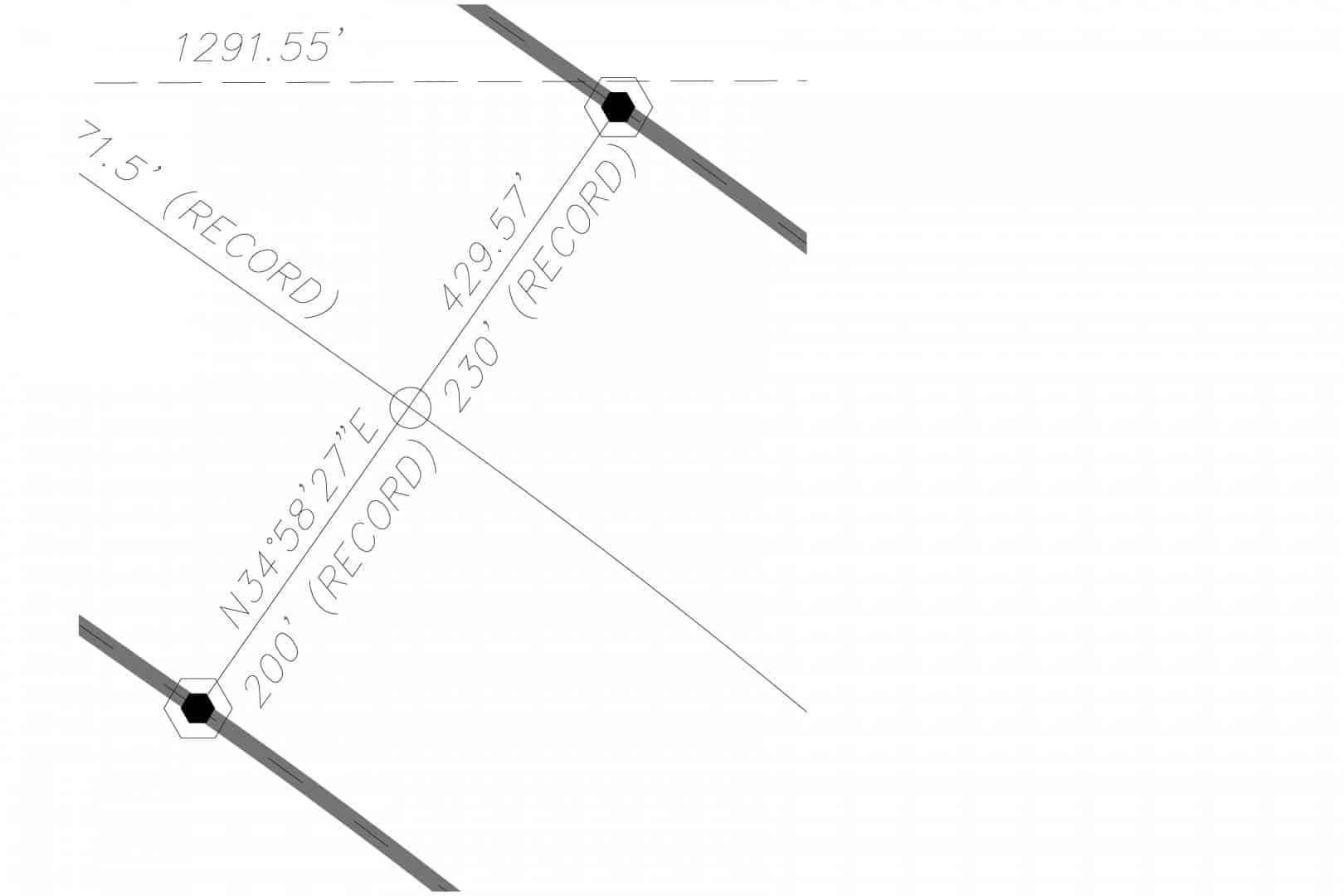

MightyMoe, post: 414668, member: 700 wrote: My latest one, on a federal highway (land is owned by the state in fee):
The description was 200' to the left and 230' to the right of centerline. Pretty typical for these parts
What are you going to do?
Kent McMillan, post: 414667, member: 3 wrote: So what one is left with is the question of whether there is some equity at work that would make markers that are at significant variance with the language of the State's deed somehow the true boundary described in the deed.
Bigger and tougher question. I am not worried about whether a "right of way" is defined by some calculated centerline and/or gets exactly 100' or whether it jogs at some old marker so much as what happens when the conveyance deeds differ by the right-of-way markers by 50 or 100 feet based on deed descriptions that don't close and are based on some protracted tie to a section corner that wasn't found @ the time.
Just like any survey/property boundary, you have widely varying differences of quality of old original descriptions as well as old original surveys. If the highway fits inside the right-of-way marks, be happy and move on.
aliquot, post: 414670, member: 2486 wrote: What are you going to do?
Go 200' to the left, and 230' to the right of the centerline.

it's also fairly common knowledge that a lengthy section of IH-35 through central austin is monumented on the ground at 202', +/-. who gets what?
and good luck locating CL (or EOP or anything) of that particular section without losing at least one rodman.

I worked on a right-of-way project once and was, told by the DOT surveyor to hold tangents and the degree of curve and let the PCs and PTs fall as they may, then call out the new station and offsets of existing monuments on the plans. Splitting monuments to come up with centerline. This particular road was through a canyon with many curves. Many monuments that were on reverse or compound curves were not radial but at 90 degrees from the previous PC or PT. I believe a surveyor would have known the difference.
Tom Adams, post: 414672, member: 7285 wrote: Bigger and tougher question. I am not worried about whether a "right of way" is defined by some calculated centerline and/or gets exactly 100' or whether it jogs at some old marker so much as what happens when the conveyance deeds differ by the right-of-way markers by 50 or 100 feet based on deed descriptions that don't close and are based on some protracted tie to a section corner that wasn't found @ the time.
Just like any survey/property boundary, you have widely varying differences of quality of old original descriptions as well as old original surveys. If the highway fits inside the right-of-way marks, be happy and move on.
To frame the question more clearly, though, take the case where the deed makes reference to the "Engineer's Centerline as now staked out upon the ground" or something similar that indicates that the description was based upon an actual survey on the ground prior to the conveyances. If there is conclusive evidence as to the location of that centerline mentioned in the conveyance, why would a surveyor not locate the boundary of the land acquired by the State in relation to that line?
MightyMoe, post: 414668, member: 700 wrote: My latest one, on a federal highway (land is owned by the state in fee):
The description was 200' to the left and 230' to the right of centerline. Pretty typical for these parts
The commoner term used by the Texas Highway Department and its successor would be "Reference Line".
Kent McMillan, post: 414678, member: 3 wrote: To frame the question more clearly, though, take the case where the deed makes reference to the "Engineer's Centerline as now staked out upon the ground" or something similar that indicates that the description was based upon an actual survey on the ground prior to the conveyances. If there is conclusive evidence as to the location of that centerline mentioned in the conveyance, why would a surveyor not locate the boundary of the land acquired by the State in relation to that line?
Okay...I did misunderstand the question. I did a retracement where the acquisitions were M&B Descriptions that would place the right of way totally outside the roadway. I actually haven't seen a lot of centerlines mentioned in the old conveyances.

aliquot, post: 414670, member: 2486 wrote: What are you going to do?
looks like he did it....
Kent McMillan, post: 414679, member: 3 wrote: The commoner term used by the Texas Highway Department and its successor would be "Reference Line".
Yes "reference line" is better than "centerline" especially when you have two different offsets.
I've seen two lines before. The "survey line" and the "design line". Those got pretty confusing sometimes.
aliquot, post: 414670, member: 2486 wrote: What are you going to do?
I will file the ROS if the client gets to that point, the right of way fits the deed so......
Kent McMillan, post: 414679, member: 3 wrote: The commoner term used by the Texas Highway Department and its successor would be "Reference Line".
deed says centerline so I will use that term
MightyMoe, post: 414689, member: 700 wrote: deed says centerline so I will use that term
If the line is actually not a centerline of anything, I'd think "the line described as the 'centerline' in the deed recorded _________" would be clearer.

As far as I have seen, it is rare for there to be any monuments at all marking the state R-O-W in Pennsylvania EXCEPT for the Turnpike Commission (a separate entity than PennDOT). Now, this may not be true for the newer highways, I have not been working along any of them.
The state controls about 40,000 miles, and I would say very little of it is monumented, in my experience.
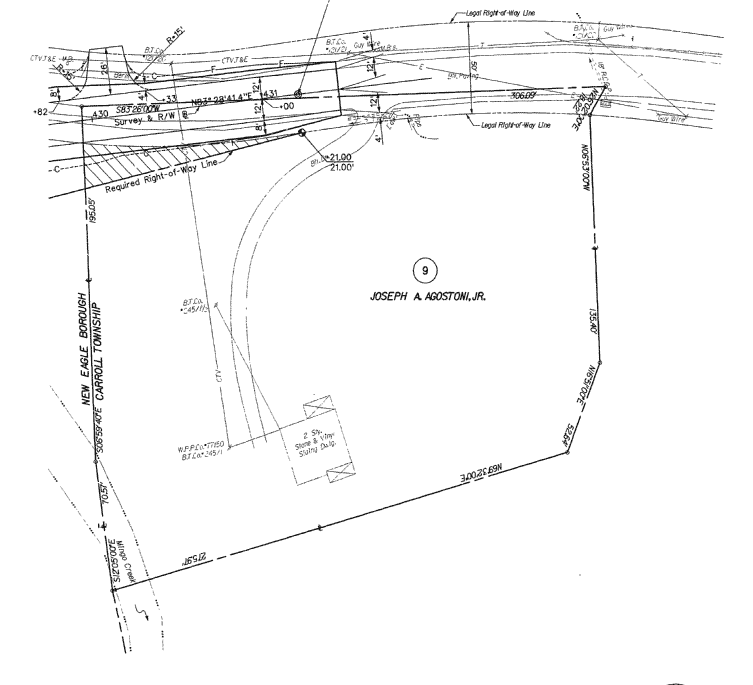
I live on a state highway (secondary road). They do not even know the width of the right of way because they cannot find the plans that the county says were given to the state when the state took over ownership. I have been multiple times to both (county and state), and they both claim to not have the plans. I will admit that is an anomaly, because the district office usually has plans. But, a the plans I typically see just have the C/L, curve info, no monuments or coordinates. Here is a typical one done in 1998:
Kent McMillan, post: 414691, member: 3 wrote: If the line is actually not a centerline of anything, I'd think "the line described as the 'centerline' in the deed recorded _________" would be clearer.
clearer for what?
MightyMoe, post: 414693, member: 700 wrote: clearer for what?
A clearer way of identifying the line if it isn't actually a centerline as the poster seemed to suggest.
Kent McMillan, post: 414694, member: 3 wrote: A clearer way of identifying the line if it isn't actually a centerline as the poster seemed to suggest.
you expect a poster to write in description language?