Reading RPLS is free for the whole profession. Members post, reply, and get the members-only rooms.

Notifications
Clear all

Topic starter
Translate
▼
English
Spanish
French
German
Italian
Portuguese
Russian
Chinese
Japanese
Korean
Arabic
Hindi
Dutch
Polish
Turkish
Vietnamese
Thai
Swedish
Danish
Finnish
Norwegian
Czech
Hungarian
Romanian
Greek
Hebrew
Indonesian
Malay
Ukrainian
Bulgarian
Croatian
Slovak
Slovenian
Serbian
Lithuanian
Latvian
Estonian
Hi
Came across this article on a tweet from POB
http://www.pobonline.com/articles/97670-the-mapping-match-lidar-v-traditional-topo
About comparing a traditional topo of a 25 mile dike system and a 153 mile lidar dike system.
Some of the comparisons looked way off to me, but I have never been involved on a lidar project, so I am only commenting on it from a traditional topo perspective.
They post this graphic
with this text "The conventional GPS survey produced a topographic dataset with approximately 1,320 topographic profiles of the dike system and each profile containing approximately 12-20 measurements. That means during that 1,921 hours we collected 26,421 measurements or roughly 13.75 measurements per hour spent.
In contrast, the 373 hours spent on collecting and producing the LiDAR dataset for the larger AOI yielded a little more than 2.9 billion individual measurements. That equates to a little more than 7.7 million measurements per hour spent."
Those topo figures look way off to me... 77 hours to survey 1 mile of dike system , cross sections at 100 feet intervals with 12-20 shots per cross section ? which equates to 14 shots per hour ? surely this must be a typo, If I was topoing that slow and unproductivly, I dont think I would be in business.
Any one else think these figures are odd ? Or just a marketing ploy to push Lidar ?
slugsy100
Posted : July 6, 2015 12:07 pm

Translate
▼
English
Spanish
French
German
Italian
Portuguese
Russian
Chinese
Japanese
Korean
Arabic
Hindi
Dutch
Polish
Turkish
Vietnamese
Thai
Swedish
Danish
Finnish
Norwegian
Czech
Hungarian
Romanian
Greek
Hebrew
Indonesian
Malay
Ukrainian
Bulgarian
Croatian
Slovak
Slovenian
Serbian
Lithuanian
Latvian
Estonian
pdop 1.0, post: 326011, member: 459 wrote: Hi
Came across this article on a tweet from POB
http://www.pobonline.com/articles/97670-the-mapping-match-lidar-v-traditional-topoAbout comparing a traditional topo of a 25 mile dike system and a 153 mile lidar dike system.
Some of the comparisons looked way off to me, but I have never been involved on a lidar project, so I am only commenting on it from a traditional topo perspective.
They post this graphic
with this text "The conventional GPS survey produced a topographic dataset with approximately 1,320 topographic profiles of the dike system and each profile containing approximately 12-20 measurements. That means during that 1,921 hours we collected 26,421 measurements or roughly 13.75 measurements per hour spent.
In contrast, the 373 hours spent on collecting and producing the LiDAR dataset for the larger AOI yielded a little more than 2.9 billion individual measurements. That equates to a little more than 7.7 million measurements per hour spent."Those topo figures look way off to me... 77 hours to survey 1 mile of dike system , cross sections at 100 feet intervals with 12-20 shots per cross section ? which equates to 14 shots per hour ? surely this must be a typo, If I was topoing that slow and unproductivly, I dont think I would be in business.
Any one else think these figures are odd ? Or just a marketing ploy to push Lidar ?
slugsy100
Look where it came from. "That Site" and the magazine (my subscription lapsed and did not renew) is mostly now about GIS and Lidar. Not true Surveying and Mapping like the fine people that post on this site, well, most of them. Of course, Lidar is better, who do you think is paying their bills..............
Posted : July 6, 2015 12:29 pm

Translate
▼
English
Spanish
French
German
Italian
Portuguese
Russian
Chinese
Japanese
Korean
Arabic
Hindi
Dutch
Polish
Turkish
Vietnamese
Thai
Swedish
Danish
Finnish
Norwegian
Czech
Hungarian
Romanian
Greek
Hebrew
Indonesian
Malay
Ukrainian
Bulgarian
Croatian
Slovak
Slovenian
Serbian
Lithuanian
Latvian
Estonian
I guess it would depend on the terrain around the dike. Looking at the LiDAR DEM photo that accompanies the article, I see some spots to the top left that look to be heavy on vegetation, on the right side there is a section that looks swampy with sparse vegetation, several structures show up that might need to be located, and the article did not make clear how the hydro data was traditionally collected.
Add to possible terrain issues the fact that they included what sounds like a pretty substantial control survey at the beginning of the project (which counts in the project time and billing), and I would not be very surprised at averaging out to 14 shots an hour.
Posted : July 6, 2015 3:23 pm

Translate
▼
English
Spanish
French
German
Italian
Portuguese
Russian
Chinese
Japanese
Korean
Arabic
Hindi
Dutch
Polish
Turkish
Vietnamese
Thai
Swedish
Danish
Finnish
Norwegian
Czech
Hungarian
Romanian
Greek
Hebrew
Indonesian
Malay
Ukrainian
Bulgarian
Croatian
Slovak
Slovenian
Serbian
Lithuanian
Latvian
Estonian
Unless LiDAR penetration of dense vegetation has vastly improved over the past 10 years, I don't buy it at all.
The article talks about the ground points used to validate the LiDAR accuracy as all being either NGS control or project control points. That means, in most if not all circumstances, reasonably good visibility from the sky to the point. That really only gives you the ability to judge LiDAR accuracies on open ground.
The article doesn't mention anything about the ground truthing that the National Standard for Spatial Data Accuracy (NSSDA) calls for to ensure accurate mapping in various ground cover conditions.
I don't work with aerial LiDAR much these days, but worked with it on several projects 9 - 12 years ago. It's possible that the laser technology has improved to better penetrate vegetation and differentiate ground surfaces from above ground objects like tree trunks, sheds, or vehicles parked under tree canopy, but my experience was that hard surfaces with visible control points nearby would be almost as good as the article indicates, but that elevations under low, fairly dense ground cover could be several tenths off, and ground under dense tree canopy and moderate to heavy underbrush, if the aerial mapper attempted to provide any info, would only provide a few scattered spot elevations between notes of "Dense Vegetation/Ground Not Visible", those spot elevations generally being +/- a bit more than 1'.
If we provided a few well selected ground shots in those vegetation cover situations, it significantly improved the accuracy of the mapping product provided to us.
Also seems that, even if you lump in the time just running control, then account for watching for snakes and gators and fighting through heavy brush on parts of the project that they either padded the hours of the ground-only survey or told their crew to be sure not to set any speed records.
It seems to me that they could have included the ground survey work to include proper ground trothing, and not inflated the ground survey hours and still come out far enough ahead of the all-ground survey to show that LiDAR was the better method for that project. Seems like a more honest comparison of $/mile probably would have come closer to $45 vs. $8 than $77 vs. $2.4.
Posted : July 6, 2015 7:08 pm
Translate
▼
English
Spanish
French
German
Italian
Portuguese
Russian
Chinese
Japanese
Korean
Arabic
Hindi
Dutch
Polish
Turkish
Vietnamese
Thai
Swedish
Danish
Finnish
Norwegian
Czech
Hungarian
Romanian
Greek
Hebrew
Indonesian
Malay
Ukrainian
Bulgarian
Croatian
Slovak
Slovenian
Serbian
Lithuanian
Latvian
Estonian
eapls2708, post: 326085, member: 589 wrote: Unless LiDAR penetration of dense vegetation has vastly improved over the past 10 years, I don't buy it at all.
I don't work with aerial LiDAR much these days, but worked with it on several projects 9 - 12 years ago. It's possible that the laser technology has improved to better penetrate vegetation and differentiate ground surfaces from above ground objects like tree trunks, sheds, or vehicles parked under tree canopy, but my experience was that hard surfaces with visible control points nearby would be almost as good as the article indicates, but that elevations under low, fairly dense ground cover could be several tenths off, and ground under dense tree canopy and moderate to heavy underbrush, if the aerial mapper attempted to provide any info, would only provide a few scattered spot elevations between notes of "Dense Vegetation/Ground Not Visible", those spot elevations generally being +/- a bit more than 1'.
Here is a screen clip showing some recent LiDAR data vs topo collected by total station:
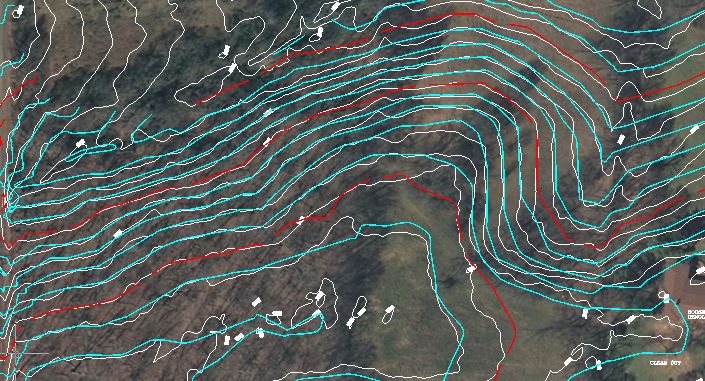
The red and cyan are total station and the white is LiDAR. Left side of the screen is pretty thick vegetation and the right side has several open fields. I haven't done any serious comparison on the data sets. Once you mentioned the inaccuracies from a few years back, I realized I had this data set sitting around. One strange thing to me is the red contour closest to the bottom - in the woods, the two sets of contour lines match well, but in the open area, they diverge a good bit.
The LiDAR data was collected at 5' horizontal spacing. Using the developed DEM, contours were generated at a 2' interval. No attempt was made at cleaning up the resulting contours.
The total station was random points where a line of sight could be established (shooting for +/- 50' grid and breaklines, but not always accomplishing that). Without doing the math on it, it looks like the LiDAR data is a pretty close match.
Since working with the two sets, I have often wondered if the sheer volume of data collected might make the LiDAR the more "correct" representation of the contours. After all, with traditional methods, exactly what happens between points relies heavily on the rod person's ability to choose the correct points to map.
Posted : July 7, 2015 8:54 am