Reading RPLS is free for the whole profession. Members post, reply, and get the members-only rooms.

Notifications
Clear all
Strictly Surveying
15
Posts
7
Users
0
Reactions
1,231
Views

Topic starter
Translate
▼
English
Spanish
French
German
Italian
Portuguese
Russian
Chinese
Japanese
Korean
Arabic
Hindi
Dutch
Polish
Turkish
Vietnamese
Thai
Swedish
Danish
Finnish
Norwegian
Czech
Hungarian
Romanian
Greek
Hebrew
Indonesian
Malay
Ukrainian
Bulgarian
Croatian
Slovak
Slovenian
Serbian
Lithuanian
Latvian
Estonian
While doing some research in the area, I came across this map. It is a map of the Sun and Moon Mine that straddles the Clear Creek/Gilpin county line.
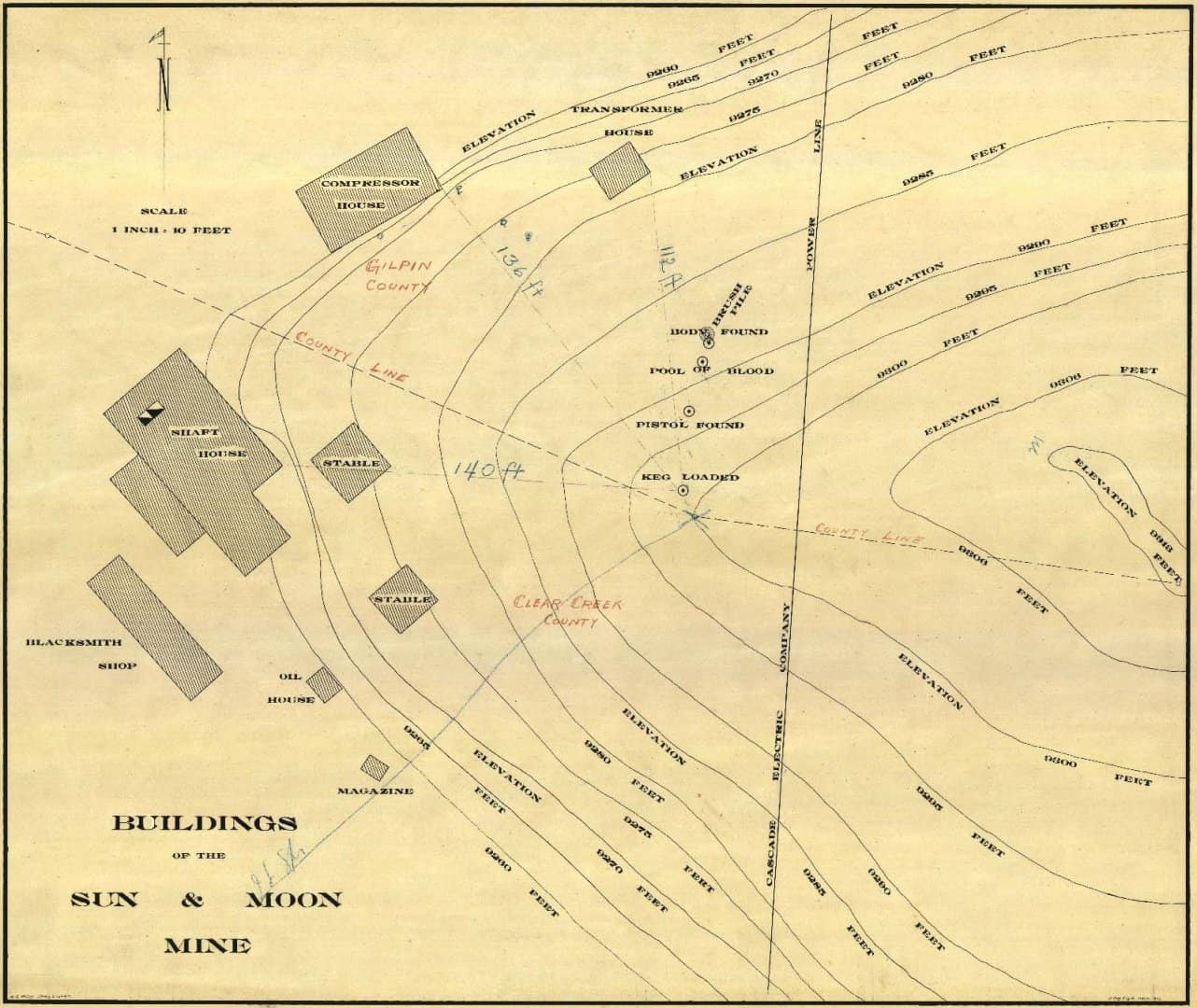
The map was prepared on December 12, 1903 by J. Aug. Ingols with the assistance of W.H. Wiley a mining engineer and U.S. Deputy Mineral Surveyor in Idaho Springs. I presume that the map was prepared as part of a trial of miners accused of trying to blow up buildings at the Sun & Moon Mine by rolling two kegs of explosives down the hill supposedly towards the compressor house and shaft house. One striking miner was fatally injured.
Here is a Wikipedia article on the strike and trials in both Clear Creek and Gilpin counties.
Idaho Springs miners' strike of 1903
The strike
In April 1903, WFM officials approached managers of the gold mines around Idaho Springs, and proposed that the normal workday be reduced to 8 hours, with no reduction in pay. The owners all refused.On 1 May 1903, the WFM local at Idaho Springs declared a strike against six gold mines, demanding the 8-hour day with no reduction in wages. About 250 miners walked out, idling six mines. Two mines reopened on 18 May with nonunion miners, but paid the nonunion men the union-demanded wage for an 8-hour day. When these mines, along with a third mine, agreed to take back striking union miners and also pay them the old wage for eight-hour days, the union declared the strike off for those mines. But the other three mines also reopened with nonunion men, and did not go to 8-hour shifts.[2]
Mine owners and businessmen banded together in the Citizens Protective League to counter what its members saw as the violent tendencies of a radical union. Such organizations were forming in many towns in Colorado. The city and county hired 14 extra deputies to protect the mines and miners. In response, the WFM local issued a statement that the deputies were a waste of taxpayer money, because the striking miners were law-abiding. The union noted that many of their members were homeowners and long-time residents of the area: "... we are not dynamiters and thugs."
Dynamite and deportations
Close to midnight on 28 July, the night watchman at the Sun and Moon mine, one of the remaining strike targets, saw two or three men up on the ridge above the mine, and a brief light, as if one of the men had struck a match. He shouted at the men, one of whom shot at him. Almost immediately, an explosion destroyed the transformer house, below where the men were seen. The dynamiters had left behind one of their number, Philip Fire, a striking union miner mortally injured by a blast, who died before dawn. The Sun and Moon employees surmised that the men on the ridge had prepared two kegs of dynamite to roll down the hill, perhaps one at the compressor house, and one at the shaft house, but, startled by the watchman, they had released the kegs prematurely; one had hit and destroyed the transformer house, and the other keg hit some object and exploded close to the saboteurs, fatally wounding one of them. Had one of the kegs exploded at the shafthouse, it might have killed the four miners in the building, as well as 14 more miners working underground.
Posted : September 15, 2017 9:22 am

Translate
▼
English
Spanish
French
German
Italian
Portuguese
Russian
Chinese
Japanese
Korean
Arabic
Hindi
Dutch
Polish
Turkish
Vietnamese
Thai
Swedish
Danish
Finnish
Norwegian
Czech
Hungarian
Romanian
Greek
Hebrew
Indonesian
Malay
Ukrainian
Bulgarian
Croatian
Slovak
Slovenian
Serbian
Lithuanian
Latvian
Estonian
That's really cool Gene, thanks for the post.
Loyal
Posted : September 15, 2017 9:33 am

Translate
▼
English
Spanish
French
German
Italian
Portuguese
Russian
Chinese
Japanese
Korean
Arabic
Hindi
Dutch
Polish
Turkish
Vietnamese
Thai
Swedish
Danish
Finnish
Norwegian
Czech
Hungarian
Romanian
Greek
Hebrew
Indonesian
Malay
Ukrainian
Bulgarian
Croatian
Slovak
Slovenian
Serbian
Lithuanian
Latvian
Estonian
Do you think they were trying to establish the location so to figure out which county to try the case in?
Posted : September 15, 2017 9:54 am
Topic starter
Translate
▼
English
Spanish
French
German
Italian
Portuguese
Russian
Chinese
Japanese
Korean
Arabic
Hindi
Dutch
Polish
Turkish
Vietnamese
Thai
Swedish
Danish
Finnish
Norwegian
Czech
Hungarian
Romanian
Greek
Hebrew
Indonesian
Malay
Ukrainian
Bulgarian
Croatian
Slovak
Slovenian
Serbian
Lithuanian
Latvian
Estonian
I found this map among a collection of maps. field books and correspondence that were kept by Percy P. Barbour. Mr Barbour was a U.S. [Deputy] Mineral Surveyor for 55 years (1901-1956) with nearly 200 mineral surveys.
The Barbour Collection was purchased from his heirs by St. Joseph Engineering Co. In 1978, the BLM obtained the collection and it was later transferred to the Clear Creek County Archivist. The collection now resides at the Arthur Lakes Library, Colorado School of Mines. The great majority of the collection has been digitized and indexed. One of the more valuable and interesting maps is the Clear Creek County Triangulation Network that goes from Fall River up to Silver Plume. There are approx. 250 stations in the network and a few stations are described in field books prepared by deputies, Wheaton, Marsh and Maxwell.
Posted : September 15, 2017 11:13 am

Translate
▼
English
Spanish
French
German
Italian
Portuguese
Russian
Chinese
Japanese
Korean
Arabic
Hindi
Dutch
Polish
Turkish
Vietnamese
Thai
Swedish
Danish
Finnish
Norwegian
Czech
Hungarian
Romanian
Greek
Hebrew
Indonesian
Malay
Ukrainian
Bulgarian
Croatian
Slovak
Slovenian
Serbian
Lithuanian
Latvian
Estonian
Now that is one interesting map, and story.
Posted : September 18, 2017 9:06 pm

Translate
▼
English
Spanish
French
German
Italian
Portuguese
Russian
Chinese
Japanese
Korean
Arabic
Hindi
Dutch
Polish
Turkish
Vietnamese
Thai
Swedish
Danish
Finnish
Norwegian
Czech
Hungarian
Romanian
Greek
Hebrew
Indonesian
Malay
Ukrainian
Bulgarian
Croatian
Slovak
Slovenian
Serbian
Lithuanian
Latvian
Estonian
I'll take "Things I Have Never Labeled on a Map" for $1,000 Alex:
- Keg Loaded
- Pistol Found
- Pool of Blood
- Body Found
Posted : September 19, 2017 3:32 pm

Translate
▼
English
Spanish
French
German
Italian
Portuguese
Russian
Chinese
Japanese
Korean
Arabic
Hindi
Dutch
Polish
Turkish
Vietnamese
Thai
Swedish
Danish
Finnish
Norwegian
Czech
Hungarian
Romanian
Greek
Hebrew
Indonesian
Malay
Ukrainian
Bulgarian
Croatian
Slovak
Slovenian
Serbian
Lithuanian
Latvian
Estonian
One of my first projects as an engineering technician was to create an isopach contour exhibit for our DA's office showing the depth of the water in relation to a body and a flashlight that was recovered.
Little did I know what I was getting into. Luckily for me a plea deal was brokered the day of the trial.
I spent a couple weeks losing sleep over what questions they were going to ask me and how I would answer.
I think I was 22 at the time.
First and last time I will accept a forensic mapping project.
Posted : September 19, 2017 4:09 pm
Translate
▼
English
Spanish
French
German
Italian
Portuguese
Russian
Chinese
Japanese
Korean
Arabic
Hindi
Dutch
Polish
Turkish
Vietnamese
Thai
Swedish
Danish
Finnish
Norwegian
Czech
Hungarian
Romanian
Greek
Hebrew
Indonesian
Malay
Ukrainian
Bulgarian
Croatian
Slovak
Slovenian
Serbian
Lithuanian
Latvian
Estonian
I find it interesting that they show a bend in the county line, but no information supporting the positioning of that boundary.
Posted : September 19, 2017 4:14 pm
Topic starter
Translate
▼
English
Spanish
French
German
Italian
Portuguese
Russian
Chinese
Japanese
Korean
Arabic
Hindi
Dutch
Polish
Turkish
Vietnamese
Thai
Swedish
Danish
Finnish
Norwegian
Czech
Hungarian
Romanian
Greek
Hebrew
Indonesian
Malay
Ukrainian
Bulgarian
Croatian
Slovak
Slovenian
Serbian
Lithuanian
Latvian
Estonian
Well, since you asked, here is the field survey of the Clear Creek/Gilpin county line conducted by the two county surveyors, A.J. Ventress and Geo. W. Schneider, respectively. The survey was conducted between Sept. 15, 1902 and Dec. 9, 1904. While the survey was not completed by December 1903, the information was likely shared with Messrs. Wiley and Ingols. W.H. Wiley (the first graduate of my alma mater; June 1883) started a mining engineering and surveying business in Idaho Springs in late 1883. Mr. Wiley was a prolific mineral surveyor with 204 mineral surveys between 1884 and 1897. In 1897, he hired Mr. Ventress to conduct the mineral surveys so he could concentrate his efforts on mining engineering.
Mr. Ventress conducted 195 mineral surveys between 1897 and 1905, when he was killed in an accident while surveying the Argo Tunnel. I attached the joint survey of the county line. It also shows the mineral surveys that cross the county line. The county line markers are 182 (NW station), 183 (station near "keg"), and 184 (East station on hilltop).
Posted : September 19, 2017 6:21 pm

Translate
▼
English
Spanish
French
German
Italian
Portuguese
Russian
Chinese
Japanese
Korean
Arabic
Hindi
Dutch
Polish
Turkish
Vietnamese
Thai
Swedish
Danish
Finnish
Norwegian
Czech
Hungarian
Romanian
Greek
Hebrew
Indonesian
Malay
Ukrainian
Bulgarian
Croatian
Slovak
Slovenian
Serbian
Lithuanian
Latvian
Estonian
imaudigger, post: 447468, member: 7286 wrote: I find it interesting that they show a bend in the county line, but no information supporting the positioning of that boundary.
I guess it's not a county boundary survey.
Maybe found monuments?
Posted : September 20, 2017 7:36 am
Translate
▼
English
Spanish
French
German
Italian
Portuguese
Russian
Chinese
Japanese
Korean
Arabic
Hindi
Dutch
Polish
Turkish
Vietnamese
Thai
Swedish
Danish
Finnish
Norwegian
Czech
Hungarian
Romanian
Greek
Hebrew
Indonesian
Malay
Ukrainian
Bulgarian
Croatian
Slovak
Slovenian
Serbian
Lithuanian
Latvian
Estonian
Gene Kooper, post: 447482, member: 9850 wrote: Well, since you asked, here is the field survey of the Clear Creek/Gilpin county line conducted by the two county surveyors, A.J. Ventress and Geo. W. Schneider, respectively. The survey was conducted between Sept. 15, 1902 and Dec. 9, 1904. While the survey was not completed by December 1903, the information was likely shared with Messrs. Wiley and Ingols. W.H. Wiley (the first graduate of my alma mater; June 1883) started a mining engineering and surveying business in Idaho Springs in late 1883. Mr. Wiley was a prolific mineral surveyor with 204 mineral surveys between 1884 and 1897. In 1897, he hired Mr. Ventress to conduct the mineral surveys so he could concentrate his efforts on mining engineering.
Mr. Ventress conducted 195 mineral surveys between 1897 and 1905, when he was killed in an accident while surveying the Argo Tunnel. I attached the joint survey of the county line. It also shows the mineral surveys that cross the county line. The county line markers are 182 (NW station), 183 (station near "keg"), and 184 (East station on hilltop).
I didn't read the notes, but it appears that they are probably following some natural feature such as a divide between drainage basins?
Those lode claim sketches are something else! That must be a very productive area. Are there any active mines today?
I could see how disputes could arise given the density of the claims. Probably a few court cases surrounding that area.
Posted : September 20, 2017 9:18 am
Topic starter
Translate
▼
English
Spanish
French
German
Italian
Portuguese
Russian
Chinese
Japanese
Korean
Arabic
Hindi
Dutch
Polish
Turkish
Vietnamese
Thai
Swedish
Danish
Finnish
Norwegian
Czech
Hungarian
Romanian
Greek
Hebrew
Indonesian
Malay
Ukrainian
Bulgarian
Croatian
Slovak
Slovenian
Serbian
Lithuanian
Latvian
Estonian
imaudigger, post: 447533, member: 7286 wrote: I didn't read the notes, but it appears that they are probably following some natural feature such as a divide between drainage basins?
Those lode claim sketches are something else! That must be a very productive area. Are there any active mines today?
I could see how disputes could arise given the density of the claims. Probably a few court cases surrounding that area.
Yes, the notes state that the county line runs from the confluence of North and South Clear Creeks, along the drainage divide between the two streams to the to the Summit of James Peak on the Continental Divide. I don't know how many mines are active today, but it would only be a fraction of the heyday of mining.
Posted : September 20, 2017 1:36 pm
Topic starter
Translate
▼
English
Spanish
French
German
Italian
Portuguese
Russian
Chinese
Japanese
Korean
Arabic
Hindi
Dutch
Polish
Turkish
Vietnamese
Thai
Swedish
Danish
Finnish
Norwegian
Czech
Hungarian
Romanian
Greek
Hebrew
Indonesian
Malay
Ukrainian
Bulgarian
Croatian
Slovak
Slovenian
Serbian
Lithuanian
Latvian
Estonian
Here is an article describing the 2015-2016 retracement/resurvey of the county boundary. Again, the work was done by the Clear Creek County Surveyor and Gilpin County Surveyor. This work is very helpful for surveyors doing retracements of mining claims that straddle the county line, esp. those where a subsequent tax sale(s) cut the claim(s) along the county line.
Nov. 2016 issue of Side Shots, the quarterly journal of the Professional Land Surveyors of Colorado
Posted : September 20, 2017 1:45 pm
Topic starter
Translate
▼
English
Spanish
French
German
Italian
Portuguese
Russian
Chinese
Japanese
Korean
Arabic
Hindi
Dutch
Polish
Turkish
Vietnamese
Thai
Swedish
Danish
Finnish
Norwegian
Czech
Hungarian
Romanian
Greek
Hebrew
Indonesian
Malay
Ukrainian
Bulgarian
Croatian
Slovak
Slovenian
Serbian
Lithuanian
Latvian
Estonian
Christine Bradley, the Clear Creek County Archivist has compiled a history of labor issues from local newspapers and kindly shared two newspaper accounts. The below stories of the dynamiting of the Sun and Moon Mine are from the Silver Plume Silver Standard and the Georgetown Courier. According to Christine's research, A.B. Clark, the editor of the Silver Standard was an avowed socialist and therefore, his newspaper tended to be sympathetic to the striking miners. The Georgetown Courier aligned itself with the mining companies.
Silver Standard August 1, 1903 p4 c1
DYNAMITE USED TO DESTROY SUN AND MOON BUILDINGS.
Union Leaders Driven Out of Idaho Springs by Citizens.The labor difficulties existing at Idaho Springs for some time reached an acute stage this week, and as announced elsewhere in this paper, culminated in the destruction of the transformer house of the Sun and Moon mine by dynamite on Tuesday night at 11:20.
The Sun and Moon property has been operated to a limited extent since the first of June with non-union men, and it is believed that it was the intention of the dynamiters to destroy the compressor plant and shaft house also, but the plan miscarried owing to the discovery of the perpetrators of the deed before they had time to fully carry out their design.
As the property was carefully guarded the plan adopted was to place the dynamite in beer kegs, attach a fuse and roll them down the hill against the buildings, and it was when a match was struck to light the fuse that the men were discovered and fired upon by the guard, but the keg was sent down the hill and landed against the transformer house where it exploded, wrecking the building, which then took fire but the flames were prevented from reaching the other buildings.
A search of the surroundings resulted in finding Philip Fire, an Austrian miner, and a member of the union, a short distance from the scene who had been so badly wounded that he died a short time after being found. It does not seem to be known what caused the death of Fire. At first it was supposed that he had been shot by the watchman or accidentally by one of his companions, as they fired several shots at the men who were guarding the mine, but an autopsy revealed that the wound was not inflicted by a bullet but was apparently caused by an explosive.
As soon as news of the affair reached Idaho Springs there was intense excitement and the authorities commenced arresting prominent union men and placing them in jail, until a score or more had been locked up.
Frank Napolli and John Carbonnetti were arrested on Wednesday and are believed to be the men who were with Fire and assisted in the work of blowing up the mine buildings, as they were seen in company with him late in the evening on the streets of the city.
On Wednesday evening the Citizens Protective league held an indignation meeting and then proceeded to the jail where the union men where [sic] confined and escorted fourteen of them to the city limits and ordered them to leave and never return.
H. E. Gregory, a member of the Georgetown union, was arrested on Thursday evening on the charge of having made threats to blow up the pipe line or dam of the United Light & Power company above Georgetown.
The affair is an unfortunate one from all points of view, but if it results in a restoration of peace in the camp so that opera?ªtions may be carried on in all the mines with a full force of men without further interruption, as now seems probable, something will have been gained at least.
For those interested, here is a link to the 50 MB PDF of the August 1, 1903 Silver Standard, which consists of 8 pages. Also, page 2, columns 1 and 2, contains an abbreviated account with the byline, "Denver, July 29".
Georgetown Courier, August 1, 1903
Sun and Moon Property Blown Up
A Dynamiter Shot.
At the hour of 11:08 Tuesday night the dynamo at the power house in Georgetown showed a short circuit, indicating that something was doing somewhere on the line. At the moment of short circuit the transformer house at the Sun and Moon mine in Gilson Gulch, near Idaho Springs, was blown up with dynamite, which had been packed in kegs to which were attached burning fuse, and probably rolled down the hill against the building. The explosion was heard for miles around, and the building and transformers were wrecked, entailing a loss of about $3,000.
It is believed that one of the kegs of powder rolled down the hill was intended for the shaft house. Had this building been wrecked, the four or five men about it, and a dozen or more men employed in the mine would have been killed.
A. E. Powell was on duty at the mine as watchman, and seeing the lighting of a match on the hill about 100 feet back of the transformer building, and the forms of three men, he called out to know who was there. For a reply three shots were fired by the men on the hillside. Powell returned the fire and was about to ascend the hill with a companion when a terrific explosion occurred. Both men were thrown to the ground, but quickly recovering they ran to the office building and telephoned to Idaho Springs for help.
The surface employees of the mine went to the wrecked building, which was burning, but made no attempt to extinguish the fire on account of the danger for live wires. Search was made on the hillside and Philip Fire, who had been employed on the Mattie mine, was discovered lying on the ground dangerously wounded from a pistol shot in the side. He was taken to the shaft house, and later to the hospital at Idaho Springs, where he died. He refused to answer questions as to who his companions were.
Under Sheriff C. P. Peck was attending the Elk lodge at Idaho Springs, and securing a posse, went to the mine, but there was little for them to do. But the wreck of the transformer building was so evidently a conspiracy arising out of the protracted strike of the miners' union, that wholesale arrests were decided upon, and some twenty odd of the leaders of the union were placed under arrest.
Among those arrested were William Bates, ex-president of the union, and Frank Nappalo and John Carbonetti, who were brought to Georgetown and placed in the county jail. The two latter are supposed to have been the companions of the man who was shot.
On Tuesday night, fourteen of the men under arrest at Idaho Springs were taken to the limits of the town and told to leave immediately and never return. The party were Howard Tresiddel, president of the local union; A. D. Alcott vice president and chairman of the executive committee; George Decker, secretary; Beter Bender, treasurer; Con. O'Brien and D. C. Compton, members of the executive committee; Thomas Walsh, J. H. Crimmons, Giss Welsh, Joe Roehri, Pat O'Brien, M. J. Reilly, Edward Carter and a man named Phillips.
Four others were held who may also be ordered to leave.
Posted : September 25, 2017 11:24 am
Translate
▼
English
Spanish
French
German
Italian
Portuguese
Russian
Chinese
Japanese
Korean
Arabic
Hindi
Dutch
Polish
Turkish
Vietnamese
Thai
Swedish
Danish
Finnish
Norwegian
Czech
Hungarian
Romanian
Greek
Hebrew
Indonesian
Malay
Ukrainian
Bulgarian
Croatian
Slovak
Slovenian
Serbian
Lithuanian
Latvian
Estonian
Thanks for the update. Love the history.
Posted : September 25, 2017 12:22 pm