Reading RPLS is free for the whole profession. Members post, reply, and get the members-only rooms.

Notifications
Clear all
Strictly Surveying
6
Posts
4
Users
0
Reactions
2,653
Views

Topic starter
Translate
▼
English
Spanish
French
German
Italian
Portuguese
Russian
Chinese
Japanese
Korean
Arabic
Hindi
Dutch
Polish
Turkish
Vietnamese
Thai
Swedish
Danish
Finnish
Norwegian
Czech
Hungarian
Romanian
Greek
Hebrew
Indonesian
Malay
Ukrainian
Bulgarian
Croatian
Slovak
Slovenian
Serbian
Lithuanian
Latvian
Estonian
Hi all
I am using *Net to learn about survey adjustments and slowly covering various surveying concepts such as the DIN 18723 standard, Standard Errors, etc which I have had much support from the community which I really appreciate so thank you.
I am now trying to understand the Chi Square concept in surveying. I have done some research into this and I know that the Chi Square relates to the "goodness of fit". I have also read the help guide in *Net about Chi Square but it is proving to be difficult to understand for me.
I was wondering if anyone knew how to manually calculate the Chi Square values for a set of field observations.
Below is a series of observations I took with a Trimble total station.
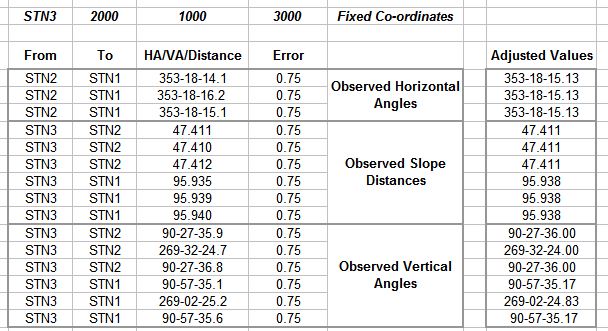
On the left are the raw unadjusted values taken directly from my instrument and on the right are the adjusted values from *net.
From this information how can you manually calculate the upper and lower Chi Square values?
The reason why I am seeking to do this manually is because I cannot find a single worked example on the internet where the Chi Square is used on survey observations, the examples I have come across on the internet relate to Height and Weight, girls and boys, or describes the Chi Square test in abstract terms .
If I can calculate it manually for the above observations then I know it will help with my understanding.
Thoughts?
Thanks
Posted : September 17, 2017 11:22 am

Translate
▼
English
Spanish
French
German
Italian
Portuguese
Russian
Chinese
Japanese
Korean
Arabic
Hindi
Dutch
Polish
Turkish
Vietnamese
Thai
Swedish
Danish
Finnish
Norwegian
Czech
Hungarian
Romanian
Greek
Hebrew
Indonesian
Malay
Ukrainian
Bulgarian
Croatian
Slovak
Slovenian
Serbian
Lithuanian
Latvian
Estonian
You're just dealing with data I.e numbers.
I'll recommend Khan Academy for review of Chi Square test or fit
It's just not for young students anymore.
Videos usually run in the 8-12 range and are sequenced to teach.
Posted : September 17, 2017 11:55 am

Translate
▼
English
Spanish
French
German
Italian
Portuguese
Russian
Chinese
Japanese
Korean
Arabic
Hindi
Dutch
Polish
Turkish
Vietnamese
Thai
Swedish
Danish
Finnish
Norwegian
Czech
Hungarian
Romanian
Greek
Hebrew
Indonesian
Malay
Ukrainian
Bulgarian
Croatian
Slovak
Slovenian
Serbian
Lithuanian
Latvian
Estonian
Alvin Tostick, post: 447089, member: 13000 wrote: You're just dealing with data I.e numbers.
I'll recommend Khan Academy for review of Chi Square test or fit
It's just not for young students anymore.
Videos usually run in the 8-12 range and are sequenced to teach.
Those videos are very cool, Alvin. Thank you. I've always wondered what Star*net was doing "under the hood", with respect to Chi Squared.
Not sure I'd want to do the math on 50 stations and 1000+ observations, but it's valuable to know what the software is doing.
Great question, Steward.
Posted : September 17, 2017 4:17 pm
Topic starter
Translate
▼
English
Spanish
French
German
Italian
Portuguese
Russian
Chinese
Japanese
Korean
Arabic
Hindi
Dutch
Polish
Turkish
Vietnamese
Thai
Swedish
Danish
Finnish
Norwegian
Czech
Hungarian
Romanian
Greek
Hebrew
Indonesian
Malay
Ukrainian
Bulgarian
Croatian
Slovak
Slovenian
Serbian
Lithuanian
Latvian
Estonian
Thanks guys.
A follow on question which I think I have confused myself about which is when setting the significance level for the Chi Square test a value of 5% is typically used.
My understanding was that If I use 5% for the Chi Square significance level then what I am saying is that I am 95% confident in accepting the Chi Square result, if I use 2.5% for a Chi Square value then I am, saying that I am 97.5% confident in accepting the Chi Square result. So in other words the smaller the value I enter for the Chi Square significance level the more confident I am in accepting the Chi Square result.
I thought this was correct until I played around with the Chi Square significance levels for some data, below is my data:-
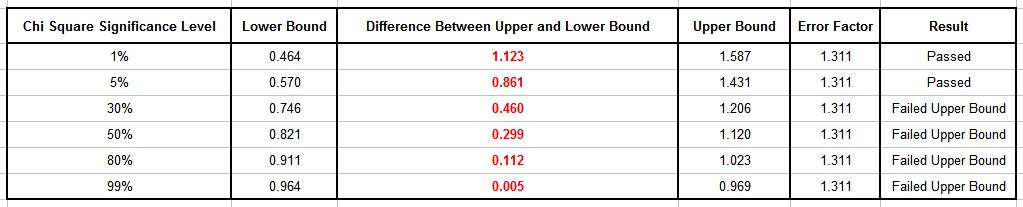
The data I was experimenting with had a total error of 1.311.
What I did was enter various Chi Square Significance level values and recorded the lower and upper bounds.
I then took the difference between the bounds.
What I realised was that if I used 1% for the Chi Square Significance level then the difference between my upper and lower bound was 1.123.
But if I used 99% for the Chi Square Significance level then the difference between my upper and lower bound was 0.005.
So my interpretation would be that my error would have to fall within a smaller range when using a 99% Chi Square Significance level in order for the Chi Square to Pass, which is in direct contradiction to what I thought was correct.
I guess what I am asking is when entering a value for the Chi Square Significance level which is correct:-
- A high percentage value means more confidence in accepting the Chi Square test
or
- A low percentage value mean more confidence in accepting the Chi Square test
Hope that makes sense.
Thanks
Posted : September 17, 2017 5:16 pm
Translate
▼
English
Spanish
French
German
Italian
Portuguese
Russian
Chinese
Japanese
Korean
Arabic
Hindi
Dutch
Polish
Turkish
Vietnamese
Thai
Swedish
Danish
Finnish
Norwegian
Czech
Hungarian
Romanian
Greek
Hebrew
Indonesian
Malay
Ukrainian
Bulgarian
Croatian
Slovak
Slovenian
Serbian
Lithuanian
Latvian
Estonian
In your initial table of data, why are ALL the numbers in the "Error" column the same. Wouldn't they naturally be different for each observation?
Posted : September 17, 2017 5:59 pm

Translate
▼
English
Spanish
French
German
Italian
Portuguese
Russian
Chinese
Japanese
Korean
Arabic
Hindi
Dutch
Polish
Turkish
Vietnamese
Thai
Swedish
Danish
Finnish
Norwegian
Czech
Hungarian
Romanian
Greek
Hebrew
Indonesian
Malay
Ukrainian
Bulgarian
Croatian
Slovak
Slovenian
Serbian
Lithuanian
Latvian
Estonian
Steward Souten, post: 447119, member: 12714 wrote: Thanks guys.
My understanding was that If I use 5% for the Chi Square significance level then what I am saying is that I am 95% confident in accepting the Chi Square result, if I use 2.5% for a Chi Square value then I am, saying that I am 97.5% confident in accepting the Chi Square result. So in other words the smaller the value I enter for the Chi Square significance level the more confident I am in accepting the Chi Square result.
Your understanding is correct. Here's why your data passed at 5% and failed at 30%. Look at a generic Chi Square distribution for a two-tailed 95% confidence interval, another way of saying at the 5% significance level:
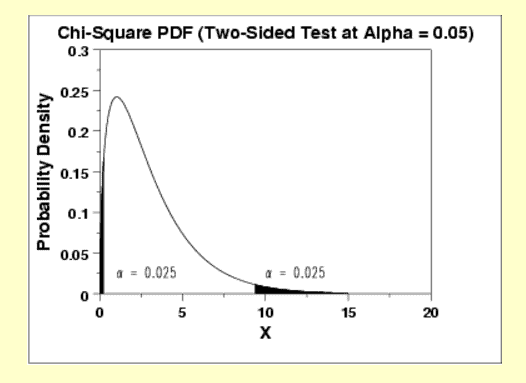
Note that any value that falls in the shaded region is rejected.
Now look at the same distribution altered for a 90% confidence interval. I apologize for its sloppy appearance, but Paint with a mouse is not always neat.
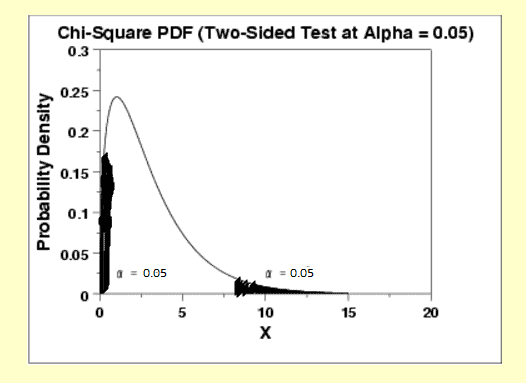
Now only 90% of the values of the statistic under study are acceptable to you. Note that the data is the same. You've just decided that only values in a much narrower range are acceptable as correct.
Note that a sample value that fell between roughly 8 and 9 would be accepted in the first graph but rejected in the second one.
So the software is working exactly as it should and it is illustrating the principal trade-off in inferential statistics. The tests are designed to quantify the probability of rejecting a correct value for a statistic. In order to be more confident that you have not rejected an acceptable value, you have to increase the range of acceptable values.
The other side of the coin is the probability that you will accept a value that should be rejected. As you adjust the level of significance, the value of one probability goes up as the other one goes down. Changing from a 5% significance level to a 10% significance level increases the probability that a good value will be rejected but decreases the probability that a bad value will be accepted.
The main takeaway is that statistical tests are an aid and not a cure. Know that lowering the significance level from 10% to 5% makes a set of data pass only because you have decided to include more data points in your acceptable region.
Posted : September 18, 2017 1:07 pm