Reading RPLS is free for the whole profession. Members post, reply, and get the members-only rooms.


Notifications
Clear all

Topic starter
Translate
▼
English
Spanish
French
German
Italian
Portuguese
Russian
Chinese
Japanese
Korean
Arabic
Hindi
Dutch
Polish
Turkish
Vietnamese
Thai
Swedish
Danish
Finnish
Norwegian
Czech
Hungarian
Romanian
Greek
Hebrew
Indonesian
Malay
Ukrainian
Bulgarian
Croatian
Slovak
Slovenian
Serbian
Lithuanian
Latvian
Estonian
Hi all
I was wondering if someone could help explain a concept relating to StarNet.
I am learning about survey adjustments using StarNet.
Using some example data of 3 x stations I have made a successful 2D adjustment with StarNet.
The issue I have is understanding what is meant by the Distance column in the Adjusted Angle Observations. Below is a screen shot of my data/output:-

As you can see from my output I have made adjustments to each angle - I do not understand what the distance value relates to?
I was wondering if anyone could explain?
Thank you
Posted : August 5, 2017 4:51 am

Translate
▼
English
Spanish
French
German
Italian
Portuguese
Russian
Chinese
Japanese
Korean
Arabic
Hindi
Dutch
Polish
Turkish
Vietnamese
Thai
Swedish
Danish
Finnish
Norwegian
Czech
Hungarian
Romanian
Greek
Hebrew
Indonesian
Malay
Ukrainian
Bulgarian
Croatian
Slovak
Slovenian
Serbian
Lithuanian
Latvian
Estonian
When you change an angle, you move your coordinate from the old point to a new point. So how much did you move it?
Sent from my SM-G955U using Tapatalk
Posted : August 5, 2017 5:51 am

Translate
▼
English
Spanish
French
German
Italian
Portuguese
Russian
Chinese
Japanese
Korean
Arabic
Hindi
Dutch
Polish
Turkish
Vietnamese
Thai
Swedish
Danish
Finnish
Norwegian
Czech
Hungarian
Romanian
Greek
Hebrew
Indonesian
Malay
Ukrainian
Bulgarian
Croatian
Slovak
Slovenian
Serbian
Lithuanian
Latvian
Estonian
It's a new feature added to 8.2 (i think). It's basically the residual angle multiplied by the horizontal distance.
So you could see (for example) that a 60 second residual is not that significant at 10 metres.
Your Std errors for angles look very small by the way, probably you have zero centring error.
Posted : August 5, 2017 6:45 am
Topic starter
Translate
▼
English
Spanish
French
German
Italian
Portuguese
Russian
Chinese
Japanese
Korean
Arabic
Hindi
Dutch
Polish
Turkish
Vietnamese
Thai
Swedish
Danish
Finnish
Norwegian
Czech
Hungarian
Romanian
Greek
Hebrew
Indonesian
Malay
Ukrainian
Bulgarian
Croatian
Slovak
Slovenian
Serbian
Lithuanian
Latvian
Estonian
Jawja, post: 440228, member: 12766 wrote: When you change an angle, you move your coordinate from the old point to a new point. So how much did you move it?
Sent from my SM-G955U using Tapatalk
Jawja
Thank you for your response, based on your statement would you agree with the following sketch:-

I guess I am trying to visualise what the Distance values mean - would you say that I have illustrated your statement correctly?
Posted : August 5, 2017 6:58 am

Translate
▼
English
Spanish
French
German
Italian
Portuguese
Russian
Chinese
Japanese
Korean
Arabic
Hindi
Dutch
Polish
Turkish
Vietnamese
Thai
Swedish
Danish
Finnish
Norwegian
Czech
Hungarian
Romanian
Greek
Hebrew
Indonesian
Malay
Ukrainian
Bulgarian
Croatian
Slovak
Slovenian
Serbian
Lithuanian
Latvian
Estonian
In today's surveying world there is almost never a project that remains as a 2D network.
Paul in PA
Posted : August 5, 2017 7:12 am
Topic starter
Translate
▼
English
Spanish
French
German
Italian
Portuguese
Russian
Chinese
Japanese
Korean
Arabic
Hindi
Dutch
Polish
Turkish
Vietnamese
Thai
Swedish
Danish
Finnish
Norwegian
Czech
Hungarian
Romanian
Greek
Hebrew
Indonesian
Malay
Ukrainian
Bulgarian
Croatian
Slovak
Slovenian
Serbian
Lithuanian
Latvian
Estonian
squowse, post: 440231, member: 7109 wrote: It's a new feature added to 8.2 (i think). It's basically the residual angle multiplied by the horizontal distance.
So you could see (for example) that a 60 second residual is not that significant at 10 metres.
Your Std errors for angles look very small by the way, probably you have zero centring error.
Squowse thank you for your response.
I understand what you are saying however I am struggling to calculate the distance values.
Using my example below:-
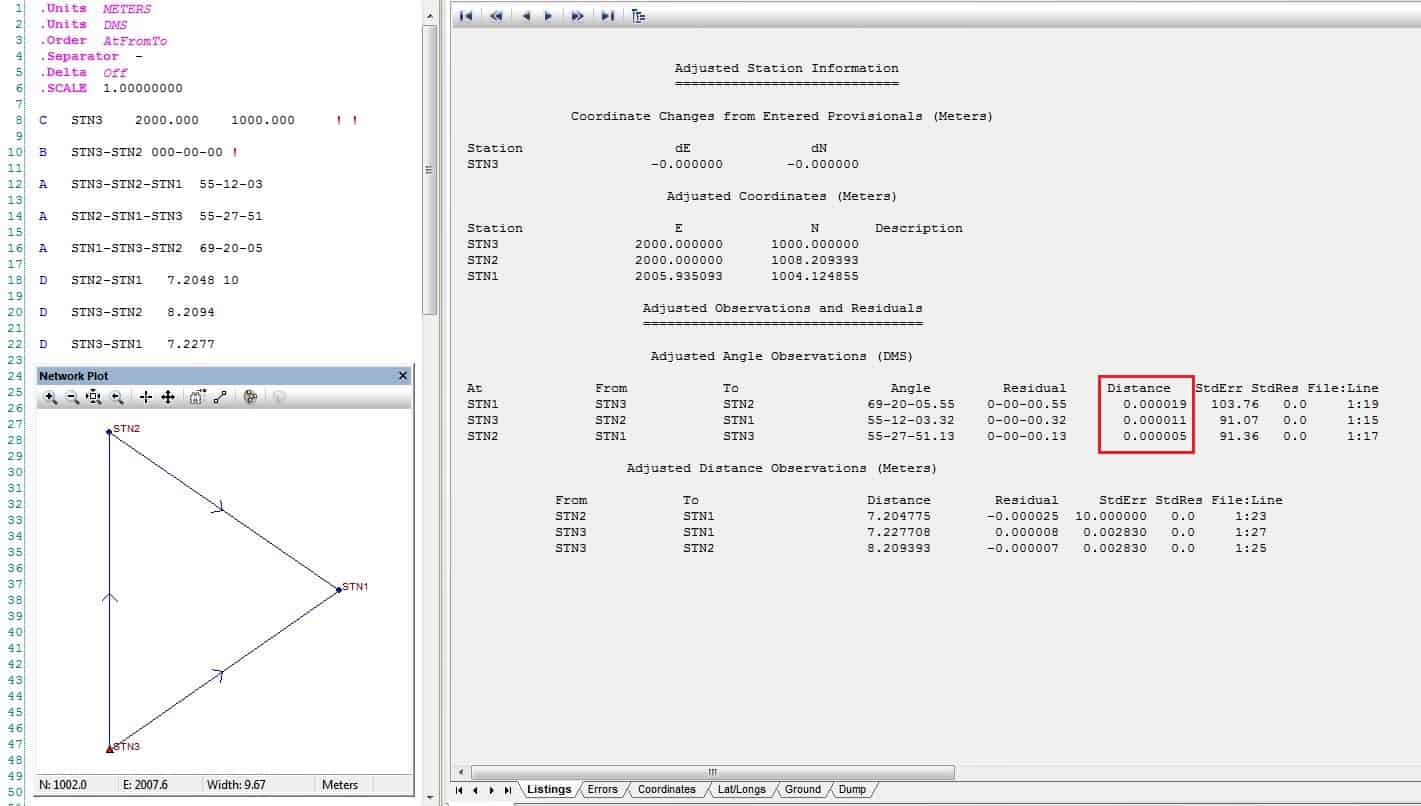
At STN1, From STN3, To STN2 I get an adjusted angle of 69-20-05.55 with a residual of 0-00-00.55 and a Distance value of 0.000019.
From the screen shot info can you explain how the Distance value of 0.000019 is worked out - it is driving me nuts?
Thanks
Posted : August 6, 2017 5:24 am

Translate
▼
English
Spanish
French
German
Italian
Portuguese
Russian
Chinese
Japanese
Korean
Arabic
Hindi
Dutch
Polish
Turkish
Vietnamese
Thai
Swedish
Danish
Finnish
Norwegian
Czech
Hungarian
Romanian
Greek
Hebrew
Indonesian
Malay
Ukrainian
Bulgarian
Croatian
Slovak
Slovenian
Serbian
Lithuanian
Latvian
Estonian
7 meters times 0.55 seconds times 0.000 00485 equals 0.000 019 meters.
Or
Distance times angular residual times tangent of 1 foot per one second.
Posted : August 6, 2017 6:03 am

Translate
▼
English
Spanish
French
German
Italian
Portuguese
Russian
Chinese
Japanese
Korean
Arabic
Hindi
Dutch
Polish
Turkish
Vietnamese
Thai
Swedish
Danish
Finnish
Norwegian
Czech
Hungarian
Romanian
Greek
Hebrew
Indonesian
Malay
Ukrainian
Bulgarian
Croatian
Slovak
Slovenian
Serbian
Lithuanian
Latvian
Estonian
Scott Zelenak, post: 440317, member: 327 wrote: 7 meters times 0.55 seconds times 0.000 00485 equals 0.000 019 meters.
Or
Distance times angular residual times tangent of 1 foot per one second.
So, in English, could you say it is:
"The distance between the unadjusted and the adjusted locations of the point, due only to the adjustment of the angle"?
As Squowse points out, and angle adjustment's impact increases with the distance between the stations.
Posted : August 6, 2017 6:53 am
Topic starter
Translate
▼
English
Spanish
French
German
Italian
Portuguese
Russian
Chinese
Japanese
Korean
Arabic
Hindi
Dutch
Polish
Turkish
Vietnamese
Thai
Swedish
Danish
Finnish
Norwegian
Czech
Hungarian
Romanian
Greek
Hebrew
Indonesian
Malay
Ukrainian
Bulgarian
Croatian
Slovak
Slovenian
Serbian
Lithuanian
Latvian
Estonian
Scott Zelenak, post: 440317, member: 327 wrote: 7 meters times 0.55 seconds times 0.000 00485 equals 0.000 019 meters.
Or
Distance times angular residual times tangent of 1 foot per one second.
Thank you Scott.
I just wanted to ask when you multiply by Distance (in this case 7meters) is that the Unadjusted distance or the Adjusted Distance.
And where does the 0.000 00485 come from? is it the tan(1foot/1sec) like you stated?, I mention this because I am struggling to get 0.000 00485?
Posted : August 6, 2017 7:53 am
Translate
▼
English
Spanish
French
German
Italian
Portuguese
Russian
Chinese
Japanese
Korean
Arabic
Hindi
Dutch
Polish
Turkish
Vietnamese
Thai
Swedish
Danish
Finnish
Norwegian
Czech
Hungarian
Romanian
Greek
Hebrew
Indonesian
Malay
Ukrainian
Bulgarian
Croatian
Slovak
Slovenian
Serbian
Lithuanian
Latvian
Estonian
1 arc second equals 4.848 X 10^ -6 radians.
Posted : August 6, 2017 9:10 am
Translate
▼
English
Spanish
French
German
Italian
Portuguese
Russian
Chinese
Japanese
Korean
Arabic
Hindi
Dutch
Polish
Turkish
Vietnamese
Thai
Swedish
Danish
Finnish
Norwegian
Czech
Hungarian
Romanian
Greek
Hebrew
Indonesian
Malay
Ukrainian
Bulgarian
Croatian
Slovak
Slovenian
Serbian
Lithuanian
Latvian
Estonian
or 7.204775 x tan (0?ø0'0.55") = 0.000019
i am pretty sure that the adjusted distance is used, but I don;t think it's possible that it could make any difference without 6 significant places.
it's slightly more complicated because the residual angle error is for the observation "from" 3 "to" 2 so the residual error could be at 3 or 2 or both. The program seems to assume that the error is at the "to" station.
Posted : August 7, 2017 4:04 am
Topic starter
Translate
▼
English
Spanish
French
German
Italian
Portuguese
Russian
Chinese
Japanese
Korean
Arabic
Hindi
Dutch
Polish
Turkish
Vietnamese
Thai
Swedish
Danish
Finnish
Norwegian
Czech
Hungarian
Romanian
Greek
Hebrew
Indonesian
Malay
Ukrainian
Bulgarian
Croatian
Slovak
Slovenian
Serbian
Lithuanian
Latvian
Estonian
squowse, post: 440424, member: 7109 wrote: or 7.204775 x tan (0?ø0'0.55") = 0.000019
i am pretty sure that the adjusted distance is used, but I don;t think it's possible that it could make any difference without 6 significant places.
it's slightly more complicated because the residual angle error is for the observation "from" 3 "to" 2 so the residual error could be at 3 or 2 or both. The program seems to assume that the error is at the "to" station.
Thanks https://surveyorconnect.com/community/members/squowse.7109/&apos ;">squowse
Posted : August 7, 2017 12:16 pm
Topic starter
Translate
▼
English
Spanish
French
German
Italian
Portuguese
Russian
Chinese
Japanese
Korean
Arabic
Hindi
Dutch
Polish
Turkish
Vietnamese
Thai
Swedish
Danish
Finnish
Norwegian
Czech
Hungarian
Romanian
Greek
Hebrew
Indonesian
Malay
Ukrainian
Bulgarian
Croatian
Slovak
Slovenian
Serbian
Lithuanian
Latvian
Estonian
Scott Zelenak, post: 440339, member: 327 wrote: 1 arc second equals 4.848 X 10^ -6 radians.
Once again thank you for your help.
Posted : August 7, 2017 12:16 pm
Translate
▼
English
Spanish
French
German
Italian
Portuguese
Russian
Chinese
Japanese
Korean
Arabic
Hindi
Dutch
Polish
Turkish
Vietnamese
Thai
Swedish
Danish
Finnish
Norwegian
Czech
Hungarian
Romanian
Greek
Hebrew
Indonesian
Malay
Ukrainian
Bulgarian
Croatian
Slovak
Slovenian
Serbian
Lithuanian
Latvian
Estonian
By the way, learning Star*net 2D adjustments is a great way to start learning what the program does and how it does it. Keep us posted on how it goes. BTW, using in-line commands, there's a way to mix 2D and 3D data. They're also good for trouble shooting when you believe some 3D data (like measure ups), are mucking up your adjustment.:)
Posted : August 7, 2017 1:43 pm