

MightyMoe, post: 412706, member: 700 wrote: Drafting Dan, 1956, created by RAH, often considered the first mention of CAD
Ah, The Door Into Summer. Great story, and the author was certainly accurate in his predictions of things to come. The title comes from the tendency of cats to look for the door to better weather. When I was young I had a cat, Chummy, who would do that. If the weather was miserable out front he would trot through the house to the back door because he knew that was the door into summer.

I remember doing everything manually. The first HP calculator I remember entering the degrees, minutes, seconds and then 60Ìá+60Ìá+ using HPs stacks to convert to decimal degrees and then using sine and cosine. Later HP came up with the one key conversion, then calculators where keystrokes could be replicated, it was called programable memory. The problem was when you turned the calculator off, everything was erased. When HP came out with continuous memory where your so-called programs would be stored and kept from one day to the next, it was a big step foward. Also somewhere in between was the polar to rectangular and rectangular to polar keys, a big step in my opinion. Later HP came up with modules, I skipped that era because the programs I had created did exactly what I needed. When I was Introduced to TDS ( now Survey Pro), I was sold and have been using it since. However, I did just purchase a Carlson Surveyor 2 and a X91+ base and rover.
I do remember having a HP98?? That my boss called Baby Jesus, it had a plotter that plotted points on a freezer paper roll. My next office software was Pacsoft and now Carlson.
Many good developments.
To this day when I comes to calculating curves, I prefer a calculator.
DxL/100 and 2xRxSin1/2delta
This and other formulas were/are? printed on the cover of every note book.

Throughout my career I have found commercial COGO routines for horizontal curves as workable. But for a vertical curves I have continually resorted to my HP 41 with Surveying I module. At times I would use programs written in spreadsheets, when I found myself away from he office with only my laptop and HP 11. What I had failed to bring up was that I wrote a punch card Fortran IV program to reduce traverse data to a coordinate list using an IBM 360 while I was a student at Lehigh University.
That was 1970, actually two years before my first college surveying class and I never though of it as a big deal. After I completed my Survey courses I bought an HP 35 which was a rather large purchase for a college student. I covered that expense by getting 21 engineering credits that semester, at the 12 credit full rate. When the HP 25 came out I convinced my father to buy one and wrote out a step by step key routine for him to reduce field data to coordinates.
Paul in PA

JEFLS, post: 412684, member: 1771 wrote: I posed your question to Dustin (Dusty) Smith, the creator of the BenchMark Survey System (AST). Dusty created BenchMark in early 1980s, and I used it in 1983 on an Apple computer.
Below is his remembrance ...."ItÛªs generally accepted that the Olivetti P-101 was the first cogo calculation device out there for surveyorsÛ? 1967/1968 time periodÛ? it used those magnetic cards we all grew to love and hateÛ? sold for $4000 and, while it was crude, it shrunk an hoursÛª worth of calculation time to about 15 minutesÛ?. Nothing since has ever had that kind of ROI.
Other devices of that time period that I competed with were made by Wylie, Wang Labs, HP, and Monroe to name a few.
The Olivetti 101 was eventually succeeded by the P-602 which had a cartridge tape storage device called the MLUÛ?"
I still use BenchMark, and have never had a problem with it that the well written manual can't solve....
JEFLS, post: 412684, member: 1771 wrote: I posed your question to Dustin (Dusty) Smith, the creator of the BenchMark Survey System (AST). Dusty created BenchMark in early 1980s, and I used it in 1983 on an Apple computer.
Below is his remembrance ...."ItÛªs generally accepted that the Olivetti P-101 was the first cogo calculation device out there for surveyorsÛ? 1967/1968 time periodÛ? it used those magnetic cards we all grew to love and hateÛ? sold for $4000 and, while it was crude, it shrunk an hoursÛª worth of calculation time to about 15 minutesÛ?. Nothing since has ever had that kind of ROI.
Other devices of that time period that I competed with were made by Wylie, Wang Labs, HP, and Monroe to name a few.
The Olivetti 101 was eventually succeeded by the P-602 which had a cartridge tape storage device called the MLUÛ?"
I still use BenchMark, and have never had a problem with it that the well written manual can't solve....

JEFLS, post: 412687, member: 1771 wrote: Let the length of curves "be a variable" as a function of delta and tangent lengths..
That's probably because railroad chord-definition curves use an approximation for length. The orange field books still contain chord-definition tables. Not replacing them with arc-definition tables was probably a dis-service to the world, but I suppose those tables are irrelevant now.

These sheets are from early days (1924) pre all the modern contrivances.
I grew up on them. Not much changed for a very long time.
I've still got a pad full of these forms.
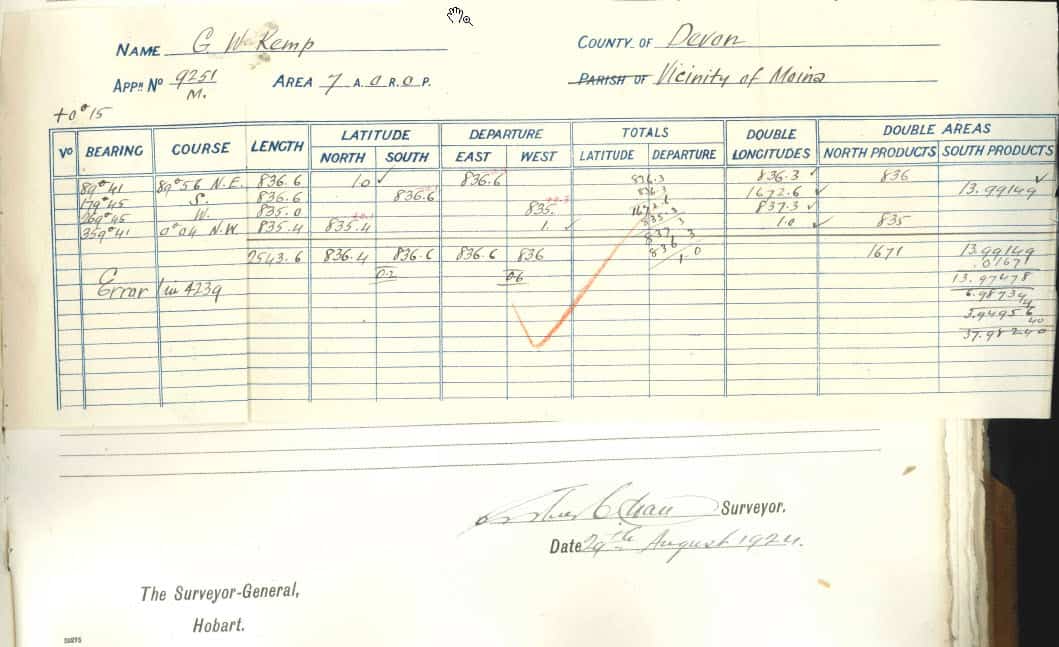
Totals of Latitudes and Departures are in fact COORDINATES.
I note that the point No. column was not used, tsk, tsk.
Paul in PA

In about 1976 Hewlett Packard had a Survey COGO package that ran on a HP 9815 computer. This was about a year after releasing the HP3800 electronic distance meter. It saved data on a cassette tape that could be recalled, 100 points I believe, could have been 50. Also the HP45 programable hand held calculator ant the the HP-67 and HP-97 had COGO packages with magnetic cards for each COGO routine to be loaded. Like Line-Line intersection, Distance-Distance, Line-Distance. There was a Survey COGO package that ran on a Tektoniks desktop computer, can't remember the name of it, that was the "hot" COGO for surveyors in about 1979.

Richard, post: 412992, member: 833 wrote: These sheets are from early days (1924) pre all the modern contrivances.
I grew up on them. Not much changed for a very long time.
I've still got a pad full of these forms.
That form is extremely similar to the ones that the U.S. Forest Service used in the 1960's. I remember Dad teaching me how to do the calcs - I was astounded at the double meridian distance method of calculating areas!

I found a track paper printout in a file today with printed numbers, dated 1958. I'm not sure what computer did that.

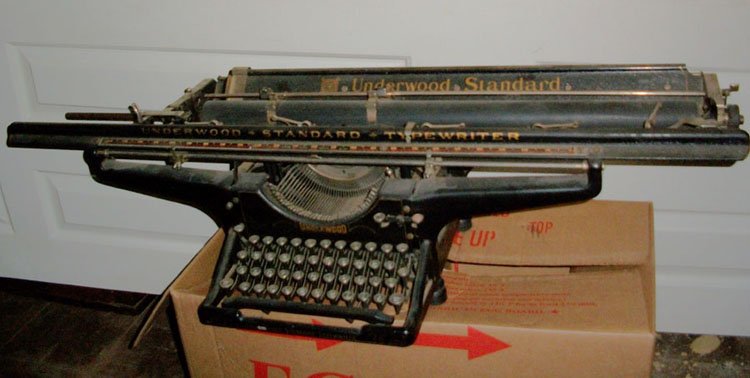
At one time, very wide carriage typewriters were available and used to label drawings.

I don't remember the model number, but we used a Monroe (desktop computer) that used punch cards to run the program. It printed on 3" roll paper (just like the old adding machines). You had to read the cards for the program, input your B&D, read another set of cards, and low and behold you had your balanced traverse. It did not plot, but it was great for number crunching. The next one we had was an HP 1765 I think. It used tapes for the program and data tapes for saving the data. The wide format z-fold printer would also print out a point map that you could overlay for hand plotting. State of the art at the time. I spent a lot of time talking to the programmers in Oregon while figuring it out.

NorthernSurveyor, post: 413299, member: 149 wrote: In about 1976 Hewlett Packard had a Survey COGO package that ran on a HP 9815 computer. [ . . . ]
Our company bought one of the first ones in the State when they came out. Truly a marvellous machine at the time. It cost $13,000 inflation adjusted today's dollars back then.

HP 9815S, HP97, HP41, WANG with the CEADS, those were all around in late 1970's when I started and I used all of them at one time or another 1979-1987. I didn't work for an outfit with a "COGO" package on a PC platform until WILDsoft in 1990, but it had been around for awhile prior to that.
SHG