Reading RPLS is free for the whole profession. Members post, reply, and get the members-only rooms.


Notifications
Clear all

Topic starter
Translate
▼
English
Spanish
French
German
Italian
Portuguese
Russian
Chinese
Japanese
Korean
Arabic
Hindi
Dutch
Polish
Turkish
Vietnamese
Thai
Swedish
Danish
Finnish
Norwegian
Czech
Hungarian
Romanian
Greek
Hebrew
Indonesian
Malay
Ukrainian
Bulgarian
Croatian
Slovak
Slovenian
Serbian
Lithuanian
Latvian
Estonian
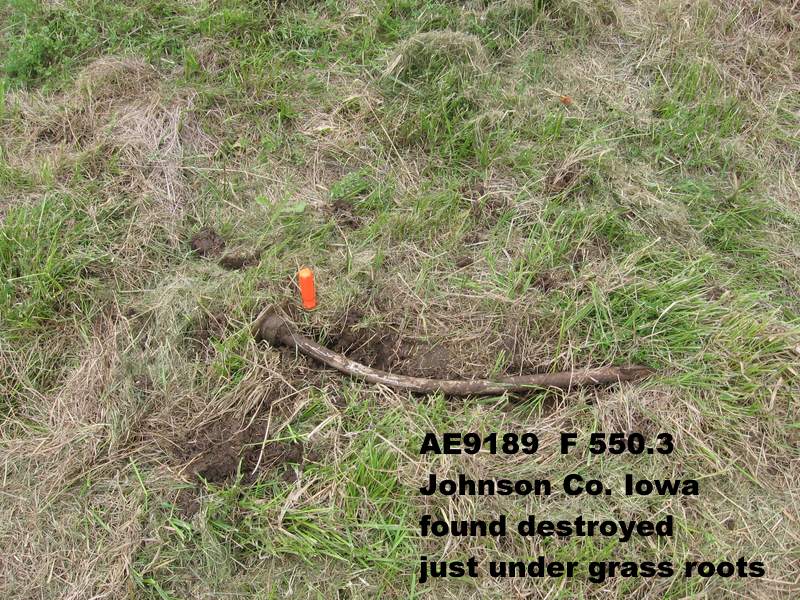
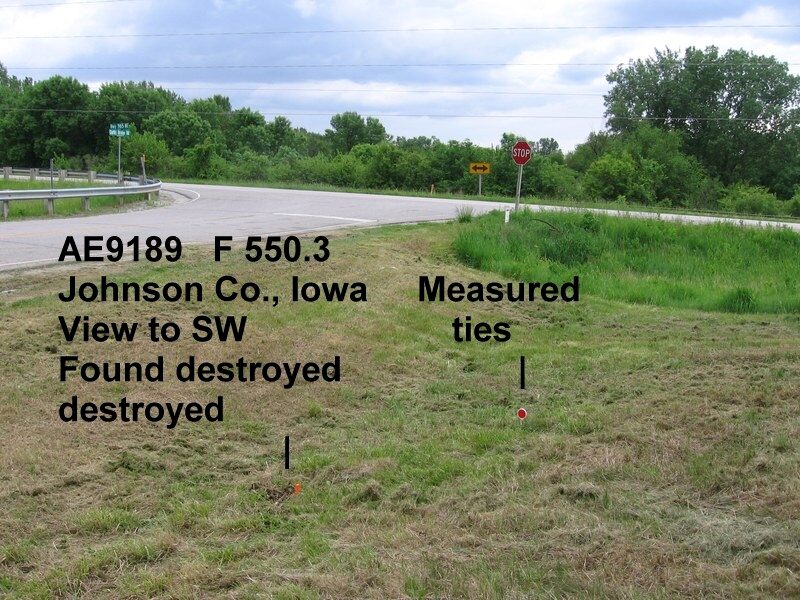
I turn in more Not Found recovery reports than found Good or Poor, but it's rare to actually prove they are destroyed. I recently did find this one destroyed and submitted these pictures to NGS.
I think they trenched in a fiber optic line and ran into it so cast it aside. It was 8 ft or more from measured ties and under grass roots so took a while to find with the (treasure hunter) metal detector.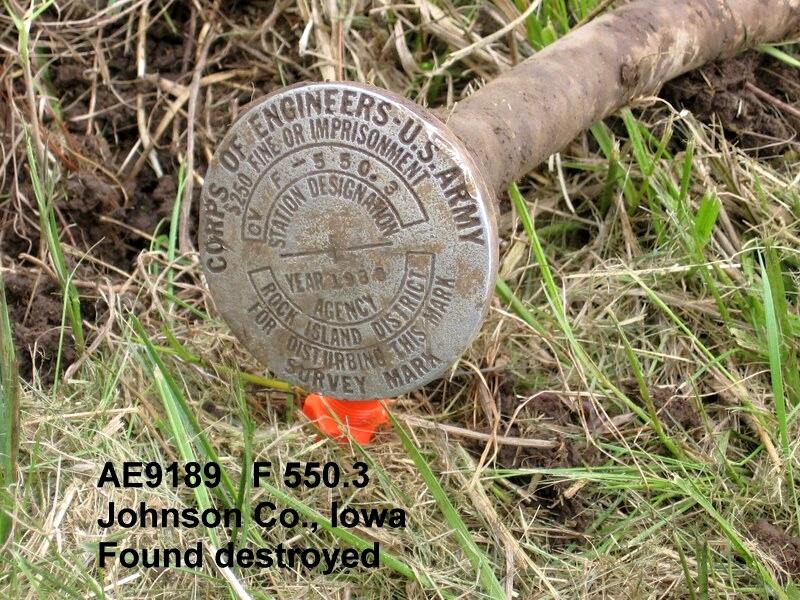
Posted : July 5, 2017 11:35 am

Translate
▼
English
Spanish
French
German
Italian
Portuguese
Russian
Chinese
Japanese
Korean
Arabic
Hindi
Dutch
Polish
Turkish
Vietnamese
Thai
Swedish
Danish
Finnish
Norwegian
Czech
Hungarian
Romanian
Greek
Hebrew
Indonesian
Malay
Ukrainian
Bulgarian
Croatian
Slovak
Slovenian
Serbian
Lithuanian
Latvian
Estonian
That there is what we call a "souvenir."
Posted : July 5, 2017 1:20 pm
Topic starter
Translate
▼
English
Spanish
French
German
Italian
Portuguese
Russian
Chinese
Japanese
Korean
Arabic
Hindi
Dutch
Polish
Turkish
Vietnamese
Thai
Swedish
Danish
Finnish
Norwegian
Czech
Hungarian
Romanian
Greek
Hebrew
Indonesian
Malay
Ukrainian
Bulgarian
Croatian
Slovak
Slovenian
Serbian
Lithuanian
Latvian
Estonian
I believe the words are "removed from the area to prevent someone from creating confusion by putting it back in the ground."
I hadn't found one to report destroyed since 2006, about 300 recovery reports ago.
Posted : July 5, 2017 2:04 pm

Translate
▼
English
Spanish
French
German
Italian
Portuguese
Russian
Chinese
Japanese
Korean
Arabic
Hindi
Dutch
Polish
Turkish
Vietnamese
Thai
Swedish
Danish
Finnish
Norwegian
Czech
Hungarian
Romanian
Greek
Hebrew
Indonesian
Malay
Ukrainian
Bulgarian
Croatian
Slovak
Slovenian
Serbian
Lithuanian
Latvian
Estonian
There were a couple of times that we had a crew find a Bench Mark on a Railroad device and we tried to look it up on the database. finally find it with the description in a totally different locations (miles away). Turned out that they had actually pulled up the whole device with the concrete base and installed it in a new location (best we could figure).
Posted : July 5, 2017 3:12 pm
Topic starter
Translate
▼
English
Spanish
French
German
Italian
Portuguese
Russian
Chinese
Japanese
Korean
Arabic
Hindi
Dutch
Polish
Turkish
Vietnamese
Thai
Swedish
Danish
Finnish
Norwegian
Czech
Hungarian
Romanian
Greek
Hebrew
Indonesian
Malay
Ukrainian
Bulgarian
Croatian
Slovak
Slovenian
Serbian
Lithuanian
Latvian
Estonian
Tom Adams, post: 435393, member: 7285 wrote: finally find it with the description in a totally different locations (miles away)
That would be an interesting situation. Do you have the PID?
I've seen one where the longitude was entered exactly one degree off. I think that one also had another PID with the correct coordinates, and no one had put two and two together because the to-reach came from opposite directions.
And there is one NF locally where the disk was installed along Hwy 30 in 1934, coordinates scaled in the 1960's when they created the data base and Hwy 30 had been routed a mile or so away, and now Hwy 30 is another mile or so further away. That can also get confusing.
Other confusions occur between original and Reset disks, although those locations are usually within sight of each other.
Posted : July 5, 2017 3:25 pm

Translate
▼
English
Spanish
French
German
Italian
Portuguese
Russian
Chinese
Japanese
Korean
Arabic
Hindi
Dutch
Polish
Turkish
Vietnamese
Thai
Swedish
Danish
Finnish
Norwegian
Czech
Hungarian
Romanian
Greek
Hebrew
Indonesian
Malay
Ukrainian
Bulgarian
Croatian
Slovak
Slovenian
Serbian
Lithuanian
Latvian
Estonian
A few years ago I was surveying boundaries in the back blocks when a bloke turned up and proceeded to inform me where his boundaries were.
One had a star marker with an SPM plate (state permanent mark) attached. He said that was the boundary mark.
I knew it was obviously flogged from other locations so I checked its original location.
It was from other side of Tasmania, Picaninny Point. Interesting the bloke claimed aboriginal descent.
Such marks don't get the protection they deserve here.
And the authorities don't do anything that I'm aware of.
Posted : July 5, 2017 3:58 pm

Translate
▼
English
Spanish
French
German
Italian
Portuguese
Russian
Chinese
Japanese
Korean
Arabic
Hindi
Dutch
Polish
Turkish
Vietnamese
Thai
Swedish
Danish
Finnish
Norwegian
Czech
Hungarian
Romanian
Greek
Hebrew
Indonesian
Malay
Ukrainian
Bulgarian
Croatian
Slovak
Slovenian
Serbian
Lithuanian
Latvian
Estonian
In our civil works construction contracts we have clauses to the effect that the contractor shall research and locate and protect all survey marks (Lands Dept, Survey Office, etc) in the Site and shall be responsible for fixing any damage.
Posted : July 5, 2017 4:05 pm
Topic starter
Translate
▼
English
Spanish
French
German
Italian
Portuguese
Russian
Chinese
Japanese
Korean
Arabic
Hindi
Dutch
Polish
Turkish
Vietnamese
Thai
Swedish
Danish
Finnish
Norwegian
Czech
Hungarian
Romanian
Greek
Hebrew
Indonesian
Malay
Ukrainian
Bulgarian
Croatian
Slovak
Slovenian
Serbian
Lithuanian
Latvian
Estonian
Richard Imrie, post: 435411, member: 11256 wrote: shall be responsible for fixing any damage
That invites them to say:
[SARCASM]"We put it back right where it was." [/SARCASM]
Posted : July 5, 2017 4:13 pm
Translate
▼
English
Spanish
French
German
Italian
Portuguese
Russian
Chinese
Japanese
Korean
Arabic
Hindi
Dutch
Polish
Turkish
Vietnamese
Thai
Swedish
Danish
Finnish
Norwegian
Czech
Hungarian
Romanian
Greek
Hebrew
Indonesian
Malay
Ukrainian
Bulgarian
Croatian
Slovak
Slovenian
Serbian
Lithuanian
Latvian
Estonian
Or, "we couldn't locate any".
Posted : July 5, 2017 4:18 pm

Translate
▼
English
Spanish
French
German
Italian
Portuguese
Russian
Chinese
Japanese
Korean
Arabic
Hindi
Dutch
Polish
Turkish
Vietnamese
Thai
Swedish
Danish
Finnish
Norwegian
Czech
Hungarian
Romanian
Greek
Hebrew
Indonesian
Malay
Ukrainian
Bulgarian
Croatian
Slovak
Slovenian
Serbian
Lithuanian
Latvian
Estonian
Bill and Richard, you are correct in that such a regulation is difficult to enforce. In most cases, no one checks.
It's still a good regulation. We have similar here. If I'm preparing certified as-builts, I notify the owner to withhold a portion of the final payment from the contractor in order to cover the fee for re-setting marks that were shown on the topographic survey but have been destroyed during construction.
Posted : July 5, 2017 4:42 pm

Translate
▼
English
Spanish
French
German
Italian
Portuguese
Russian
Chinese
Japanese
Korean
Arabic
Hindi
Dutch
Polish
Turkish
Vietnamese
Thai
Swedish
Danish
Finnish
Norwegian
Czech
Hungarian
Romanian
Greek
Hebrew
Indonesian
Malay
Ukrainian
Bulgarian
Croatian
Slovak
Slovenian
Serbian
Lithuanian
Latvian
Estonian
Richard, post: 435406, member: 833 wrote: Such marks don't get the protection they deserve here.
And the authorities don't do anything that I'm aware of.
So; it's a global problem then...
Posted : July 5, 2017 4:47 pm
Translate
▼
English
Spanish
French
German
Italian
Portuguese
Russian
Chinese
Japanese
Korean
Arabic
Hindi
Dutch
Polish
Turkish
Vietnamese
Thai
Swedish
Danish
Finnish
Norwegian
Czech
Hungarian
Romanian
Greek
Hebrew
Indonesian
Malay
Ukrainian
Bulgarian
Croatian
Slovak
Slovenian
Serbian
Lithuanian
Latvian
Estonian
ScottySantaFe, post: 435418, member: 9477 wrote: I notify the owner to withhold a portion of the final payment from the contractor in order to cover the fee for re-setting marks that were shown on the topographic survey but have been destroyed during construction.
That's a good idea. I think we'll add something similar to our contracts.
Posted : July 5, 2017 4:51 pm

Translate
▼
English
Spanish
French
German
Italian
Portuguese
Russian
Chinese
Japanese
Korean
Arabic
Hindi
Dutch
Polish
Turkish
Vietnamese
Thai
Swedish
Danish
Finnish
Norwegian
Czech
Hungarian
Romanian
Greek
Hebrew
Indonesian
Malay
Ukrainian
Bulgarian
Croatian
Slovak
Slovenian
Serbian
Lithuanian
Latvian
Estonian
Around here, poor folk have chiseled and pried the caps off of concrete bridge abutments to sell for scrap metal.
Posted : July 5, 2017 5:10 pm
Translate
▼
English
Spanish
French
German
Italian
Portuguese
Russian
Chinese
Japanese
Korean
Arabic
Hindi
Dutch
Polish
Turkish
Vietnamese
Thai
Swedish
Danish
Finnish
Norwegian
Czech
Hungarian
Romanian
Greek
Hebrew
Indonesian
Malay
Ukrainian
Bulgarian
Croatian
Slovak
Slovenian
Serbian
Lithuanian
Latvian
Estonian
Richard, post: 435406, member: 833 wrote: One had a star marker
That's the second reference you've made to a "star marker." I'm not familiar with it, and an image search turned up nothing likely. Can you descirbe a star marker, and maybe post a photo of one?
Posted : July 5, 2017 5:36 pm
Translate
▼
English
Spanish
French
German
Italian
Portuguese
Russian
Chinese
Japanese
Korean
Arabic
Hindi
Dutch
Polish
Turkish
Vietnamese
Thai
Swedish
Danish
Finnish
Norwegian
Czech
Hungarian
Romanian
Greek
Hebrew
Indonesian
Malay
Ukrainian
Bulgarian
Croatian
Slovak
Slovenian
Serbian
Lithuanian
Latvian
Estonian
My guess would be a (piece of) steel star picket fence post, aka y-post, waratah:

We've seen a few of those here in Fiji, set in concrete, top about 0.75' below ground level.
Posted : July 5, 2017 5:58 pm

Translate
▼
English
Spanish
French
German
Italian
Portuguese
Russian
Chinese
Japanese
Korean
Arabic
Hindi
Dutch
Polish
Turkish
Vietnamese
Thai
Swedish
Danish
Finnish
Norwegian
Czech
Hungarian
Romanian
Greek
Hebrew
Indonesian
Malay
Ukrainian
Bulgarian
Croatian
Slovak
Slovenian
Serbian
Lithuanian
Latvian
Estonian
Are you saying that if you put it back exactly where it belongs, it would cut through the fibre optic lines?
HMMM!
Paul in PA
Posted : July 5, 2017 7:10 pm

Translate
▼
English
Spanish
French
German
Italian
Portuguese
Russian
Chinese
Japanese
Korean
Arabic
Hindi
Dutch
Polish
Turkish
Vietnamese
Thai
Swedish
Danish
Finnish
Norwegian
Czech
Hungarian
Romanian
Greek
Hebrew
Indonesian
Malay
Ukrainian
Bulgarian
Croatian
Slovak
Slovenian
Serbian
Lithuanian
Latvian
Estonian
I had one once (using the UK meaning of Bench Mark as height, rather than position) where a number of surveys in an area conflicted. On investigation several had used a bench mark on a bridge parapet wall. It matched the description for position and height above road surface, but it was on the OUTSIDE of the parapet. Nobody else seemed to have wondered why it was on that side. The parapet had been carefully rebuilt and the stone with the bench mark had been turned round and reused.
I also had a construction site once where the foreman appeared one morning with a chunk of brickwork containing the site bench mark, which had been on the wall adjacent to the site entrance. "I know this is important, so I thought I'd better bring it in for safe keeping, in case it gets damaged" says he!
Posted : July 6, 2017 3:03 am
Translate
▼
English
Spanish
French
German
Italian
Portuguese
Russian
Chinese
Japanese
Korean
Arabic
Hindi
Dutch
Polish
Turkish
Vietnamese
Thai
Swedish
Danish
Finnish
Norwegian
Czech
Hungarian
Romanian
Greek
Hebrew
Indonesian
Malay
Ukrainian
Bulgarian
Croatian
Slovak
Slovenian
Serbian
Lithuanian
Latvian
Estonian
[USER=10]@Jim Frame[/USER] the other Richard is right on. They're properly called star pickets, but we also in survey use call them star markers when they are placed alongside a permanent mark of some description.
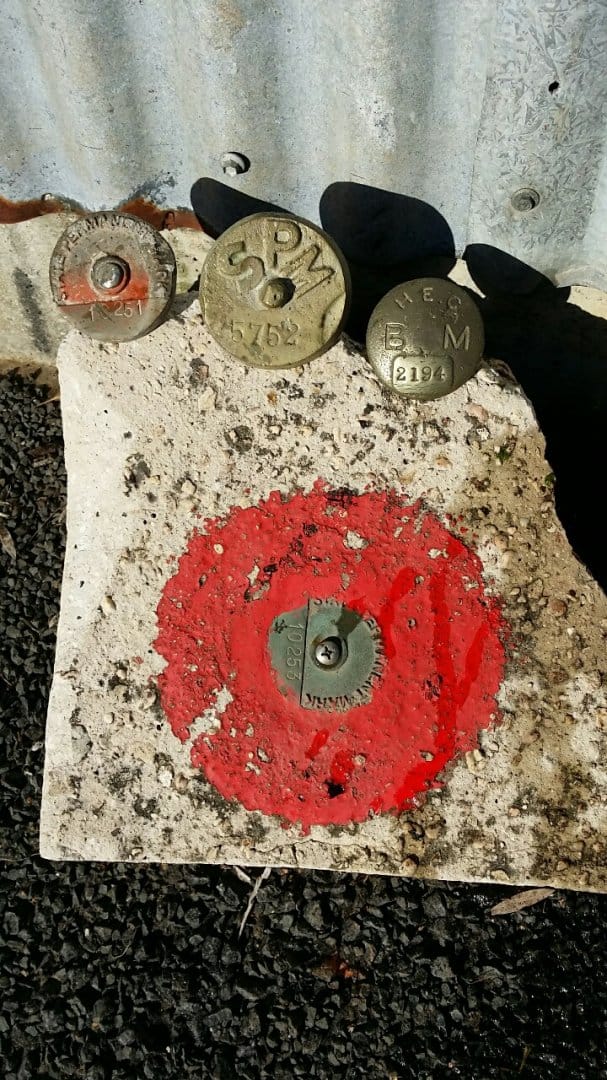
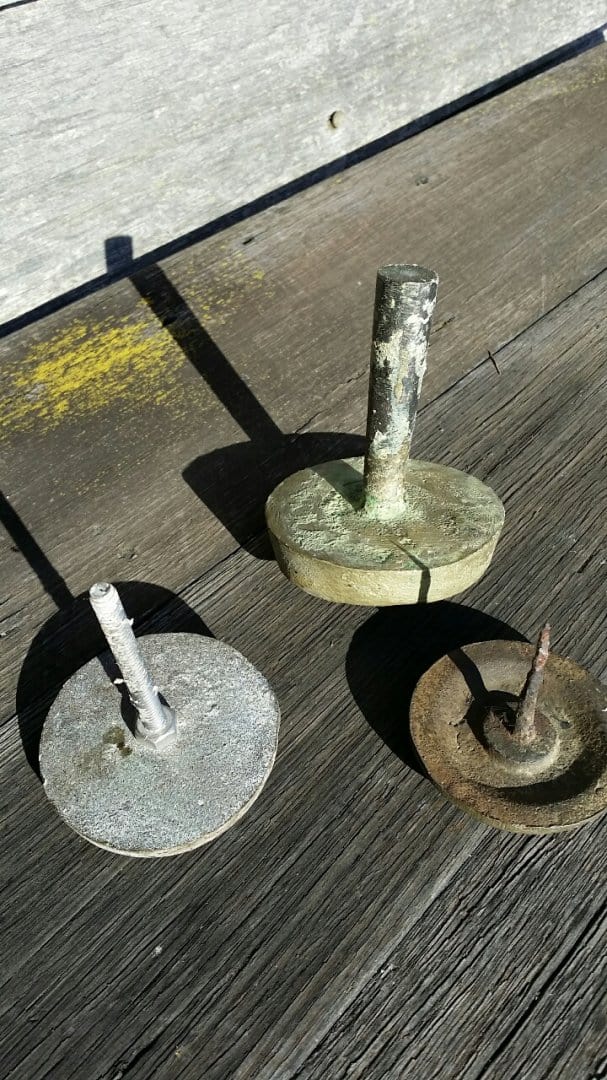
Below are some old permanent marks salvaged from demolished areas.
These show various types and ages.
Solid brass mushroom probably from the 40's?
Lighter discs about 80's
Other smaller mushroom mid 50's. It was part of a levelling run probably 30 miles long. Quite common. Now rapidly being lost or obliterated.
The concrete was an old culvert headwall now replaced.
The star pickets are commonly used for fencing, construction, surveying, landscaping
Posted : July 6, 2017 3:03 am
Translate
▼
English
Spanish
French
German
Italian
Portuguese
Russian
Chinese
Japanese
Korean
Arabic
Hindi
Dutch
Polish
Turkish
Vietnamese
Thai
Swedish
Danish
Finnish
Norwegian
Czech
Hungarian
Romanian
Greek
Hebrew
Indonesian
Malay
Ukrainian
Bulgarian
Croatian
Slovak
Slovenian
Serbian
Lithuanian
Latvian
Estonian
Richard, post: 435480, member: 833 wrote: They're properly called star pickets, but we also in survey use call them star markers when they are placed alongside a permanent mark of some description.
Around here we just call them steel fence posts, sometimes studded-T fence posts.
Posted : July 6, 2017 5:20 pm