Reading RPLS is free for the whole profession. Members post, reply, and get the members-only rooms.

Notifications
Clear all
Strictly Surveying
5
Posts
2
Users
0
Reactions
445
Views

Topic starter
Translate
▼
English
Spanish
French
German
Italian
Portuguese
Russian
Chinese
Japanese
Korean
Arabic
Hindi
Dutch
Polish
Turkish
Vietnamese
Thai
Swedish
Danish
Finnish
Norwegian
Czech
Hungarian
Romanian
Greek
Hebrew
Indonesian
Malay
Ukrainian
Bulgarian
Croatian
Slovak
Slovenian
Serbian
Lithuanian
Latvian
Estonian
Here is sort of an interesting puzzle. This map is archived in the Libary of Congress as "Plat of Unidentified City" and contains some clues that I'd think a surveyor could use to identify the place. Note that the scale is given in English feet, but the notation is in Spanish. Note also the West variation of magnetic North.
http://www.loc.gov/resource/g3934p.lh000891/&apos ;">[Plat of unidentified city].
Posted : October 30, 2015 10:42 pm
Topic starter
Translate
▼
English
Spanish
French
German
Italian
Portuguese
Russian
Chinese
Japanese
Korean
Arabic
Hindi
Dutch
Polish
Turkish
Vietnamese
Thai
Swedish
Danish
Finnish
Norwegian
Czech
Hungarian
Romanian
Greek
Hebrew
Indonesian
Malay
Ukrainian
Bulgarian
Croatian
Slovak
Slovenian
Serbian
Lithuanian
Latvian
Estonian
The folks at NOAA have obligingly provided an interactive map of magnetic declinations. If the date of the plat is about 1845, this will generate the isogonic lines of 4 degrees West variation.
Posted : October 30, 2015 11:06 pm
Topic starter
Translate
▼
English
Spanish
French
German
Italian
Portuguese
Russian
Chinese
Japanese
Korean
Arabic
Hindi
Dutch
Polish
Turkish
Vietnamese
Thai
Swedish
Danish
Finnish
Norwegian
Czech
Hungarian
Romanian
Greek
Hebrew
Indonesian
Malay
Ukrainian
Bulgarian
Croatian
Slovak
Slovenian
Serbian
Lithuanian
Latvian
Estonian
 I guess there are mysteries and then there are mysteries. I just noticed that the metadata for the map in the Library of Congress catalogue lists it as probably a map of Pensacola, Florida. Generally, it does appear to be consistent with the above example, aside from the declination noted on the "unknown" map.
Posted : October 31, 2015 12:25 am

Translate
▼
English
Spanish
French
German
Italian
Portuguese
Russian
Chinese
Japanese
Korean
Arabic
Hindi
Dutch
Polish
Turkish
Vietnamese
Thai
Swedish
Danish
Finnish
Norwegian
Czech
Hungarian
Romanian
Greek
Hebrew
Indonesian
Malay
Ukrainian
Bulgarian
Croatian
Slovak
Slovenian
Serbian
Lithuanian
Latvian
Estonian
There can't be too many places where a particular isogonal line crosses a shore line. It looks like a pretty substantial fort there, that might still be standing today.
Posted : October 31, 2015 5:19 am
Topic starter
Translate
▼
English
Spanish
French
German
Italian
Portuguese
Russian
Chinese
Japanese
Korean
Arabic
Hindi
Dutch
Polish
Turkish
Vietnamese
Thai
Swedish
Danish
Finnish
Norwegian
Czech
Hungarian
Romanian
Greek
Hebrew
Indonesian
Malay
Ukrainian
Bulgarian
Croatian
Slovak
Slovenian
Serbian
Lithuanian
Latvian
Estonian
rfc, post: 342530, member: 8882 wrote: There can't be too many places where a particular isogonal line crosses a shore line. It looks like a pretty substantial fort there, that might still be standing today.
As it turns out, the magnetic declination represented by the North arrow wasn't a very good clue if the arrow with the half fleur-de-lis head represented magnetic North and the other with the smaller, double-sided head was true North. Here are the estimates of the actual angle of variation of magnetic North for Pensacola, Florida.
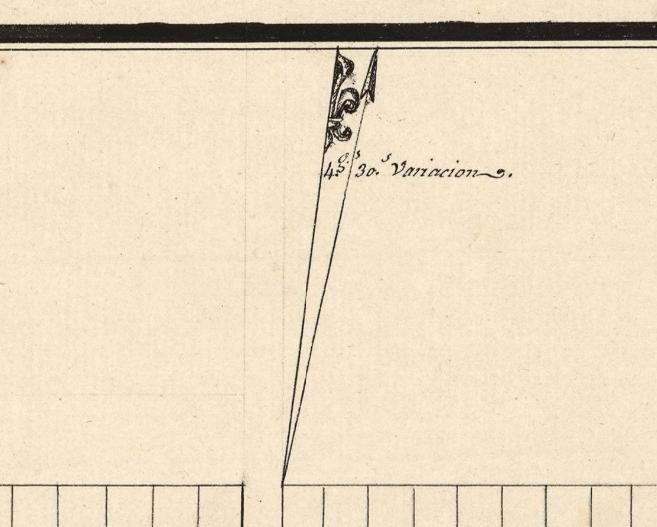
Even as an East declination, it isn't terribly close to the estimated declination for around 1810, the supposed year of the map if these estimates from the National Geophysical Data Center models are reasonably accurate:
Latitude: 30å¡ 29' 16" N
Longitude: 87å¡ 11' 22" W
Year Declination
1810 7å¡ 10.0' E
1820 7å¡ 16.0' E
1830 7å¡ 16.0' E
Posted : October 31, 2015 9:55 am