

A Harris, post: 412077, member: 81 wrote: @ paden Cash
Ask Louisiana, they have been trying for centuries to hold back the Red River back with no solution at all.
At some times it simply goes where it wants to go.
The sifting sands are on the move 24/7 between Texas and Oklahoma along the Red River making it unfit to wade in or swim because it will swallow up most anything.
It narrows and deepens at the bend around Fulton, Arkansas to where you could throw a rock across from bank to bank and I have done that.
Between Fulton and the Gulf of Mexico they have built levees, locks and dams when it decides to get out of its banks not much will stop that from happening.
There are some portions of the bank that you just want to have a long rope tied around your waste for the crew to pull you to safety if you get swept away.
The Red can indeed be a wild and crazy river when it takes a notion. On the other had I have actually walked across the Red River...although there were a few places I actually ran. If I had only leisurely strolled, or even stopped to smell the bull nettles, I would probably have been swallowed up.
One old man put it in a few words: The River is always there. If you can't see the water it's just because it's hiding underground.
For any of the readers that can't follow the chronology of the argument here's an informative but simplistic explanation:
http://www.redriverpropertyrights.com/?page_id=5&apos ;"> http://www.redriverpropertyrights.com/?page_id=5
Basically the south boundary of the Louisiana Purchase was described as the "south bank" of the Red River. Implying the entire river bed went with the property. For 214 years people have come up with all sorts of ways to determine what the words "south bank" really meant.
Edit: Although the link above is informative, it states the shared boundary between Texas & Oklahoma is 116 miles in length. Those must be 'Texas' miles that consist of 5,280 varas instead of feet.

paden cash, post: 412084, member: 20 wrote: For 214 years people have come up with all sorts of ways to determine what the words "south bank" really meant.
Probably the more correct statement, though, would be :
"For 214 years people have come up with all sorts of ways to determine what the words "south bank" really meant, depending upon where producing oil wells happened to have been drilled. "
One thing that should be noted about the engineer and topographer Arthur A. Stiles is that when he invented the theory of the gradient boundary, he himself admitted that it was basically something that only a person with his unique resume would ever be able to locate. Later surveyors claimed a bit of the Scent of Stiles for themselves by asserting that no surveyor who had not personally been out in the field with Arthur Stiles could ever successfully locate any gradient boundary.
Kent McMillan, post: 412091, member: 3 wrote: Probably the more correct statement, though, would be :
"For 214 years people have come up with all sorts of ways to determine what the words "south bank" really meant, depending upon where producing oil wells happened to have been drilled. "
You're correct. The only place buzzards congregate is where there is carrion. In this case, attorneys and royalties.
But as an Oklahoma surveyor I should probably be ashamed of myself, but I have purposely ignored everything that has transpired over the last 40 years concerning ownership of the river bed. I have several surveyor friends in parts of SE Oklahoma that border the river and have helped me maintain this attitude.
And I have not read all the cases that culminated in the 2000 Red River agreement. But what is interesting is the Federal government's assertion to ownership. Granted the original PLSS surveys stopped at the north bank, I don't believe that left the river bed as federal property but as property remaining with the Territory. And to confound the issue Oklahoma was actually divided in two: the Oklahoma Territory and Indian Territory. Apparently neither of which was actually accepted as a legal "territory" by Congress. We just kind of sublimed from surplus unassigned lands to Statehood.
Texas and Oklahoma should have quit arguing the point years ago. Now the Feds want to step in and really mess it up.
Kent McMillan, post: 412093, member: 3 wrote: One thing that should be noted about the engineer and topographer Arthur A. Stiles is that when he invented the theory of the gradient boundary, he himself admitted that it was basically something that only a person with his unique resume would ever be able to locate. Later surveyors claimed a bit of the Scent of Stiles for themselves by asserting that no surveyor who had not personally been out in the field with Arthur Stiles could ever successfully locate any gradient boundary.
I agree. In my opinion the "gradient" method borders on insanity from a practical standpoint. Maybe we should install "border cams" every half-mile to document the movement of the river. Software could be developed to accurately produce the daily changing gradient line...

Both states should let the issue sit idle while they quietly transfer the money into a special account, that they would have been spending on attorneys, surveys, employee wages, ect. When this account is large enough, pay off all the people along the river and call it good. Nobody will care about where the boundary is after that.

Kent McMillan, post: 412093, member: 3 wrote: One thing that should be noted about the engineer and topographer Arthur A. Stiles is that when he invented the theory of the gradient boundary, he himself admitted that it was basically something that only a person with his unique resume would ever be able to locate. Later surveyors claimed a bit of the Scent of Stiles for themselves by asserting that no surveyor who had not personally been out in the field with Arthur Stiles could ever successfully locate any gradient boundary.
Is the Red considered non-navigable? Is that why the Feds think they own it and not the State of Oklahoma?
Dave Karoly, post: 412130, member: 94 wrote: Is the Red considered non-navigable? Is that why the Feds think they own it and not the State of Oklahoma?
Yes, the Red River is non-navigable in federal law. Under Texas law, it would be navigable by reason of its width, but no part of the bed of the Red is in Texas. Here's a link to :
Oklahoma v. Texas
258 U.S. 574 (1922)
https://supreme.justia.com/cases/federal/us/258/574/
Kent McMillan, post: 412132, member: 3 wrote: Yes, the Red River is non-navigable in federal law. Under Texas law, it would be navigable by reason of its width, but no part of the bed of the Red is in Texas. Here's a link to :
Oklahoma v. Texas
258 U.S. 574 (1922)
https://supreme.justia.com/cases/federal/us/258/574/
I read the article Paden linked.
So the State jurisdicitional boundary was the south bank (oversimplification, I know) which is still the Texas title boundary. Texas and Oklahoma agreed (with the approval of Congress) to the vegetation line for jurisdictional purposes only because it was a legal no mans land (mainly for criminals). It would appear some Texas landowners may have part of their holdings in Oklahoma's jurisdiction.
In Oklahoma the Red River is non-navigable so the patent holders in the GLO Townships own to the thread of the river. The State has no title interest and the Federal government must reason that the land between the thread and the Texas line is unpatented public domain. This commentary is given without reading the Supreme Court opinion.

Kent McMillan, post: 412093, member: 3 wrote: One thing that should be noted about the engineer and topographer Arthur A. Stiles is that when he invented the theory of the gradient boundary, he himself admitted that it was basically something that only a person with his unique resume would ever be able to locate. Later surveyors claimed a bit of the Scent of Stiles for themselves by asserting that no surveyor who had not personally been out in the field with Arthur Stiles could ever successfully locate any gradient boundary.
i once sat through a day-long seminar on identifying and measuring gradient boundaries, and can say- without any reservation- i understand no more about it subsequent to the seminar than before. which only proves one thing: people are still finding ways to get some of the stink on themselves.
Dave Karoly, post: 412148, member: 94 wrote: So the State jurisdicitional boundary was the south bank (oversimplification, I know) which is still the Texas title boundary. Texas and Oklahoma agreed (with the approval of Congress) to the vegetation line for jurisdictional purposes only because it was a legal no mans land (mainly for criminals). It would appear some Texas landowners may have part of their holdings in Oklahoma's jurisdiction.
Yes to the provisions of the Red River Boundary Compact (linked below) regarding the adoption of the vegetation line as the boundary between Texas and Oklahoma which include the following:
(4) while the south bank, at any given time, may be located through expensive and time-consuming survey techniques, such surveys can, at best, identify the south bank only as it exists at the time of the survey;
(5) locating the south bank through survey techniques is of minimal aid when agencies of the party states must locate the state boundary line for law enforcement, administrative, and taxation purposes; and
(6) the interests of the party states are better served by establishing the boundary between the states through use of a readily identifiable natural landmark than through use of an artificial survey line.
(2) "Vegetation line" means the visually identifiable continuous line of vegetation that is adjacent to that portion of the riverbed kept practically bare of vegetation by the natural flow of the river and is continuous with the vegetation beyond the riverbed. Stray vegetation, patches of vegetation, or islands of vegetation within the riverbed that do not form such a line are not considered part of the vegetation line. Where the riverbed is entered by the inflow of another watercourse or is otherwise interrupted or disturbed by a man-made event, the line constituting the boundary is an artificial line formed by extending the vegetation line above and below the other watercourse or interrupted or disturbed area to connect and cross the watercourse or area.
(b) The permanent political boundary line between the states of Texas and Oklahoma along the Red River is the vegetation line along the south bank of the Red River except for the Texoma area, where the boundary does not change.
(g) Should there be a change in the watercourse of the Red River, the party states recognize the rules of accretion, erosion, and avulsion. The states agree that accretion or erosion may cause a change in the boundary between the states if it causes a change in the vegetation line. With regard to avulsion, the states agree that a change in the course of the Red River caused by an immediately perceivable natural event that changes the vegetation line will change the location of the boundary between the states.
http://www.statutes.legis.state.tx.us/Docs/NR/htm/NR.12.htm
I don't think that the United States was involved in the Red River Boundary Compact. I think it was just a matter between Oklahoma and Texas. As a technical result, while it may have had the effect of fixing the state boundary at the vegetation line along the South bank of the Red River, it would not have affected the boundary of land in the bed of the Red River to which the United States retained title, either in its own name or in trust for certain Native American tribal groups.
Dave Karoly, post: 412148, member: 94 wrote: I read the article Paden linked.
So the State jurisdicitional boundary was the south bank (oversimplification, I know) which is still the Texas title boundary.
That's not what I got out the Red River Boundary Compact. It's possible that I'm overlooking something, but the language seems clear enough that Texas and Oklahoma are fixing the boundary between the states at the vegetation line on the South side of the Red River. In other words, on one side of the vegetation line, you're OK and on the other you're more than Okay.
That agreement between the two states did not, however, effect the location of the boundary between the United States and Spain along the South bank of the Red River as determined by the US Supreme Court in Oklahoma v. Texas. That was the gradient boundary along the south bank of the river unless the channel had been altered by avulsion after 1821, in which case the south bank of the pre-avulsive channel remained the South bank of the Red River boundary.
Since the United States owns at least the south half of the bed of the Red River, and in most cases probably the entire width of the bed, and wasn't a party to the Red River Boundary Compact, the agreement between Texas and Oklahoma could not by itself also determine the location of the south bank of the Red River to be in any position other than the adjudicated position along the gradient boundary. The novel effect would be to place land South of the gradient boundary in the State of Oklahoma and in many cases to strand relict channels of the Red River owned by the United States inside the State of Texas.
But the question that the Red River Boundary Compact raises is: "What gives states the authority to alter their boundaries without an act of Congress?" Presumably a similar question of authority has arisen before in other boundary suits between states.
In this case in particular, it isn't that the gradient boundary along the South bank of the Red River can't be determined. It's that the determination is time-consuming and expensive and seems like a waste of effort considering that the boundary will continue to change location on the ground through the natural forces at work in the river. In other words, Since the boundary isn't unknown, this would not be a boundary agreement to fix some unknown line, but merely adopting a line known not to be the original line for reasons of convenience and practicality.
Kent McMillan, post: 412176, member: 3 wrote: That's not what I got out the Red River Boundary Compact. It's possible that I'm overlooking something, but the language seems clear enough that Texas and Oklahoma are fixing the boundary between the states at the vegetation line on the South side of the Red River..
Interestingly, the surveyor that took 5 years to complete this survey (commenced 28Jul03 - completed 03Sept08) states in his notes that his retracement it was "clearly evident" the gradient line established by Arthur Stiles was found to have not changed since 1923. I say bullsh*t
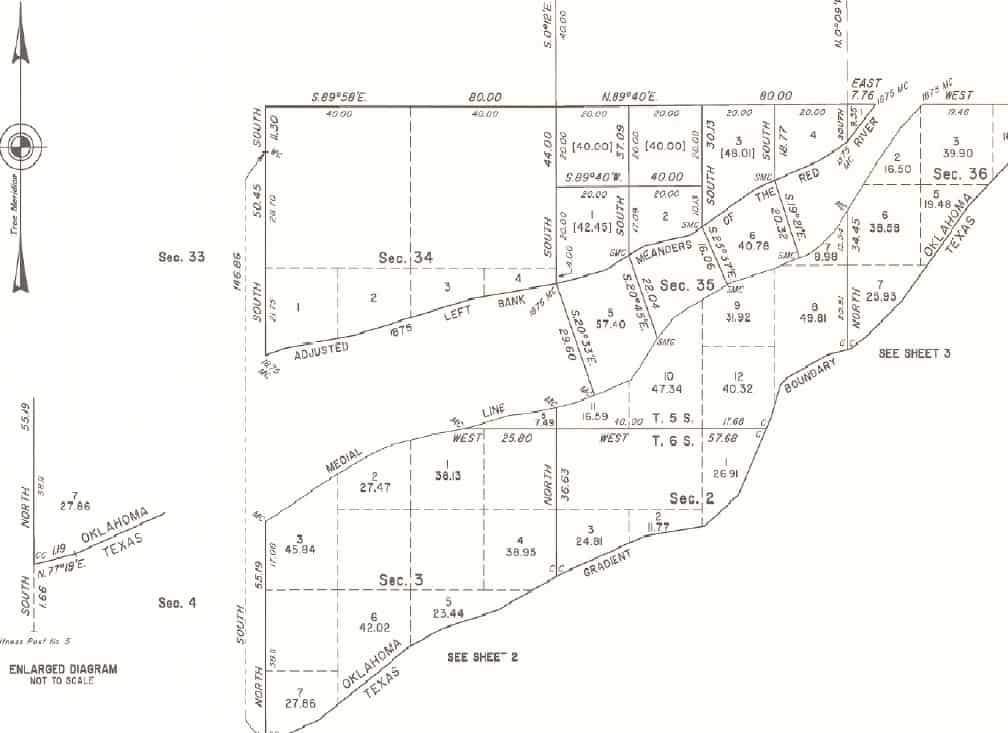
A 2003-2008 Dependent Resurvey by the GLO in the area would affirm your assumption I think...maybe not.
paden cash, post: 412187, member: 20 wrote: Interestingly, the surveyor that took 5 years to complete this survey (commenced 28Jul03 - completed 03Sept08) states in his notes that his retracement it was "clearly evident" the gradient line established by Arthur Stiles was found to have not changed since 1923. I say bullsh*t
What I get out of the field notes that you linked is an excerpt from the report of Arthur A. Stiles ca. 1925 in which he remarked that the gradient boundary in the vicinity of the Big Bend hadn't changed in two years.
The idea that a surveyor could put the gradient boundary as located by Stiles et al. in 1923 or so on the ground and consider that to remain the South bank of the Red River is upon its face more than a bit bizarre, however. For it to remain in the exact same position would require either (a) absolutely no processes of erosion or accretion present in that reach of the river (which seems impossible) or (b) that some avulsive event occured after Stiles survey in 1923 that cut a new channel but did not move the boundary as it had existed in 1923.
That last is possible, I suppose. I wonder if that is why the surveyor resorted to reconstructing the South bank from Stiles' work in 1923 or so. There was an extensive amount of investigation directed toward the question of where the channel of the Red River had been in the vicinity of the Big Bend in 1821 in the course of Oklahoma v. Texas - geological, hydrological, and botanical - and the conclusion was that the channel had gradually shifted after 1821 to the position it occupied in 1923 (or so).
Kent McMillan, post: 412191, member: 3 wrote: What I get out of the field notes that you linked is an excerpt from the report of Arthur A. Stiles ca. 1925 in which he remarked that the gradient boundary in the vicinity of the Big Bend hadn't changed in two years.
The idea that a surveyor could put the gradient boundary as located by Stiles et al. in 1923 or so on the ground and consider that to remain the South bank of the Red River is upon its face more than a bit bizarre, however. For it to remain in the exact same position would require either (a) absolutely no processes of erosion or accretion present in that reach of the river (which seems impossible) or (b) that some avulsive event occured after Stiles survey in 1923 that cut a new channel but did not move the boundary as it had existed in 1923.
That last is possible, I suppose. I wonder if that is why the surveyor resorted to reconstructing the South bank from Stiles' work in 1923 or so. There was an extensive amount of investigation directed toward the question of where the channel of the Red River had been in the vicinity of the Big Bend in 1821 in the course of Oklahoma v. Texas - geological, hydrological, and botanical - and the conclusion was that the channel had gradually shifted after 1821 to the position it occupied in 1923 (or so).
My take on it (after following these guys for years with their "resurveys" ) is they pencil whipped it, plain and simple. The nature of a gradient boundary is fluid in itself. To think one could come up with the same gradient results as an 80 year old survey is poppycock considering the dynamics of the Red River. There are other newer GLO surveys all over that area. I haven't looked, but I bet they all came up with more or less the same thing as Arthur did in 1923. That would not surprise me.
Not that re-establishing the Stiles' line would be bad. Great. Get after it. At some point in time someone has to call something "good" and put things to rest.
paden cash, post: 412194, member: 20 wrote: Not that re-establishing the Stiles' line would be bad. Great. Get after it. At some point in time someone has to call something "good" and put things to rest.
The gradient boundary, though, is tied to the river channel. As the river channel changes through erosion, accretion, and avulsion, the gradient boundary necessarily moves as well. The only scenario I can see in which it would be plausible for the gradient boundary along the south bank of some reach of the Red River not to have moved since 1923 is that the river cut a new channel in some avulsive event, leaving the boundary along the south bank unchanged as a result.
Kent McMillan, post: 412195, member: 3 wrote: The gradient boundary, though, is tied to the river channel. As the river channel changes through erosion, accretion, and avulsion, the gradient boundary necessarily moves as well. The only scenario I can see in which it would be plausible for the gradient boundary along the south bank of some reach of the Red River not to have moved since 1923 is that the river cut a new channel in some avulsive event, leaving the boundary along the south bank unchanged as a result.
I think the Red River should have its own set of rules when it comes to accretion or avulsion. What I have witnessed in my lifetime is every spring the River experiences avulse flows. In comparison the Canadian River has some areas that can be compared in a strikingly similar fashion to the 1874 surveys with little or no change; not so with our common Red River boundary.
It would have been a lot simpler just to give you all the damned thing back in 1846. 😉
paden cash, post: 412194, member: 20 wrote: My take on it (after following these guys for years with their "resurveys" ) is they pencil whipped it, plain and simple.
Just out of curiosity, I thought I'd pull the quad sheet and aerial photos covering the GLO plat that you posted. Is that in Tillman County, OK, just a couple of miles west of the Cotton County line, land appearing on Burburnett quadrangle?
It's north of Wichita Falls, just east of the interstate.