

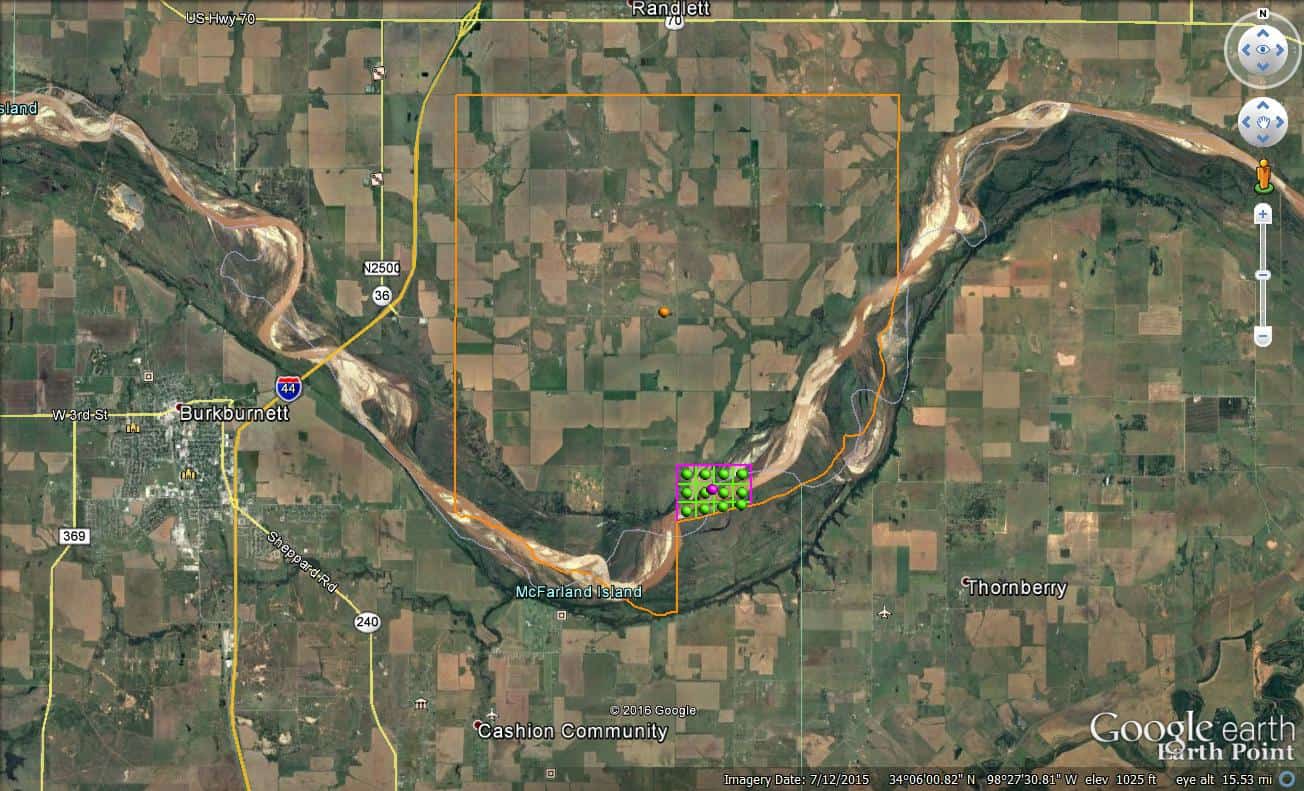
Kent McMillan, post: 412202, member: 3 wrote: Just out of curiosity, I thought I'd pull the quad sheet and aerial photos covering the GLO plat that you posted. Is that in Tillman County, OK, just a couple of miles west of the Cotton County line, land appearing on Burburnett quadrangle?
Twp. 5 South, Range 12 West, Cotton County...'bout 8 miles due east of Burkburnett.

Okay, so here is approximately how the resurvey plat from which you posted a detail overlays Thornberry Quadrangle. The mistfit of the gradient boundary to the bluff line on the South bank doesn't appear to be consistent with an avulsion, so it does tend to make one wonder what evidence was thought to compel the conclusion that the 1923 gradient boundary location hadn't changed in 80 years.
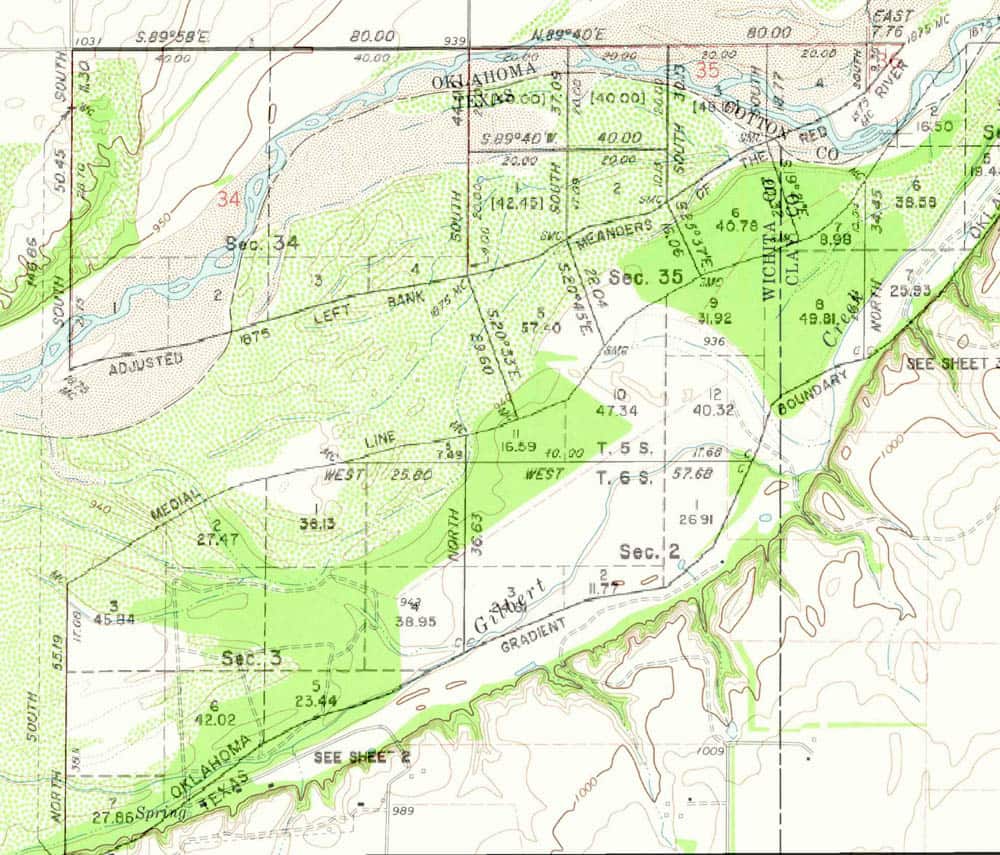
This reach of the Red River near Burkburnett should be one that was mapped by Arthur Stiles and his staff. So the topography of the river channel ca. 1923 would not be a likely subject for speculation. What is now Gilbert Creek could be a relict channel of the river. I wonder what historical aerial imagery exists for this locality.
Here's a link to the actual map that Mssrs. Kidder and Stiles made of the Big Bend of the Red River for submission to the Supreme Court in Oklahoma v. Texas
I took a part of the Kidder/Stiles topo map of a part of the Big Bend of the Red River near Burkburnett that I linked above and overlaid it on Burkburnett Quadrangle. As may be seen, the delineation of the Texas-Oklahoma boundary as represented on the quad sheet is essentially identical to that delineated on the Kidder/Stiles map.
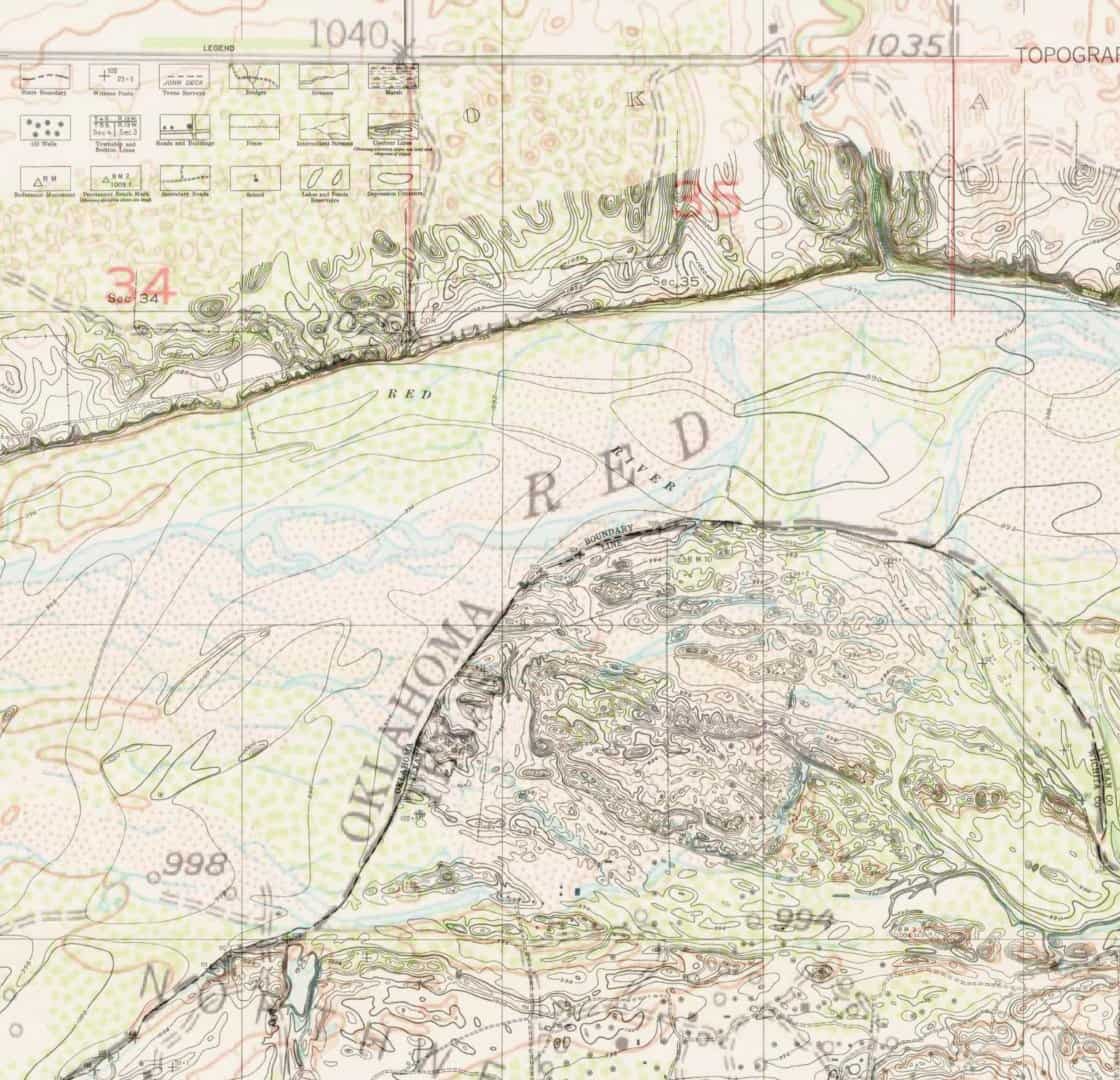
BTW, here is a link to the Third Report that the Boundary Commissioners, Kidder and Stiles made to the US Supreme Court in Oklahoma v. Texas. One thing that is particularly interesting about this report is the record of the public hearings that were held in various counties with the object of taking testimony about historical channels of the Red River to identify avulsiive changes. The summary of the results was that very few avulsions are described and in those few cases, both the testimony was nearly unanimous and was also supported by evidence on the ground.
http://www.glo.texas.gov/ncu/SCANDOCS/archives_webfiles/arcmaps/webfiles/arcmaps/pdfs/3//3061.pdf

Kent McMillan, post: 412156, member: 3 wrote: Yes to the provisions of the Red River Boundary Compact (linked below) regarding the adoption of the vegetation line as the boundary between Texas and Oklahoma which include the following:
(4) while the south bank, at any given time, may be located through expensive and time-consuming survey techniques, such surveys can, at best, identify the south bank only as it exists at the time of the survey;
(5) locating the south bank through survey techniques is of minimal aid when agencies of the party states must locate the state boundary line for law enforcement, administrative, and taxation purposes; and
(6) the interests of the party states are better served by establishing the boundary between the states through use of a readily identifiable natural landmark than through use of an artificial survey line.
(2) "Vegetation line" means the visually identifiable continuous line of vegetation that is adjacent to that portion of the riverbed kept practically bare of vegetation by the natural flow of the river and is continuous with the vegetation beyond the riverbed. Stray vegetation, patches of vegetation, or islands of vegetation within the riverbed that do not form such a line are not considered part of the vegetation line. Where the riverbed is entered by the inflow of another watercourse or is otherwise interrupted or disturbed by a man-made event, the line constituting the boundary is an artificial line formed by extending the vegetation line above and below the other watercourse or interrupted or disturbed area to connect and cross the watercourse or area.
(b) The permanent political boundary line between the states of Texas and Oklahoma along the Red River is the vegetation line along the south bank of the Red River except for the Texoma area, where the boundary does not change.
(g) Should there be a change in the watercourse of the Red River, the party states recognize the rules of accretion, erosion, and avulsion. The states agree that accretion or erosion may cause a change in the boundary between the states if it causes a change in the vegetation line. With regard to avulsion, the states agree that a change in the course of the Red River caused by an immediately perceivable natural event that changes the vegetation line will change the location of the boundary between the states.
http://www.statutes.legis.state.tx.us/Docs/NR/htm/NR.12.htmI don't think that the United States was involved in the Red River Boundary Compact. I think it was just a matter between Oklahoma and Texas. As a technical result, while it may have had the effect of fixing the state boundary at the vegetation line along the South bank of the Red River, it would not have affected the boundary of land in the bed of the Red River to which the United States retained title, either in its own name or in trust for certain Native American tribal groups.
It was approved by congress, but without relinquishing any federal claims of title. And the avulsion referred to is under the very broad Oklahoma rule, rather than the more restrictive Texas and Federal rule. But yeah, seems like a case ripe for a new rule specific to the problem.
Never mind.
Kent McMillan, post: 412237, member: 3 wrote: Hmm. It looks as if I didn't get the resurvey plat properly overlaid on the quad sheet. The misfit of topography only means that McMillan picked the wrong square on the checkerboard.
I just thought it was one of the areas where Stiles testified there was no evidence of avulse river movement. 😉
paden cash, post: 412240, member: 20 wrote: I just thought it was one of the areas where Stiles testified there was no evidence of avulse river movement. 😉
Actually, it is just downstream from McFarland Island. We'll have to see what Kidder and Stiles said about that since the "island" bit sounds like an avulsion.
Edit: Actually, Map No. 6 of the Third Report indicates that while there was an avulsion, it was limited to the area South of McFarland Island.
Kent McMillan, post: 412243, member: 3 wrote: Actually, it is just downstream from McFarland Island. We'll have to see what Kidder and Stiles said about that since the "island" bit sounds like an avulsion.
Although I only "scanned" the GLO notes you posted (did not read them in depth), there were at least a couple of cases where avulsion was involved. Funny thing..in every case Texas wound up with more land. I really didn't see a single case where Oklahoma made out with more area. This may also be due to the instructions under which Stiles was working. His map (page 82) of Pitts Bend and Allen Island made an appendage of Texas appear particularly (and possible physiologically) "intrusive" into Choctaw County, OK. I had to chuckle.
A modern map of the area appears as though the river returned more to its historic bed. I have not checked any Oklahoma records to see if Texas still claims the Pitts holdings as Stiles' map shows.
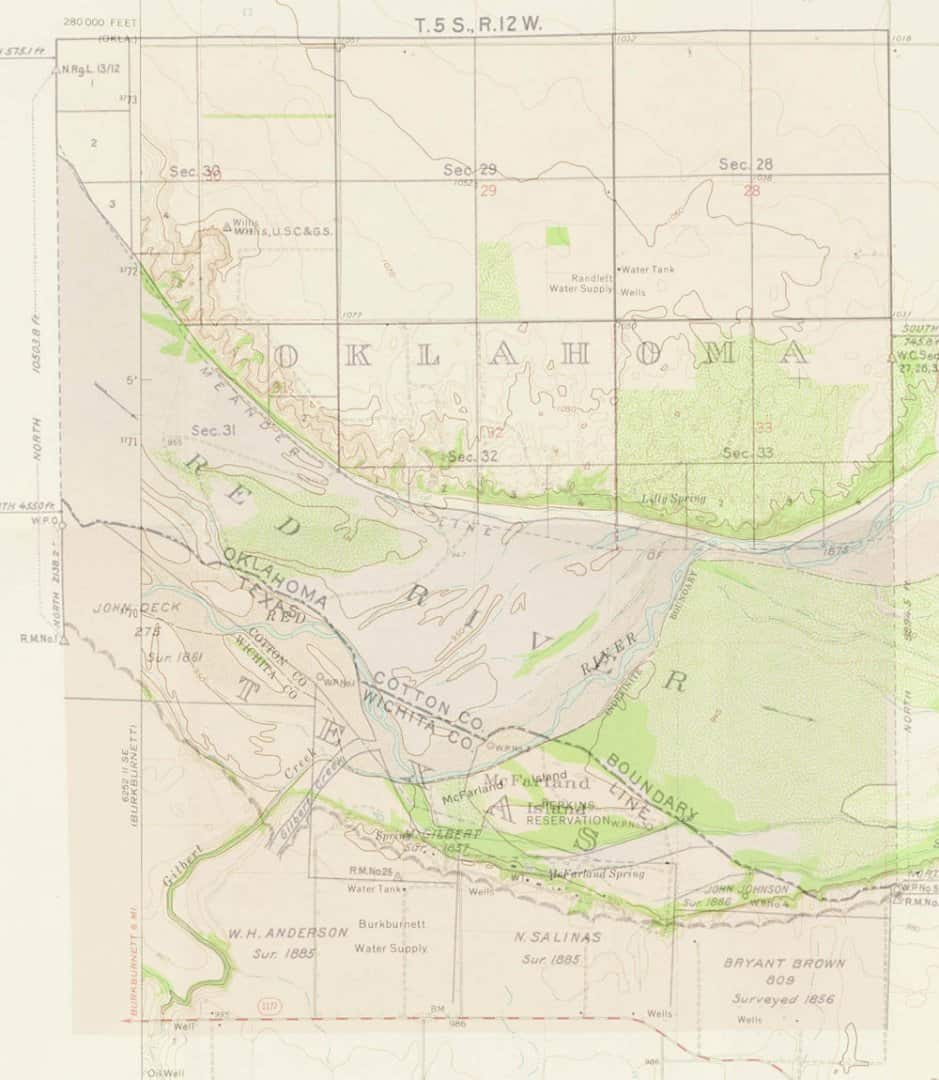
Here's what Map No. 6 from Kidder and Stiles' Third Report (linked above) looks like when overlaid on Thornberry, Tex quadrangle. Basically, it shows what appears to be the Kidder-Stiles location of the gradient boundary in about the same position as represented at the upstream end of the GLO resurvey plat.

Dave Karoly, post: 412203, member: 94 wrote: It's north of Wichita Falls, just east of the interstate.
That would be in the vicinity of Burkburnett.
paden cash, post: 412240, member: 20 wrote: I just thought it was one of the areas where Stiles testified there was no evidence of avulse river movement.
One of the features shown on the USGS map is that Gilbert Creek runs approximately parallel with the river, but in a back drain that is probably formed by accretions between the creek and the river. That would make me think that the gradient boundary is probably on the river side of the accretions. It would not make me think that the gradient boundary hadn't moved a whit since 1923 along that reach of the Red, however.

Has the BLM survey been protested?
Dave Karoly, post: 412381, member: 94 wrote: Has the BLM survey been protested?
I don't know, but I'm going to go out on a limb and guess that the gradient boundary along the South bank of the Red River really is quite a ways from the river's North bank and is thousands of feet South of the Texas-Oklahoma boundar delineated by some USGS maps.
The vicinity of McFarland Island covered by the map below that is an overlay of the 1923 Kidder-Stiles map of the Texas-Oklahoma boundary onto the USGS Thornberry, Tex Quadrangle shows the gigantic difference between the State boundary delineated on the quad sheet and labelled "Indefinite Boundary" and where the 1923 surveyors found the gradient boundary to be. This is immediately upstream from the area shown on the BLM plat that paden cash posted.
At the time Kidder and Stiles did their mapping, Gilbert Creek flowed right into the Red River, but by the time of the arial photography from which the quad sheet was compiled, the creek had returned to flowing along a channel formed between the bluff on the Texas side and an accretion bank between the bluff and the main channel of the Red River.
The delineation of the State boundary on the USGS map looks more obviously wrong than the BLM location of the gradient boundary which probably is much closer to the Texas bluff than as depicted on the quad sheet. My somewhat educated guess is that if the gradient boundary is indeed held to be the South boundary of the bed of the Red River owned by the United States, that a whole bunch of landowners on the Texas side are going to have to deal with the fact that they never owned any of the land North of the gradeient boundary.
Kent McMillan, post: 412403, member: 3 wrote: I don't know, but I'm going to go out on a limb and guess that the gradient boundary along the South bank of the Red River really is quite a ways from the river's North bank and is thousands of feet South of the Texas-Oklahoma boundar delineated by some USGS maps.
The vicinity of McFarland Island covered by the map below that is an overlay of the 1923 Kidder-Stiles map of the Texas-Oklahoma boundary onto the USGS Thornberry, Tex Quadrangle shows the gigantic difference between the State boundary delineated on the quad sheet and labelled "Indefinite Boundary" and where the 1923 surveyors found the gradient boundary to be. This is immediately upstream from the area shown on the BLM plat that paden cash posted.
At the time Kidder and Stiles did their mapping, Gilbert Creek flowed right into the Red River, but by the time of the arial photography from which the quad sheet was compiled, the creek had returned to flowing along a channel formed between the bluff on the Texas side and an accretion bank between the bluff and the main channel of the Red River.
The delineation of the State boundary on the USGS map looks more obviously wrong than the BLM location of the gradient boundary which probably is much closer to the Texas bluff than as depicted on the quad sheet. My somewhat educated guess is that if the gradient boundary is indeed held to be the South boundary of the bed of the Red River owned by the United States, that a whole bunch of landowners on the Texas side are going to have to deal with the fact that they never owned any of the land North of the gradeient boundary.
I'm reading the law review article.
Could you link the first and second reports?
Okay I've gotten about a third of the way through the law review article but we have to pick up the boy wonder (grandson). I have learned all I need is 1each professional topographer, professional hydroghapher, a level, and some 2x4s and stakes, simple.
Dave Karoly, post: 412433, member: 94 wrote: I'm reading the law review article.
Could you link the first and second reports?
This link will take you to the various reports that are in the holdings of the Texas GLO. The two maps filed as Wichita County Rolled Sketch 18 show both the triangulation net that controlled the mapping along one reach of the river as well as a larger picture of the width of the bed of the Red River (the distance between the gradient boundaries along the North and South banks::
http://www.glo.texas.gov/history/archives/map-store/index.cfm#search/0/Kidder
Kent McMillan, post: 412454, member: 3 wrote: This link will take you to the various reports that are in the holdings of the Texas GLO. The two maps filed as Wichita County Rolled Sketch 18 show both the triangulation net that controlled the mapping along one reach of the river as well as a larger picture of the width of the bed of the Red River (the distance between the gradient boundaries along the North and South banks::
http://www.glo.texas.gov/history/archives/map-store/index.cfm#search/0/Kidder
So the method involves finding the lowest qualified bank on either side of the river within a 5 or 6 mile stretch. Do the heights he established above the toe of the bank stay the same or do they keep shifting?
In other words, does a new survey involve reestablishing the mid bank height then staking the gradient or do you use his mid bank height to stake the gradient line?