

Compass Land Surveying by Henry Sipe
http://www.amazon.com/Compass-Land-Surveying-Henry-Sipe/dp/0870120840
Search BeerLeg for Warren Knight Sipe Sumner Compass.
DDSM:beer::beer:
(A smart owner would hire a Forester to manage his timber crop and a Land Surveyor to manage the boundaries...)

I am a land surveyor, but I spent my youth hanging out with timber cruisers, and started my career surveying with compass and clinometer, doing "rough and dirty" surveying of pipeline routes and petroleum distribution roads.
Here is my suggestion:
If you have a bit of money, pick up an iPad mini or similar sized tablet equipped with REAL gps, and download the "offline topo maps" app. This will show you your location on a usgs map. This will REALLY assist in locating section corners.
One trick for declination, is to use an adjacent roadway that is coincident with a section line and see how it compares to the map. Easy to stand in the middle of a road and sight a mile. Be aware that the differences you find may change from one township to the next (assuming you are using the original glo maps).
Oh, and if I were you, I would be very aware of ownership on both sides of the line, anf make it VERY clear to those above you that you approximated the described line.

Jerry,
First you have to understand that most of the surveyors on this site don't know much about the timber industry in Northwest (Prophet excluded).
Second you have to understand that most of the surveyors on this site have not used a compass very much.
You have already verified that you know there are times to call the surveyor out and get it done right, period.
So here is the scoop on what you want to do:
Set your compass as close as you can to the current declination for the local you are in.
Start at a known corner (say a section corner) and run & flag line at the bearing on the plat.
At the record distance, look for the quarter corner.
You will miss it by some amount.
Compute the bearing you would have to run to hit that corner, starting at the quarter corner run & flag the line back toward the section corner till your flag lines get close enough together and (feather them in) completing that line.
Return to the quarter corner, running & flagging the next line to the record distance.
Find the corner, measure the amount you missed, compute the new bearing and run & flag the line back to get the accuracy you need.
Don't continue to try to adjust your declination to match any of the bearings on the record maps.
Just run the lines, record your miss and record the bearing of that line, correct back and move ahead.
This works with a staff compass and it works with a hand compass.
Some hand compasses are hard to adjust and hard to read so the lines are not as accurate.
Over time you learn how to run a straight line with a compass if you are paying attention.
Straight lines can be run with a compass even with local attraction affecting the compass, you just have to learn how.
I remember one section breakdown with a compass down in St. Maries, Idaho that was difficult to say the least.
Now for the surveyors, this is an activity that has been done this way in the Northwest for forever.
We should try to understand that each of our areas have local practices, monuments, etc. that someone from outside the area doesn't get right off.
I know that most of you could not describe this procedure because you did not have the experience in running a compass so we will give you a pass on that.
We had one section breakdown that we hired a PLS to come in and set the corners a year after my compass survey.
He was so happy to have the lines brushed out!
He called me to report that not one temporary corner was off by more than a foot. He was amazed that our work was that good.
Anyway, happy compass surveying!!

Never could figure out how timber companies figure that they are making money leaving a strip of trees a mile long compared to paying for a survey.

Luke, I have done what you describe above. To flag an old survey. I did find 2 corners, near each other. Got my declination. Retraced the whole thing. It works.
N

Jerry,
I'm sure that this thread has answered a lot of your questions but one thing that I didn't see noted is the accuracy of your compass. Can you read it to the nearest minute? One minute of error equals about 0.1 feet at 200'. If you're one degree off, then that error is 3.5' at 200'.
It takes a great skill to run a line with a compass to a high degree of accuracy.
Dtp

Luke CO PLS, post: 370427, member: 1220 wrote:
This works with a staff compass and it works with a hand compass.
Some hand compasses are hard to adjust and hard to read so the lines are not as accurate.
Over time you learn how to run a straight line with a compass if you are paying attention.
Straight lines can be run with a compass even with local attraction affecting the compass, you just have to learn how.
Regarding a tool to look into using, check out one of the several Marine hand bearing compasses such as this one made by Weems and Plath:
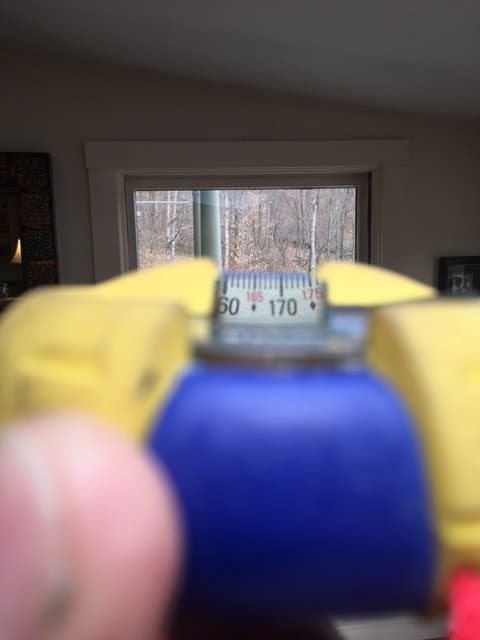
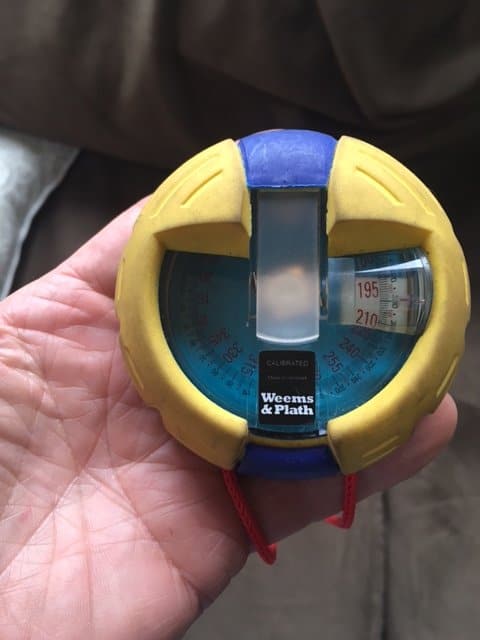
It may not be accurate to a minute, but the precision you gain by holding it up and sighting a line of flagging behind and ahead counts for a lot.
Also, because the compass "card" in these types of compasses is so low mass, local attraction rarely affects them unless you're standing over an engine block or something. They're very stable to use. The cards are viscously damped, for fast and easy use. I've never staked out logging tracts but trekked 10's of miles through dense woods mountain biking with one of these.
I'm surprised though, no one has mentioned two other essential tools that would make life easier: A good handheld GPS, and Google Earth Pro.
You take your plat, enter it into Google Earth using metes and bounds; record the approximate coordinates, export a gpx file to your handheld, and you pretty much have an additional data set to work with in the woods.
Having a GPS can also help with what can be as big a problem as azimuth when navigating in the woods: distance. It can be very deceiving sometimes. If you miss your corner, you can be dead on line but too far past.

Thanks for the info Luke Co.
I was a bit worried what I was doing was totally off. But you are correct this is standard practice. When you have timber companies that own 1 million acres things definitely get marked without a surveyor. I am glad you were able to read through the lines and see what I was getting at. So I am basically doing what you described. Down and back to the quarter corner...normally pretty close....then run back and if I was super close just tidy up and check on the way back.
I do have a question here. If say I ran from a corner and arrived at a 1/4 corner and I was 40 feet off at the bearing I ran..... what is the formula you can use to figure what the actual bearing should have been. To bring you dead on from one monument to the other? I am sure there is a simple way to figure this? It would be nice to use that corrected bearing when I go back and see if it is dead on!
Also the one thing I think people may not understand is the blazing out here. Now yes, anyone could be have cut a blaze, but I use a combination of my compass, blazes, and gps/aerial photo combo. The last being just a general guide. If the blazes are faced correctly to my compass line I am feeling pretty damn good. And they really do help as normally we are not clearing a line of sight through thickets and such. I do not know if blazes are as widespread in other parts of the country?
Thirdly I normally use just a suunto flat plate mirrored compass, which is alright but not the most precise things to see degrees on. I also just picked up a Brunton pocket transit for this current project. What is everyones thoughts on these? It definitely has a learning curve........but it does seem to help me be a bit more precise then the suunto where only every 2 degrees is marked. It is a markedly different compass to use then the flat plate mirrored style. I'm also curious about these marine hand compasses I do not quite get how they operate by the photos.
And lastly someone above mentioned a survey book......is that a good one or can someone mention a super basic book that would be handy for forestry/ real estate, fencing etc! Something in layman terms but something that may lay down some basic fundamentals. It would really help if it was tied into the PLSS as the vast majority of parcels we work in Montana are breakdowns of the original PLSS surveys, anywhere from 40 acres to 640 acres.
Now to answer a few questions! Why do companies leave these strips of timber for miles! Well please check the value (or lack thereof) of timber and the price a PLS gets for every mile they mark. They seem to love to come out and find corners and quarter corners (which we already have found) and then the price goes way up to actually mark the line totally with staking whereby a forester would not need to use a compass between points.
I would agree with several of you that the skill required to run a precise compass line over a mile of rugged terrain is high......all I can say is thank god for the blazes from he old boys!
I appreciate whoever mentioned the offline topo app. That is a handy bugger and more accurate on my phone/gps then the cadastral ownership overlays.
I would agree with several of you that the skill required to run a precise compass line over a mile of rugged terrain is high......all I can say is thank god for the blazes from he old boys!
I have blazed and painted a few miles of section lines in my youth. It wasn't uncommon to run across "cutting corners" set by timber cruisers (good ol' boys) back in the day....agreement lines that were blazed....multiple vintage blaze lines - maybe one goes to a cutting corner, the other to a corner set by single proportion method - then maybe a third blaze line that goes to a corner set by proper retracement methods.
I would not advocate calculating boundaries from deeds and survey plats -> georeferencing in Google Earth ->"staking" via. GPS. Can it be a useful "tool"? Absolutely. However, it is also a good way to get yourself in trouble.
Speaking of Google Earth, some of the mistakes I have seen caused by timber cruisers flagging between "corners" could be seen by space. The old moss covered rock mounds (cutting corners) created a nice 1 mile section (verified with a hip chain and matching the USGS quad map )...too bad the actual section was 500' short of a mile...oops. Those were always interesting surveys...I remember thinking "those guys are going to freak out when they see where the boundary really is"....or..."Good thing we marked this line before they cut those trees"....or..."Those 4 large ponderosa pine trees probably just paid for the survey, I don't know why they are complaining about the price of the survey"
You cannot even imagine how many miles of flagged compass lines I have gotten to compare to actual surveyed lines. Lets just say there has been lots of snickering and head shaking. Luckily most timber companies are good neighbors to each other. Horse trading timber to resolve conflicts is not uncommon.

Surveyors often run extremely accurate instruments today to retrace an original line. But we almost never use that accurately-run line to establish the corners. We get to where we think a corner should be and we search, search, and search some more to try to find original evidence of where the corner was originally set. We go to great extreme to find original evidence. We would search for bearing trees, the blazed lines, evidence of mounds of stones that might have held the original mark.
We have found corners many feet from where we expect to find them, and if we were running a compass, we would have even a greater error search area. So, yes, a swinging compass needle subject to magnetic pull and not so great sighting ability, can definitely put you way off of the original surveyor's swinging compass needle.
Not sure, but I hope that helps. (and don't be offended about some of us saying that novices shouldn't be practicing land surveying. We have seen the problems that some owners have created because they thought they knew. It's not different than an electrician saying you might get hurt if you do your own wiring, or similar relative issues).

Jerry Fallon, post: 370674, member: 11650 wrote: Thanks for the info Luke Co.
I was a bit worried what I was doing was totally off. But you are correct this is standard practice. When you have timber companies that own 1 million acres things definitely get marked without a surveyor. I am glad you were able to read through the lines and see what I was getting at. So I am basically doing what you described. Down and back to the quarter corner...normally pretty close....then run back and if I was super close just tidy up and check on the way back.
I do have a question here. If say I ran from a corner and arrived at a 1/4 corner and I was 40 feet off at the bearing I ran..... what is the formula you can use to figure what the actual bearing should have been. To bring you dead on from one monument to the other? I am sure there is a simple way to figure this? It would be nice to use that corrected bearing when I go back and see if it is dead on!
Also the one thing I think people may not understand is the blazing out here. Now yes, anyone could be have cut a blaze, but I use a combination of my compass, blazes, and gps/aerial photo combo. The last being just a general guide. If the blazes are faced correctly to my compass line I am feeling pretty damn good. And they really do help as normally we are not clearing a line of sight through thickets and such. I do not know if blazes are as widespread in other parts of the country?
Thirdly I normally use just a suunto flat plate mirrored compass, which is alright but not the most precise things to see degrees on. I also just picked up a Brunton pocket transit for this current project. What is everyones thoughts on these? It definitely has a learning curve........but it does seem to help me be a bit more precise then the suunto where only every 2 degrees is marked. It is a markedly different compass to use then the flat plate mirrored style. I'm also curious about these marine hand compasses I do not quite get how they operate by the photos.
And lastly someone above mentioned a survey book......is that a good one or can someone mention a super basic book that would be handy for forestry/ real estate, fencing etc! Something in layman terms but something that may lay down some basic fundamentals. It would really help if it was tied into the PLSS as the vast majority of parcels we work in Montana are breakdowns of the original PLSS surveys, anywhere from 40 acres to 640 acres.
40/2640=sin of angle from the bearing you ran=00-52. If you are using a pocket compass then make it one degree.
With a staff compass about 10' is possible. So you would think you would be way off after a mile but the errors tend to cancel. A foot or two in a half mile is very possible with ordinary skill. The other thing I have found...it's more accurate to do more shorter sights rather than trying to extend it, especially in thick brush. I found this from experience. If it's thick just go 40 or 50' at a time. This way you have more chances to eyeball back over your line checking for blunders.
I take my vest off at each setup and my belt has a plastic buckle.
Staff compass is the best way to do it.