

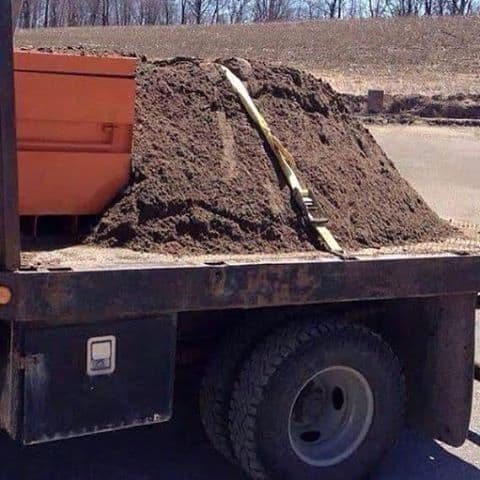
Engineers are a bit like this truck driver... get tied up with compliance.
RADU

Bradl, post: 338524, member: 2848 wrote: It also depends on how the specs are written and if there is tolerance for acceptance. We make sure the contractor's dirt is within hundredths.
I may not work with lots as described in the original post, but 15% of the sub, CAB, CTB to HMA in one lot (one days production not to exceed 2,400sy), cannot exceed 0.04' of the approved design elevation or it must be fixed and no skin patching allowed. Within that lot (2400sy) if one elevation is +/- 0.06' from design elevation, that lot must be corrected. If they are fat on CTB and have to mill the HMA, they better have the required thickness or big sections come out at the contractor's cost.
Some of those are words I recognize...

Good one Radu!! Aloha

There are varying grade tolerances the contractor is held to at each stage of construction.
Can't hold the contractor to .04' when you only stake it to the nearest .10'
The grade tolerances get tighter as you approach finish grade.
It is very easy to grade a roadway within .04' of design grade (even though some contractors make it look difficult).
When large cuts are involved, the slope stakes are labeled to the nearest .1', then additional stakes are set to the nearest .01' once you are closer to grade.
If the initial grade stakes will remain throughout construction, they are staked to the nearest .01' so they can be used to check final grade.

If trying to grade to the hundredth prevents even one "birdbath" somewhere, I'm all for it.

They have their software set to show dimensions to 2 decimal places.
I still find new deeds where the acreage is quoted to 4 decimal places for land in the middle of nowhere rural backwater America.
It is a cad thing..............

FL/GA PLS., post: 338436, member: 379 wrote: Can anyone explain to me why Civil Engineers show proposed lot grades in a ÛÏnormalÛ subdivision to the hundredth? :-S
IÛªve yet to meet a grader operator that can grade a lot to a hundredth of a foot.
Well, can anyone explain why surveyors show ground elevations in dirt areas to the nearest 0.01'? All our range pole points (even the dull ones) seem to sink into dirt to some extent...

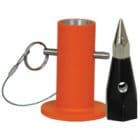
Get a Topo Shoe for the rod. I rarely put the point on the rod anymore unless I'm doing boundary work.

Jim in AZ, post: 341385, member: 249 wrote: Well, can anyone explain why surveyors show ground elevations in dirt areas to the nearest 0.01'? All our range pole points (even the dull ones) seem to sink into dirt to some extent...
I was just reviewing some survey drawings where they annotated the acreage to the 0.01 square foot and double annotated it in acres to the hundredth of an acre. One is super-minutiae and the other is to, like, the nearest 53 square feet.
I am one of the ones guilty of often going to the hundredth of a foot in distances even if it is beyond the precision of the work, as well as always going to the nearest second of arc. I just can't see taking a number in front of me and rounding. However, I won't go to the thousandth of a foot or the decimal-second, as that would be nuts. It's kind of like that adage "every one driving slower than you is a slow Ba@#$%d and every one driving faster than you is a crazy SOB." (George Carlin actually I believe) I like to publish just one step more precise than my actual precision, so that reproducing or running math on my numbers doesn't introduce growing rounding errors.

vern, post: 341386, member: 3436 wrote: Get a Topo Shoe for the rod. I rarely put the point on the rod anymore unless I'm doing boundary work.
What Vern said:
0.001AC = 43.56sf....I said 53 above - typo.

FL/GA PLS., post: 341464, member: 379 wrote: What Vern said:
How do you shoot a gutter flow line?

A plastic rebar cap on the end of the rod works as well, can even let a couple 100ths of the rod tip through for when you want to tie something with the rod.

A Harris, post: 341384, member: 81 wrote: They have their software set to show dimensions to 2 decimal places.
I still find new deeds where the acreage is quoted to 4 decimal places for land in the middle of nowhere rural backwater America.
It is a cad thing..............
Oh, come on. Don't you know that design happens in the computer, and it carries 25 significant digits. I mean, only showing the hundredths is really truncating the number. [;>
I have recently been asked by a reviewer to show pipe slopes and flow line elevations to 3 decimal places. It works great in the calculator.
It does take at least 3 decimal places to obtain minimal results.
And yes, internally within your own machine as you plan and draw and compute, things are being kept to 27 decimal places, so as long as you are still in the drawing everything works fine.
The problem occurs when coords are downloaded or uploaded with a setting of keeping only two or less decimal places, as many do without knowing it.
When the data with 2 or less decimal places are downloaded into the crew's data collector and they go out and try to stake to a line that has deficient depth of control, bad things occur and bad results are brought back into the office to be downloaded and replacing the original defined data.
You get a corrupted data file..........:'(

That's what I'd say. Water to drain needs to run down hill. Maybe they can't grade a parking lot better than a tenth but they can do better with concrete. What if you want 0.25 feet per hundred feet drop and the breaks don't hit tenths. You need to design it to work whether they build it that way or not.

Paul in PA, post: 338557, member: 236 wrote: If someone where to lay out paving stakes on a highway to the nearest tenth, your teeth would be rattling as you drove along that new pavement.
Or hitting sheet flow at posted highway speeds, seems like they would catch things like that in the design phase. There's times when I believe the old roads being replaced, were constructed (warts and all) better than their replacement.
R.J. Schneider, post: 343266, member: 409 wrote: Or hitting sheet flow at posted highway speeds
sorry, meant a channeled sheet flow (if the is such a term) which concentrates in one area.

thebionicman, post: 338502, member: 8136 wrote: I've known my fair share of Engineers over the years. I have yet to meet one who believed that operators could get tighter than 0.1' with dirt. If they were as dumb as some here imply we would be living in third world conditions...
Well said.
What the starter of the main thread seems to be questioning is really not an issue of significant figures or precision calculation. It is simply how accurate a set of drawings shows the design position of something. Why should it bother someone that a plan sheet shows a design grade to the nearest hundredth?
I don't think I have ever set or seen a surveyor set finish subgrade bluetops to the nearest tenth. Wouldn't setting them to the nearest tenth of a foot mean that the surveyor had 0.05' of leeway plus or minus? In flat country that is way too much in many cases. I have always seen earthwork bluetops set to the nearest hundredth.
The real bottom line is whether the engineer requires in the specs that the final grade has to be to nearest tenth or not. The plan grade is a target grade, and any practicing engineer knows that a tolerance in earthwork is acceptable.
The coords PCs and PT of curves are usually shown to 0.01. I imagine that the vast majority of them are not constructed to that accuracy either. And on most RTK surveys, the boundary surveys show distances to nearest 0.01 feet as well, and RTK is certainly not that accurate.
What is the beef?
ÛÏWhy should it bother someone that a plan sheet shows a design grade to the nearest hundredth?Û
ItÛªs not bothering me, I simply asked a specific question about lot corner grades.
And now I understand why thanks to many responses.
ÛÏWhat is the beef?Û
None at all.
Simply amused by the Engineers that go off tangent and start lecturing about grading highways, roadways, etc., when I was curious about Lot Grading plans.