Reading RPLS is free for the whole profession. Members post, reply, and get the members-only rooms.

Notifications
Clear all

Topic starter
Translate
▼
English
Spanish
French
German
Italian
Portuguese
Russian
Chinese
Japanese
Korean
Arabic
Hindi
Dutch
Polish
Turkish
Vietnamese
Thai
Swedish
Danish
Finnish
Norwegian
Czech
Hungarian
Romanian
Greek
Hebrew
Indonesian
Malay
Ukrainian
Bulgarian
Croatian
Slovak
Slovenian
Serbian
Lithuanian
Latvian
Estonian
I'm making some good progress, troubleshooting some errant traverses done this past spring. For orientation and location, I've used, as a "base line", a survey done by an LS. It consists of a line, entered manually (not surveyed), as S31-02-39W, 1690.83'.
But, in a recent check, an inverse between the two endpoints of the line shows the right distance, but a different bearing (S31-02-13W).
See here:
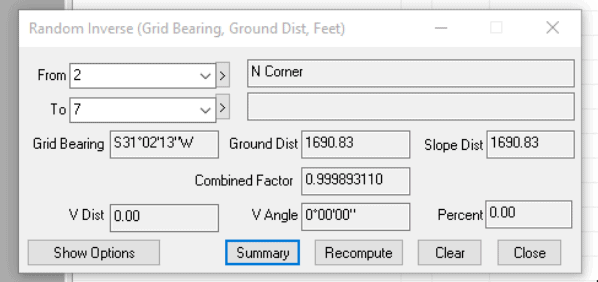
I believe when I manually entered the traverse, I started point 2 at 5000,5000,1000, then I translated it to the appropriate local coordinate (428377.983, 1618500.069). Below is the projection information I'm using for the survey: (I'm still very confused about the difference between the "Scale Factor", shown below, and the "Combined Factor", shown above, but that's for another thread (or a re-read of the multitudes of threads on the subject)).
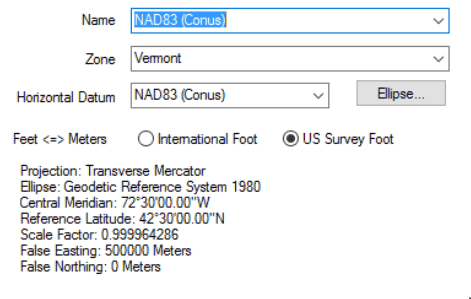
For now, though, the question is this:
Why does the inverse show a different bearing than what I entered? Is it a function of the scale factors applied to all such bearings (the so called "ground to grid" thing). Or is it possible that it happened when I translated the survey from 5000, 5000, 1000 to the current location? I could probably try to re-trace my steps and find out, but thought this might be a dead easy one for the pros to help with. Thanks in advance.
Posted : August 4, 2015 11:54 am

Translate
▼
English
Spanish
French
German
Italian
Portuguese
Russian
Chinese
Japanese
Korean
Arabic
Hindi
Dutch
Polish
Turkish
Vietnamese
Thai
Swedish
Danish
Finnish
Norwegian
Czech
Hungarian
Romanian
Greek
Hebrew
Indonesian
Malay
Ukrainian
Bulgarian
Croatian
Slovak
Slovenian
Serbian
Lithuanian
Latvian
Estonian
WOW...not nearly enough information to answer your question.
IF (BIG IF) you have "setup" your traverse in Vermont SPC correctly, AND you have input [at least] TWO traverse stations with accurate Vermont SPC Coordinates...AND [reasonably] "accurate" NAVD88 "elevations" (or NAD83 Ellipsoid Heights)... Bear in Mind that NAD83 SPC "elevations factors" are a function of ellipsoid height, so unless you have a Geoid Model in the mix, you should be using Ellipsoid Heights, NOT "elevations" (although the difference may very well be trivial for your purposes).
OR one accurate Vermont SPC (pt.2?) AND an accurate Vermont SPC Grid Bearing...(to either the backsight or along the first "leg" of your traverse)
AND...have entered your traverse data (horizontal and vertical) correctly...
AND your Software is working (setup) properly...
THEN...
The "combined scale factor" SHOULD BE [somewhat] unique for each "leg" of your traverse.
The SPC Scale Factor (.999 964 286) is only valid along the Central Meridian, it will vary either side thereof, depending on how far East or West of the Central Meridian you are (and EACH traverse station or "leg" IS).
The "combined scale factor" for any "leg" is a function of the "grid" scale factor at each end of the "leg" AND the mean elevation/height of said "leg" (unless you SET/FORCE a singular value).
Now obviously most Software will allow you to SELECT a "project CAF" (will makes some sense in many cases), BUT if you are really trying to compute this traverse in a rigorous fashion, then you need to play the whole game (Horizontal AND Vertical).
I'll no doubt catch a bunch of crap about "close enough, ain't no mountains here, too complicated, whatever... But if you are trying to learn what all of this SPC/UTM/LDP "projection stuff" is all about, I think it's best to just jump right in, and play the WHOLE game.
just my two bits,
Loyal
Posted : August 4, 2015 12:32 pm
Translate
▼
English
Spanish
French
German
Italian
Portuguese
Russian
Chinese
Japanese
Korean
Arabic
Hindi
Dutch
Polish
Turkish
Vietnamese
Thai
Swedish
Danish
Finnish
Norwegian
Czech
Hungarian
Romanian
Greek
Hebrew
Indonesian
Malay
Ukrainian
Bulgarian
Croatian
Slovak
Slovenian
Serbian
Lithuanian
Latvian
Estonian
About the "bearing" issue...
If the "input bearing" (S31-02-39W) is NOT a Vermont SPC GRID bearing, AND you have [somehow] "rotated" your Traverse to align with the Vermont SPC Grid, then of course the bearings will be different.
THIS is important...you MUST align YOUR bearings with the Vermont Grid, if you hope to compute Vermont Grid Coordinates.
Loyal
Posted : August 4, 2015 12:42 pm

Translate
▼
English
Spanish
French
German
Italian
Portuguese
Russian
Chinese
Japanese
Korean
Arabic
Hindi
Dutch
Polish
Turkish
Vietnamese
Thai
Swedish
Danish
Finnish
Norwegian
Czech
Hungarian
Romanian
Greek
Hebrew
Indonesian
Malay
Ukrainian
Bulgarian
Croatian
Slovak
Slovenian
Serbian
Lithuanian
Latvian
Estonian
S31-02-39W, 1690.83'
(S31-02-13W)
You are trying way to hard. KISS
Most boundary work in your area is NOT performed on Grid, and you are not using GPS or True Grid coordinates. There is NO reason for you have a SCALE FACTOR. Infact you may be introducing error, since you use an EDM you already measure ground distances. No need to scale it. Plus I presume your original survey was also in ground distances.
But to answer your questions. This likely is not the only factor in your slight differences in the bearings. It could be attributed to lack of significant digits in your computations. In order carry bearings out the the second, you will want atleast 5 decimal places carried in your computations.
Posted : August 4, 2015 1:08 pm

Translate
▼
English
Spanish
French
German
Italian
Portuguese
Russian
Chinese
Japanese
Korean
Arabic
Hindi
Dutch
Polish
Turkish
Vietnamese
Thai
Swedish
Danish
Finnish
Norwegian
Czech
Hungarian
Romanian
Greek
Hebrew
Indonesian
Malay
Ukrainian
Bulgarian
Croatian
Slovak
Slovenian
Serbian
Lithuanian
Latvian
Estonian
Well, grasshopper, you definitely need to share more information. If you did not rotate, or go through an adjustment, you should get the exact same bearing you entered. Obviously you need to share some things. How much difference is your entered bearing vs. your inversed bearing. You may have to master exactly what you are doing with the software you are using. What is your software?
Posted : August 4, 2015 1:34 pm
Topic starter
Translate
▼
English
Spanish
French
German
Italian
Portuguese
Russian
Chinese
Japanese
Korean
Arabic
Hindi
Dutch
Polish
Turkish
Vietnamese
Thai
Swedish
Danish
Finnish
Norwegian
Czech
Hungarian
Romanian
Greek
Hebrew
Indonesian
Malay
Ukrainian
Bulgarian
Croatian
Slovak
Slovenian
Serbian
Lithuanian
Latvian
Estonian
leegreen, post: 330445, member: 2332 wrote: S31-02-39W, 1690.83'
(S31-02-13W)You are trying way to hard. KISS
Most boundary work in your area is NOT performed on Grid, and you are not using GPS or True Grid coordinates. There is NO reason for you have a SCALE FACTOR. Infact you may be introducing error, since you use an EDM you already measure ground distances. No need to scale it. Plus I presume your original survey was also in ground distances.
But to answer your questions. This likely is not the only factor in your slight differences in the bearings. It could be attributed to lack of significant digits in your computations. In order carry bearings out the the second, you will want atleast 5 decimal places carried in your computations.
A clarification:
The line in question is not something I surveyed using EDM. It was input manually (not as coordinates, but as bearing and distance, directly from the original survey). I've entered all the points at 1000' elevation. That survey says:
"Bearings shown on this plat refer to Vermont Grid North as established by OPUS observations using Topcon Hyperlite+ GPS receivers. Convergence = -0-03'."
I'm surveying NOT using GPS, but a total station. I'm using this baseline as reference only, and understand that as long as I start at one end and end at the other (or pick points up in between), it doesn't really matter How the baseline is oriented in space.
But I was curious about the survey I entered manually. I actually entered another one as well...nearly the same azimuth (S30-31W) and that one is off by 27". This one is off by 26", so I think the projection is "causing" the differences I'm seeing.
Posted : August 4, 2015 1:50 pm
Topic starter
Translate
▼
English
Spanish
French
German
Italian
Portuguese
Russian
Chinese
Japanese
Korean
Arabic
Hindi
Dutch
Polish
Turkish
Vietnamese
Thai
Swedish
Danish
Finnish
Norwegian
Czech
Hungarian
Romanian
Greek
Hebrew
Indonesian
Malay
Ukrainian
Bulgarian
Croatian
Slovak
Slovenian
Serbian
Lithuanian
Latvian
Estonian
Loyal, post: 330439, member: 228 wrote:
OR one accurate Vermont SPC (pt.2?) AND an accurate Vermont SPC Grid Bearing...(to either the backsight or along the first "leg" of your traverse)AND...have entered your traverse data (horizontal and vertical) correctly...
THEN...
The "combined scale factor" SHOULD BE [somewhat] unique for each "leg" of your traverse.
The SPC Scale Factor (.999 964 286) is only valid along the Central Meridian, it will vary either side thereof, depending on how far East or West of the Central Meridian you are (and EACH traverse station or "leg" IS).
The "combined scale factor" for any "leg" is a function of the "grid" scale factor at each end of the "leg" AND the mean elevation/height of said "leg" (unless you SET/FORCE a singular value).
This is what I did, except I entered the survey "flat"...at 1000'. I could put in fairly accurate elevations, if that would make a difference.
I'll no doubt catch a bunch of crap about "close enough, ain't no mountains here, too complicated, whatever... But if you are trying to learn what all of this SPC/UTM/LDP "projection stuff" is all about, I think it's best to just jump right in, and play the WHOLE game.
That's exactly what I'm trying to do (learn). I've got a long way to go on the "close enough" thing.:-)
Posted : August 4, 2015 1:59 pm

Translate
▼
English
Spanish
French
German
Italian
Portuguese
Russian
Chinese
Japanese
Korean
Arabic
Hindi
Dutch
Polish
Turkish
Vietnamese
Thai
Swedish
Danish
Finnish
Norwegian
Czech
Hungarian
Romanian
Greek
Hebrew
Indonesian
Malay
Ukrainian
Bulgarian
Croatian
Slovak
Slovenian
Serbian
Lithuanian
Latvian
Estonian
rfc, post: 330433, member: 8882 wrote: I'm making some good progress, troubleshooting some errant traverses done this past spring. For orientation and location, I've used, as a "base line", a survey done by an LS. It consists of a line, entered manually (not surveyed), as S31-02-39W, 1690.83'.
But, in a recent check, an inverse between the two endpoints of the line shows the right distance, but a different bearing (S31-02-13W).
See here:
I believe when I manually entered the traverse, I started point 2 at 5000,5000,1000, then I translated it to the appropriate local coordinate (428377.983, 1618500.069). Below is the projection information I'm using for the survey: (I'm still very confused about the difference between the "Scale Factor", shown below, and the "Combined Factor", shown above, but that's for another thread (or a re-read of the multitudes of threads on the subject)).
For now, though, the question is this:
Why does the inverse show a different bearing than what I entered? Is it a function of the scale factors applied to all such bearings (the so called "ground to grid" thing). Or is it possible that it happened when I translated the survey from 5000, 5000, 1000 to the current location? I could probably try to re-trace my steps and find out, but thought this might be a dead easy one for the pros to help with. Thanks in advance.
The reason is because there is a computation error with the coordinates on point 7.
Because this is the basis line then the coordinates are only a function of the bearing and distance, it has nothing to do with projections.
The vector (bearing) and distance will create the coordinate at point 7, if the inverse doesn't match then the coordinate is simply wrong, the first thing is to calculate the correct coordinate at point 7, then proceed with everything else from there.
As far as being on the grid, who knows if you are, that will be a survey issue, but any calculations done will think it's on the grid, even if you are a million feet from where the coordinates say, even if you are rotated 5 or 10 degrees.
Posted : August 4, 2015 2:09 pm
Topic starter
Translate
▼
English
Spanish
French
German
Italian
Portuguese
Russian
Chinese
Japanese
Korean
Arabic
Hindi
Dutch
Polish
Turkish
Vietnamese
Thai
Swedish
Danish
Finnish
Norwegian
Czech
Hungarian
Romanian
Greek
Hebrew
Indonesian
Malay
Ukrainian
Bulgarian
Croatian
Slovak
Slovenian
Serbian
Lithuanian
Latvian
Estonian
Tom Adams, post: 330447, member: 7285 wrote: Well, grasshopper, you definitely need to share more information. If you did not rotate, or go through an adjustment, you should get the exact same bearing you entered. Obviously you need to share some things. How much difference is your entered bearing vs. your inversed bearing. You may have to master exactly what you are doing with the software you are using. What is your software?
I didn't rotate it. I thought I published what I entered (S31-02-39W) with what I inverse (S31-02-13), a difference of 26". I'm using TraversePC (which I understand not many folks here like or use). Now that I'm thinking about it, I'm not sure how an inverse could be any different as a result of the scale factor, but I can find out if the software is doing something it's not.
Perhaps I can reset the scale factor back to 1.0 (get off the SPC grid), do an inverse between the two points, and see what happens.
Posted : August 4, 2015 2:11 pm
Translate
▼
English
Spanish
French
German
Italian
Portuguese
Russian
Chinese
Japanese
Korean
Arabic
Hindi
Dutch
Polish
Turkish
Vietnamese
Thai
Swedish
Danish
Finnish
Norwegian
Czech
Hungarian
Romanian
Greek
Hebrew
Indonesian
Malay
Ukrainian
Bulgarian
Croatian
Slovak
Slovenian
Serbian
Lithuanian
Latvian
Estonian
rfc, post: 330450, member: 8882 wrote: I could put in fairly accurate elevations, if that would make a difference.
It would make a difference, BUT it may be (and probably IS) a trivial consideration. Basically, any "error" in the Ellipsoid Height of your Traverse stations DOES carry over into the "combined factor" (~21 feet of height = ~1ppm).
Computing State Plane (or UTM/LDP) Coordinates from a Total Station Traverse IS a 3d proposition. Now obviously a "short leg" traverse across reasonably flat terrain, can be done (computed) without worrying too much about height variances, but THAT is something that one does AFTER one has achieved a reasonable understanding of the basic geometry of the underlying process.
I think that it's great that you are digging into the nut-n-bolts of all of this, too bad more folks don't take the time to understand what all of the buttons [actually] DO.
Loyal
Posted : August 4, 2015 2:13 pm
Topic starter
Translate
▼
English
Spanish
French
German
Italian
Portuguese
Russian
Chinese
Japanese
Korean
Arabic
Hindi
Dutch
Polish
Turkish
Vietnamese
Thai
Swedish
Danish
Finnish
Norwegian
Czech
Hungarian
Romanian
Greek
Hebrew
Indonesian
Malay
Ukrainian
Bulgarian
Croatian
Slovak
Slovenian
Serbian
Lithuanian
Latvian
Estonian
rfc, post: 330455, member: 8882 wrote:
I'm not sure how an inverse could be any different as a result of the scale factor, but I can find out if the software is doing something it's not.
Meant to say I can find out if the software is doing something it shouldn't be doing.
Posted : August 4, 2015 2:23 pm
Translate
▼
English
Spanish
French
German
Italian
Portuguese
Russian
Chinese
Japanese
Korean
Arabic
Hindi
Dutch
Polish
Turkish
Vietnamese
Thai
Swedish
Danish
Finnish
Norwegian
Czech
Hungarian
Romanian
Greek
Hebrew
Indonesian
Malay
Ukrainian
Bulgarian
Croatian
Slovak
Slovenian
Serbian
Lithuanian
Latvian
Estonian
rfc, post: 330449, member: 8882 wrote: A clarification:
The line in question is not something I surveyed using EDM. It was input manually (not as coordinates, but as bearing and distance, directly from the original survey). I've entered all the points at 1000' elevation. That survey says:"Bearings shown on this plat refer to Vermont Grid North as established by OPUS observations using Topcon Hyperlite+ GPS receivers. Convergence = -0-03'."
I'm surveying NOT using GPS, but a total station. I'm using this baseline as reference only, and understand that as long as I start at one end and end at the other (or pick points up in between), it doesn't really matter How the baseline is oriented in space.
But I was curious about the survey I entered manually. I actually entered another one as well...nearly the same azimuth (S30-31W) and that one is off by 27". This one is off by 26", so I think the projection is "causing" the differences I'm seeing.
If all bearings are off the same amount, regardless of distance. Then it sounds like a rotation needs to be applied.
Posted : August 4, 2015 3:09 pm
Translate
▼
English
Spanish
French
German
Italian
Portuguese
Russian
Chinese
Japanese
Korean
Arabic
Hindi
Dutch
Polish
Turkish
Vietnamese
Thai
Swedish
Danish
Finnish
Norwegian
Czech
Hungarian
Romanian
Greek
Hebrew
Indonesian
Malay
Ukrainian
Bulgarian
Croatian
Slovak
Slovenian
Serbian
Lithuanian
Latvian
Estonian
leegreen has a good point, all all of the bearing inverses off, and are they all off the same 26"? That can narrow down what might have happened. Can you review what you input in that software? If so, make sure you didn't have a typo in inputting that bearing. You are correct that you wouldn't have a bearing change if you just applied a scale factor. Out of curiosity, what is the convergence angle at that point from grid to true north?
Posted : August 5, 2015 7:56 am
Translate
▼
English
Spanish
French
German
Italian
Portuguese
Russian
Chinese
Japanese
Korean
Arabic
Hindi
Dutch
Polish
Turkish
Vietnamese
Thai
Swedish
Danish
Finnish
Norwegian
Czech
Hungarian
Romanian
Greek
Hebrew
Indonesian
Malay
Ukrainian
Bulgarian
Croatian
Slovak
Slovenian
Serbian
Lithuanian
Latvian
Estonian
Lee and Tom are spot on, something is hinky with the bearings.
For Tom (ASSUMING the coordinates rfc posted are Vermont SPC):
===========================================================
  North(Meters)	 East(Meters)	 Datum	 Zone
INPUT =  130569.8704	   493319.8077	  NAD83	 4400
===========================================================
LATITUDE		 LONGITUDE		 AREA	CONVERGENCE	  SCALE FACTOR
DD MM SS.sssss   DDD MM SS.sssss		   DD MM SS.ss
--------------   ---------------   ----	-----------	  ------------
43 40 31.14140   072 34 58.22506   VT	  -0  3 25.95	  0.9999648
Loyal
Posted : August 5, 2015 8:29 am
Topic starter
Translate
▼
English
Spanish
French
German
Italian
Portuguese
Russian
Chinese
Japanese
Korean
Arabic
Hindi
Dutch
Polish
Turkish
Vietnamese
Thai
Swedish
Danish
Finnish
Norwegian
Czech
Hungarian
Romanian
Greek
Hebrew
Indonesian
Malay
Ukrainian
Bulgarian
Croatian
Slovak
Slovenian
Serbian
Lithuanian
Latvian
Estonian
Tom Adams, post: 330553, member: 7285 wrote: leegreen has a good point, all all of the bearing inverses off, and are they all off the same 26"? That can narrow down what might have happened. Can you review what you input in that software? If so, make sure you didn't have a typo in inputting that bearing. You are correct that you wouldn't have a bearing change if you just applied a scale factor. Out of curiosity, what is the convergence angle at that point from grid to true north?
The convergence at Point 2 is -03-25". At Point 7 it's -03-33".
As for the bearings all being off the same? They are not! I tried inversing from each point on the traverse to the next one...2 to 11, 11 to 31, 31 to 14, 14 to 7. Sure enough, I found errant coordinates for point 11 (the first along the way).
Here's what (I think) happened: I entered the survey, intending it to be a base line...a "yard stick" that I could use to check my work. But I neglected to hold it all...to protect the coordinates from moving. I subsequently took a side shot, or used one of the points as an occupied point, and I believe that, because that point was not protected, it proceeded to re-calculate the coordinates of the point.
I unprotected the points in question, made sure all of the projection information was correct, re entered the data, then protected the points' coordinates and the inverses match perfectly.
I think what this grasshopper has learned is:
1. Moving from local coordinates to an SPC projection can (and will) change distances and bearings. In this case, with distances so small (less than 2000'), the differences would be much smaller than the 26".
2. The first conclusion to jump to is not the above, but that I might have made a mistake in my work.
Earlier on, Loyal hit the nail on the head when he said:
"AND...have entered your traverse data (horizontal and vertical) correctly..."
Mighty Moe got it right too:
"...if the inverse doesn't match then the coordinate is simply wrong..."
:-$:-$:-$:-$:-$
Posted : August 5, 2015 8:38 am