

Does it really make that much of a difference whether it's inside or outside diameter when the corner is marked with 8" well casing pipe sticking up 5'? Yes. I had one of those last summer. The original plat called for a hub and tack.
Just because I'm paranoid, doesn't mean they aren't out to get me.

Does anyone still use pipe and what was the advantage of using pipe when it was common?

imaudigger, post: 416228, member: 7286 wrote: What law are you referring to?
A size 1" Schedule 40 steel pipe (common size) measures pretty close to 1" I.D.
Many surveyors would call this out as "Fnd. 1-1/4" I.P"
The wording on monuments in our statutes refers to 'least dimension'. That is the attribute important to us. It's easy to put OD on the map and in the legend. That lets anyone looking at the map know the monuments comply. It is slso the way we buy metal caps. The ones in common use here fit over the object they are being affixed to.

party chef, post: 416269, member: 98 wrote: Does anyone still use pipe and what was the advantage of using pipe when it was common?
I don't know of anyone that has regularly used pipe as monument material in the last 30 years.
In 1969 I worked for a surveyor here in Norman that was adamant about the use black gas pipe for corner monuments. Even back then I believe we were probably one of the last that did.
On rainy days we would occupy the workbench in the garage behind the office and cut 10' pieces of unthreaded 1/2" pipe into 16" to 18" chunks. We'd place the pipe in a vice and hacksaw halfway through the pipe. One would then turn the pipe one-quarter turn in the vice and "push-pull" until the pipe broke on the opposite side of the saw cut. Any jagged edge was cleaned up with a shop hammer and the concrete floor. This gave the pipe a unique appearance on the end to differentiate it from other surveyors' pipes. We inaccurately referred to them as "pinched pipes". This was very important to the "old man" to be able to identify his company's work by sight. And our procedure was an 'industrial' secret we were sworn not to divulge. I have found a few of them over the years and I can still recognize them at a glance. Nowadays we just shove those silly nylon plastic caps over a rebar.
I remember when the old man reluctantly allowed us to start using rebar for some larger subdivisions. We were all happy until we realized he was purchasing 21' lengths of #4 and we STILL had to cut the damned things up with that hand-blistering hacksaw.
Old memory: The 'office' was an old residence on the main drag here in Norman that the old man had purchased for an office. The only good thing about the property was the 20' x 20' concrete block garage he had built in the back for storage and such. That was the surveyor's "den". It had one small natural gas open heater that felt really good on cold days. We had a work bench and a desk AND a telephone. We only got half the garage though...the old man kept his 1939 Hudson Coupe under a tarp in the other half. It was a deep burgundy color with light gray mohair seats and the old man would drive it on the weekends. I remember the way the interior smelled.

I smell another "cash brothers story" there somewhere... That car!



Nate The Surveyor, post: 416139, member: 291 wrote: We ain't plummers....
Well, would you trust a guy, who can't measure a nominal pipe size, to measure your property?
In Chicago aren't land surveyors in the plumbers union?
paden cash, post: 416068, member: 20 wrote: Yeah, but it can get confusing.
The work I do requires me to identify a lot of aerial electrical lines and utilities. Although most poles nowadays are power poles; there are a lot of just telephone poles out there also. And there are joint-attach poles. When I set a 40d nail in a pole for a reference I can't get too descriptive without maybe confusing the next guy.
"Set 40d nail in SW side of PP at knee height" to me is probably understood better by our brethren than "Set 40d nail in Class 4/40 SPC treated joint-use 12.5 kV distribution structure".
My work is similar to yours as I measure a lot of poles, of all kinds. I'm mildly curious the tecnique your guys use for tieing poles with GPS in particular seeing as you can't occupy the center. Couple RP shots noting quadrants and do a dist/dist intersect?
Just because I'm paranoid, doesn't mean they aren't out to get me.
Nate The Surveyor, post: 416275, member: 291 wrote: I smell another "cash brothers story" there somewhere... That car!
Us lowly chain-apes were barely allowed to even be in the garage, let alone "molest" Old Jack's prize Hudson. We did get a peek or two from time to time.
I remember Jack, the 'old man' engineer-surveyor owner use to "work" on his Hudson over the weekends sometimes. We could always tell he had been in the garage because he would bitch that the tools weren't where they were suppose to be and the desk was cluttered. Once he spilled the contents of the car's oil-bath air-cleaner on the front fender...he was sick about it for weeks. He claimed it stained the paint but to tell you the truth I never could tell.
And no "Cash brothers" stories. My brothers were smart enough to find jobs in other endeavors. Pops worked there and after I quit school I was indentured as a perpetual snot-nosed grunt and/ or gopher for the rest of my life at that place. I think I started at a dollar an hour (maybe even less). Every payday I endured verbal slings and arrows letting me know how lucky a stupid kid like me was to even have such a "cushy" job.
Funny thing is that old house is a day-care now I think. It's a block around the corner from my house and I look at it every day. 😉
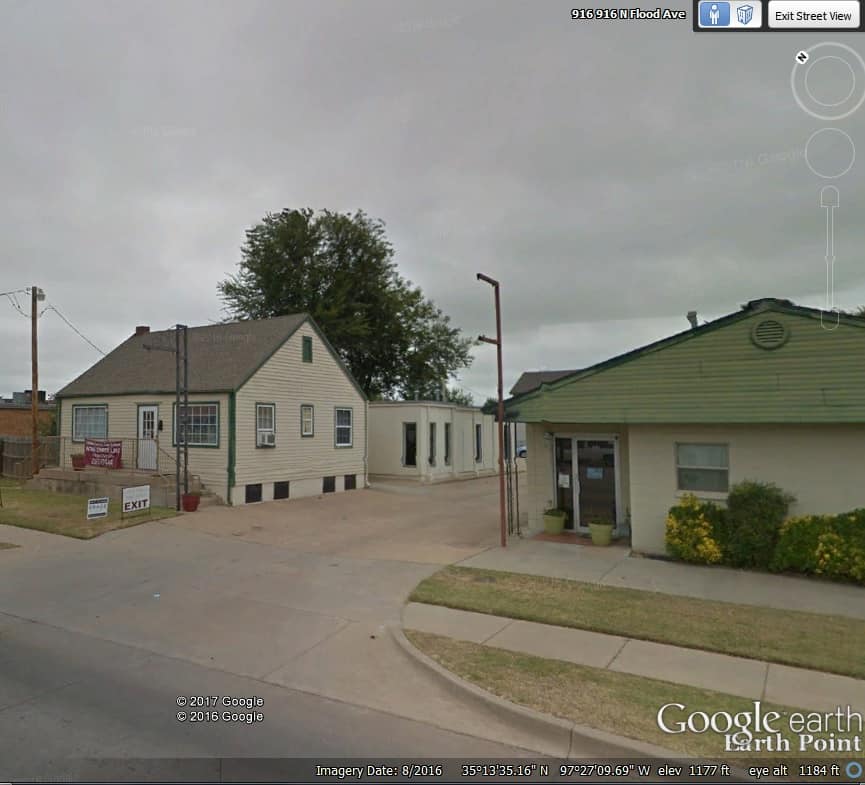
The old man eventually tore down the garage and built the office building behind the old house after he started getting Highway Department work.
The building in the foreground with shrubs use to be a horse lot when I worked there. The old engineer built that building and operated it as a testing lab for a number of years. I have no idea what ever became of his Hudson.
Williwaw, post: 416279, member: 7066 wrote: My work is similar to yours as I measure a lot of poles, of all kinds. I'm mildly curious the tecnique your guys use for tieing poles with GPS in particular seeing as you can't occupy the center. Couple RP shots noting quadrants and do a dist/dist intersect?
Easy-peasy. Whether it's a rover or TS we take two opposing shots at points equidistant to the face of the pole (usually as close as one can get and still keep the rod plumb). The Class of pole indicates the diameter and is noted. In the dgn I snap a line between the two shots and place an appropriate circle at the midpoint.
Funny thing though is a lot of times we shoot the attachment heights, cross-arms and the tops of the poles with a reflectorless TS. When all this info is in a drawing you can see just how catty-wampus out of plumb utility poles are. A 35' pole can be 3 or 4 feet out of plumb and hardly get noticed. The engineers are constantly questioning if the drawing is correct.

paden cash, post: 416274, member: 20 wrote: and we STILL had to cut the damned things up with that hand-blistering hacksaw
My current setup would've made you green with envy.
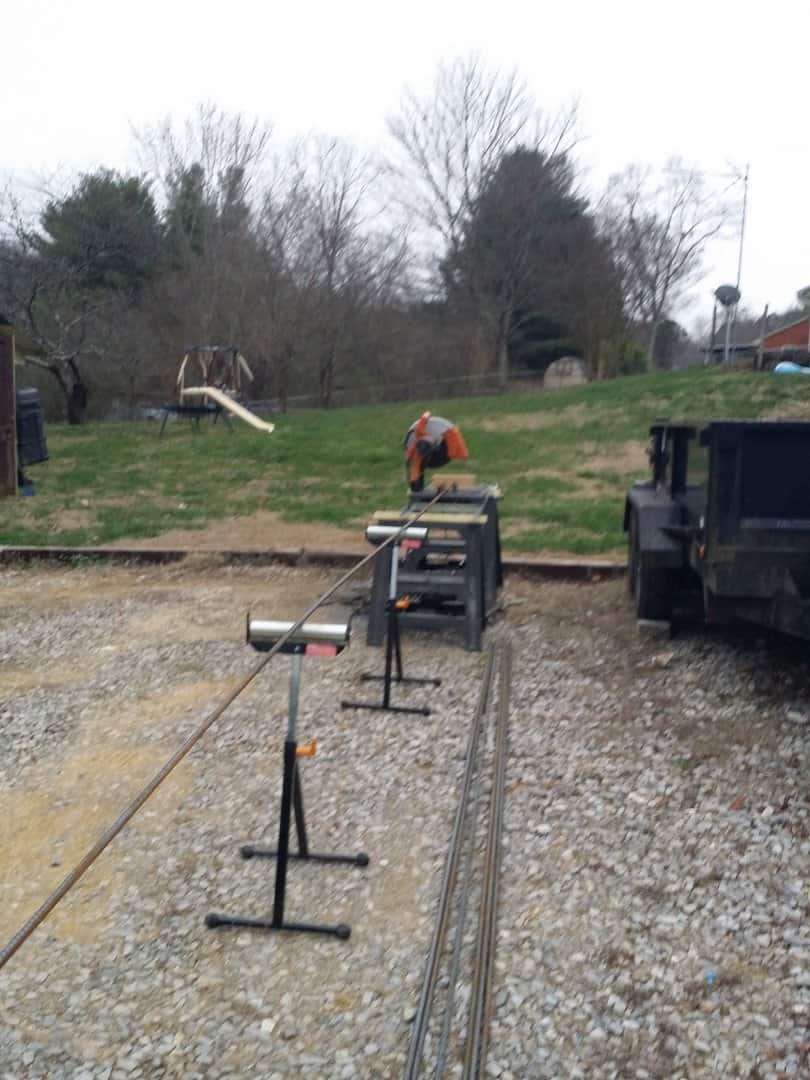
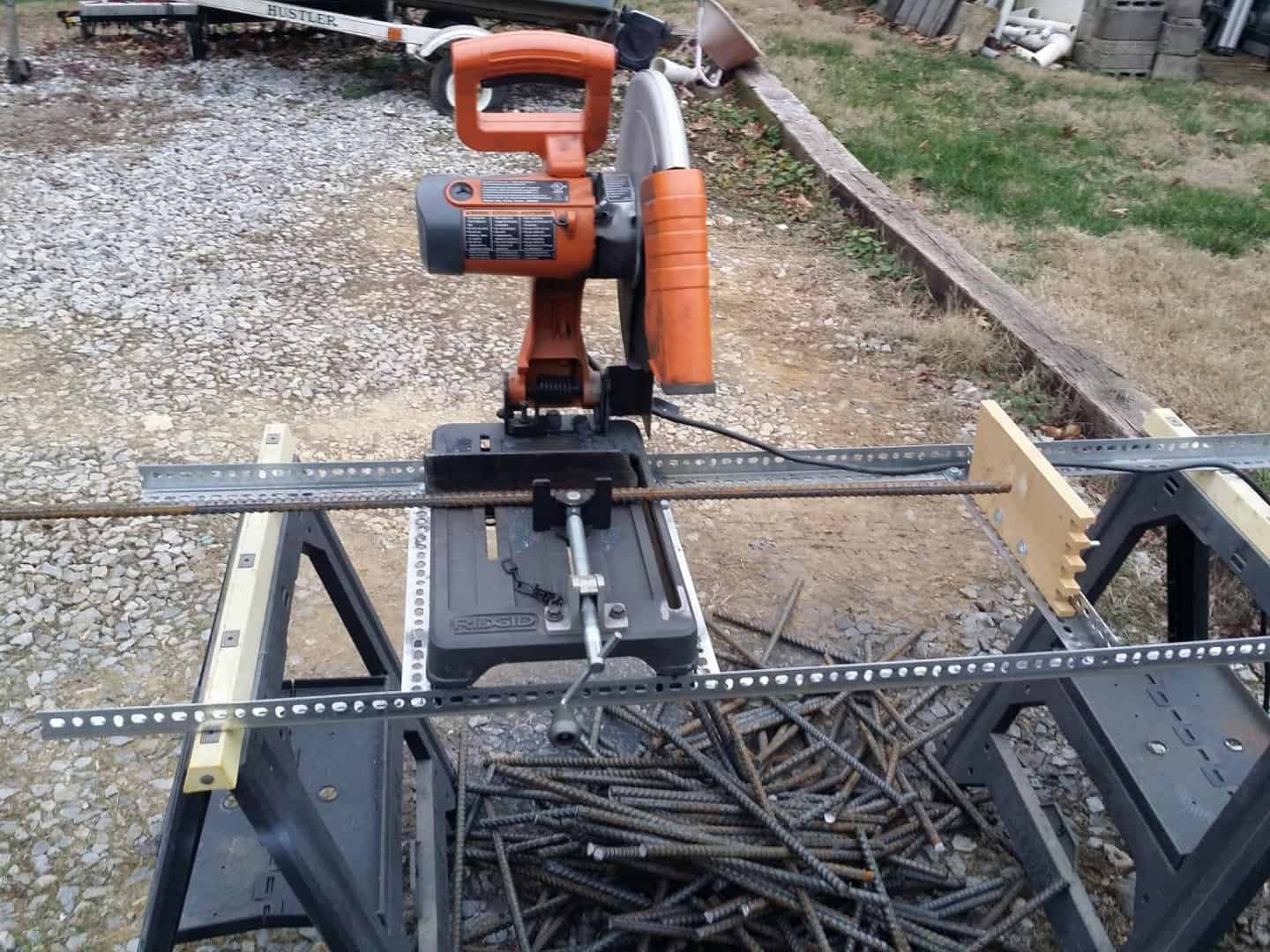
A few years back the local firm that cut our rebar got picky and decided that they wouldn't supply us with anything shorter than two feet. I inquired why and was told that shorter lengths fall through the shear table and thus require more work. They eventually cut one more batch for us but charged us dearly and complained to boot. The rig above was my solution.
The rollers are spaced to support a twenty foot rebar, the metal frame keeps the saw from vibrating around the work area, and the gravel work area keeps grass fires to a minimum. I shop around and have one of the local supply houses drop 30-40 20 foot sticks in my driveway. I can cut about 250 18" pieces per hour and typically get a couple of hours out of a $5 cut-off wheel. Locally 1/2" x 18" is running $1 each precut and I can cut them for $0.50 each. By the time I pay myself, I break even cost wise but have a better quality rebar to work with. All of the ends are clean and straight vs. the last inch or so being twisted if they're shear cut.

party chef, post: 416269, member: 98 wrote: Does anyone still use pipe and what was the advantage of using pipe when it was common?
We still set 1/2" pipe 26" long here, they're a nice monument but are pricey, about $5 a pop after we get them cut to length and reemed one one side so the cap doesn't get bunged up.
party chef, post: 416269, member: 98 wrote: Does anyone still use pipe and what was the advantage of using pipe when it was common?
they last, galvanized inside and out. buy the 20' joints and a power hacksaw, cut 4 or 5 at a pop.
paden cash, post: 416285, member: 20 wrote: That was Jack's "happy" face...
Clint, but whatever.
Peter Ehlert, post: 416298, member: 60 wrote: they last, galvanized inside and out. buy the 20' joints and a power hacksaw, cut 4 or 5 at a pop.
Clint, but whatever.
Jack was my old boss...

party chef, post: 416269, member: 98 wrote: Does anyone still use pipe and what was the advantage of using pipe when it was common?
I use pipe if I'm setting the monument in a stream or marshy area. Pipes can be left sticking up and will still be sturdy. I'll usually get a 10', 3/4" piece of galv. pipe, cut it in half, and pound it in so that 1-1.5' is sticking up. Plastic ID cap fits inside. I'll set only a few of these each year.

We occasionally still set pipe, usually for LSLS work, where it is for a replacement of a missing section corner. We do so because we can stamp information into the wall of the pipe, or, on some occasions, weld the information into the wall of the pipe. We also have tried riveting stainless steel dogtags (with the information embossed into the tag) on set pipes, but we are not sure how well we like them for corners.

In another life when i worked on pipelines as a welder helper I had to memorize this Pipe = ID up to 6" Pipe = OD 8" and bigger
For what we do I always use ID

ppm, post: 416058, member: 6808 wrote: When you call out an Iron Pipe, do you call it as inside diameter (ID) or outside (OD)?
In my neck of the woods we don't use pipes anymore, but find them all the time. I know when I worked in California, we found pipes all the time. Sometimes even with a YPC inside it. Anyway... I had always in the past thought that a surveyor should measure outside diameter of an Iron Pipe, but I am coming around to saying that it should be inside (largely because that is how it is measured at the hardware store). I guess it should always be stated, at this point but what is your standards at your office?
Always ID here.

According to the TSPS Manual of Practice, pipes should be sized by the inside diameter.