

I missed Kent. I am happy he is back, for so many reasons.

Kent McMillan, post: 348824, member: 3 wrote: In the case of TXAU that is the subject of this thread, I showed above that the least squares estimate of the position of TXAU, both horizontal and vertical, based upon three 6-hour sessions, each session straddling the period when the record from TXAU was used to solve the vectors from it to various project control points, did not differ significantly (meaning: at 95% confidence level) from the coordinates of TXAU as published by NGS.
In other words, comparison of the high-quality OPUS Static solutions from three other CORS points 50km to 100km distant did not show any conclusive evidence of significant movement, so there was no reason not to consider the coordinates of TXAU as published to be reliable. This is what any surveyor can easily do to verify the stability of a CORS site.
I'd think you would need a lot more observation time to conclude a station had moved, even if it failed the above test. If you find a difference how do you know if the station moved or whether there were ionospheric/tropo anomalies that affected that station differently from the others you are comparing it to?

Bill93, post: 348874, member: 87 wrote: I'd think you would need a lot more observation time to conclude a station had moved, even if it failed the above test. If you find a difference how do you know if the station moved or whether there were ionospheric/tropo anomalies that affected that station differently from the others you are comparing it to?
Well, the least squares estimate was based upon three 6-hour sessions over three different days and the CORS sites used in the OPUS solution were all the same sites under 100km from the point positioned on each day. Both the long sessions and the different days would give me a fair amount of assurance that there was no anomolous atmospheric effect in play. The repeatibility of results from day to day makes testing the reality of the covariance matrix for the solution that OPUS reported possible, i.e. that the residuals are within expected limits.
The annual and semi-annual variations in the NAD83 positions of CORS antennas that I deal with generally seem to be regional, not specific to a site itself, so if one gets an OPUS solution using other CORS antennas whose stability is shown to be good in the time series plot, and without residuals inconsistent with the covariance estimates for the three solutions, I would say that the position derived by OPUS is a good measure of relative movement in relation to the other sites.
The problem of positioning within NAD83 as I conceive it to be really reduces to positioning with respect to the local segment of the CORS network.
Statistically, we are just testing the hypothesis that the distance from the current least squares estimate of TXAU is greater than 0.000m at greater than 95% confidence. In this case, the uncertainty attached to the estimate of the distance at 95% confidence was greater than the distance itself, but in any event the difference was under 3mm horizontally.

I'm not sure if it is ok to ask about a guy's NAD's or if their not right...
Just saying.... Mine are right 99.9% of the time.
You may want to check the Long-term Time Series, just in case.

gschrock, post: 348820, member: 556 wrote: So in short, yes, in some places one must take the displacement of CORS into consideration. But I would agree that if someone works in part of the country where a CORS value does not change over many years, all of this would seem alien, but that does not mean it is an insignificant or laughable matter to others.
hello Gavin. what does the displacement mean for the local surveyor? if his/her region is/isn't sailing along with the CORS station is this confirmed with regular or occasional local tie surveys? if a surveyor is using the coordinates from a homogenised, wider realisation of NAD broadcast from the CORS then he may report a local NAD coordinate which is in conflict with the local control.

The main problem with CORS is that it moves over time, in some areas it seems it's quite fast. This becomes an issue as control is laid out for local projects and the OPUS CORS shifts......
After enough time the CORS and the local control will no longer match.
Some users are actually "fixed" in time with respect to coordinate systems at the point the control was laid out and can't change,,,,,Coal mines, Highways, Flood control,,,,,and many of these control other uses, it really doesn't help much to tie to CORS OPUS for a flood elevation when the flood maps are contoured from the local NAVD88 bench marks.
So there is always a determination made when you begin....do you tie to CORS and float coordinates over time, or do you fix the project in time and never change, holding local monuments once established....
We are starting a new project for engineering drawings on a campus,,,the requirement there is to hold the local control points on site. They are about 0.3' from CORS and .2' vertically. You would make a mess of things shoving CORS NAD83(2011) over the NAD83(93) 88 control points. And no they are not changing, we have asked and there is no way they want to "update". Just imagine all the data that would need to change, who would pay for doing that, who would do it?
Same with the county wide mapping which was done in the early 2000 and which the flood maps are based on, same with a 200 sq mi mapping project we started in 2003, which started out mapping a township and then later in 2012 added another 6 townships. It was decided to keep the control on the original set of points and merge the mapping with the first set, using NAD83 (93) and geoid03.
MightyMoe, post: 348913, member: 700 wrote: The main problem with CORS is that it moves over time, in some areas it seems it's quite fast.
I think that Conrad's point was that over areas perhaps 100km in extent or more from a CORS site, the movement is more or less as a block. That would be true in Australia and in most of the Continental US. So the annual and semi-annual variations in NAD83 coordinates that appear in the Long-term Time Series plots for a particular site are typically mirrored in those of surrounding sites. The whole region is moving in the same direction at the same velocity over a time scale of a decade or more.

Kent McMillan, post: 348916, member: 3 wrote: the movement is more or less as a block. That would be true in Australia and in most of the Continental US.
Then there are those lucky folks with projects that span two tectonic plates, as in parts of California. Fortunately, to date I haven't been one of them.
huh???
If you examine the Long-term Time Series Plot of a typical CORS site, you'll see a variation from the published position that has a six-month and 12-month period, i.e. troughs and peaks at about those intervals. However, that doesn't reflect a movement in just that site since the same pattern usually shows up in the time series plots of other CORS sites in the region. In other words, the whole region is behaving as a more or less rigid block, so the apparent movements at just one site don't really effect positioning on the block with respect to other regional CORS sites.
so?
MightyMoe, post: 348980, member: 700 wrote: so?
So, the surveyor is more concerned with trends and major jumps on the time series plots. If the plot just wiggles back and forth along the X-axis, then it means things are cool, no correction to the published coordinates are most likely needed.

gschrock, post: 348946, member: 556 wrote: Hello Conrad,
Of course we would much rather never have to deal with velocity, but our state is on the edge of the plate, the Pacific Rim of Fire, and conflicts with the relatively tiny San Juan de Fuca plate which is wedged between our coastal regions and the Pacific Plate.
At plate edges, velocities vary more towards the edges, in both speed and direction. In the interior of our state the movement is more homogeneous (as you've described) and CORS (or local stations) may not go out of tolerance for 4-8 years. But on the coast that can be as little as 4 months for an individual station. The National Science Foundation funded the PBO (plate boundary obsertvatory) project that put 900 CORS, mainly on the west coast.
We learned the hard way. When our network began and was confined to a small area the movement was fairly homogeneous, but still over a few years we saw individual stations going out of tolerance faster than others that were only 70km away. Users in areas of predictable movement know to update any calibrations as CORS are updated. We had a lot to learn from areas of the world with massive geodetic arrays in tectonically active zones (Japan, Malaysia et al). The question was how best to maintain the 1x2 cm tolerance for the network while constraining to the national framework. The answer came from academia and the NGS.
Our first 2 stations were built in cooperation with the two universities in our state studying regional plate movement. They have had continuously operating GPS sites since the early 90's in a wide array - we have also collaborated on all of the 100+ stations in our network to these to their mix. A groundbreaking study of subduction zone quakes (aka silent quakes) is shown in thttp://www.earthscope.org/assets/uploads/events/Tim_Melbourne_Presentation.pdf&apos ;">he following link to a presentation w/ graphics showing the varied velocities around our state. You will see what we are up against.
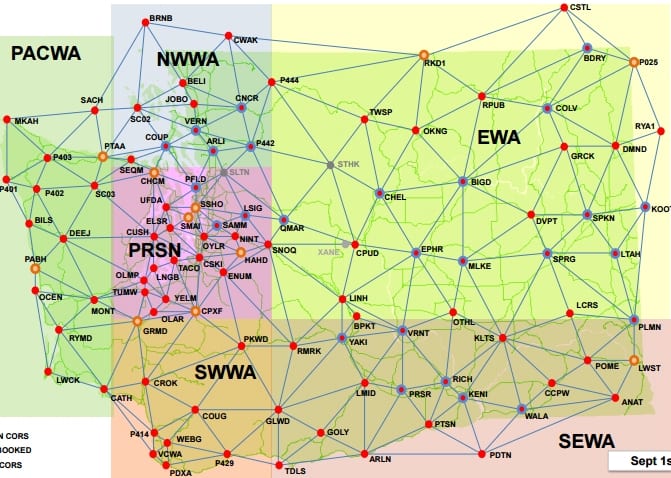
The jointly developed solution (for the 110 stations of the several hundred in our state that are in real-time solutions) was to divide our state into six functional zones (see below), based mainly on the generalized velocity in each zone (and the predicted rate at which to update) but also we had found that the tropospheric scaling in the processing for real-time varied as from the coast or mixed regions and the far interior. This amalgam of considerations is why some folks had also found that mixing and matching baselines of varied lengths under rapidly changing conditions yielded inconsistent results.
Users of network solutions know which zone solution to pick when they work in different parts of the state, and how much the values may have changed since their last observations in the same area. Different users have different approaches to localizing for time dependent consideration or ties to legacy local control (as Moe has noted). That is up to them, we simply provide updated NAD values for the stations. Actually, we do the evaluation of the relative integrity of a subnet in ITRF as one of the steps bu publish in NAD. We constrain to NGS CORS each time we need to update, but we will choose which NGS CORS have current values that have not gone out of their own tolerance (sometimes they do not publish new values until the site is far out of tolerance as Jim noted in posted graph.
Yes, it would be wonderful to work in the calm interior, but I am truly appreciating the surveyors out this way who have learned (over 14+ year now) how to live on the edge.
Good morning Gavin,
Is HTDP enough to keep up with such a dynamic zone? Or, do you resort to other means to stay up to date with the changes?
Kent McMillan, post: 348986, member: 3 wrote: So, the surveyor is more concerned with trends and major jumps on the time series plots. If the plot just wiggles back and forth along the X-axis, then it means things are cool, no correction to the published coordinates are most likely needed.
A quick check of the TXAU CORS site shows movement of close to 1" in a short time-(NAD83(2007)22.71311(W) to NAD83(2011)22.71225(W)- the question becomes do you "chase" that movement. Or do you "fix" your coordinates in time and ignore the t value of the point.
Clearly if you set points in a high dollar area of Austin and a high rise expensive building is designed from them, you don't want the next guy to bring in new values for TXAU and stake that building you want to either update the coordinates on the boundary points, shift the engineering design to match, or hold the old superseded points. That has been and continues to be the vexing question we face.
Also the CORS points don't always have a long life, many have been discontinued with new ones replacing them but in different locations. A CORS point set in 2013 will have no old superseded value to use. If (when) TXAU is removed there will be no way to use the 2011 oir 2007 value for it to do later surveys in legacy control
Kent McMillan, post: 348890, member: 3 wrote: You may want to check the Long-term Time Series, just in case.
You are right my error elipses just got bigger!
Every survey is different:)