Reading RPLS is free for the whole profession. Members post, reply, and get the members-only rooms.

Notifications
Clear all

Topic starter
Translate
▼
English
Spanish
French
German
Italian
Portuguese
Russian
Chinese
Japanese
Korean
Arabic
Hindi
Dutch
Polish
Turkish
Vietnamese
Thai
Swedish
Danish
Finnish
Norwegian
Czech
Hungarian
Romanian
Greek
Hebrew
Indonesian
Malay
Ukrainian
Bulgarian
Croatian
Slovak
Slovenian
Serbian
Lithuanian
Latvian
Estonian
How do you personally achieve redundancy for least squares? Which of the following do you do-
- Sets
- Cross ties
- Closed traverses
- GPS points
- Other methods
Is it feasible to do an open traverse and adjust in LS using just multiple sets?
Posted : November 7, 2015 3:12 pm

Translate
▼
English
Spanish
French
German
Italian
Portuguese
Russian
Chinese
Japanese
Korean
Arabic
Hindi
Dutch
Polish
Turkish
Vietnamese
Thai
Swedish
Danish
Finnish
Norwegian
Czech
Hungarian
Romanian
Greek
Hebrew
Indonesian
Malay
Ukrainian
Bulgarian
Croatian
Slovak
Slovenian
Serbian
Lithuanian
Latvian
Estonian
Totalsurv, post: 343442, member: 8202 wrote: Is it feasible to do an open traverse and adjust in LS using just multiple sets?
Yes, but your error ellipses will tell you that the uncertainty grows as you move away from your starting position. Closing the traverse would provide very valuable information to keep the ellipses small. Make up some data and try it.
Posted : November 7, 2015 3:43 pm

Translate
▼
English
Spanish
French
German
Italian
Portuguese
Russian
Chinese
Japanese
Korean
Arabic
Hindi
Dutch
Polish
Turkish
Vietnamese
Thai
Swedish
Danish
Finnish
Norwegian
Czech
Hungarian
Romanian
Greek
Hebrew
Indonesian
Malay
Ukrainian
Bulgarian
Croatian
Slovak
Slovenian
Serbian
Lithuanian
Latvian
Estonian
I always have multiple sets between traverse points and at least single sets to boundary points. You do achieve redundancy by simply tying sets on an open ended traverse, but the gain is minimal. If you completely reran the open traverse then you would have something.
Connecting the endpoints of a traverse - and other points of the traverse where the opportunity presents itself - with a GPS vector is a good thing, and I often do that if completing a loop is not possible.
An old fashioned loop traverse is the most common.
Having networked cross ties is probably the ultimate, but often not feasible. You get them when you can.
Posted : November 7, 2015 4:18 pm

Translate
▼
English
Spanish
French
German
Italian
Portuguese
Russian
Chinese
Japanese
Korean
Arabic
Hindi
Dutch
Polish
Turkish
Vietnamese
Thai
Swedish
Danish
Finnish
Norwegian
Czech
Hungarian
Romanian
Greek
Hebrew
Indonesian
Malay
Ukrainian
Bulgarian
Croatian
Slovak
Slovenian
Serbian
Lithuanian
Latvian
Estonian
Along with running your standard traverse sets, I will change the set up to backsight the previously stored foresight and then foresight the original backsight. In doing this you can actually run two traverses on the same points at the same time in different directions.
Posted : November 7, 2015 5:32 pm

Translate
▼
English
Spanish
French
German
Italian
Portuguese
Russian
Chinese
Japanese
Korean
Arabic
Hindi
Dutch
Polish
Turkish
Vietnamese
Thai
Swedish
Danish
Finnish
Norwegian
Czech
Hungarian
Romanian
Greek
Hebrew
Indonesian
Malay
Ukrainian
Bulgarian
Croatian
Slovak
Slovenian
Serbian
Lithuanian
Latvian
Estonian
Yes, of the above and anything that may appear to help improve quality and correctness of the data.
I like to shoot and check between every setup and every backsite and to turn a couple of stakeouts to check correct data entry before acquiring new data.
Having something physically in place to backsite is important to me. I have seen too many trusting IMen to only backsite once per setup and think that their instrument will hold on zero thru all the angles turned.
Numero Uno and most important procedure is to keep a check on the equipment and make sure that everything is adjusted and in tune thruout each day.
Numero Two is training so that everyone knows how to properly handle the equipment. When I see a hand taking too long to setup a tripod or bipod, they get a refresher course immediately.
:gammon:
Posted : November 7, 2015 5:35 pm

Translate
▼
English
Spanish
French
German
Italian
Portuguese
Russian
Chinese
Japanese
Korean
Arabic
Hindi
Dutch
Polish
Turkish
Vietnamese
Thai
Swedish
Danish
Finnish
Norwegian
Czech
Hungarian
Romanian
Greek
Hebrew
Indonesian
Malay
Ukrainian
Bulgarian
Croatian
Slovak
Slovenian
Serbian
Lithuanian
Latvian
Estonian
Adam, post: 343453, member: 8900 wrote: Along with running your standard traverse sets, I will change the set up to backsight the previously stored foresight and then foresight the original backsight. In doing this you can actually run two traverses on the same points at the same time in different directions.
Calling this "two traverses" is optimistic at best. Unless you're breaking your setups between the measurements from the new backsight (the former foresight), you're just taking another set of measurements from the same setups. You'd have to be using a seriously defective instrument for the redundancy provided to be materially better than just measuring another set of angles and distances from original backsight to original foresight. Breaking the setups would at least add redundancy to the centering, which is significant if reliable positions of the points in the ground is the goal.
Posted : November 8, 2015 12:42 am

Translate
▼
English
Spanish
French
German
Italian
Portuguese
Russian
Chinese
Japanese
Korean
Arabic
Hindi
Dutch
Polish
Turkish
Vietnamese
Thai
Swedish
Danish
Finnish
Norwegian
Czech
Hungarian
Romanian
Greek
Hebrew
Indonesian
Malay
Ukrainian
Bulgarian
Croatian
Slovak
Slovenian
Serbian
Lithuanian
Latvian
Estonian
Totalsurv, post: 343442, member: 8202 wrote: How do you personally achieve redundancy for least squares? Which of the following do you do-
- Sets
- Cross ties
- Closed traverses
- GPS points
- Other methods
Is it feasible to do an open traverse and adjust in LS using just multiple sets?
NO, an open traverse with just sets can be meaned but not adjusted. At best you get error ellipses, depending on the software.
A proper closed traverse can be adjusted.
A closed traverse with cross ties can be adjusted.
An open or closed traverse with GPS points can be adjusted.
An open traverse can be rerun in it's entirety and adjusted. An adjustment in that case would make sense if different equipment/techniques were used with differing estimations of precision.
Paul in PA
Posted : November 8, 2015 1:54 am

Translate
▼
English
Spanish
French
German
Italian
Portuguese
Russian
Chinese
Japanese
Korean
Arabic
Hindi
Dutch
Polish
Turkish
Vietnamese
Thai
Swedish
Danish
Finnish
Norwegian
Czech
Hungarian
Romanian
Greek
Hebrew
Indonesian
Malay
Ukrainian
Bulgarian
Croatian
Slovak
Slovenian
Serbian
Lithuanian
Latvian
Estonian
We run open open traverses through LS in tunnel work.
The control points themselves are bolted and braced c-channel with a 5/8th threaded bolt and are very stable unless hit by machinery. There are two traverse lines per tunnel and they have cross ties but are independent of each other. At each extension of the network we jump back one leg to ensure stability. At the start of each day we check l,t,i, and c on the guns and calibrate the a monthly. At the start of each occupation up we plug in atmospheric conditions for ppm. Sets are turned 3 times, then the top is popped, alidade twisted 120 degrees and another set three is wrapped, if the diff. HZ angle is greater than 2", a third set is wrapped. Digital levels are also run through the points. At approx 2/3 tunnel length a geodesist is brought in to check azimuth with a gyroscope, and the resulting correction is applied to the network, this if for tunnels of less than 2500m, for longer runs the geodesist would be brought in as appropriate.
I am just a poor dumb field guy and can not speak to the office end but the machines come through the exit seal at the end and I have been quite impressed with the closure and precision achieved.
Posted : November 8, 2015 10:50 am

Translate
▼
English
Spanish
French
German
Italian
Portuguese
Russian
Chinese
Japanese
Korean
Arabic
Hindi
Dutch
Polish
Turkish
Vietnamese
Thai
Swedish
Danish
Finnish
Norwegian
Czech
Hungarian
Romanian
Greek
Hebrew
Indonesian
Malay
Ukrainian
Bulgarian
Croatian
Slovak
Slovenian
Serbian
Lithuanian
Latvian
Estonian
Totalsurv, post: 343442, member: 8202 wrote: How do you personally achieve redundancy for least squares? Which of the following do you do-
- Sets
- Cross ties
- Closed traverses
- GPS points
- Other methods
Is it feasible to do an open traverse and adjust in LS using just multiple sets?
Posted : November 8, 2015 11:36 am
Translate
▼
English
Spanish
French
German
Italian
Portuguese
Russian
Chinese
Japanese
Korean
Arabic
Hindi
Dutch
Polish
Turkish
Vietnamese
Thai
Swedish
Danish
Finnish
Norwegian
Czech
Hungarian
Romanian
Greek
Hebrew
Indonesian
Malay
Ukrainian
Bulgarian
Croatian
Slovak
Slovenian
Serbian
Lithuanian
Latvian
Estonian
Totalsurv, post: 343442, member: 8202 wrote: How do you personally achieve redundancy for least squares? Which of the following do you do-
- Sets
- Cross ties
- Closed traverses
- GPS points
- Other methods
Is it feasible to do an open traverse and adjust in LS using just multiple sets?
It would be best if you would read a book like "Adjustment Computations Spatial Data Analysis by Charles D. Ghilani and Paul R. Wolf.
This will answer all your questions regarding Redundancy (Degrees of Freedom).
JOHN NOLTON
Posted : November 8, 2015 11:43 am
Translate
▼
English
Spanish
French
German
Italian
Portuguese
Russian
Chinese
Japanese
Korean
Arabic
Hindi
Dutch
Polish
Turkish
Vietnamese
Thai
Swedish
Danish
Finnish
Norwegian
Czech
Hungarian
Romanian
Greek
Hebrew
Indonesian
Malay
Ukrainian
Bulgarian
Croatian
Slovak
Slovenian
Serbian
Lithuanian
Latvian
Estonian
Optimistic yeah, but it is helpful. Instrument is releveled and centered facing the foresight for each set up.
Posted : November 8, 2015 5:05 pm

Translate
▼
English
Spanish
French
German
Italian
Portuguese
Russian
Chinese
Japanese
Korean
Arabic
Hindi
Dutch
Polish
Turkish
Vietnamese
Thai
Swedish
Danish
Finnish
Norwegian
Czech
Hungarian
Romanian
Greek
Hebrew
Indonesian
Malay
Ukrainian
Bulgarian
Croatian
Slovak
Slovenian
Serbian
Lithuanian
Latvian
Estonian
To have a truly redundant measurements, each point needs to have measurements to and from at least two other points in the network. From at to 1-2-3, 1-2-4, 4-1-3 for example
Posted : November 8, 2015 6:27 pm

Translate
▼
English
Spanish
French
German
Italian
Portuguese
Russian
Chinese
Japanese
Korean
Arabic
Hindi
Dutch
Polish
Turkish
Vietnamese
Thai
Swedish
Danish
Finnish
Norwegian
Czech
Hungarian
Romanian
Greek
Hebrew
Indonesian
Malay
Ukrainian
Bulgarian
Croatian
Slovak
Slovenian
Serbian
Lithuanian
Latvian
Estonian
Totalsurv, post: 343442, member: 8202 wrote: How do you personally achieve redundancy for least squares? Which of the following do you do-
- Sets
- Cross ties
- Closed traverses
- GPS points
- Other methods
Is it feasible to do an open traverse and adjust in LS using just multiple sets?
Combining GPS vectors with conventional measurements is the way I would prefer to introduce significant redundancy in a survey traverse. Just GPS-derived positions along the traverse, as long as the uncertainties of those positions can be characterized weill is very useful.
When I didn't have GPS, adding azimuth observations along traverses made a large improvement in results. The other method that I used quite a bit was taking angles to intersected objects like radio antennas, windmills, and aircraft warning lights on tall structures. Those angles added a condition that usually made a big improvement in the uncertainty of adjusted positions.
In the case of an open traverse I would measure the distances back and forward and check the starting and ending azimuths of the line by whatever means was at hand, solar observation being typically a very good choice if nothing else was at hand.
I recall one survey where a spur traverse had to be run to set a marker about three miles away from a well-positioned control point on a hill. The spur line looked like this:
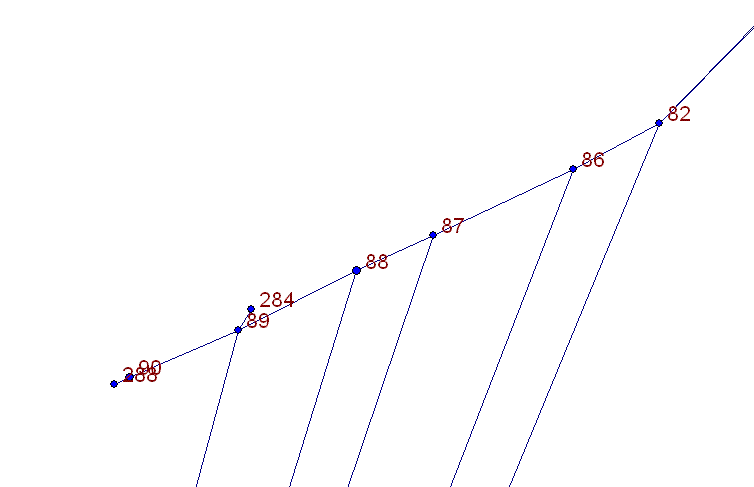
To give an idea of scale, the control point on the hill was CP No. 75 and I could locate CP No. 82 from it, but beyond that, the land rolled below the horizon and so the rest of the line had to be traversed in shorter jumps so:
75-82: 11,938.86 ft.
82-86: 483.83 ft.
86-87: 765.53 ft.
87-88: 417.87 ft.
88-89: 655.70 ft.
89-90: 585.45 ft.
90-288: 84.10 ft.
In making the survey, I had located a number of windmills by triangulation and one of those windmills could be plainly seen from CP No.82 at a distance of 13,573.36 ft. I measured the angle 75-82-WM to check the direction of the line to 82 and also measured angles to the WM as indicated on the sketch above. So, what would have been a fairly loose tie ended up quite well surveyed (after the observations were adjusted in Star*Net) for minimal additional effort. The uncertainty in the calculated tie from CP No.75 to the endpoint at Rod and Cap No. 288 was +/-0å¡00'03" at 95% confidence, which was definitely good enough for that project.
Posted : November 8, 2015 7:36 pm
Translate
▼
English
Spanish
French
German
Italian
Portuguese
Russian
Chinese
Japanese
Korean
Arabic
Hindi
Dutch
Polish
Turkish
Vietnamese
Thai
Swedish
Danish
Finnish
Norwegian
Czech
Hungarian
Romanian
Greek
Hebrew
Indonesian
Malay
Ukrainian
Bulgarian
Croatian
Slovak
Slovenian
Serbian
Lithuanian
Latvian
Estonian
Kent McMillan, post: 343534, member: 3 wrote: In making the survey, I had located a number of windmills by triangulation ....
BTW, just as a point of clarification, the object to point at when measuring an angle to a windmill is the vertical axis that the motor pivots around. It is usually a well-defined thing. Surveying out in West Texas in the days before GPS, locating control points near windmills was a good strategy because it made it much simpler to actually find the prism and target as the distances stretched out well beyond a few miles. So the traverse tended to run past windmills and that made it easy to get very good triangulated positions on them to begin with.
Posted : November 8, 2015 8:12 pm

Translate
▼
English
Spanish
French
German
Italian
Portuguese
Russian
Chinese
Japanese
Korean
Arabic
Hindi
Dutch
Polish
Turkish
Vietnamese
Thai
Swedish
Danish
Finnish
Norwegian
Czech
Hungarian
Romanian
Greek
Hebrew
Indonesian
Malay
Ukrainian
Bulgarian
Croatian
Slovak
Slovenian
Serbian
Lithuanian
Latvian
Estonian
Hi all, newbie here and I have a question on this topic.
I run open traverse (network, see below) in underground mine. Some of the levels are linked so I have a linked traverse but not all. I measure 4 sets and not just classical traverse I have prisms in the side walls, so from each station I measure foresight (next station), 2 wall prisms (located between station and backsight) and 2 wall prisms (located between station and foresight) so thats 5 points from each station (this varies from some stations I have measured just foresight and one wall prism but from some stations I measured 6-8 wall prisms, on average its 4 wall prism). From time to time I did check on my station setups by performing a resection using these wall prisms. Now the results are confusing, chi-square test passed but error ellipses on station coordinates are huge semi major ellipse axis is on some points 0,5 m. These points are 800-1100m away from known points. On points closer to the known points semi major ellipse axis is 1 cm and the further I go the bigger it gets. I had around 200 stations and 380 wall prisms with just 5 known points (2 on the start, 2 on the end and 1 in the middle), with 3 open traverses (1100 m, 760 m, 350m away from closest known point). Complete network is cca 4 km long.
So the question is what to assume here good or not, error ellipses are huge but chi-square test passed.
Thanks S.
Posted : December 21, 2015 2:09 pm
Translate
▼
English
Spanish
French
German
Italian
Portuguese
Russian
Chinese
Japanese
Korean
Arabic
Hindi
Dutch
Polish
Turkish
Vietnamese
Thai
Swedish
Danish
Finnish
Norwegian
Czech
Hungarian
Romanian
Greek
Hebrew
Indonesian
Malay
Ukrainian
Bulgarian
Croatian
Slovak
Slovenian
Serbian
Lithuanian
Latvian
Estonian
senci, post: 350035, member: 10869 wrote: I run open traverse (network, see below)
The "see below" apparently didn't come through. A network diagram would be helpful for those trying to understand the situation.
Posted : December 21, 2015 2:22 pm
Translate
▼
English
Spanish
French
German
Italian
Portuguese
Russian
Chinese
Japanese
Korean
Arabic
Hindi
Dutch
Polish
Turkish
Vietnamese
Thai
Swedish
Danish
Finnish
Norwegian
Czech
Hungarian
Romanian
Greek
Hebrew
Indonesian
Malay
Ukrainian
Bulgarian
Croatian
Slovak
Slovenian
Serbian
Lithuanian
Latvian
Estonian
I ment on explanation below, but will post network plot form microsurvey starnet tomorrow.
This is the theory
http://www.slideshare.net/brett_grocock/recent-changes-in-underground-traversing-techniques-in-western-australia
Thanks S
Posted : December 21, 2015 2:31 pm

Translate
▼
English
Spanish
French
German
Italian
Portuguese
Russian
Chinese
Japanese
Korean
Arabic
Hindi
Dutch
Polish
Turkish
Vietnamese
Thai
Swedish
Danish
Finnish
Norwegian
Czech
Hungarian
Romanian
Greek
Hebrew
Indonesian
Malay
Ukrainian
Bulgarian
Croatian
Slovak
Slovenian
Serbian
Lithuanian
Latvian
Estonian
In an open-ended traverse the magnitude of your error ellipses is governed by your error estimates. Passing chi-square requires that your data be as precise as your error estimates say it is. If your error estimates are reasonable given the equipment and methods being used, and your data passes chi-square, then your error ellipses are what they are. Your only way to reduce those ellipses is to collect more precise data, and reduce the error estimates accordingly. In other words, you need both sufficiently precise data and appropriate error estimates to both achieve small ellipses and pass the chi-square.
BTW, you are collecting multiple sets of readings, but you haven't mentioned what the "splits" are.
Posted : December 21, 2015 2:48 pm
Translate
▼
English
Spanish
French
German
Italian
Portuguese
Russian
Chinese
Japanese
Korean
Arabic
Hindi
Dutch
Polish
Turkish
Vietnamese
Thai
Swedish
Danish
Finnish
Norwegian
Czech
Hungarian
Romanian
Greek
Hebrew
Indonesian
Malay
Ukrainian
Bulgarian
Croatian
Slovak
Slovenian
Serbian
Lithuanian
Latvian
Estonian
One point of the article is the well-known fact that you need long sights to reduce the accumulation of angle errors. Redundant observations, sighting to multiple prisms at each setup as illustrated in one of their diagrams, is a way to tie together the longest available sights. I'll be interested to see your own traverse diagram.
Posted : December 21, 2015 5:31 pm

Translate
▼
English
Spanish
French
German
Italian
Portuguese
Russian
Chinese
Japanese
Korean
Arabic
Hindi
Dutch
Polish
Turkish
Vietnamese
Thai
Swedish
Danish
Finnish
Norwegian
Czech
Hungarian
Romanian
Greek
Hebrew
Indonesian
Malay
Ukrainian
Bulgarian
Croatian
Slovak
Slovenian
Serbian
Lithuanian
Latvian
Estonian
senci, post: 350035, member: 10869 wrote: Hi all, newbie here and I have a question on this topic.
I run open traverse (network, see below) in underground mine. Some of the levels are linked so I have a linked traverse but not all. I measure 4 sets and not just classical traverse I have prisms in the side walls, so from each station I measure foresight (next station), 2 wall prisms (located between station and backsight) and 2 wall prisms (located between station and foresight) so thats 5 points from each station (this varies from some stations I have measured just foresight and one wall prism but from some stations I measured 6-8 wall prisms, on average its 4 wall prism). From time to time I did check on my station setups by performing a resection using these wall prisms. Now the results are confusing, chi-square test passed but error ellipses on station coordinates are huge semi major ellipse axis is on some points 0,5 m. These points are 800-1100m away from known points. On points closer to the known points semi major ellipse axis is 1 cm and the further I go the bigger it gets. I had around 200 stations and 380 wall prisms with just 5 known points (2 on the start, 2 on the end and 1 in the middle), with 3 open traverses (1100 m, 760 m, 350m away from closest known point). Complete network is cca 4 km long.
So the question is what to assume here good or not, error ellipses are huge but chi-square test passed.Thanks S.
Passing chi-square is a function of not only your observations, but how you've characterized your standard errors. If you're using Starnet, you can adjust those assumptions iteratively. It makes it pretty to see how good the network is, and to pick up outliers.
Posted : December 21, 2015 5:53 pm
Page 1 / 2
Next