Reading RPLS is free for the whole profession. Members post, reply, and get the members-only rooms.

Notifications
Clear all
Strictly Surveying
11
Posts
6
Users
0
Reactions
890
Views

Topic starter
Translate
▼
English
Spanish
French
German
Italian
Portuguese
Russian
Chinese
Japanese
Korean
Arabic
Hindi
Dutch
Polish
Turkish
Vietnamese
Thai
Swedish
Danish
Finnish
Norwegian
Czech
Hungarian
Romanian
Greek
Hebrew
Indonesian
Malay
Ukrainian
Bulgarian
Croatian
Slovak
Slovenian
Serbian
Lithuanian
Latvian
Estonian
Does anyone know how features such as Forts that appear on Florida Township plats, the boundaries of which were surveyed in 1825 and section lines surveyed in 1849, were plotted. There is no information that I can find in the field notes referring to the location of this Fort. I have information indicating that the fort was dismantled in 1838 so would not have been existent when the section lines were run. The Fort in question is Fort Moniac near the source of the St. Mary's river from the Second Seminole Indian War and I have determined that I had an ancestor 2nd Lt Cornelius Rain who was stationed there in April of 1840. I currently live about 7 miles South of the location shown on the township plat and am getting permission to "hunt" the private land where it appears for artifacts with a metal detector and am curious how accurately those things were plotted on the plats.
Posted : July 13, 2014 6:34 pm

Translate
▼
English
Spanish
French
German
Italian
Portuguese
Russian
Chinese
Japanese
Korean
Arabic
Hindi
Dutch
Polish
Turkish
Vietnamese
Thai
Swedish
Danish
Finnish
Norwegian
Czech
Hungarian
Romanian
Greek
Hebrew
Indonesian
Malay
Ukrainian
Bulgarian
Croatian
Slovak
Slovenian
Serbian
Lithuanian
Latvian
Estonian
There are a number of Forts that existed in Oklahoma at the time of the GLO surveys. Most of these were after 1870 however. Most are not particularly detailed but fairly accurate in their location. These forts were where the survey crews received shipments of equipment, viddles and their pay. I would bet they located them.
I couldn't quickly come up with any forts here at the house, but there was a trading post a few miles east that was in place at the time of the survey:


a recent aerial still shows the old cattle trail (if you know where to look). The property is now privately owned and occupied:

I'm not at all familiar with the Florida surveys, but they are probably your best bet. Where else are you going to find a map or plat that early with any precision?
Posted : July 13, 2014 9:07 pm
Topic starter
Translate
▼
English
Spanish
French
German
Italian
Portuguese
Russian
Chinese
Japanese
Korean
Arabic
Hindi
Dutch
Polish
Turkish
Vietnamese
Thai
Swedish
Danish
Finnish
Norwegian
Czech
Hungarian
Romanian
Greek
Hebrew
Indonesian
Malay
Ukrainian
Bulgarian
Croatian
Slovak
Slovenian
Serbian
Lithuanian
Latvian
Estonian
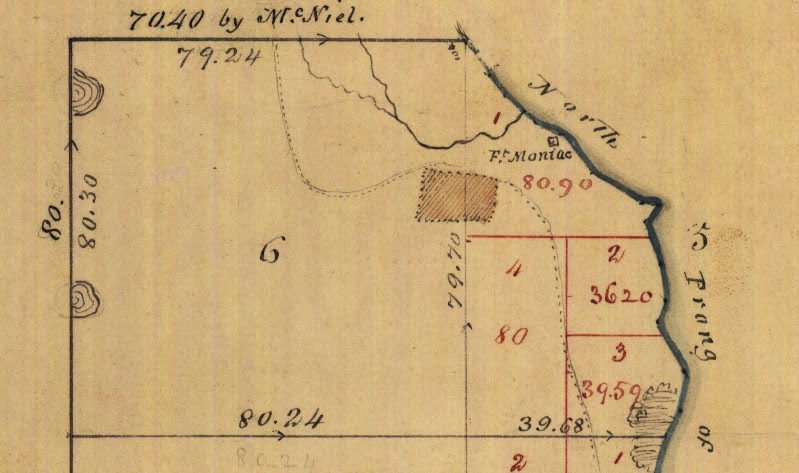

Posted : July 13, 2014 10:12 pm

Translate
▼
English
Spanish
French
German
Italian
Portuguese
Russian
Chinese
Japanese
Korean
Arabic
Hindi
Dutch
Polish
Turkish
Vietnamese
Thai
Swedish
Danish
Finnish
Norwegian
Czech
Hungarian
Romanian
Greek
Hebrew
Indonesian
Malay
Ukrainian
Bulgarian
Croatian
Slovak
Slovenian
Serbian
Lithuanian
Latvian
Estonian
I would encourage you to see if you can find and partner with an archaeologist who is interested in historical work in your state. They are trained to extract the maximum information possible from a site.
An archaeological site is a book whose pages can only be read once. If you turn them without reading them carefully, they are lost.
I was among the volunteers on a local project conducted by our Office of the State Archaeologist. (Prior thread) The township map from the 1840's noted a trading post and farm fields that had been set up by the government for use by the natives (which they weren't all that interested in). The area has always been farmed since that time.
The survey notes not only sketched the location of the trading house, but the surveyor also took bearings on it from two places on his section line. You can plot whatever part of the house he sighted to within a couple yards. Unfortunately, several entire sections of the surrounding land has been in the ownership of a cooperative society since 1856, and no one has bothered to perpetuate the section corners. Thus there is nothing within miles to measure from, and coming from miles away would likely be so inaccurate in matching the original lines as to be useless.
The archaelogical crew walked 10-meter squares flagging and collecting surface finds, counted and bagged per square for further analysis. We found dozens or hundreds of items per square in the neighborhood of that trading house: pieces of broken cups and plates, broken building materials, clay pipes (a common trade item at the time), a few pieces of metal, etc.
The next step was a metal detector scan of those squares that had a concentration of materials. We did not dig each item, but counted hits.
Using the counts from the surface collection and metal detector scans, we then placed auger tests. For this, you take an auger-type post hole digger and go down a few centimeters at a time (maybe 2 inches), noting the soil color (against a Munsell chart), texture, and composition (sand, loam, clay, etc). Knowing the soil layers is important for reconstructing what has occurred here in terms of erosion, deposition, and digging, and gives context to any artifacts. All the soil from the digging is put through a wire screen (1/4 inch mesh is typical) to recover artifacts, which are inventoried and bagged per soil layer in each hole.
Based on the results so far, the next step was to place 1x1 meter pits. These were also excavated in layers (5 cm?), the soil changes noted, the dirt sifted, and artifacts recorded. They found more of similar items and a couple coins from the trading post era.
The preliminary test holes were able to hit a couple pits that may have been used for storage and later for refuse. Archaeologists love garbage, because it can tell so much. It is a major source about diet; they can tell most animal bones apart and even sometimes tell whether bones were from spring or fall kills, and sometimes identify fish species. Other trash may tell trading patterns, such as from where tableware or clay pipes were made.
In the end, they had confirmed the location of the trading post within 10's of meters and learned more about what was being eaten and what was being traded. Confirmation of the trading post also narrowed down the search area and the Indian village was found nearby, which was one of the original goals.
Posted : July 14, 2014 6:56 am
Topic starter
Translate
▼
English
Spanish
French
German
Italian
Portuguese
Russian
Chinese
Japanese
Korean
Arabic
Hindi
Dutch
Polish
Turkish
Vietnamese
Thai
Swedish
Danish
Finnish
Norwegian
Czech
Hungarian
Romanian
Greek
Hebrew
Indonesian
Malay
Ukrainian
Bulgarian
Croatian
Slovak
Slovenian
Serbian
Lithuanian
Latvian
Estonian
Thanks Bill I will do that. I have a contact at the University of Florida Paleontology Department and although his area of historic interest is much further back in time I'm sure he could give me the name of someone who might take an interest in my endeavor.
Posted : July 14, 2014 7:57 am
Topic starter
Translate
▼
English
Spanish
French
German
Italian
Portuguese
Russian
Chinese
Japanese
Korean
Arabic
Hindi
Dutch
Polish
Turkish
Vietnamese
Thai
Swedish
Danish
Finnish
Norwegian
Czech
Hungarian
Romanian
Greek
Hebrew
Indonesian
Malay
Ukrainian
Bulgarian
Croatian
Slovak
Slovenian
Serbian
Lithuanian
Latvian
Estonian
This brings up another question. How or where can I find the original field notes from the survey? The notes available appear to be hand written transcripts of the originals as they have no accompanying sketches whatsoever, this old fort lies on the bank of the St Marys river and would most likely have been located during the meander of same which took place during the 1849 survey of the section lines. The notes available for the running of that line make no mention of the fort.
Posted : July 14, 2014 8:07 am

Translate
▼
English
Spanish
French
German
Italian
Portuguese
Russian
Chinese
Japanese
Korean
Arabic
Hindi
Dutch
Polish
Turkish
Vietnamese
Thai
Swedish
Danish
Finnish
Norwegian
Czech
Hungarian
Romanian
Greek
Hebrew
Indonesian
Malay
Ukrainian
Bulgarian
Croatian
Slovak
Slovenian
Serbian
Lithuanian
Latvian
Estonian
I'Ve been told that items of topography not tied in directly in the survey are sketched in by the deputy from memory with their locatiOn determined "by ocular estimation"... A sketch plat was prepared by the surveyor and transmitted to the survey office along with the draft notes.
-jlw
Posted : July 14, 2014 8:31 am
Topic starter
Translate
▼
English
Spanish
French
German
Italian
Portuguese
Russian
Chinese
Japanese
Korean
Arabic
Hindi
Dutch
Polish
Turkish
Vietnamese
Thai
Swedish
Danish
Finnish
Norwegian
Czech
Hungarian
Romanian
Greek
Hebrew
Indonesian
Malay
Ukrainian
Bulgarian
Croatian
Slovak
Slovenian
Serbian
Lithuanian
Latvian
Estonian
Are those "Sketch Plats" and draft notes available anywhere? National archives perhaps?
Posted : July 14, 2014 9:44 am

Translate
▼
English
Spanish
French
German
Italian
Portuguese
Russian
Chinese
Japanese
Korean
Arabic
Hindi
Dutch
Polish
Turkish
Vietnamese
Thai
Swedish
Danish
Finnish
Norwegian
Czech
Hungarian
Romanian
Greek
Hebrew
Indonesian
Malay
Ukrainian
Bulgarian
Croatian
Slovak
Slovenian
Serbian
Lithuanian
Latvian
Estonian
Jerry will have the definitive answer, but the original field tablets were almost always destroyed upon completion of the field notes and plat.
Posted : July 14, 2014 10:23 am

Translate
▼
English
Spanish
French
German
Italian
Portuguese
Russian
Chinese
Japanese
Korean
Arabic
Hindi
Dutch
Polish
Turkish
Vietnamese
Thai
Swedish
Danish
Finnish
Norwegian
Czech
Hungarian
Romanian
Greek
Hebrew
Indonesian
Malay
Ukrainian
Bulgarian
Croatian
Slovak
Slovenian
Serbian
Lithuanian
Latvian
Estonian
Randy,
Maybe Joe Knetch could help find any sketches that may exist.
Posted : July 14, 2014 10:55 am
Topic starter
Translate
▼
English
Spanish
French
German
Italian
Portuguese
Russian
Chinese
Japanese
Korean
Arabic
Hindi
Dutch
Polish
Turkish
Vietnamese
Thai
Swedish
Danish
Finnish
Norwegian
Czech
Hungarian
Romanian
Greek
Hebrew
Indonesian
Malay
Ukrainian
Bulgarian
Croatian
Slovak
Slovenian
Serbian
Lithuanian
Latvian
Estonian
Steve;
I'm not familiar with Joe Knetch, does he work with FDEP or somewhere at the federal level. I found a Greg Knetch that works for FDEP.
Posted : July 14, 2014 12:56 pm