

Scott Ellis, post: 445259, member: 7154 wrote: Bill.
I am in no way a troll as you have called me. I am on this forum under my real name and not hiding behind a name like some of the members of this forum. I am also a register professional land surveyor on a land surveying forum.
How many Surveys have you stamped and signed?
Yes I believe the PLSS is an easy system to learn and survey in. The only time it is complicated is when the step by step instructions are not followed.
Just another rude Texan, dime a dozen you are.
You and Kent "Talks big can't deliver" McMillan are trolls, you should just own it. True Kent is more suave about it.
Kent McMillan, post: 445258, member: 3 wrote: On the East line of Triangle "A" the engineering plan cum subdivision plat covering the land East of S Hill Camp Road shows a centerline of the road that evidently the responsible professional determined by some means to be that of S Hill Camp Road.
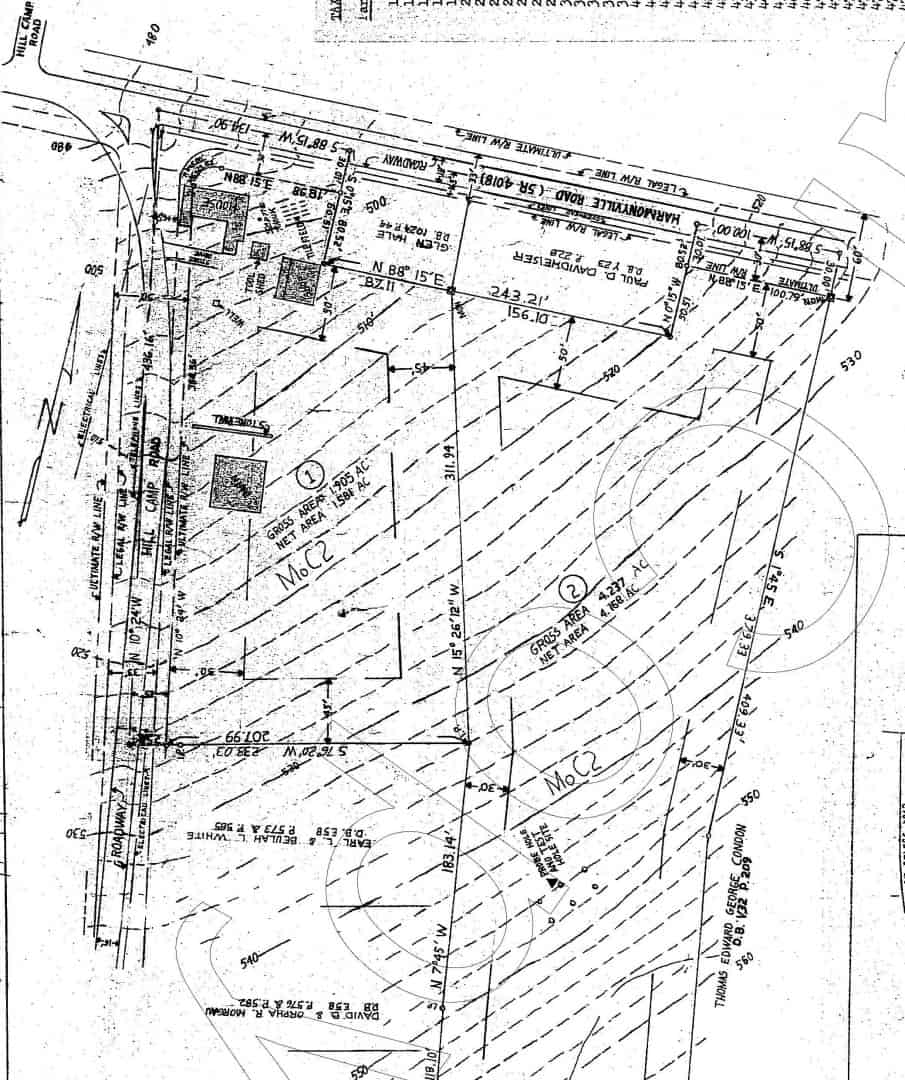
What particularly interests me about that is that it shows an existing structure partly in the statutory right-of-way in the position in which the 1883 farm map indicates a structure.
Bach Bach Bach CHICKEN! LOL

Scott Ellis, post: 445259, member: 7154 wrote: I am in no way a troll
You claim that you are not a troll. But on this subject you are trolling. It's not a good look for you. Let's drop it.

Mark Mayer, post: 445263, member: 424 wrote: You claim that you are not a troll. But on this subject you are trolling. It's not a good look for you. Let's drop it.
I never bring up the subject of PLSS being easier first. I always say it as a replied to the PLSS surveys taking jabs at Metes and Bounds states.
If they can not handle being reminded they are in a easy survey system they can quit talking jabs at the metes and bounds system.
Kent McMillan, post: 445258, member: 3 wrote: On the East line of Triangle "A" the engineering plan cum subdivision plat covering the land East of S Hill Camp Road shows a centerline of the road that evidently the responsible professional determined by some means to be that of S Hill Camp Road.
This at least shows monuments set and found, which yields the chance to agree with it. I'm still not seeing any justification for calling it the "legal right of way".
Dave Karoly, post: 445261, member: 94 wrote: Just another rude Texan, dime a dozen you are.
You and Kent "Talks big can't deliver" McMillan are trolls, you should just own it. True Kent is more suave about it.
What ever Dave you sit at your government desk job trying to tell private surveyors how to survey.
Why don't you fly halfway across the country to look for a rock in the road?
Scott Ellis, post: 445259, member: 7154 wrote: How many Surveys have you stamped and signed?
Scott Ellis, post: 445266, member: 7154 wrote: ... sit at your government desk job ....
You often make good contributions to the conversation. I'd dislike having to block you. But that's trolling. Drop it.

Mark Mayer, post: 445265, member: 424 wrote: This at least shows monuments set and found, which yields the chance to agree with it. I'm still not seeing any justification for calling it the "legal right of way".
The term "legal right-of-way" is, I believe, the minimum statutory right-of-way of 33 ft. along the centerline of that road
Here's the applicable Pennsylvania law:
Section 2306. Width of Public Roads.--The width of the right-of-way of a public road in townships shall not be less than thirty-three feet or more than one hundred and twenty feet, and the width of the right-of-way of alleys opened by the township as public roads shall not be less than fifteen feet. The minimum required width shall be in addition to any width required for necessary slopes in cuts or fills.
Section 2307. Certain Roads Declared Public Roads.--(a) Every road which has been used for public travel and maintained and kept in repair by the township for a period of at least twenty-one years is a public road having a right-of-way of thirty-three feet even though there is no public record of the laying out or dedication for public use of the road.
Mark Mayer, post: 445268, member: 424 wrote: You often make good contributions to the conversation. I'd dislike having to block you. But that's trolling. Drop it.
Mark
If you want to block me go ahead it. I am not going to sit back and let someone call me a Troll that I am rude and all talk and no delivery.

Kent McMillan, post: 445269, member: 3 wrote: The term "legal right-of-way" is, I believe, the minimum statutory right-of-way of 33 ft. along the centerline of that road
Here's the applicable Pennsylvania law:
Section 2306. Width of Public Roads.--The width of the right-of-way of a public road in townships shall not be less than thirty-three feet or more than one hundred and twenty feet, and the width of the right-of-way of alleys opened by the township as public roads shall not be less than fifteen feet. The minimum required width shall be in addition to any width required for necessary slopes in cuts or fills.
Section 2307. Certain Roads Declared Public Roads.--(a) Every road which has been used for public travel and maintained and kept in repair by the township for a period of at least twenty-one years is a public road having a right-of-way of thirty-three feet even though there is no public record of the laying out or dedication for public use of the road.
With all due respect, and there is much due (regardless of your clear attempts to get the goat of PLSS surveyors, and not necessarily speaking to the question at hand), when we out east look at ancient road layouts, and potential building encroachments thereon, we (I) tend to give the offending structure the right of way, so to speak. If a structure has been there since 1700, it likely has a right to be there. In fact there is a statute regarding improvements in the described right of way and the right to continue the occupation in Vermont. Not particularly interested in pulling up particular statutes at the moment, but will post tomorrow if interested.
I don't survey in PA, so cannot speak directly to the particular situation, but this is clearly a case where knowledge of local custom and common law are critical. This is no $700 lot staking, this is a typical colonial survey. The complications and nuances are many, and are best left to a practitioner skilled in this geographic area.
If anyone has an issue in the south end of Portsmouth, I'm glad to help, but with regards to the particulars of the OP, I will leave that to the local experts.
Sent from my SM-G900P using Tapatalk
Paul D, post: 445281, member: 323 wrote: With all due respect, and there is much due (regardless of your clear attempts to get the goat of PLSS surveyors, and not necessarily speaking to the question at hand), when we out east look at ancient road layouts, and potential building encroachments thereon, we (I) tend to give the offending structure the right of way, so to speak.
Actually, that was precisely why I mentioned the apparent encroachment into the 33 ft. right-of-way shown on that modern subdivision plat. It puts the correctness of the location of the right-of-way in question, particularly if the structure predates the road. That last bit is purely speculative, but plausible. The 1883 farm map of the township shows a structure in place on that side of the road that was evidently relocated sometime between 1873 and 1883.
On the other hand, as I understand the effect of the Pennsylvania statute under which that right-of-way would exist in the absence of any contrary record, if the road was originally established at a width less than 33 ft., there is nothing in the statute that would widen the road ex post facto.
As to waiting to hear from any Pennsylvania surveyors familiar with the area around Harmonyville in Warwick township of Chester County, I'm afraid that will be too long a wait. I thought the discussion progressed well in the absence of any local input aside from some folks who got agitated by the idea that some planted stone monuments might still exist under road pavements. That couldn't be helped, though.
Apparently there is a great business opportunity waiting for a surveyor who can demonstrate that he or she has unusual skill at actually finding the stones that are commonly regarded as either (a) never having been set or (b) having disappeared. It isn't clear, though whether he or she would be better paid to actually find the stones or NOT to find them.


I wish I had Kent's self-confidence. The stuff legends are made of...
I've tried to stay out of this one and let KNM spew his instructive and critical admonishments on someone other than us poor PLSS surveyors; it has been a breath of fresh air. But given the laws of statistics and the length of time Mr. McMillan has been practicing (in more ways than the literal) I found myself wondering about something:
Does anybody here think that Kent has ever been wrong as wrong could be? Will anybody here acknowledge the fact that nobody makes it through an entire career with stepping in your own poop and having to admit you're wrong and fix it? I wonder which would be easier for Kent; to admit he's wrong to others, or himself?
I have two sons. One is like me and holds his tongue (most of the time) until he's thought things through. His younger brother is a loud mouth and prone to some extremely obnoxious behavior. Talking about his boisterous younger brother, the older quiet son asked me once, "Dad how come nobody has ever whipped my brother's butt?"
My reply was simple. I told him I'm sure he's had his butt kicked. But we'll never know about it because he is just the kind of person that would never admit it to anyone. 😉
btw - I've stood around for over a month taking shots locating buried utilities for a big GPR contract at the local AFB. It is far from the silver bullet Kent suggests. In some cases it is practically useless.
paden cash, post: 445309, member: 20 wrote: I've tried to stay out of this one and let KNM spew his instructive and critical admonishments on someone other than us poor PLSS surveyors; it has been a breath of fresh air. But given the laws of statistics and the length of time Mr. McMillan has been practicing (in more ways than the literal) I found myself wondering about something:
Does anybody here think that Kent has ever been wrong as wrong could be?
What I've found over the course of a long career is that there is always more evidence than can be found in three hours on any project. That is an axiom of land surveying. The set stones that i've found in Texas have usually been unmistakable things, pieces of dressed stone, some of which had a top section broken off by a road grader, but with recoverable positions. My favorite was about an 8 x 8 piece of chalk limestone (not native to the locality) that was about 0.8 ft. away from (and 1.5 ft. lower than) an iron pipe that a very good surveyor had set in the late 1930s, plainly without having found the set stone.
No lookee, no findee is also axiomatic.

paden cash, post: 445309, member: 20 wrote:
Does anybody here think that Kent has ever been wrong as wrong could be?
Yes. But I try not to feed trolls.
Lately he has been guilty of making grand assumptions, then building upon them as if they are given Fact.
In general, he is being myopic. The world is much bigger than Texas.
But then again, he is being a subtle troll... deflecting and discrediting those that are not his fanbois.
Answering a simple direct question is not his nature.
Well, actually he is not so subtle.
Peter Ehlert, post: 445314, member: 60 wrote: Lately he has been guilty of making grand assumptions, then building upon them as if they are given Fact.
Well, the foregoing thread serves as is an example of how complex problems are solved by making trial assumptions and then carrying the investigation forward until other facts emerge. I consider this to be a fundamental way of solving mysteries and one that serves well. I trust it is understood that uncertainty is inherent in land surveying work, both in terms of measurements and in the details of the events in the history of a tract of land.
So, how does a professional surveyor deal with uncertainty? He or she does it by making good and reasonable estimates (which field measurements should be, for example) and then reconciling such discrepances as emerge when the picture as a whole is considered. What I have done in the course of this thread has been to demonstrate various iterations of trial assumptions with successive revisions as necessary, to arrive at trial solutions that successively reconcile more of the evidence as that evidence emerges. You should note that this process also guided the investigations that uncovered that evidence. Any surveyor who is afraid to dig in the wrong spot in case someone might be watching may want to just keep the truck parked at the office.

Kent McMillan, post: 445318, member: 3 wrote: Any surveyor who is afraid to dig in the wrong spot in case someone might be watching may want to just keep the truck parked at the office.
I'll definitely agree with that comment, 100%
Ya can't find what you don't look for!
Loyal

Reasons for not searching for the original stones in roads presented in this post.
- Experience has shown that they don't exist. All have been destroyed, removed at some instance in the past. It would be a time waster to search.
- Various hinderances to ROW for recovery. High costs associated with safety, excavation involving equipment and personnel. Costs that prohibit work acquisitions.
Some have provided answers to #1. Occupation evidence and later surveys are the basis of determination. Some have made facetious remarks about stonefinder services etc. So if the search for road stones are abandoned then maybe some Templarlike secret society of surveyors would organize to accept the task. Subterranean Stone Survey Society aka 'S4'
Probing rod, shovels, GPR or even a dowsing rod, it does not matter. One should take a look.
From the link to the Austin rental firm located in nearby Harrisburg, PA, it looks like a $400-600 expense. Tack on extra manpower costs then this could be an appreciable expense for a search effort.
#2, permission and procedures, this is a problem.
Local agencies and authorities have made it difficult to proceed with lane or traffic control to dig in pavement. Turf guarding. Some require paying a police presence for traffic control. This has handcuffed the surveyor in his duties and is a real concern.

As long as you let the client know just what it will cost her, just what the ramifications are, and just what the result of the search will accomplish; by all means go for it.
I haven't heard anyone give any kind of estimate from beginning to end or any kind of theory of what the end game is here.
I suspect that you all know what she would say to you if you did.
Alvin Tostick, post: 445324, member: 13000 wrote: Reasons for not searching for the original stones in roads presented in this post.
- Experience has shown that they don't exist. All have been destroyed, removed at some instance in the past. It would be a time waster to search.
- Various hinderances to ROW for recovery. High costs associated with safety, excavation involving equipment and personnel. Costs that prohibit work acquisitions.
Some have provided answers to #1. Occupation evidence and later surveys are the basis of determination. Some have made facetious remarks about stonefinder services etc. So if the search for road stones are abandoned then maybe some Templarlike secret society of surveyors would organize to accept the task. Subterranean Stone Survey Society aka 'S4'
Probing rod, shovels, GPR or even a dowsing rod, it does not matter. One should take a look.
From the link to the Austin rental firm located in nearby Harrisburg, PA, it looks like a $400-600 expense. Tack on extra manpower costs then this could be an appreciable expense for a search effort.#2, permission and procedures, this is a problem.
Local agencies and authorities have made it difficult to proceed with lane or traffic control to dig in pavement. Turf guarding. Some require paying a police presence for traffic control. This has handcuffed the surveyor in his duties and is a real concern.
When you consider how many locations could be investigated by GPR in a day, while the rental expense might be prohibitive for a relatively low-value small parcel survey with no valuable improvements planned, the economy of searching for twenty stones for the same rental price would drastically alter the unit cost. A surveyor working in a specific geographic area should be able to put the information generated to good use.
What really is needed is a technique that is optimized for finding planted stones of some threshold minimum size that is both spatially accurate and minimally invasive. In the case of Warwick township in Chester County, it appears that the search areas for most of the stones in roads would be generally significantly less than 20 ft. x 20 ft. and probably typically under 10 ft. x 10 ft.