

Or was that 0.134 difference, so moved points 0.067 outside? I blundered somewhere, not sure which.

rfc
Thanks for providing additional explanation. I had no idea, because there was no information about that in the original post, that you were analyzing a traverse for errors. Too, it was not obvious that this was an academic exercise and that you categorize or allude to yourself as a student.
The picture, if it accurately represents the traverse, helps interpretation. However, the 321 and 322 points are not shown. From where and how were they observed? A complete and scaled picture will yield more information than the sum of all individual discrete mathematical analyses. The picture should come first and the mathematical analyses should follow from the picture.
Terminology:
1 - "I had two lines that, in order to "align" them, meant both translation and rotation."
2 - "A transformation alone would not have solved the problem, because there was clearly angular mis-alignment apparent as well."
- - In mathematical discussion, transformation, means translation, rotation and scale. Transformation is the inclusive term. The solution I presented was a transformation that included only rotation and translation. Scale was not considered because it was not stated or there were no implications that measurement units for points 13 and 14 differed from those of 321 and 322. "Mis-alignment" indicates a need for "rotation." Tom's suggestion "I assumed you were trying to figure out how to rotate a closed figure into a common bearing base" is just another way of saying a transformation, only rotation, is desired. Of course, and this digresses, transformations can be confused with projections - another topic.
- - Bill93, in a following post, also implies a transformation. Although not exactly defined in the same manner as that I presented, it is similar. The least squares transformation translation points are the line midpoints and the rotation is alignment of one line with the other. This minimizes the square of the residuals between points 321 and 14 and 322 and 13. Because there are only two points with assumed equal weights or precisions, the residuals are equal.
Angular error analysis:
If it was desired to determine an angular error at point 14, its value would be that of angle 18-14-10. Then, around point 14 points 13, 12, 11 and 10 could be rotated by that amount to align point 10 with point 18, or, points 15, 16, 17, and 18 could be rotated to align point 18 with point 10. Verification of angular error would be determined by distance comparison from point 14 to points 10 and 18. A very small difference could indicate a 15-14-13 angular error (alluded to in one of Tom's posts). A significantly large difference could indicate error resulted from other measurements or sources.
Based upon the picture presented, any other solution would not yield meaningful results.
As in Cool Hand Luke, Paul Neuman said "What we have here is a failure to communicate!" The problem was presented with too many unknowns and assumptions and too few facts, especially those that were relevant. Desired objectives needed to be made clear. As stated prior, a complete scaled picture would greatly improve the communication. And that's why surveyors draw plats and maps - communication.

rfc, post: 328748, member: 8882 wrote: But if there's a geometric solution, there must be a mathematical solution too.
Saying "But if there's a geometric solution, then there's likely an algebraic one, too." would come close to squaring you with the mathematicians. An exception would be those who would say that using a trig function disqualifies the operation as an algebraic one. But that goes from being picky to being picky, picky.

geonerd, post: 328904, member: 8268 wrote: Show off :angel:
:-$ Wasn't really showing off, I was just trying to explain the steps I was taken to make the calculation. If I were trying to get the right answer I would have made sure and run some checks.

MLSchumann, post: 328962, member: 471 wrote: rfc
Thanks for providing additional explanation. I had no idea, because there was no information about that in the original post, that you were analyzing a traverse for errors. Too, it was not obvious that this was an academic exercise and that you categorize or allude to yourself as a student.
The picture, if it accurately represents the traverse, helps interpretation. However, the 321 and 322 points are not shown. From where and how were they observed? A complete and scaled picture will yield more information than the sum of all individual discrete mathematical analyses. The picture should come first and the mathematical analyses should follow from the picture.
Ya, understood. I purposely did not present the entire traverse, because I've got a number of errors in it, and I suspect they're due to flaky .rw5 editing (big on my plate at the moment for things to learn). I've found from past experience here that when it comes to such challenges, it's sometimes helpful to put out the big picture and ask for help if I'm stumped, but more often, more valuable if I just grind it out myself, point by point; observation by observation. In retrospect, I probably didn't help myself early on by doing three sets (BD/FD-FR/BR) everywhere, threw in multitudes of side shots, (also with sets), then mid traverse decided I needed (wanted) to be on SPC, took time out to learn that; just keeping track of all the edits has been a challenge; the files are pages long. Add to that learning two new pieces of software at the same time, and i've got my hands full.
But when I came upon the snippet I posted here, it intrigued me, so I threw it out there, hoping it'd point me to areas of the traverse to take a closer look at, (it did), and reaped the benefits (which included using least squares without software..something I never really gave much thought to before.)
So, to sum up...you're absolutely correct that throwing out a "complete and scaled picture will yield more information...." but without also supplying the volumes of raw data that would go along with such a patch quilt of a traverse, it wouldn't really serve my purpose right now. I'm blessed to be in position of not having to "figure it out before the boss comes in at 8 am" or anything like that. I'm a strong believer in the ages old adage: "Give a man a fish and you've fed him for a day; teach a man to fish, and you've fed him for life".
Thanks for all the help.:-)
MLSchumann, post: 328962, member: 471 wrote: Bill93, in a following post, also implies a transformation.
I restricted it to a rotation and a translation, as I understood the original problem statement. No more general transformation than that.
The translation is determined by the choice of pivot for the rotation. I tried least squares to find the pivot point, but there is so much leverage that LS was unable to do a decent job of converging on it. Once I got the whole problem in my head, it was obvious what it was trying to head for and I worked out the answer, but with a numerical blunder the first time.

Tom Adams, post: 328998, member: 7285 wrote: :-$ Wasn't really showing off, I was just trying to explain the steps I was taken to make the calculation. If I were trying to get the right answer I would have made sure and run some checks.
😉

I'm answering from a pure blunder detection as listed in the enlarged, elaborated illustration later.
If I have a closed traverse that doesn't close, I COGO between same points from both ends.
10 to 14 should = 18 to 14, and similar combinations.
That can often point to simple issues that then suddenly make sense and the lights come on.
rfc, post: 328748, member: 8882 wrote: But, if one wanted to estimate (or calculate as closely as possible), where the center of the circle would be, such that if one of the lines was rotated on an arc of that center point, the two would align very closely?
A fascinating problem you have posed, sir. Indeed, you can rotate one of the lines so that it aligns exactly with the other. And, one of the two pivot points can be found easily with algebra.
Here's the diagram:
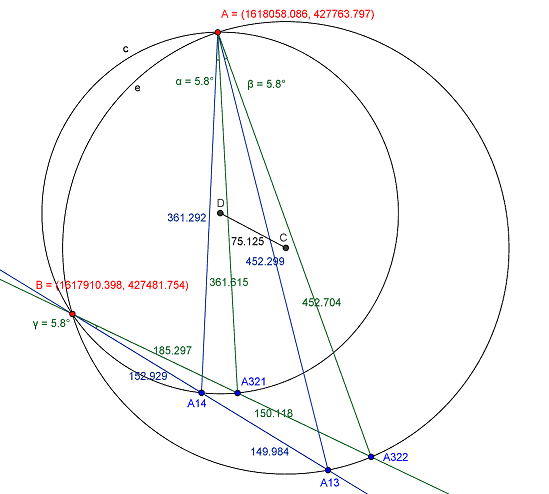
Note that one of the pivot points is the intersection point of the two lines. The other is the intersection of two circles. The first circle is the one that passes through points 14, 321, and the intersection of the two lines. The second one is the circle that passes through points 13, 322, and the intersection of the two lines. When you do this rotation, the two lines will coincide exactly and the error will disappear. If you visualize the two circles as the ends of a telescope, the points are misaligned only because you are looking through the telescope at an angle. When you square your view, the points coincide.
Points C and D are the centers of the two circles. They are just more than 75 feet apart. The angles between all of the significant pairs of lines emanating from the vanishing points are 5.8 degrees, which is the angle of rotation required to bring the lines into coincidence. Probably not the best way to handle blunders, but it is an interesting problem.

MathTeacher, post: 329170, member: 7674 wrote: A fascinating problem you have posed, sir. Indeed, you can rotate one of the lines so that it aligns exactly with the other. And, one of the two pivot points can be found easily with algebra.
Here's the diagram:
Note that one of the pivot points is the intersection point of the two lines. The other is the intersection of two circles. The first circle is the one that passes through points 14, 321, and the intersection of the two lines. The second one is the circle that passes through points 13, 322, and the intersection of the two lines. When you do this rotation, the two lines will coincide exactly and the error will disappear. If you visualize the two circles as the ends of a telescope, the points are misaligned only because you are looking through the telescope at an angle. When you square your view, the points coincide.
Points C and D are the centers of the two circles. They are just more than 75 feet apart. The angles between all of the significant pairs of lines emanating from the vanishing points are 5.8 degrees, which is the angle of rotation required to bring the lines into coincidence. Probably not the best way to handle blunders, but it is an interesting problem.
Cool.
Your two pivot points will make the lines co-linear, but only pivot A will make their endpoints near coincident, which I understood was the goal.
Furthermore, the lines 13-14 and 321-322 as given were not of identical length, only close. Therefore the optimum pivot point to minimize the difference in endpoints cannot be found exactly by this construction. And the perpendicular bisectors of the lines 13-322 and 14-321, using the method shown much earlier in this thread, do not intersect at exactly either Point A nor the optimum pivot.
Bill93, post: 329173, member: 87 wrote: the lines 13-14 and 321-322 as given were not of identical length, only close
It's hard to put one over on you, Bill. While it's true that, if points 321 and 322 move along their respective circles, they will coincide exactly with points 14 and 13, that would not be a rotation. A rotation keeps distances constant. Thanks for pointing that out and setting me straight. Your pivot point and mine are close to each other only because the two lines are almost the same length.
Brad Ott, post: 329172, member: 197 wrote: Cool.
Very Cool indeed!
As it's turning out, I found a 6 degree error on the other side of the traverse. This is interesting, to say the least.
If the goal were only to rotate one line to become co-linear with the other, I think there is a continuous locus of pivot points available, not just your A and B. Each choice of pivot point on that locus results in the rotated endpoints being a different distance along that target line. I haven't yet worked out what that locus looks like.
Bill93, post: 329214, member: 87 wrote: If the goal were only to rotate one line to become co-linear with the other, I think there is a continuous locus of pivot points available, not just your A and B. Each choice of pivot point on that locus results in the rotated endpoints being a different distance along that target line. I haven't yet worked out what that locus looks like.
Why wouldn't the center point of C and D be THE location to move the two lines about, (from their center points' current locations to their new location?
Before getting into any other discussions about the problem presented in the original post:
There are two significant conditions affecting the desired solution.
1. The measurement precision is the same for all the points given.
This means all points have the same weight.
2. The measurement units for the position of both lines is the same.
This means the scale is unity.
Because there are only two points, only two measurements for each and that precisions are the same, it means the residuals for or at the transformed point locations will be equal. Excluding the probability the measurements between the one set of measurements and the other are exactly the same, because scale is unity, the values of the residuals will not be zero.
An item I believe is being overlooked is that in a rotation, it is completely irrelevant where the rotation point is located. To comply with mathematical convention, I use the term rotation point instead of pivot point.
In the solution by MathTeacher, it is stated "Note that one of the pivot points is the intersection point of the two lines. The other is the intersection of two circles." This is all well and good. However, any point in the plane can be used to rotate about. Regardless of the rotation point location, it is the rotation amount determined by the difference in two line directions that aligns one line with another - that is - makes them parallel. By making the lines parallel, the residuals, associated only with the rotation, are minimized. For two parallel lines in a plane the minimized distance between the two lines is produced by the shortest line which is the length of a line normal to the two parallel lines.
To illustrate this, whether one uses pen and paper or a computer drafting program, one only has to draw two lines, one at a different direction than the other. Rotate one of the lines about any point by the difference in directions to make it parallel to the other. This shows that no matter what rotation point is used, if the lines are parallel, they are aligned along the same direction. It further illustrates the basic geometric theorem and its converse are true:
Parallel lines have the same direction and Two lines of the same direction are parallel.
Because of the conditions stated, the translation has to be from the mid-point of the rotated line to the mid-point of the other. If this is not the case, then the residuals will not be equal. As in the rotation case, this may be visualized by drawing on paper or the computer screen.
Using popsicle sticks, it is possible to physically reproduce the problem and solution. First, one stick is cut by a small amount and rounded. Then, both stick ends are labeled with 14 and 13 on one and 321 and 322 on the other and mid-points are marked on each. Next the sticks are laid down on a table in an orientation approximating that in the problem presented in the original post. After this, the stick labeled 321 and 322 is rotated, using any rotation point, to be parallel with the stick labeled 14 an 13. Keeping the the stick labeled 321 and 322 in its rotated orientation slide, transpose, it to the stick labeled 14 and 13. This completes a physical representation of a least squares transformation of rotation and translation for two points. It is that simple and not any more complicated than that. Just why would anyone want to complicate such a simple solution? Why?
While solutions so far presented may be to determine some other desired objective, they circumvent the simplicity of the geometry of the originally desired solution. It is possible to fly from Los Angeles to Seattle by flying from Los Angeles to Mexico City then to Denver and finally to Seattle. However, simplicity is achieved by flying directly from Los Angeles to Seattle. If there are reasons to be in Mexico City and Denver, then that's what needs be done. If there are no reasons, why then fly to Mexico City and Denver?
MLSchumann, post: 329357, member: 471 wrote: Just why would anyone want to complicate such a simple solution? Why?
One answer is that the original problem prohibited the use of a translation.
And the original post had had a goal of finding the best-fit rotation point. That seemed to be more important to him than finding the final position of the rotated line.
Bill93, post: 329404, member: 87 wrote: And the original post had had a goal of finding the best-fit rotation point. That seemed to be more important to him than finding the final position of the rotated line.
Absolutely correct. Long ago, you were one of the ones (helping me troubleshoot a traverse), who suggested that you should look for clues, possibly far from where the problem appears, swinging arcs from points that are situated in the right place to help figure out where the traverse went wrong.
In this case, I know I could translate and rotate "manually", just aligning the points, but that wasn't the point. I wanted to investigate first, a single blunder that might account for the disparity in location between these pairs of points. Then, if that didn't work, I'd investigate the possibility of more than one blunder (one angular, one distance). At this point I suspect that the case, but it's still early.
Way down on my list is finding the least squares answer to the "best fit" question. If and when I get there, I'd probably take into consideration as such things as the fact that 321 was an OP, 322 was a side shot (each with their own uncertainties), and 13 and 14 were manually plotted from a previously published survey, with unknown certainties, etc.
But above all, finding the answer is not nearly as important to me as the tremendously valuable conversation here about different ways to solve what in my head at first was just a curiously unique problem. This place is great.:good::good::good:
Not to beat a dead horse but, any rotation of two or more points will at minimum result in a translation. If the rotation point is one of the point the others will be translated. If the rotation point is not one of the points then, all points will be translated. It is impossible to do a rotation of two or more points without it resulting in a translation. The points move, meaning in mathematic parlance, they are translated. In Euclidian geometry, the notion that the problem can be solved without a translation is impossible. The response "One answer is that the original problem prohibited the use of a translation" did not disclose or denounce this impossiblility!
It has been my argument that it is not necessary in the surveying situation presented to find a rotation point that results in the desired translation. It is a digression and distraction. In designing mechanical parts, and this was alluded to in the first post, it may be a consideration. However, determining this special "rotation point" is not necessary for achieving the final objective of transforming the two points so that the residuals are minimized - "the two would align very closely" - called a "best fit" by some. Its educational value is that one learns it is not efficient. Perhaps the extra time and effort is justified for the surveyor as a function of time-billable hours? How is it justified for a client?
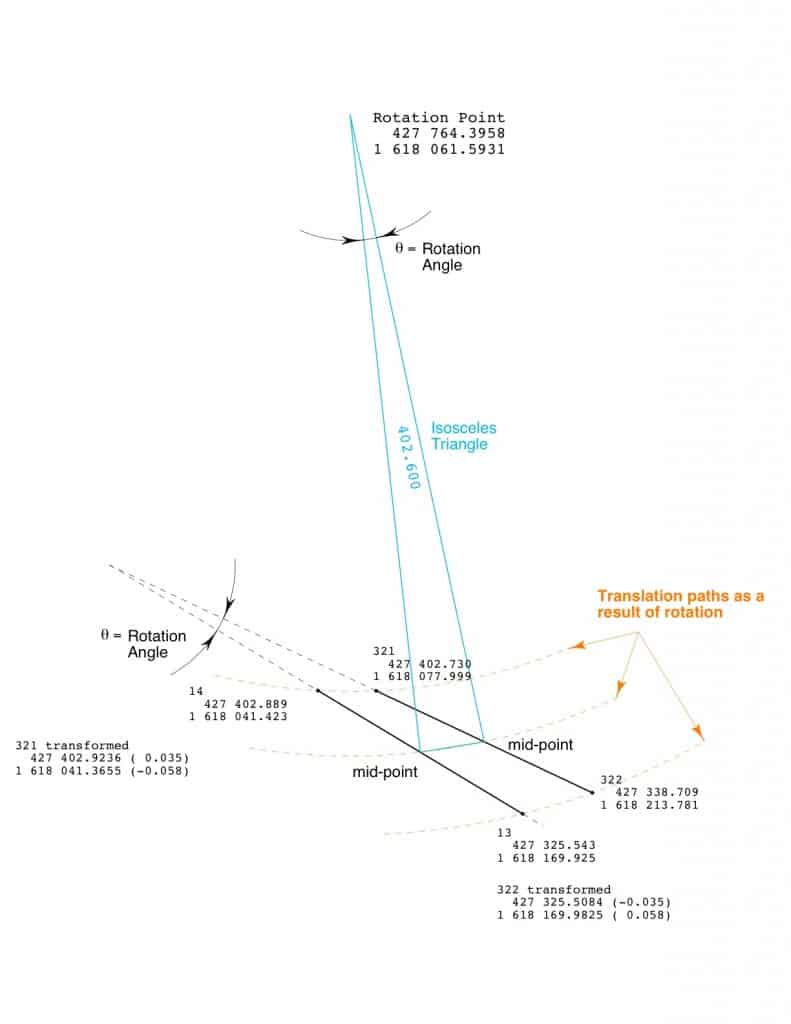
However, if it is so desired, in order to find the intermediate desired objective rotation point, the following steps will yield the solution:
1. Determine the difference in direction between the two lines to determine the rotation angle.
2. Construct an isosceles triangle with the rotation angle opposite or subtending the line connecting the mid-points of the two lines.
3. The rotation point is the vertex of the angle opposite the base of the isosceles triangle.
Refer diagram
Am I befuddled? A surveyor wanting to learn has taken himself down a path that does not lead to an efficient solution. Should he be directed to continue travel on that path or might it be better to suggest a direct path?
As for detecting traverse or survey network problems, in most cases drawing and examining a complete scaled drawing will not only reveal them but, suggest the more efficient solutions. Combined with a least squares adjustment, it is even more effective.