

Robert Hill, post: 409962, member: 378 wrote: He who laughs last has....
...dug the deepest.

I don't know CjRob, it looks to me like you missed he corner by a foot or so ! 🙂 LOL 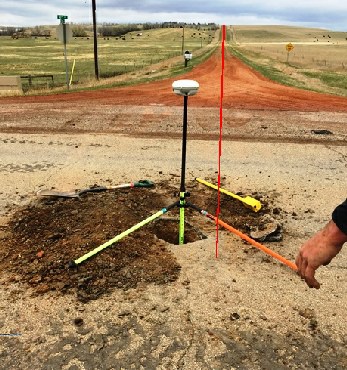

we need to remember the Home Owner. They need something they can see (not hidden and only a Surveyor can find)
something at the surface, a durable as possible, and a Corner Record

foggyidea, post: 409967, member: 155 wrote: I don't know CjRob, it looks to me like you missed he corner by a foot or so ! 🙂 LOL
Yeah it would appear that way ;), if that one is bad the one 8 feet east would be even worse. The one we found in the picture actually fits better believe it or not.

Why would a surveyor hesitate to set a new monument at the surface and document this by filing a corner record?
Is it considered taking on un-necessary liability?
imaudigger, post: 409988, member: 7286 wrote: Why would a surveyor hesitate to set a new monument at the surface and document this by filing a corner record?
Is it considered taking on un-necessary liability?
I hesitate setting a new monument over an existing monument without doing a new corner record, because I don't always trust that the person before has done their due diligence in researching the record. But if I would set a new monument over top of an existing monument, I would do a corner record.

The main reason I like setting a new marker over the top and leaving the old one underneath is if the top one ever gets removed the one down underneath is still there.

I agree (with those who said)....leave the original there and set a monument over it. Not a nail. It shows the owner where his corner is for cripes sake. If you have a vehicle to record what you did, (a corner record) and/or a survey plat do that as well.
A monument that deep is virtually useless. A pvc pipe is nice, but a good way to collect water that is hard to drain out. The purpose of "monumenting" your corners is so that they can be found. They shouldn't be buried under 2 feet of dirt.

I do not set monuments above deep monuments, because I do not want anyone following behind me to think the surface item is the monument. A called for 1/2" iron rod is the corner, not a 60d nail set on the surface. I have met survey hands who will not even dig their first trip around a property. They will use their GPS to store a point on any "Tone" they get, and send their work into the tech, who then crunches the numbers and tells them which tones are more likely to be the right place to dig. I am not about to leave a nail that could be off because I pushed down in the soft dirt when I stood up for them to mistake for a corner. Yes, the trade off is those same crews probably won't dig deep enough to find those rebar anyways, but that's the difference between el cheapo rapido survey crews and those of us who take a little pride in our work.

I wouldn't mess with what is there or leave anything that could damage it. It looks like you dug a fine hole and thus made it easier for the homeowner to find it as long as you set a witness and perpetuated it is with a map. I am in a recording state which provides us a vehicle to do pretty much anything reasonable. Since this was a front corner one could have set an offset in the pavement. Dad would have left the hole but put a flag stone over it. I hate to reach down into open holes though because squishy things live down there.
I wonder though, if the ditch was filled in, where does the road drainage go?

If monuments are too deep, such as .75' or so, I set my monument (pin with my cap) over said monument. Then note this on my plat that is required to be recorded. If the monument is above .75', then I do not set anything above it. I am afraid the monument I would set above would be too short to guarantee the stability. In this case, a lot of times I leave the monument exposed and show the owner. They can then mark it however they want. I don't worry about the next surveyor too much. If they do there job properly, they will have a copy of my plat and know that the monument is deep or that my pin is directly over a deep monument. If the monument or my set monument is at the surface, I usually tell the owner to dig around it, bury a coffee can around it, and fill it will Concrete. If they do or not, that's up to them. Just a suggestion. I personally do not like nails above found monuments. Too easily disturbed.
Sent from my SM-G930R4 using Tapatalk
I have tied flagging and ran it up as I back filled the hole, also have just dumped extra flagging in the hole as well. Unless the customer requests that he is able to "see" the corners (or a fence guy or such) I wouldn't really leave any nails, and wouldn't bother with double setting a corner. Good find though!

I heard a story a number of years ago from another surveyor who was digging for a monument when he came across either a business or index card, I can't recall which- it had some writing that said something like, "Keep digging- you're halfway there".
I've also tossed extra flagging in holes; anything that can alert another surveyor that they're digging in the correct location is a good thing. Although nowadays, I try to leave them accessible whenever possible to be in compliance with WAC 332-120-020.
The only superior evidence is that which you haven't yet found.

When I first started surveying most property corners were 2"x2" redwood stakes, usually painted white.
It was common to put a flattened beer can over the point so the next guy wouldn't damage the wood when digging for it.
It was also a good excuse to have beer cans in the truck.

When I set permanent control monuments on Forest Roads I dig down a foot and set the rebar/cap in the bottom then bury it. A couple of references on nearby trees is useful to find it again. Hopefully it'll survive road maintenance that way.

I encountered one quarter corner located near a railroad crossing in the middle of a graveled county road. Over time the road bed had been elevated, apparently more than once, to lessen the steepness of the approach to the crossing. Following the record surveys we learned that the original monument was a limestone of specific dimensions set in the government survey in 1865. Above that was a 1" axle approximately 24" in length set in the 1930's. Above that was a 5/8" iron bar approximately 24" in length set in the 1950's. We found the 5/8" iron bar a bit more than two feet deep per the references from the 1950's. We then set a 1/2" rebar 24" in length above that to make the future surveyors jobs considerably easier than what we had encountered.

I think just about any surveyor would shoot your nail and see that it matched the subdivision plat and never dig it up because they would assume a nail was set because something was below the depth of the nail that didn't need to be disturbed or penetrates by a monument that was longer.
If the attached washer has identification back to you or your company I'm a going again have to assume that you intended for it to be the corner and I shouldn't disturb it, as the identification maker is per the board rules.
If it isn't marked with identifying information I'm going to be wondering who in the world isn't following board rules or who in the world is setting traverse points near a property corner and I will then shoot it and dig it up and see if anything is under it

Alan Cook, post: 409964, member: 43 wrote: I think raising the original monument to the surface would be a consideration. It seems that we have a duty to rehab corner monuments that we find displaced, bent, run over, or what have you, and that raising an original monument to the surface would serve the public interest.
The problem with resetting the original m0nument at a higher level that will fall in fill instead of undisturbed earth is that you destroy part of the proof of the fact that the marker is original and undisturbed in the process if there is no means to leave a record of your controlled relocation of the monument.
I wouldn't assume that the surveyor who set the marker doesn't have a record of the elevation at which it was originally placed in relation to all of the other markers he or she set when the subdivision was laid out. If there is such a record, the gross discrepancy in the position of the reset marker would be an excellent proof that it was not in fact an original undisturbed boundary marker from the original layout of the subdivision and resetting it would have been a waste of time.
What I think is a much better practice is to set self-explanatory reference markers. One option that works well is to set a spike and washer on the extension of the side lot line and in a drill hole in the curb or sidewalk stamped "PL EXTENDED", with the offset for extra credit. Naturally, if there is no curb, a rod and cap will work as long as it has explanatory stampings (obviously not an option with El Cheapo brand plastic caps) and it isn't close enough to the actual monument to conceal its magnetic signature.
I can't count the number of times that I've had to reference a newly set marker to dig beneath it to find the original remaining in place. Give the next surveyor some clue. BTW 16" to 22" of cover isn't really that deep as long as you keep the addtional ferrous junk away from the actual marker.
If you feel the need to add a marker that is visible on the surface, just cut a length of 1/2" thin-wall PVC irrigation pipe, set it over the buried marker, and backfill the hole. No competent surveyor should be confused by that, but the landowner will be able to use it for building fences and landscaping. The PVC won't bother a metal detector and you can even leave the PVC up a foot or so if high visibility seems warranted.

Be sure to leave a monument on the point that a landowner can see, find and use, we don't survey for surveyors. Hopefully the state rules aren't restrictive to the point that it's cost prohibitive to file a record of survey.
In Texas there is no place to file drawings of surveys in the courthouse?

I like to use the flagging approach. A surveyor will follow bits of flagging right down to the monument, I know I do anyway.
Shawn, please post the make/model of that 5oz detector, LOVE to have one!