Reading RPLS is free for the whole profession. Members post, reply, and get the members-only rooms.

Notifications
Clear all

Topic starter
Translate
▼
English
Spanish
French
German
Italian
Portuguese
Russian
Chinese
Japanese
Korean
Arabic
Hindi
Dutch
Polish
Turkish
Vietnamese
Thai
Swedish
Danish
Finnish
Norwegian
Czech
Hungarian
Romanian
Greek
Hebrew
Indonesian
Malay
Ukrainian
Bulgarian
Croatian
Slovak
Slovenian
Serbian
Lithuanian
Latvian
Estonian
Guys,
I am NOT trying to cause trouble, although I would be surprised if some/many are not troubled by my commentary.
I just re-read Knud Hermansen's piece, "A Surveyor's Responsibility and Possession Boundaries." I don't know how to make a link, but probably someone after me will do so.
Anyway, I agree with him 100%.
Here is my rub, though. The real issue is this: The problem is not whether to monument the fenceline as the boundary (which is NOT the surveyor’s role), but when to recognize the fence as a monument (which IS the surveyor’s role)?
How does one decide. In cases of monuments of record, the issue is pretty clear. How bout when there is no record?
When is a fence just a fence? When is it a monument?
I know that there is no "score card" which when all 15 of these 20 questions are answered in the affirmative that the fence becomes a monument, but there must be some underlying principles which we all have used to make such a determination.
How FAR do you routinely go in the way of collecting testimony as to age, purpose, acceptance, etc., of a fence?
When I began my boundary surveying career in the mid 1970's (10 years after starting in construction/highway surveying, I was mentored that the deed is PARAMOUNT.
WHAT THE DEED SAYS (LITERALLY, IS WHAT THEY OWN.)
I have had the pleasure of surveying (and licensed) in 6 states, conducted boundary surveys adjoining and international border (wasn't smart enough at the time to know that I shouldn't have done that +o( , am one of the beta CFedS class.
I have earned my moniker. But, I recognize that I can always learn, even if I am old enough that I will have to re-learn it tomorrow because I have forgotten it, again.
I love this site!!!!!!!
thanx,
Geezer;-)
Posted : March 7, 2013 10:44 am

Translate
▼
English
Spanish
French
German
Italian
Portuguese
Russian
Chinese
Japanese
Korean
Arabic
Hindi
Dutch
Polish
Turkish
Vietnamese
Thai
Swedish
Danish
Finnish
Norwegian
Czech
Hungarian
Romanian
Greek
Hebrew
Indonesian
Malay
Ukrainian
Bulgarian
Croatian
Slovak
Slovenian
Serbian
Lithuanian
Latvian
Estonian
I think it is ethical to:
1.) Do a FENCE LINE / occupation line survey, and LABEL it as such, and let the CLIENT by his actions MAKE it into record title. Via Court, Quitclaim etc.
2.) Do a RECORD TITLE survey, showing what the deeds say, and all conflicts therewith.
3.) Do a COMBINATION survey, so long as everything is LABELED!
OK?
It is UN ethical to do the above 1 or 3, and PRETEND it is a 2 above.
TELL WHAT YOU DID, and we are ok.
I sometimes do a "Record Title Survey" and then add the note to ONE or several corners, "Yielded to found Monument" when it is reasonable.
N
Posted : March 7, 2013 10:58 am

Translate
▼
English
Spanish
French
German
Italian
Portuguese
Russian
Chinese
Japanese
Korean
Arabic
Hindi
Dutch
Polish
Turkish
Vietnamese
Thai
Swedish
Danish
Finnish
Norwegian
Czech
Hungarian
Romanian
Greek
Hebrew
Indonesian
Malay
Ukrainian
Bulgarian
Croatian
Slovak
Slovenian
Serbian
Lithuanian
Latvian
Estonian
I have not read the article, but in the context of the title "possession boundaries", I say it's not a monument until the parties put it in writing or a judge does.
Absent a written agreement by the parties, all the surveyor can do is give an opinion of what they think a judge will say, based on the evidence so far available (more may turn up in a litigation process). I think the surveyor has a duty to investigate enough to determine if the parties are in disagreement over whether the line is the fence, so that it can be noted. A reasonable investigation would include talking with both parties if it appears possession does not agree with the deed lines.
Posted : March 7, 2013 11:46 am

Translate
▼
English
Spanish
French
German
Italian
Portuguese
Russian
Chinese
Japanese
Korean
Arabic
Hindi
Dutch
Polish
Turkish
Vietnamese
Thai
Swedish
Danish
Finnish
Norwegian
Czech
Hungarian
Romanian
Greek
Hebrew
Indonesian
Malay
Ukrainian
Bulgarian
Croatian
Slovak
Slovenian
Serbian
Lithuanian
Latvian
Estonian
You begin with the questions:
1) Who built the fence or caused it to be built?
2) Why did they build the fence?
3) How did they decide to place the fence where it is at?
4) If it was placed as a boundary fence, what method did they use to determine the (presumed) correct location?
5) Was there any previous establishment of the boundary on the ground?
Once you get the answers to those, then you have information to begin analyzing the matter. There are other pertinent questions that could be asked, and more may come up based on the answers to these.
It's normally not a decision one can make just by viewing the fence. It's an investigation to determine if it is reliable evidence of a valid boundary establishment. If it is, it's not representative of an unwritten right, adverse possession, or any other sort of transfer. It is simply a reasonable attempt to have made an original establishment of the boundary described in the deed.
And with that thought, I come up with another couple of questions:
6) Did the fence precede the deed describing the line?
7) Was the present fence built along the same course as an older partition that it replaced? If so, start seeking the answers to all of the same questions about the previous fence, wall, hedge, whatever.
Posted : March 7, 2013 1:20 pm
Topic starter
Translate
▼
English
Spanish
French
German
Italian
Portuguese
Russian
Chinese
Japanese
Korean
Arabic
Hindi
Dutch
Polish
Turkish
Vietnamese
Thai
Swedish
Danish
Finnish
Norwegian
Czech
Hungarian
Romanian
Greek
Hebrew
Indonesian
Malay
Ukrainian
Bulgarian
Croatian
Slovak
Slovenian
Serbian
Lithuanian
Latvian
Estonian
Evan,
I appreciate your thoughts. Definitely a list to begin with. Not to be negative, but in my experience, most of those answers are going to be guesses, abeit hopefully educated guesses.
thanx,
Geezer
Posted : March 7, 2013 2:00 pm

Translate
▼
English
Spanish
French
German
Italian
Portuguese
Russian
Chinese
Japanese
Korean
Arabic
Hindi
Dutch
Polish
Turkish
Vietnamese
Thai
Swedish
Danish
Finnish
Norwegian
Czech
Hungarian
Romanian
Greek
Hebrew
Indonesian
Malay
Ukrainian
Bulgarian
Croatian
Slovak
Slovenian
Serbian
Lithuanian
Latvian
Estonian
Posted : March 7, 2013 2:07 pm

Translate
▼
English
Spanish
French
German
Italian
Portuguese
Russian
Chinese
Japanese
Korean
Arabic
Hindi
Dutch
Polish
Turkish
Vietnamese
Thai
Swedish
Danish
Finnish
Norwegian
Czech
Hungarian
Romanian
Greek
Hebrew
Indonesian
Malay
Ukrainian
Bulgarian
Croatian
Slovak
Slovenian
Serbian
Lithuanian
Latvian
Estonian
> Not to be negative, but in my experience, most of those answers are going to be guesses, abeit hopefully educated guesses.
That's exactly the point. You're typically dealing with old fences that no one knows who built or when.
There are really two questions, in my view:
- Does the fence offer a clue as to where a line was originally run? That is, is the fence something that appears to have been built to a line run and marked that has some resemblance to the record title?
- Does the fence represent some agreement between adjoining landowners (keeping in mind that the mere existence of a fence proves nothing (in Texas) other than that there is a fence there)?
If all you've got is a ragged pasture fence that nobody knows who built or for what purpose, then I'd ask any surveyor who wants to insist it's the boundary to step out of the car.
Posted : March 7, 2013 10:47 pm

Translate
▼
English
Spanish
French
German
Italian
Portuguese
Russian
Chinese
Japanese
Korean
Arabic
Hindi
Dutch
Polish
Turkish
Vietnamese
Thai
Swedish
Danish
Finnish
Norwegian
Czech
Hungarian
Romanian
Greek
Hebrew
Indonesian
Malay
Ukrainian
Bulgarian
Croatian
Slovak
Slovenian
Serbian
Lithuanian
Latvian
Estonian

Posted : March 8, 2013 7:03 am

Translate
▼
English
Spanish
French
German
Italian
Portuguese
Russian
Chinese
Japanese
Korean
Arabic
Hindi
Dutch
Polish
Turkish
Vietnamese
Thai
Swedish
Danish
Finnish
Norwegian
Czech
Hungarian
Romanian
Greek
Hebrew
Indonesian
Malay
Ukrainian
Bulgarian
Croatian
Slovak
Slovenian
Serbian
Lithuanian
Latvian
Estonian
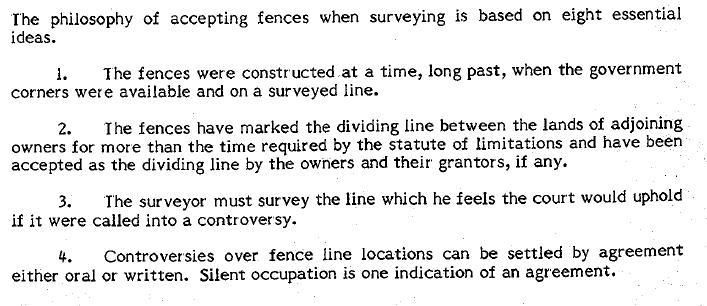
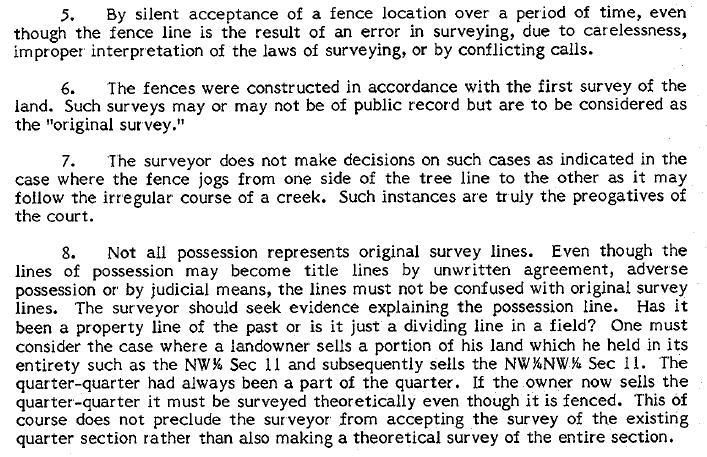
Could you please provide a citation for the above clips?
Posted : March 8, 2013 8:42 am
Translate
▼
English
Spanish
French
German
Italian
Portuguese
Russian
Chinese
Japanese
Korean
Arabic
Hindi
Dutch
Polish
Turkish
Vietnamese
Thai
Swedish
Danish
Finnish
Norwegian
Czech
Hungarian
Romanian
Greek
Hebrew
Indonesian
Malay
Ukrainian
Bulgarian
Croatian
Slovak
Slovenian
Serbian
Lithuanian
Latvian
Estonian
I will provide a citation hopefully later today
Posted : March 8, 2013 9:15 am
Translate
▼
English
Spanish
French
German
Italian
Portuguese
Russian
Chinese
Japanese
Korean
Arabic
Hindi
Dutch
Polish
Turkish
Vietnamese
Thai
Swedish
Danish
Finnish
Norwegian
Czech
Hungarian
Romanian
Greek
Hebrew
Indonesian
Malay
Ukrainian
Bulgarian
Croatian
Slovak
Slovenian
Serbian
Lithuanian
Latvian
Estonian
> Guys,
>
> I am NOT trying to cause trouble, although I would be surprised if some/many are not troubled by my commentary.
>
No trouble at all caused. This is an incredibly important topic for discussion anytime it's raised. And, yes. Some may be "troubled" but the reality remains; there is a separation in our profession between those trained under two doctrines of surveying.
> I just re-read Knud Hermansen's piece, "A Surveyor's Responsibility and Possession Boundaries." I don't know how to make a link, but probably someone after me will do so.
>
> Anyway, I agree with him 100%.
>
I used to eat articles like this up, hook, line and sinker. I was, after all, trained up under the same doctrine and view Dr. Hermansen as one of my early mentors. My study of the law since my early training has radically changed my view. There have been many fundamental changes in the law in recent decades which have allowed the surveying profession to formulate and express their opinions with regard to boundary locations. I have testified in court numerous times over my career and have learned a great deal from that experience. It's changed the way I think and the way I survey.
I disagree with Hermansen's premise laid out in the beginning of the article. He states in the first paragraph:
"A professional land surveyor’s responsibilities in regard to performing a boundary retracement survey are composed of two dependent parts. First, the surveyor is required ‘to follow in the footsteps of the original surveyor.’ ... The second part of the surveyor’s responsibility is to provide their client with a defensible professional opinion on the location of the boundary (i.e., original footsteps) communicated in a useful and understandable manner."
I have come to the conclusion that there is only one responsibility for the surveyor: Gather the evidence necessary to determine the location of the boundary. I would agree that sometimes the evidence points to a boundary laid down by footsteps of an early surveyor (the first premise of Hermansen's article). When retracing footsteps, an occupation line established soon after the survey was conducted may provide the best available evidence of the footsteps. I would agree with Hermansen's second premise that we have a responsibility to provide an opinion of the boundary and to communicate that opinion effectively. I disagree with equating the "boundary" with "i.e. original footsteps."
The courts are replete with examples of boundaries established with no reference to any "original footsteps" yet the boundary is legally established in all cases by applying one of a limited set of rules in every case. The courts never distinguish one type of boundary from another. Every boundary is seen as either having been established or not yet established. That's why we see the courts take the position that there are two types of surveys: one that represents the location of an unestablished boundary in accordance with the intent of the landowners and one that retraces the established boundary. If there are only these two types of boundaries, why is the surveying profession attempting to determine which boundaries we can locate and which boundaries we cannot?
> Here is my rub, though. The real issue is this: The problem is not whether to monument the fenceline as the boundary (which is NOT the surveyor’s role), but when to recognize the fence as a monument (which IS the surveyor’s role)?
>
Have you ever seen a single court case where this statement was made? I've seen it written in surveying texts and had it driven into my head as a young trainee to the point of indoctrination. Has anyone in our profession ever been chastised by the court for determining an occupation line as a boundary? No. Instead I see case after case upholding surveyors who properly determine the boundary location in accordance with the legal principles. I also frequently read cases which outright chastise surveyors for NOT recognizing occupation lines which provide the best evidence of an established boundary.
The most often quoted phrase concerning land surveyors in American courts is quoted from Chief Justice Cooley's case of Diehl v. Zanger where "the visitation of the surveyor might well be set down as a great public calamity." How long will we argue this point before we hear what the court is telling us? Many of our profession blatantly refuse to recognize legally established boundaries and continue to "cause consternation in many communities" and cause "incalculable mischief".
Instead of hearing what the court is proclaiming, we seem satisfied with the general notion that we've come to be known by: "No two surveyors can ever agree." Curt Brown, in a 1979 article entitled "Land Surveyor's Liability to Unwritten Rights," stated:
"In my early writings, I generally advocated that surveyors should locate land boundaries in accordance with a written deed; all conveyances based upon unwritten rights should be referred to attorneys for resolution. ... Can a surveyor monument the lines of ownership obtained by unwritten means? To my knowledge, absolutely nothing in the law prevents him from doing so. Clearly from my conversations with attorneys, this is not an unauthorized practice of law. ... The real question is, What should he do?"
> How does one decide. In cases of monuments of record, the issue is pretty clear. How bout when there is no record?
> When is a fence just a fence? When is it a monument?
>
The courts have provided our profession with centuries of clearly cut examples reciting intricate details designed to answer these very questions. How is it that we can claim ignorance of the law?
> I know that there is no "score card" which when all 15 of these 20 questions are answered in the affirmative that the fence becomes a monument, but there must be some underlying principles which we all have used to make such a determination.
>
Yes. In fact, there is a "score card" that the courts rely upon every time. And, there are only a few questions which must be answered if every case. There are five distinct "underlying principles" the courts have laid down for us to follow when we determine the location of every boundary we ever survey. Yet, we've been taught or have simply supposed that we can't apply the law when deriving our opinions; or, we've determined that some boundary laws we can apply while others we cannot. That is our demise. We are expected to know the law and to properly apply the law every time we make a boundary determination.
> How FAR do you routinely go in the way of collecting testimony as to age, purpose, acceptance, etc., of a fence?
>
As far as is reasonably necessary. How hard is it to ask a few questions and how long do we expect it takes? These questions, when asked as a routine part of our initial reconnaissance, can often save hours of discovery time to find evidence which is readily available when a proper question is posed to the right individual. When we overlook interviewing the landowners with regard to their boundaries, we overlook a vital part of the evidence the court routinely relies upon to determine boundaries. When did it become acceptable practice for surveyors to ignore or fail to gather the evidence?
> When I began my boundary surveying career in the mid 1970's (10 years after starting in construction/highway surveying, I was mentored that the deed is PARAMOUNT.
> WHAT THE DEED SAYS (LITERALLY, IS WHAT THEY OWN.)
>
I, too was taught this very principle. I've come to find that it is a myth. The purpose of the deed is clearly laid out by the courts as being to identify the parcel conveyed and the nature of the estate conveyed. It is not the station of the description to "describe in every detail" the location of the boundaries. Once the parcel is identified, the surveyor's role is to utilize the written evidence along side of other documentary evidence (neighboring deeds, surveys, etc.), physical evidence, and parol testimony, to determine the facts presented, and to apply the appropriate rule of law which supports the boundary as established.
> I have earned my moniker. But, I recognize that I can always learn, even if I am old enough that I will have to re-learn it tomorrow because I have forgotten it, again.
>
This is the best realization I have ever had. The more I study, the more I learn. The more I learn, the more I learn that I don't yet know. The more I don't know, the more I study. I'm always open to learn more than I know today.
JBS
Posted : March 8, 2013 10:28 am

Translate
▼
English
Spanish
French
German
Italian
Portuguese
Russian
Chinese
Japanese
Korean
Arabic
Hindi
Dutch
Polish
Turkish
Vietnamese
Thai
Swedish
Danish
Finnish
Norwegian
Czech
Hungarian
Romanian
Greek
Hebrew
Indonesian
Malay
Ukrainian
Bulgarian
Croatian
Slovak
Slovenian
Serbian
Lithuanian
Latvian
Estonian
There should be a J.B. Stahl textbook on every shelf next to Brown, et. al.
Posted : March 8, 2013 10:44 am

Translate
▼
English
Spanish
French
German
Italian
Portuguese
Russian
Chinese
Japanese
Korean
Arabic
Hindi
Dutch
Polish
Turkish
Vietnamese
Thai
Swedish
Danish
Finnish
Norwegian
Czech
Hungarian
Romanian
Greek
Hebrew
Indonesian
Malay
Ukrainian
Bulgarian
Croatian
Slovak
Slovenian
Serbian
Lithuanian
Latvian
Estonian
> There should be a J.B. Stahl textbook on every shelf next to Brown, et. al.
Just don't put it next to this 😉
Posted : March 8, 2013 10:49 am

Translate
▼
English
Spanish
French
German
Italian
Portuguese
Russian
Chinese
Japanese
Korean
Arabic
Hindi
Dutch
Polish
Turkish
Vietnamese
Thai
Swedish
Danish
Finnish
Norwegian
Czech
Hungarian
Romanian
Greek
Hebrew
Indonesian
Malay
Ukrainian
Bulgarian
Croatian
Slovak
Slovenian
Serbian
Lithuanian
Latvian
Estonian
I will state the obvious: he would have to write it first which doesn't seem to be happening.
I don't blame him, it would be a big job with little reward. Another national textbook doesn't seem to be what we need, anyway.
There are resources available mostly written by Attorneys, some State specific, which are updated yearly, not every two decades. The national textbooks have their place as a starting point but the problem they have been largely treated as the "only thing."
Posted : March 8, 2013 10:55 am

Translate
▼
English
Spanish
French
German
Italian
Portuguese
Russian
Chinese
Japanese
Korean
Arabic
Hindi
Dutch
Polish
Turkish
Vietnamese
Thai
Swedish
Danish
Finnish
Norwegian
Czech
Hungarian
Romanian
Greek
Hebrew
Indonesian
Malay
Ukrainian
Bulgarian
Croatian
Slovak
Slovenian
Serbian
Lithuanian
Latvian
Estonian
JB's philosophies and CA case law are somewhat divergent. For other locales, maybe not so much. Your mileage may vary.
Posted : March 8, 2013 11:18 am

Translate
▼
English
Spanish
French
German
Italian
Portuguese
Russian
Chinese
Japanese
Korean
Arabic
Hindi
Dutch
Polish
Turkish
Vietnamese
Thai
Swedish
Danish
Finnish
Norwegian
Czech
Hungarian
Romanian
Greek
Hebrew
Indonesian
Malay
Ukrainian
Bulgarian
Croatian
Slovak
Slovenian
Serbian
Lithuanian
Latvian
Estonian
JBStahl
Great post as usual and thanks for sharing your professional views on surveying issues.
It seems to me that some surveyors cling to their belief that only the record deed can be laid out on the ground and use the phony baloney reason that "you can't sell what you don't own"!
Well it is the responsibility of the surveyor to find out what the landowner does own?
Some use the deed entirely, some use the protracted lines entirely and some use judgement in determining the boundaries as have been established on the ground.
I think it comes down to liability and some surveyors think that they are safe when using the deed or protracted lines only!
After all, they can read it in some textbooks that this is the way.
The best part of it all, is a board like this where various opinions are stated daily and hopefully will make all stop and think a little more about what they are doing.
I would guess that there are not that many surveyors that have your experience, background research, and general knowledge of the survey profession and we all should be thankful for you sharing.
Sincerely,
Keith
Posted : March 8, 2013 11:32 am
Translate
▼
English
Spanish
French
German
Italian
Portuguese
Russian
Chinese
Japanese
Korean
Arabic
Hindi
Dutch
Polish
Turkish
Vietnamese
Thai
Swedish
Danish
Finnish
Norwegian
Czech
Hungarian
Romanian
Greek
Hebrew
Indonesian
Malay
Ukrainian
Bulgarian
Croatian
Slovak
Slovenian
Serbian
Lithuanian
Latvian
Estonian
> JB's philosophies and CA case law are somewhat divergent. For other locales, maybe not so much. Your mileage may vary.
Huh????
Not hardly. From my conversations with JB, reading his many informative posts, and my own extensive studying, I believe JB's "philosophies" are directly in line with CA case law, Idaho case law, Texas case law, Phillipine case law, Maine case law, Arizona case law, etc., etc, etc,.
I believe JB's philosophy is nothing more than a surveyor should is professionally obligated to learn the law, learn how to apply the law, and apply the law in accordance with the laws of the jurisdiction(s) in which you practice. How can that be contrary to any state's law?
It may be contrary to the writings, teachings, and beliefs of many surveyors, licensing boards, authors, mentors and attorneys, but it certainly isn't contrary to what the courts and public expect us to do.
Posted : March 8, 2013 11:38 am
Translate
▼
English
Spanish
French
German
Italian
Portuguese
Russian
Chinese
Japanese
Korean
Arabic
Hindi
Dutch
Polish
Turkish
Vietnamese
Thai
Swedish
Danish
Finnish
Norwegian
Czech
Hungarian
Romanian
Greek
Hebrew
Indonesian
Malay
Ukrainian
Bulgarian
Croatian
Slovak
Slovenian
Serbian
Lithuanian
Latvian
Estonian
> There should be a J.B. Stahl textbook on every shelf next to Brown, et. al.
I'd settle for someone actually reading Diehl v. Zanger and what Justice Cooley said in passing about original monuments. The implication in that case was that the pattern of old occupation was the best available evidence of where boundaries actually had been marked when the subdivision had been laid out. The contrary position was a merely theoretical line that the City Engineer (as I recall) had run with no connection to any identifiable corner of the original subdivision.
Posted : March 8, 2013 11:40 am
Translate
▼
English
Spanish
French
German
Italian
Portuguese
Russian
Chinese
Japanese
Korean
Arabic
Hindi
Dutch
Polish
Turkish
Vietnamese
Thai
Swedish
Danish
Finnish
Norwegian
Czech
Hungarian
Romanian
Greek
Hebrew
Indonesian
Malay
Ukrainian
Bulgarian
Croatian
Slovak
Slovenian
Serbian
Lithuanian
Latvian
Estonian
You could post any or some divergent opinions?
Posted : March 8, 2013 11:42 am

Translate
▼
English
Spanish
French
German
Italian
Portuguese
Russian
Chinese
Japanese
Korean
Arabic
Hindi
Dutch
Polish
Turkish
Vietnamese
Thai
Swedish
Danish
Finnish
Norwegian
Czech
Hungarian
Romanian
Greek
Hebrew
Indonesian
Malay
Ukrainian
Bulgarian
Croatian
Slovak
Slovenian
Serbian
Lithuanian
Latvian
Estonian
> > ....Has anyone in our profession ever been chastised by the court for determining an occupation line as a boundary? No. Instead I see case after case upholding surveyors who properly determine the boundary location in accordance with the legal principles. I also frequently read cases which outright chastise surveyors for NOT recognizing occupation lines which provide the best evidence of an established boundary.
>
> JBS
To get to the crux of the question more succintly, as Kent referred to, fences are an extremely slippery slope. Why? Because usually the land owners do not now who erected the fence, or if they remember when, they usually have no idea if it was built in reliance on a surveyed line. Moreoever, whatever parol evidence you may get, is probably unreliable, because most folks memory of the origin of an ancient fence is foggy at best, and guesswork most of the time.
Specifically to your point JB, of why courts chastise surveyors for not recognizing occupation lines (in this case, were specifically talking about a fence only as an improvement, not outbuildings, office buildings, parking lots, etc..) is that parol evidence about fences is usually unreliable, if you get any at all, and a prudent surveyor is not going to step out on a limb for that. Rarely, if ever, is a fence the "best evidence of an established line". What's more certain than an old foggy memory, or no memory, of an ancient fence erection, is the written intention of the parties. In most cases, this is the "best evidence", and most certain.
While I'm not against your premise, I rarely see a case where it is the clear cut best evidence.
Posted : March 8, 2013 11:46 am
Page 1 / 3
Next