

According to the Geodetic glossary:
leveling, double-run - Leveling done by proceeding from starting point to final point and then returning to the starting point in the opposite direction.
Usually, the same general route is taken on returning as on going out, and points occupied in the morning on the forward part of the journey are occupied in the afternoon on the returning part. This and other precautions are intended either to cancel or to identify systematic errors as well as to reduce random errors.
leveling, single-run - Leveling done by proceeding from the starting point to the final point of a level line without leveling back to the starting point.
level line, double-run - A level line in which the measurements are made from starting point to end point (the end point may be the same as the starting point, thus forming a looped level line) and then back again in the opposite direction.
See also leveling, double-run.
level line, simultaneous - A level line composed of two single lines run over the same route, both in the same direction, but using different turning points for each.
Also called a simultaneous double line.
leveling, double-simultaneous - (1) Leveling carried out with leveling rods marked with two different scales, both on the same face or one on each face, with each scale being read immediately after the other is read.
(2) See leveling, double-rodded. By comparing the differences of elevation as computed from the different scales, a blunder can usually be detected. Statistically, the method gives approximately the same effect as using two foresights and two backsights. It will not detect other kinds of random or systematic errors.

John Hamilton, post: 351004, member: 640 wrote: leveling, double-run - Leveling done by proceeding from starting point to final point and then returning to the starting point in the opposite direction.
Just don't call it a baseline...

Leveling is the determination in difference of elevation from point A to point B.
If you do not compare it to the difference in elevation from point B to point A you have not made a valid measurement.
Just the same as a traverse measurement from A to B is not a valid measurement without also measuring from B to A.
From the Geodetic Glossary:
"surveying - Measuring distances, angles, heights, etc., to determine the relative locations of points on the Earth"
A measurement comprise more than one observation, a level run as accepted by others in this thread is only an observation. Something must be observed and noted at least twice before it qualifies as a measurement.
There are parts of the geodetic glossary that appear not to have been written by survey experts.
Paul in PA

A measurement needs to be; Valid and Reliable:


"Just don't call it a baseline..."
[sarcasm]you're a bad person....[/sarcasm]
Paul, that is so incorrect. I can run a line of levels A to B to C to D to E, etc. If the endpoints are known existing marks, and the line closes, I have a valid line of levels that can be adjusted. Same as a traverse. I can run a traverse one way between known points, I don't need to run it back to the starting point.
Curiously, I am dealing with a situation right now where a client ran levels one way between 4 existing marks (a linear project). He also GPS'd the two end marks. The GPS agrees with the published values (not NGS, but supposedly 2nd order, although I know for a fact the previous crew that set the marks in 2004 was not using an invar rod, I guess that means their closures were second order). The GPS (long session) difference agreed with the published difference within 0.002 m (12 km). However, the current leveling has a bust from mark 1 to mark 2. If I would have been doing it I would have double run it (forward and back once, not twice) because there are only four marks so you cannot get a two mark tie at both ends. He told me that the marks were no good, because his closure over the 12.8 km was 0.055 m versus allowable 0.029 m. As I told him, there is no way to know that unless you double run it, and the GPS agreeing with the published would seem to indicate that the marks are OK. Unfortunately the project is along an extremely busy interstate highway with heavy truck traffic, and they had to run the shoulder as there is no room to run elsewhere. I have narrowed the problem down to a 1.9 km section, but I feel the whole thing should have been double run.

mvanhank222, post: 350941, member: 8673 wrote: Did you use a rod bubble or some waving read function
There is a bubble on the rod. We did not use a bipod or monopod to steady the rod.
John Hamilton, post: 350993, member: 640 wrote: Double run leveling is forward-back runnings of a section. Good practice is to run them at different times of day, for example forward in the AM and back in the PM.
Here, I found a definition of double run leveling on page 3-10 of NOAA Manual NOS NGS 3, Geodetic Leveling:

A double run does not improve your accuracy, it only shows if you have any accuracy at all.
Big Al,
In no way does NOAA say a single run is acceptable, the instructions are to note what you did and finish the run back at another time. If they do not check, you do it again.
A one way run is only part of the leveling, I can accept that you call a 1/2 the job as a run, just as long as you understand it is only 1/2 the job, not a finished product.
John,
Tying into a different benchmark is acceptable, it is just not part of today's discussion.
Paul in PA.
It is allowable in the NGS specs to run one way between existing marks if the new run meets the section misclosure. All new marks must be double run.
From "FGCS Bar Code Leveling Specifications V4.1:
For establishing a height of a new bench mark, double-run procedures must be used.
Single-run methods can be used to relevel existing work provided the new work
meets the allowable section misclosure.
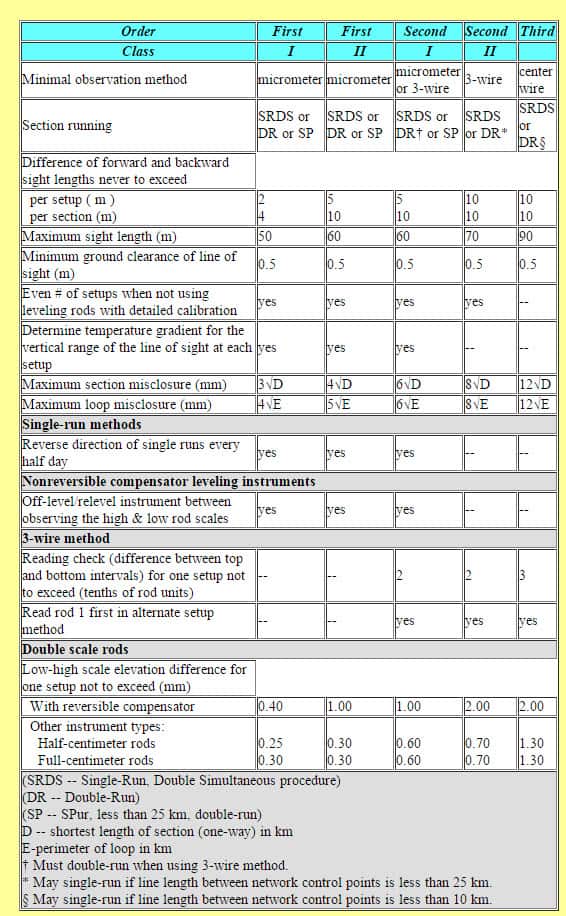
In the days before digital levels, it was acceptable to do single runs when using a double scale rod and there were a sufficient number of existing marks at each end (2 mark and 3 mark ties). I did a 130 mile second order class I line in 1989 that we only had to run one area (about 50 km) double run where there were no existing marks. There were existing marks along most of the route (Pittsburgh to Fairmont, WV along the Monongahela River). FGCC specs stated that for second order class II, lines could be single run if it was less than 25 km between existing marks. In all cases they could be double simultaneous (using high scale/low scale on the rods) as long as closures could be checked by loops or existing marks.
Here is a table from the 1984 specs (before digital levels):

Paul in PA, post: 351051, member: 236 wrote: A double run does not improve your accuracy, it only shows if you have any accuracy at all.
If the double run shows that you probably don't have any blunders, then the average of the two runs is statistically more accurate than a single run.

John Hamilton, post: 351004, member: 640 wrote: According to the Geodetic glossary:
leveling, double-run - Leveling done by proceeding from starting point to final point and then returning to the starting point in the opposite direction.
Usually, the same general route is taken on returning as on going out, and points occupied in the morning on the forward part of the journey are occupied in the afternoon on the returning part. This and other precautions are intended either to cancel or to identify systematic errors as well as to reduce random errors.
I too question the Geodetic glossary's statements. How can you occupy the same turning points out and back when using turtles and/or turning pins? Also, how can you guarantee similar atmospherics on both legs?
And, how does using the same turning points cancel/reduce random errors? Contemplate a double run with only one turning point. Just to simplify, imagine the least count of the instrument is one foot. The turning point is 0.6' higher than BM#1, so it's booked as 1' higher, and BM#2s elevation is statistically booked 0.4' higher than its true value. On the return loop, if using the same TP the process is reversed and the closure looks perfect to the nearest foot. Using a different return TP that is, say 1.4' higher than BM#1 is booked as 0' higher and the loop miscloses by 1', so after adjusting the loop (subtract 0.5' from BM#2's booked value) BM#2 is reported as 0.1' different than its true value, much better, don't you think? Using the same TPs out and back *increases* least count error because of a smaller sample set. Using different turning points doubles the randomness of the turning point's true elevations, same precision, better accuracy. This is basic statistics, folks.
We all know the real reason surveyors mark their TPs and use them on the return loop, blunder detection, so the 2' foot blunder fix can be done on site or maybe the next day after office reduction problems. Another thought experiment, when running a closed traverse to set a control station, why not use the same stations on the way out as on the way back to detect blunders? Anybody use that procedure? Would it degrade the accuracy of the new control station?
I've presented this argument to many PLSs over the years and have been basically thrown down the well. I agree it's a small matter in ordinary levelling work.
But occasionally when talking with non space based geodesists I see a light bulb go off in their heads and they say, "Yep, using the same turning points out and back creates a correlation at the TPs and and reduces the redundancy of the observations by up to 50%, especially if there's only a few turning points. The out and back observations at a given TP are no longer independent." Some offer an example, a bad TP that settles significantly between turns on the way out, rebounds after a few hours and behaves similarly on the way back. Not detectable during analysis and the loop will meet specifications but actually be out of spec. Using different TPs out and back will cause the loop to exceed misclosure limits because of the one spongy TP not being used twice (redundantly). Similarly if not using invar rods; other rods lengthen and shorten depending on facing sun or in shade at the turn, wind direction cooling, morning vs. afternoon etc. Your in the field standard of height differences is not accurate (your rod) and shrinks or swells with the weather and makes height differences too high or too low. On a short loop you may close to the mm but be off by 10mm. Equipment matters.
The egghead then goes haywire and starts talking about poorly calibrated instruments, observing too low on the rod (refraction), crappy tripods, swinging rods instead of braced and levelled rods, instrument man bias (eliminated by digital levels, BTW), ignoring atmospherics, yada-yada. I try to bring him back to earth by asking, really, what's so wrong about using the same TPs out and back and he glazes over and fires back "How can that possibly happen when using a turtles and/or pins? All TPs are ephemeral and by definition unstable, only usable during the 10-15 minute turn; only BMs matter." Usually these are German PHds or NGS type guys.
I've probably run 1000 miles of levels over my career for various purposes with various equipment from hand levels to a Zeiss NI2 with micrometer and all the bells and whistles, invar rods, umbrellas, 5 man crews, et.al. To get things to mm tight specs is a huge endeavor, and closures which are dead nuts doesn't mean the loop is valid, *especially* if you use the same TPs forward and back. Closure is not the touchstone, procedures, equipment, etc. are designed to prevent claims of mm accuracy when there's 10s of mm errors in the process.
The thing that bothers me is the new folks who run digital levels and get supertight closures in difficult atmospherics with non invar rods and claim mm accuracy are blowing smoke up their client's asses. Or worse, the folks who run total station trig levelling and claim 2nd order accuracy ( yes, I know NGS has published the specs and I have done runs using their specs). The clients don't care; actually their needs are +- 5mm and having a LS sign off on 1mm is good enough for their project; if it's 20mm off they know who to sue.
To learn more, look up metrology. a millimeter or sub-mm accuracy is not in the purvey of land surveyors, it's a heavy science best left to other professionals.
Mike Marks, post: 351089, member: 1108 wrote: I too question the Geodetic glossary's statements. How can you occupy the same turning points out and back when using turtles and/or turning pins? Also, how can you guarantee similar atmospherics on both legs?
"Points" in this context means bench marks, not TPs. And you don't want similar atmospherics on the back run, you want different conditions.
You will undoubtedly have different HI on the way back, so that takes care of the correlation of least counts.
If a TP settles in the time between foresight and backsight, and "behaves similarly" on the return trip, then the errors tend to cancel when you adjust the loop. The settling shows up in the misclosure, so it alerts you if it is large, but doesn't have that much effect on the result.

To answer the OPs question, you gotta love a spreadsheet;
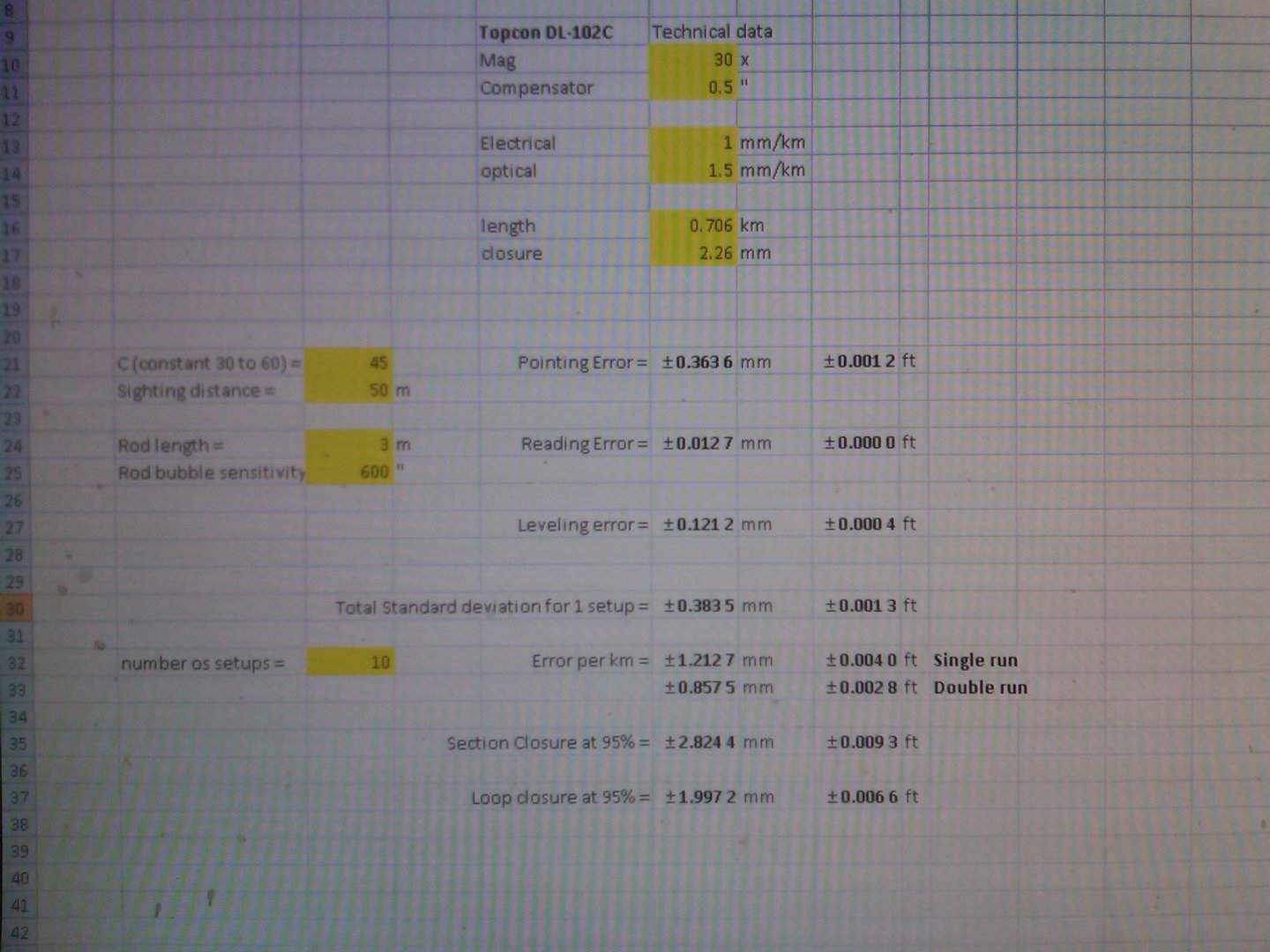
Ignoring procedures, equipment and a host of other error sources, the technical specs for your level instrument (only) compute out to the section and loop standard deviations shown above.
Jim Frame, post: 351092, member: 10 wrote: "Points" in this context means bench marks, not TPs. And you don't want similar atmospherics on the back run, you want different conditions.
Yes, *different* atmospherics on the return run; what I thought and what I typed came out backwards.:-$ And, interpreting "points" to mean bench marks in the glossary quote makes the definition sensible.
But in spite of my jumping on the wrong horse, what say you? Do you use the same turning points out and back?
Mike Marks, post: 351224, member: 1108 wrote: Do you use the same turning points out and back?
For casual leveling I use the same ones when convenient. For geodetic leveling I'm using a turtle and/or a pin, so it's not an option.

Mike Marks, post: 351224, member: 1108 wrote: Do you use the same turning points out and back?
I will, if it's convenient. There is no particular reason not to. Except that when adjusting your loop by the old add/subtract method of balancing FSs and BSs you potentially end up with two different elevations for the same point, which is embarrassing. If adjusting by LS that isn't a problem.
Bill93, post: 351105, member: 87 wrote: You will undoubtedly have different HI on the way back, so that takes care of the correlation of least counts.
If a TP settles in the time between foresight and backsight, and "behaves similarly" on the return trip, then the errors tend to cancel when you adjust the loop. The settling shows up in the misclosure, so it alerts you if it is large, but doesn't have that much effect on the result.
I don't see how the HI elevations enter in to my little 1' instrument least count thought experiment. I did not mention HIs in the experiment and am puzzled by your introduction of them. HIs are purely a +- (BS-FS) event, mathematically not a part of the levelling process except for a thousand procedural errors were are not discussing here. TPs and BMs are the fiducial marks in the course of a levelling run.
Assuming the operator always rotates the (wooden) micrometer dial correctly (books 1.6' as 2' and 1.4' as 1'), both foresights and backsights, he'll book TP1 as 1' higher when it's actually only 0.6' but the closure will be perfect, no adjustment, BM2 is off by 0.4' when using the same TPs out and back. By using a different TP (which happens to be 1.4' higher than BM1) on the way back there's no correlation at the second TP and a 1' misclosure occurs, so the 0.4' discrepancy will pop out and the adjusted height of BM2 will be closer to its true height, 0.1' vs. 0.4'. Of course, real world TPs aren't always 1.6' or 1.4' different than the BMs (only 20% of the observations :angel:), but this thought experiment selects a worst case scenario to prove a point; in the statistical real world in one turning point vs. two different turning points double runs the problem would be less glaring. But it's still there, bias due to correlation because of using the same turning point out and back degrades accuracy and could still meet misclosure specifications. The same correlation problem would occur with multiple turning point runs if you choose to use the same turning points on the return run. Help me out here; I've spent a couple hours sketching and think I'm right. If you can explain how true vs. booked HI elevations enter into the scenario that would help me understand.
On to your second point, yes, the perfect *settling* of one TP on a given multiple TP run (and a single TP run BTW) could make BM2 too high, and if the TP is occupied on the way back and it *settles* again perfectly, the misclosure would be 2x the settlement value, which would be perfectly eliminated by the adjustment. But, and this is important, your raw double loop run would not meet specifications for closure if the problem TP settlement was significant when trying to meet geodetic specifications, so the run (or at least another single run according to NGS) would have to be repeated. Agreed a level run for topographic or construction purposes (hell, I've used GPS to get +- 0.2 feet accuracy) is appropriate, but when clients shove and demand mm accuracy (astronomic sites, major technical alignments), I back away.
I'm guessing based on your response(s) that you think using the same turning points out and back from BM to BM is an acceptable practice.
Is that your position?