

Mike Marks, post: 351089, member: 1108 wrote: Just to simplify, imagine the least count of the instrument is one foot. The turning point is 0.6' higher than BM#1, so it's booked as 1' higher
The level doesn't read the difference between the bench mark and the turning point. It reads (HI - BM) to whatever precision and then reads (HI - TP) to that precision and it or you subtract to find (TP - BM). For some HI setups each one of the readings will be rounded to some fraction high or low, and for a different HI they may be rounded the same or differently. So the rounding error does not accumulate in the difference fo readings, but is somewhat randomized on the many readings of a long loop.
And I hope you aren't trying to achieve an accuracy comparable to the least count of the instrument, anyway.
I see some advantages in using the same TP on the way back if they are stable, as that lets you look for blunders and inaccuracies on a setup-by-setup basis instead of over the whole loop. I see very little downside to re-using them.

Mike Marks wrote... "I'm guessing based on your response(s) that you think using the same turning points out and back from BM to BM is an acceptable practice."
It is not. Using the same turning points could be construed as cheating.
Historic boundaries and conservation efforts.

not my real name, post: 351244, member: 8199 wrote: Using the same turning points could be construed as cheating.
I don't think fraud is germane to the discussion. If the field personnel can't be trusted to follow prescribed procedures and accurately report the results, then all bets are off.
Mike Marks, post: 351242, member: 1108 wrote: and if the TP is occupied on the way back and it *settles* again perfectly
Different situation, but related: I've always found it interesting that high-order NGS level runs along RR lines sometimes (often? usually?) used rail spikes as TPs. I asked a colleague -- a now-retired NGS geodesist who spent some years overseeing field operations -- about this, and his response was that their tests indicated that the spikes settled back to the same position after a train passed, so they didn't worry about having a train go by between foresight and backsight.
not my real name, post: 351244, member: 8199 wrote: It is not. Using the same turning points could be construed as cheating.
In what way would it be cheating? I see it as an honest attempt to gather the most easily checked measurements.
The goal is to obtain accurate and reliable data. There are no rules that say you have to make it any harder than necessary.
Jim Frame, post: 351253, member: 10 wrote: his response was that their tests indicated that the spikes settled back to the same position after a train passed, so they didn't worry about having a train go by between foresight and backsight.
I have no experience with NGS measurements, but I'm surprised at this.
I had gotten the impression (but can't point to a source) that not only would they not use foresight and backsight to a spike on the active line with a train passing between times, but that even after the passing of a train some time had to elapse for re-settling before a spike could be used as a TP.

Using same turns adds redundancy.
I'm trying to understand the other side of the discussion but I'm getting hung up on the "settling" of one tp in identical measures in two separate runs.
Scott Zelenak, post: 351262, member: 327 wrote: I'm getting hung up on the "settling" of one tp in identical measures in two separate runs.
My guess is that the concept is related to a procedure that's common in casual leveling but not allowed in geodetic work: using a nail in AC pavement as a TP. Those can easily settle noticeably between the forward and back runs, especially on a hot day.

When running double simultaneous First Order leveling there is very little chance of blunder if all prodedures are followed.
The instrument isn't moved until the differences between high scale readings and low scale readings meets the criteria for whatever is being sought.
I can understand that checking the results at intermediate turning points may help to isolate blunders. My thoughts and surveying experiences were like that too at one time. However once I learned the definition of a level circuit to be this I changed my ways: "The measurement of bench mark elevations by spirit leveling in two different directions from one end of the circuit to another. Different turning points are used in each of the two directions." from the Definitions of Surveying and Associated Terms, by the American Congress on Surveying and Mapping, reprinted in 1989.
Historic boundaries and conservation efforts.

Jim Frame, post: 351253, member: 10 wrote: Different situation, but related: I've always found it interesting that high-order NGS level runs along RR lines sometimes (often? usually?) used rail spikes as TPs. I asked a colleague -- a now-retired NGS geodesist who spent some years overseeing field operations ...
For what it's worth, in conversation with a leveling party chief he revealed that he had gotten in trouble with his bosses because he did not have enough sections to rerun. The notion was that if you were not having some sections fail to close you were working too slow.
The idea that the railroad spikes returned to their original locations may be perfectly valid. I think it was more of a necessity. Running levels along railroad lines over the vast expanses of the west left the level party with few options. These were hardworking folks. There are no longer any dedicated leveling crews at NGS.
I never liked leveling. I did a lot. Never had much hands-on experience with digital leveling. Both optical and digital require careful attention to detail. I never liked folks to run over the same points running forward and backward. Using turtles and turning pins does make the issue moot. Keeping close tally over how you are doing does seem to risk biased readings.
Of course we should also remember that these field differences in height are not the same as differences in orthometric heights like those expressed in NAVD88. See NGS too LVL_DH.
Mike Marks said in the OP.
"But occasionally when talking with non space based geodesists I see a light bulb go off in their heads and they say, "Yep, using the same turning points out and back creates a correlation at the TPs and and reduces the redundancy of the observations by up to 50%, especially if there's only a few turning points. The out and back observations at a given TP are no longer independent." Some offer an example, a bad TP that settles significantly between turns on the way out, rebounds after a few hours and behaves similarly on the way back. Not detectable during analysis and the loop will meet specifications but actually be out of spec. Using different TPs out and back will cause the loop to exceed misclosure limits because of the one spongy TP not being used twice (redundantly)."
I don't believe I've ever encountered that scenario.
The "loop will meet specifications but actually be out of spec.", part throws me. My answer is, and I will know the run fails tolerance. It happens occasionally. But I don't believe it was ever one tp moving between foresight and backsight shots the same measure in two separate runs.

I do not understand that a fixed turning point is considered less redundant.
While the noted elevation at the TP may be exactly as on a previous run, the observation was made with the level as a different setup and the observation is not exactly he same. Or are they thinking you use a whole bunch of levels and leave each of them setup as you walk back and forth?
I never worried that a TP was at the exact same elevation, the main point was to simplify having consistent shot distances from the level.
Paul in PA
Special Publication 140.
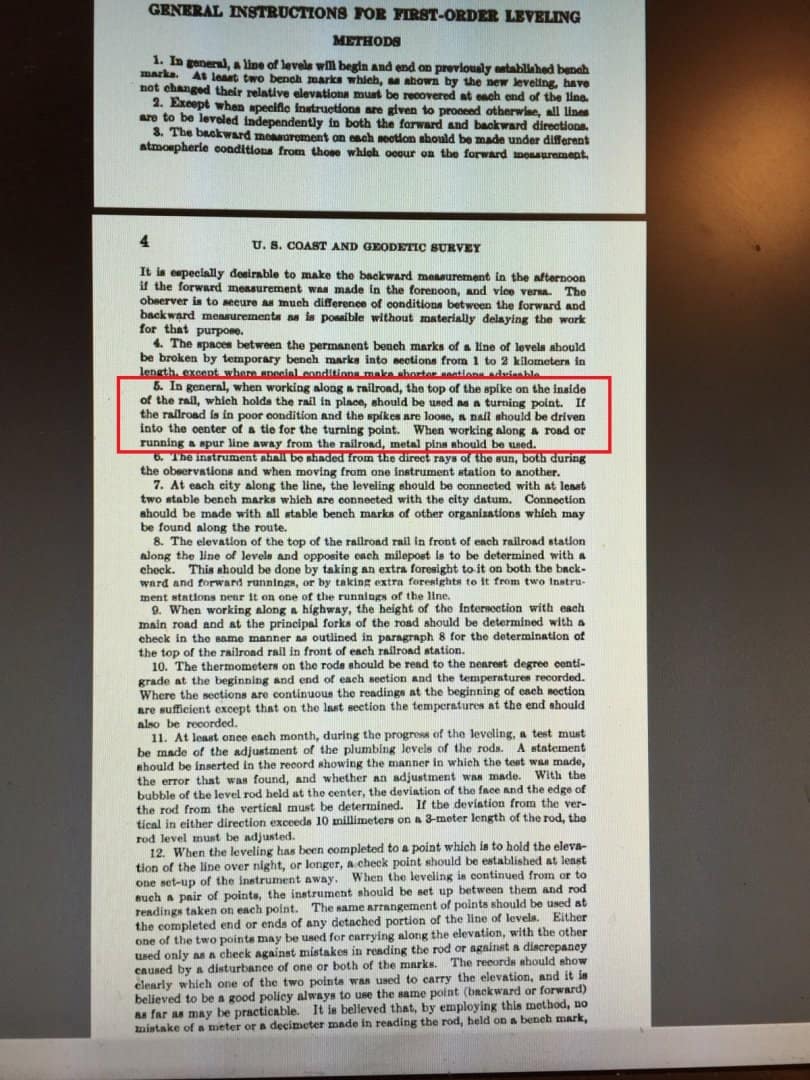
Funny that the author considered the inside spikes preferable to those on the outside. I can't think of any difference between the two.

In 2007; around the time of the big height modernization push; the NGS put on a 2 day class; together with the LSAW. 16 hours of "how to run levels". I thought I knew a lot about how to do this. After the class; I found out how little I really knew.
The class started with a power point picture of a crew working on an asphalt road grade. The next slide was a list of rules. Rule No. 1: Never run levels on an asphalt road grade.

Scott Zelenak, post: 351274, member: 327 wrote: Mike Marks said in the OP.
"But occasionally when talking with non space based geodesists I see a light bulb go off in their heads and they say, "Yep, using the same turning points out and back creates a correlation at the TPs and and reduces the redundancy of the observations by up to 50%, especially if there's only a few turning points. The out and back observations at a given TP are no longer independent." Some offer an example, a bad TP that settles significantly between turns on the way out, rebounds after a few hours and behaves similarly on the way back. Not detectable during analysis and the loop will meet specifications but actually be out of spec. Using different TPs out and back will cause the loop to exceed misclosure limits because of the one spongy TP not being used twice (redundantly)."I don't believe I've ever encountered that scenario.
The "loop will meet specifications but actually be out of spec.", part throws me. My answer is, and I will know the run fails tolerance. It happens occasionally. But I don't believe it was ever one tp moving between foresight and backsight shots the same measure in two separate runs.
My bad, I got it wrong. I misquoted the geodesist and my only defense is it was from a conversation at an ACSM convention in the seventies. I now state the geodesist said *something* about settling TPs, exactly what, I can't recall. I do clearly remember he said using the same TPs out and back is bad practice, especially if there's only a few TPs in the run.
Upon further contemplation and as noted by others above using the magic settling TP both out and back would result in a 2x the settlement misclosure, which would cancel out upon adjustment of the loop resulting in BM#2s elevation being correct. If using different TPs out and back the settling TP would result in a 1x the settlement misclosure, which after loop adjustment would result in BM#2's elevation being off by 1/2x.
The "magic settling TP" scenario actually is an argument *for* using the same TPs out and back, strangely.
Scott Zelenak, post: 351274, member: 327 wrote: I don't believe I've ever encountered that scenario.
The "loop will meet specifications but actually be out of spec.", part throws me. My answer is, and I will know the run fails tolerance. It happens occasionally. But I don't believe it was ever one tp moving between foresight and backsight shots the same measure in two separate runs.
My bad, I got it wrong. I misquoted the geodesist and my only defense is it was from a conversation at an ACSM convention in the seventies. I now state the geodesist said *something* about settling TPs, exactly what, I can't recall. I do clearly remember he said using the same TPs out and back is bad practice, especially if there's only a few TPs in the run.
Upon further contemplation and as noted by others above, using the magic settling TP both out and back would result in a 2x the settlement misclosure, which would cancel out upon adjustment of the loop resulting in BM#2s elevation being correct. If using different TPs out and back the settling TP would result in a 1x the settlement misclosure, which after loop adjustment would result in BM#2's elevation being off by 1/2x.
The "magic settling TP" scenario actually is an argument *for* using the same TPs out and back, strangely.

Turn on a plumb bob. Oh I forgot nobody carries those any more. Set your spike in the powerpole one foot below grade. That way the utility company doesn't see it and beat it out. And always reference a nail to it. (So you can check to see if it has been disturbed). So hopefully when you come back it will still be there. Don't paint you turns on the ties or rail road spikes, maintennance crews will think it is suppose to be replaced. After all my years of saftey courses now I can't believe how many miles of level runs I did along active tracks when I was younger.
Jim Frame, post: 351250, member: 10 wrote: I don't think fraud is germane to the discussion. If the field personnel can't be trusted to follow prescribed procedures and accurately report the results, then all bets are off.
Ain't that the truth. I once worked on a crew doing T2 EDM traverses where one instrumentman thought quite highly of himself because his occupation times were noticeably shorter than ours. Turns out he was not observing the reciprocal vertical angle and was mentally calculating the "scope inverted" value +- a few seconds and booking that. This was with the old style T2 without an automatic vertical circle compensator, so his *procedure* masked the index error. A sharp office guy quickly noticed his vertical angle splits were consistently smaller than ours and called him out on it. God knows what other *shortcuts* he was taking.
We had to rerun the 3 or 4 traverses where he was instrumentman. Unfortunately, it was a gov'mnt crew so he couldn't be fired, but he did get to be brushman exclusively for the rest of the summer.:-D